60 · GPU Execution, Memory Hierarchy & Kernel Launches
Source: fanout.sh / inference-eng / 12-06 · ~7 min
NOTE
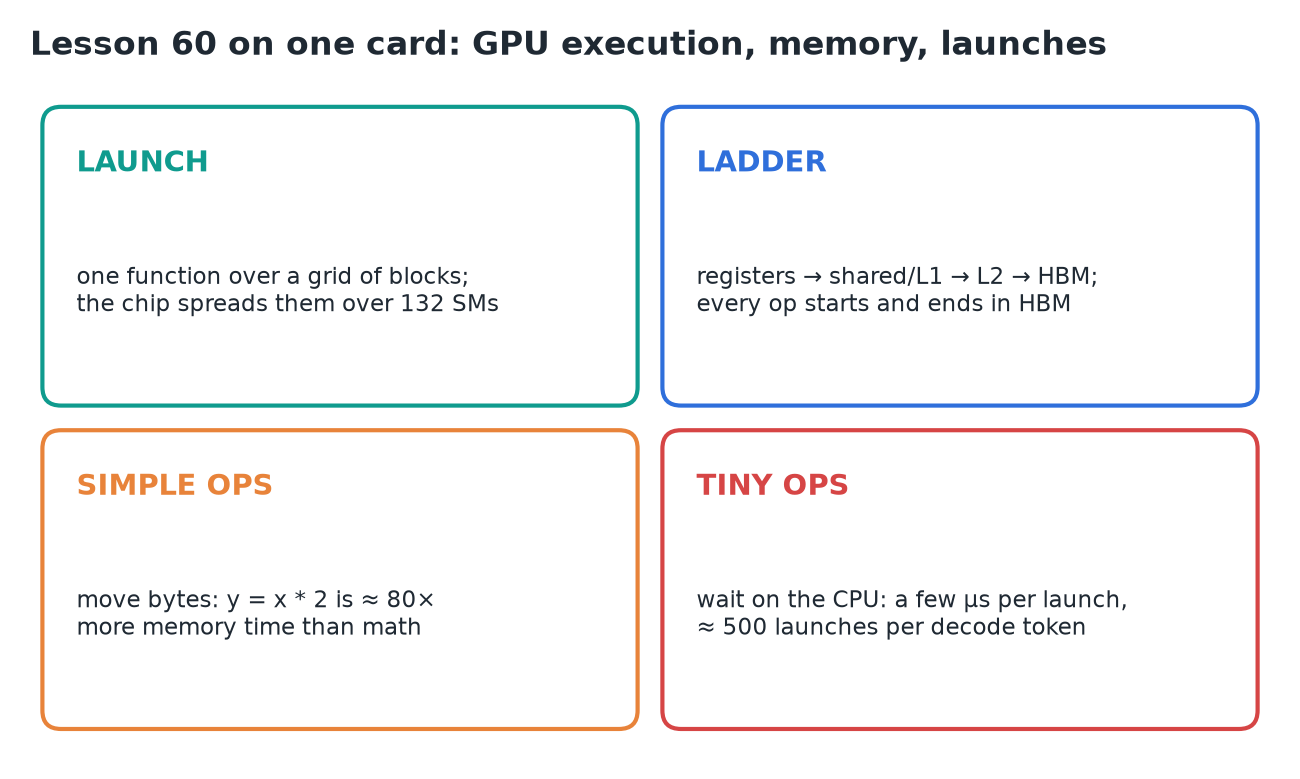
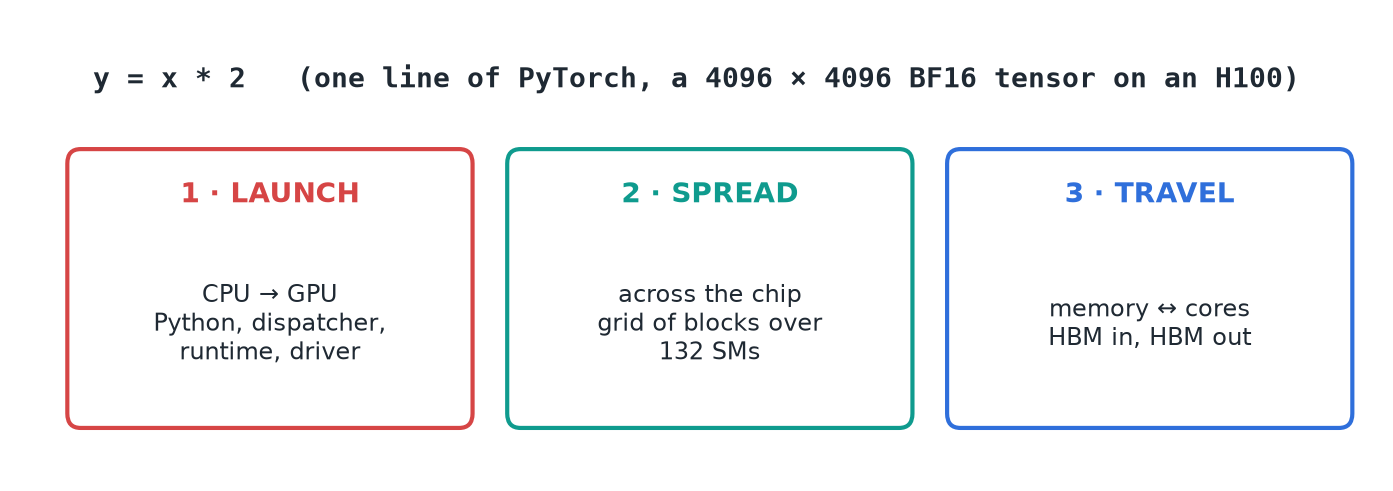
Even y = x * 2 on an H100 pays three separate costs: the CPU must launch a kernel, the GPU must spread the work over its 132 SMs, and the numbers must travel from HBM to the cores and back. Any one of them can be what makes a model slow. Simple ops spend their time moving bytes; tiny ops spend it waiting on the CPU. That gives every millisecond three buckets: compute, memory, overhead.
1. Three costs behind one line
 Each step can be the bottleneck.
- Launch: the CPU tells the GPU to run a kernel.
- Spread: the GPU distributes the work across the chip.
- Travel: inputs come from memory to the cores, outputs go back.
2. How work spreads over the chip
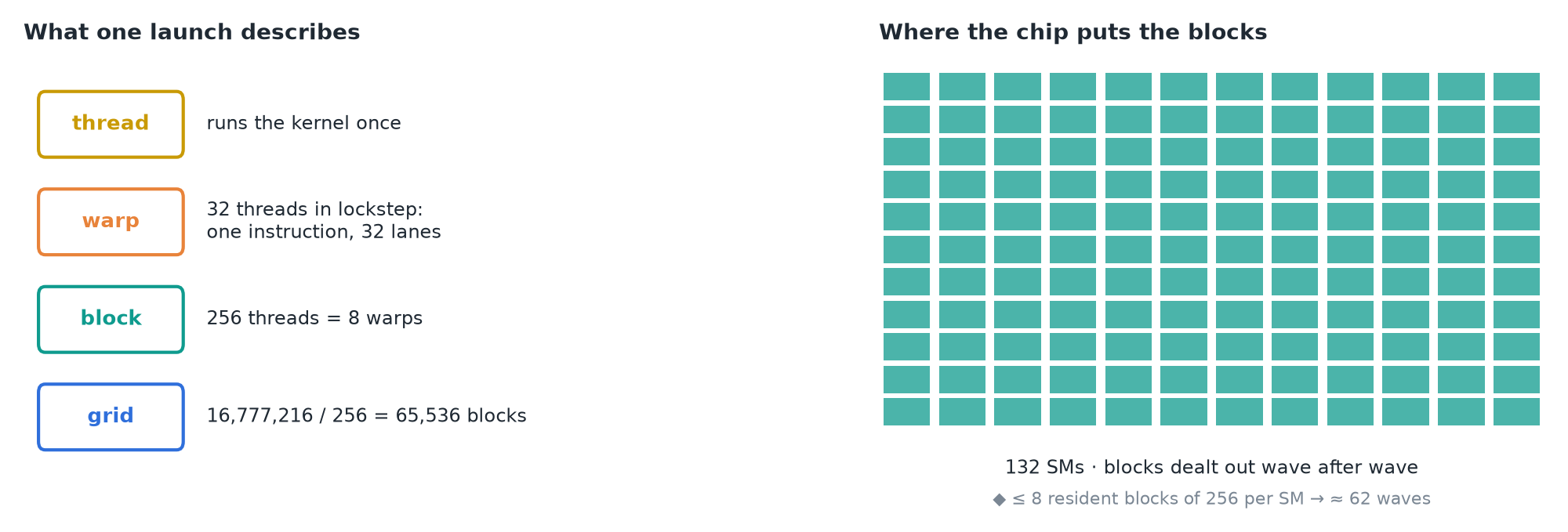 The launch says what and how many; the chip says where.
- An H100 is not one big processor: it's 132 streaming multiprocessors (SMs) laid out like tiles.
- A kernel is one function the GPU runs many times at once, once per thread.
- Warp: 32 threads in lockstep (one instruction, 32 lanes). Warps pack into blocks; all blocks of one launch form the grid.
- Example: x is 4096 × 4096 = 16,777,216 numbers. At 256 threads per block, the grid is 65,536 blocks.
- The hardware deals blocks to SMs wave after wave until all are done.
- ◆ An SM holds at most 2,048 resident threads, so ≤ 8 blocks of 256 at once: 132 × 8 = 1,056 blocks per wave, ≈ 62 waves.
3. The memory ladder
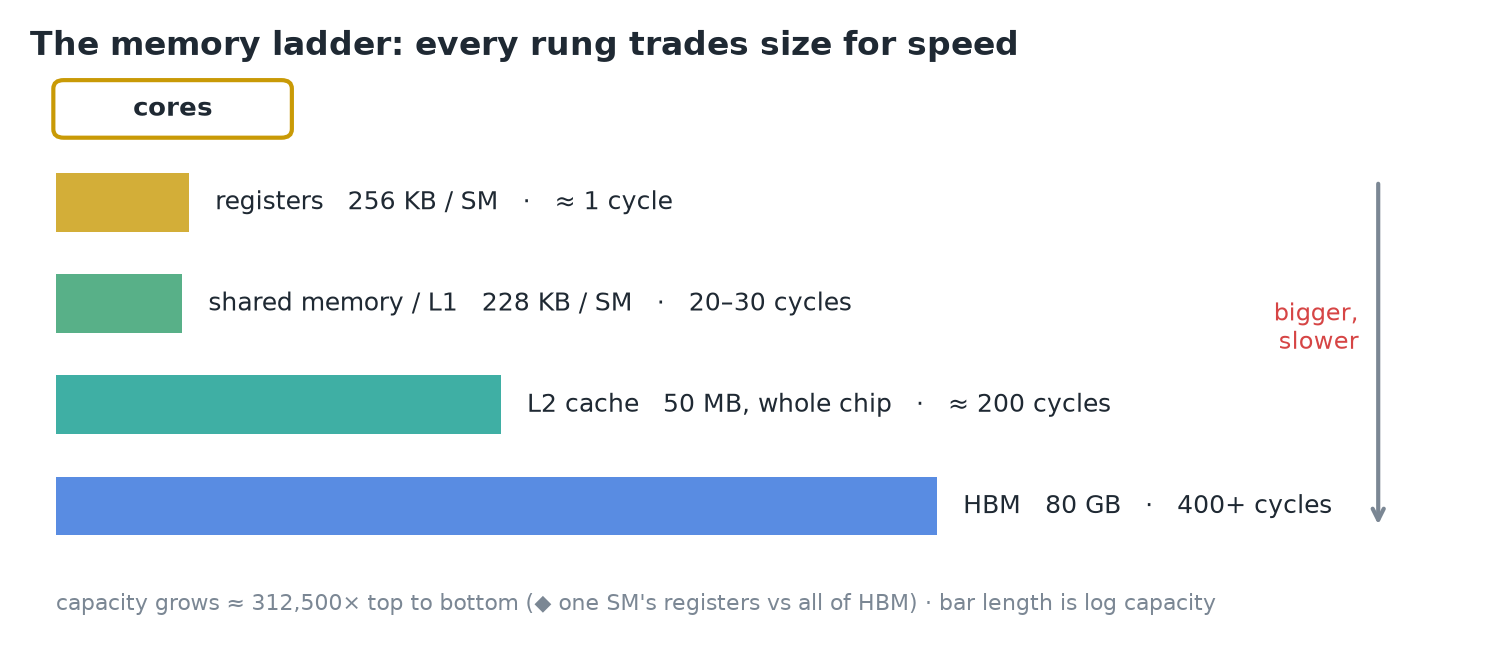 Every rung trades size for speed.
| Rung | Size | Latency |
|---|---|---|
| registers | 256 KB per SM | ≈ 1 cycle |
| shared memory / L1 | up to 228 KB per SM | 20–30 cycles |
| L2 cache | 50 MB, whole chip | ≈ 200 cycles |
| HBM | 80 GB (what nvidia-smi shows) | 400+ cycles |
- Top to bottom, capacity grows ≈ 300,000×. ◆ That's one SM's 256 KB of registers against all 80 GB of HBM (312,500×); the whole chip's registers (132 × 256 KB ≈ 34 MB) are only ≈ 2,400× smaller than HBM.
IMPORTANT
A normal PyTorch op starts with its inputs in HBM and ends with its output in HBM. Nothing stays on the chip between operations.
4. Price the line
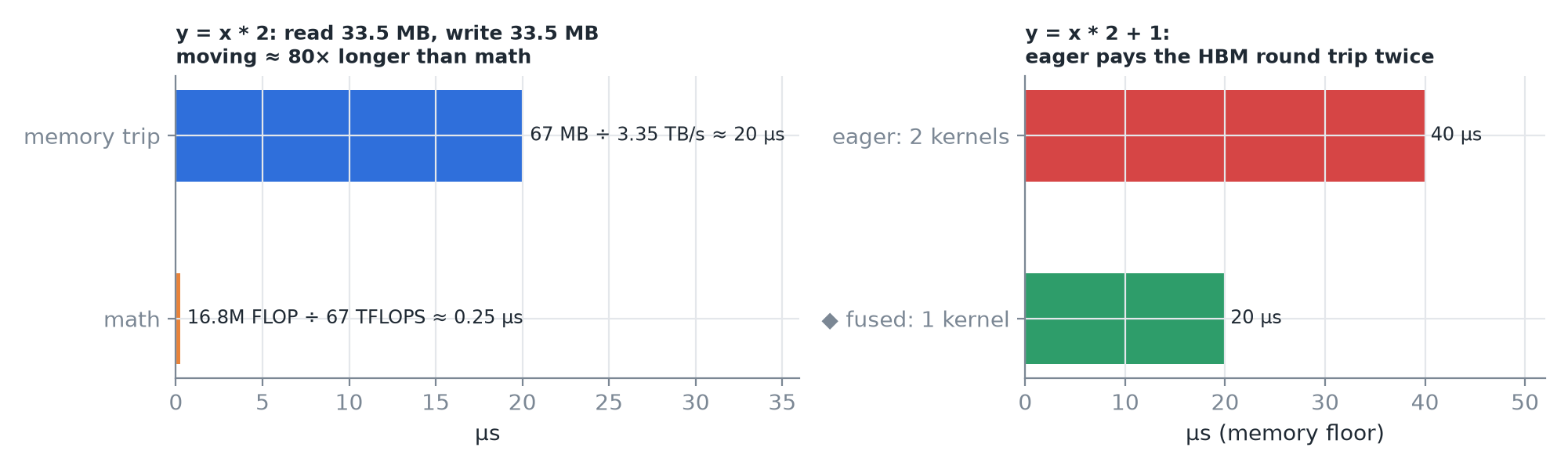 Bytes, not math, set the time.
- Read x (16.8M × 2 bytes in BF16 = 33.5 MB), write y (33.5 MB): 67 MB of traffic.
- Math at the H100's 67 TFLOPS of ordinary (non-tensor-core) math: a quarter of a microsecond.
- Moving takes ≈ 80× longer than computing. The cores mostly wait for bytes: memory-bound.
y = x * 2 + 1in eager PyTorch is two kernels, so it pays the HBM round trip twice (◆ ≈ 40 µs against ≈ 20 µs if fused into one).
5. Launch overhead
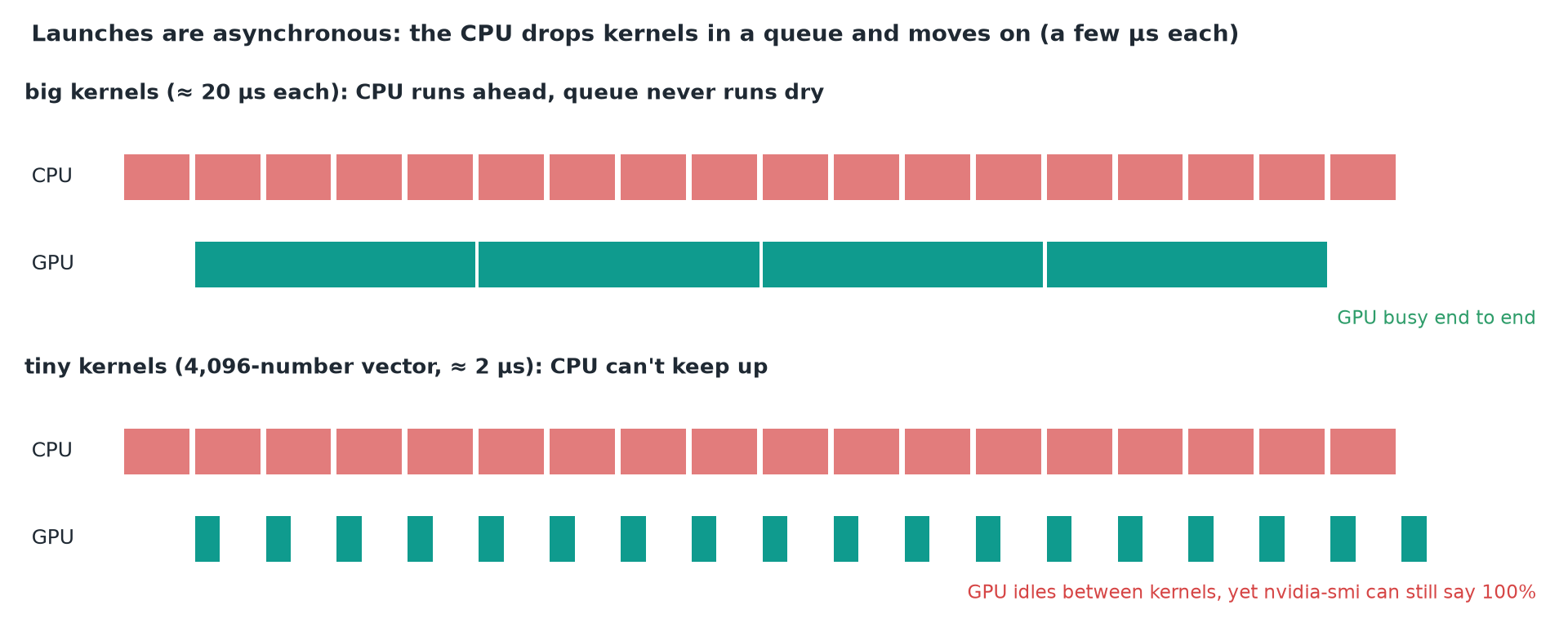 Same CPU launch rate, very different GPU timelines.
- A launch walks Python → PyTorch's C++ dispatcher → CUDA runtime → driver → GPU. That's a few µs per launch, the same for huge or tiny kernels.
- Launches are asynchronous: the CPU drops kernels into a queue and moves on, so it can run ahead of the GPU.
- Big kernels (the 20 µs multiply): the CPU stays ahead and the queue never runs dry.
- Tiny kernels (a single 4,096-number vector, ≈ 2 µs): the CPU can't keep up. The GPU finishes each kernel and sits idle waiting for the next launch.
WARNING
nvidia-smi can still show 100% utilization here. It only means some kernel was running during the sample, not that the chip was busy.
6. One decode step
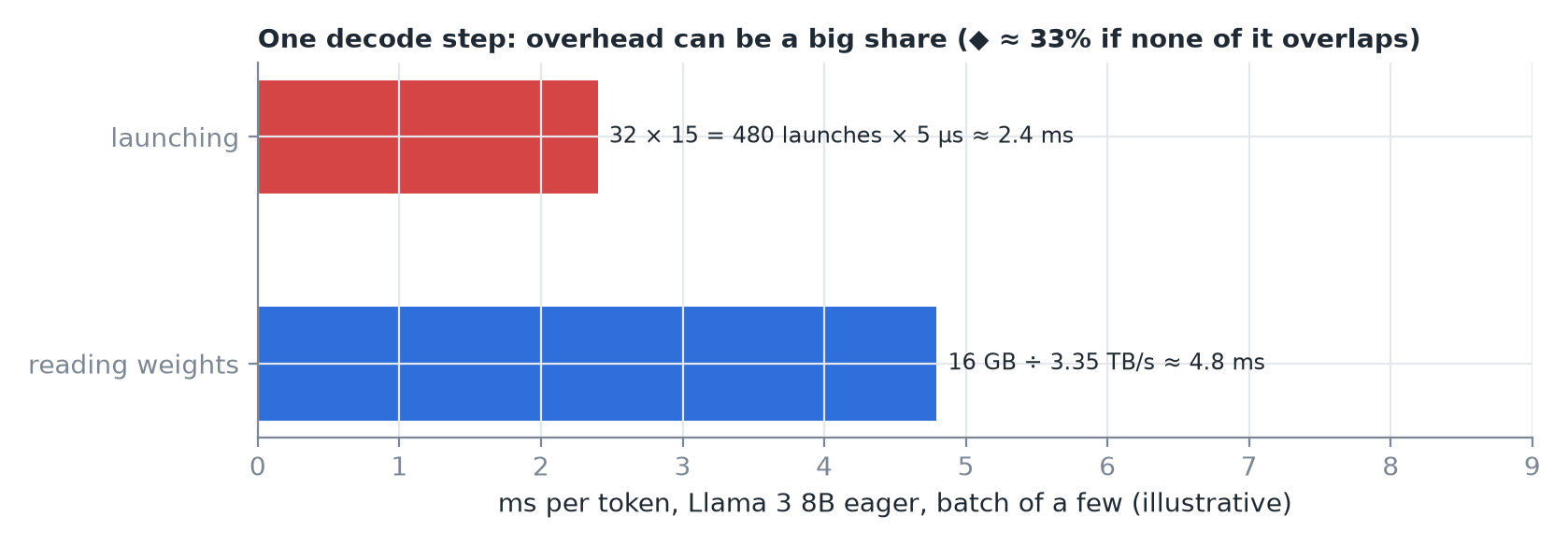 The lesson's numbers are illustrative; the shape is real.
- Generating one token runs every layer on a handful of vectors: lots of small kernels.
- Llama 3 8B: 32 layers × ≈ 15 kernels in plain eager mode ≈ 500 launches per token.
- At ≈ 5 µs each, launching alone is ≈ 2.5 ms (480 × 5 = 2.4 ms).
- Reading 16 GB of weights at 3.35 TB/s is ≈ 4.8 ms.
- So a big share of each token can be overhead, neither math nor memory. ◆ If none of it overlapped, ≈ 33% of the step.
7. Three buckets, one fix each
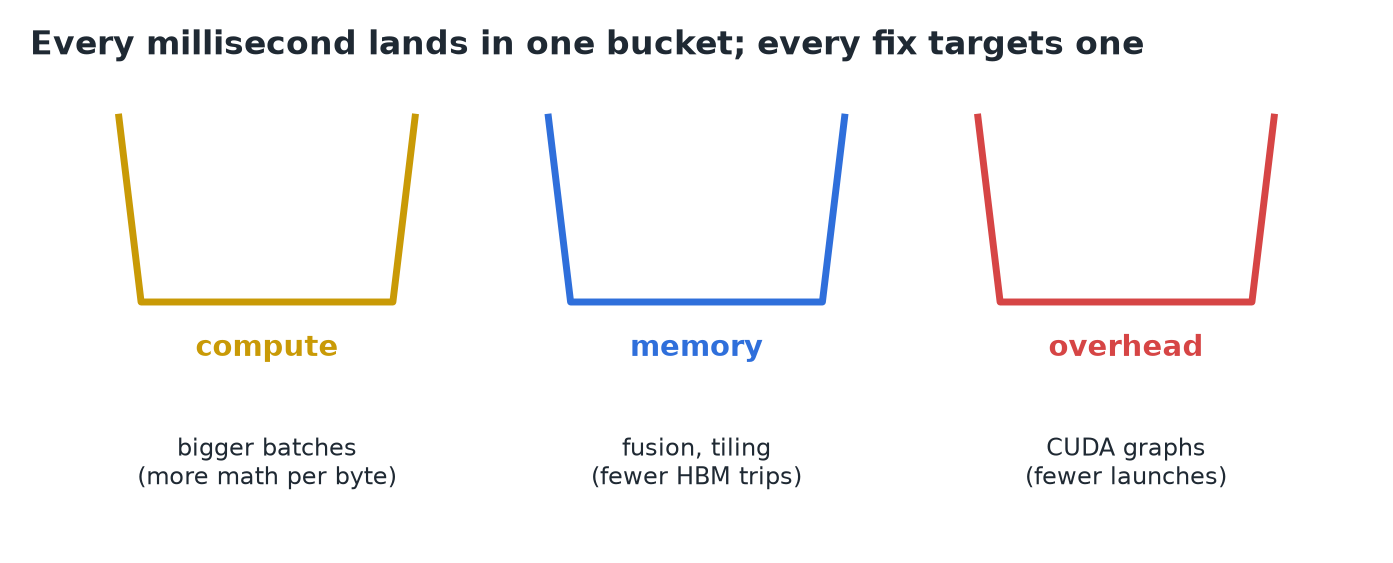
- Compute: bigger batches give the math more to do per byte.
- Memory: fusion and tiling cut HBM round trips.
- Overhead: CUDA graphs cut launches.
8. Recap