36 · Queueing, Fairness, Cancellation & Preemption
Source: fanout.sh / inference-eng / 07-05 · ~6 min
NOTE
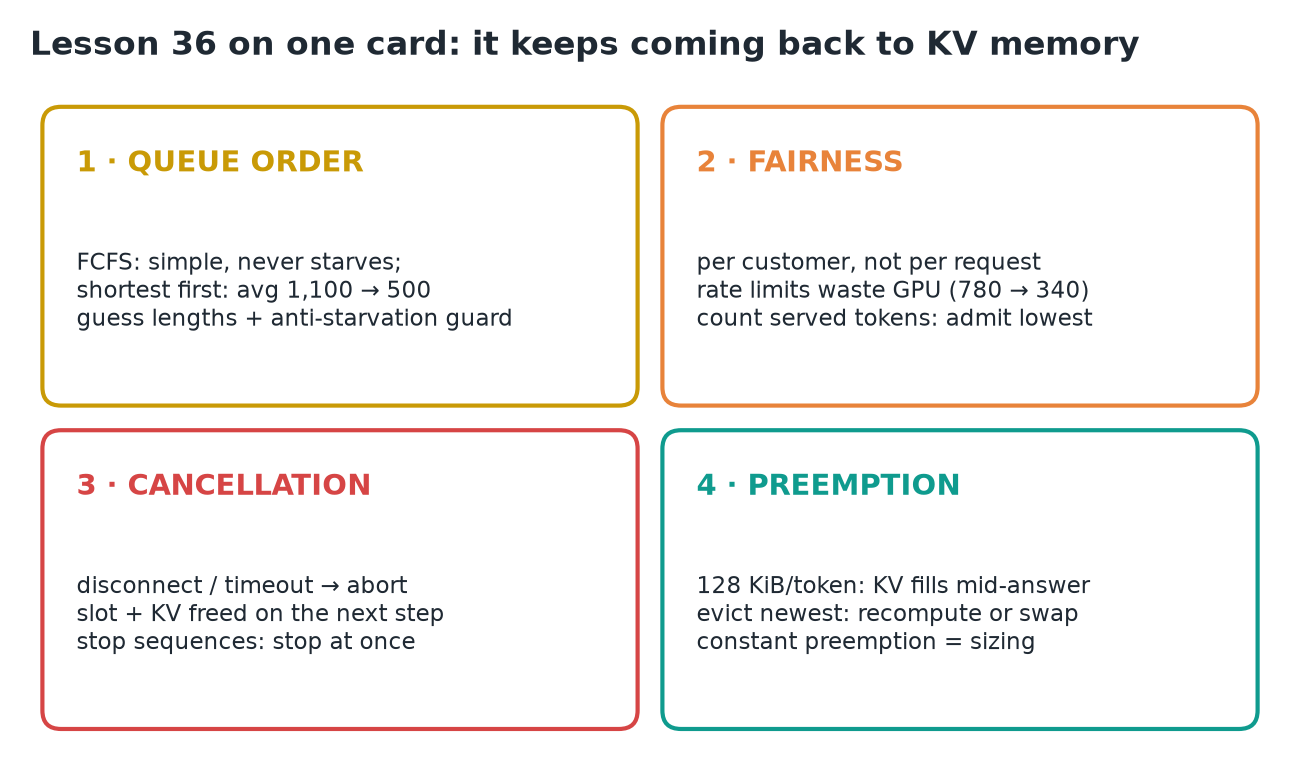
Under real load there isn't room for everyone, so the scheduler answers four questions. Queue order sets average latency: FCFS never starves anyone, but shortest first cuts the example's average finish from 1,100 to 500 steps, if you can guess lengths and guard long requests. Fairness is per customer: counting each client's served tokens (Virtual Token Counter) beats blunt rate limits, which dropped throughput from ~780 to ~340 tokens/s. Cancelled work should be aborted at once to free its slot and KV. When KV memory runs out (128 KiB per token on Llama 3.1 8B), the engine preempts a request by recomputing or swapping it.
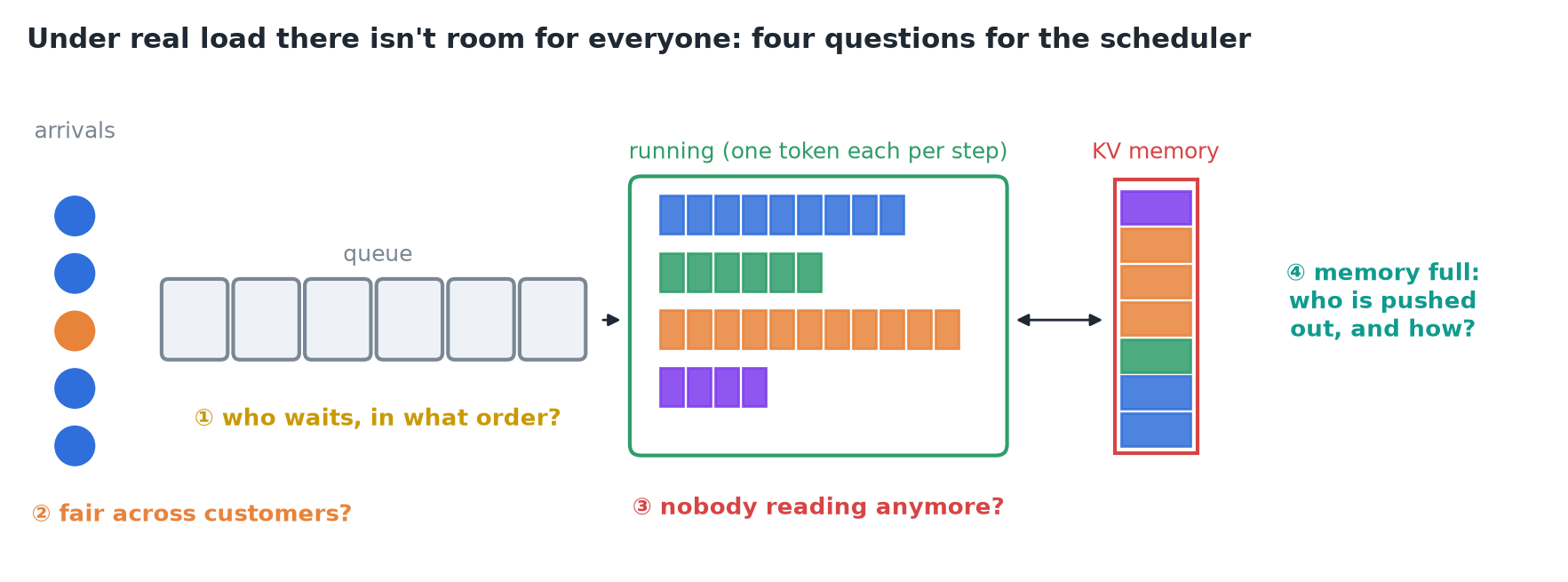 Requests queue, customers compete, users leave, and running requests outgrow memory.
1. The queue: who waits, and in what order?
- Most engines, vLLM included, default to first come, first served (FCFS): simple, and no request ever starves.
- With a long request at the front, everyone behind it waits: head-of-line blocking. Shortest job first (SJF) is the classic cure.
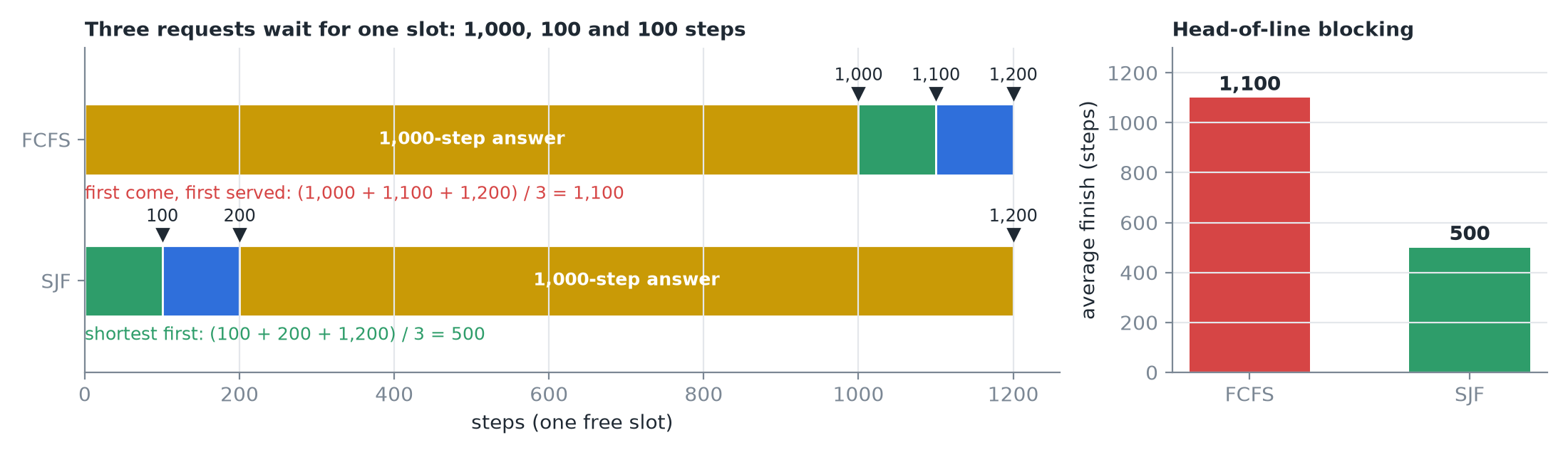 One free slot, three waiting requests. The long one finishes at 1,200 either way; running the short ones first more than halves the average.
CAUTION
Nobody knows an answer's length before it's generated. Research schedulers predict lengths, or just which request is shorter (a learning-to-rank scheduler reported 2.8× lower chatbot latency, 2024). They also need a guard so long requests never wait forever.
- ◆ vLLM also has
--scheduling-policy priority, which orders the queue by a per-requestpriorityfield instead of arrival time.
2. Fairness: per customer, not per request
Client A sends 90% of the traffic, client B a trickle. Under FCFS, B's few requests sit behind a wall of A's.
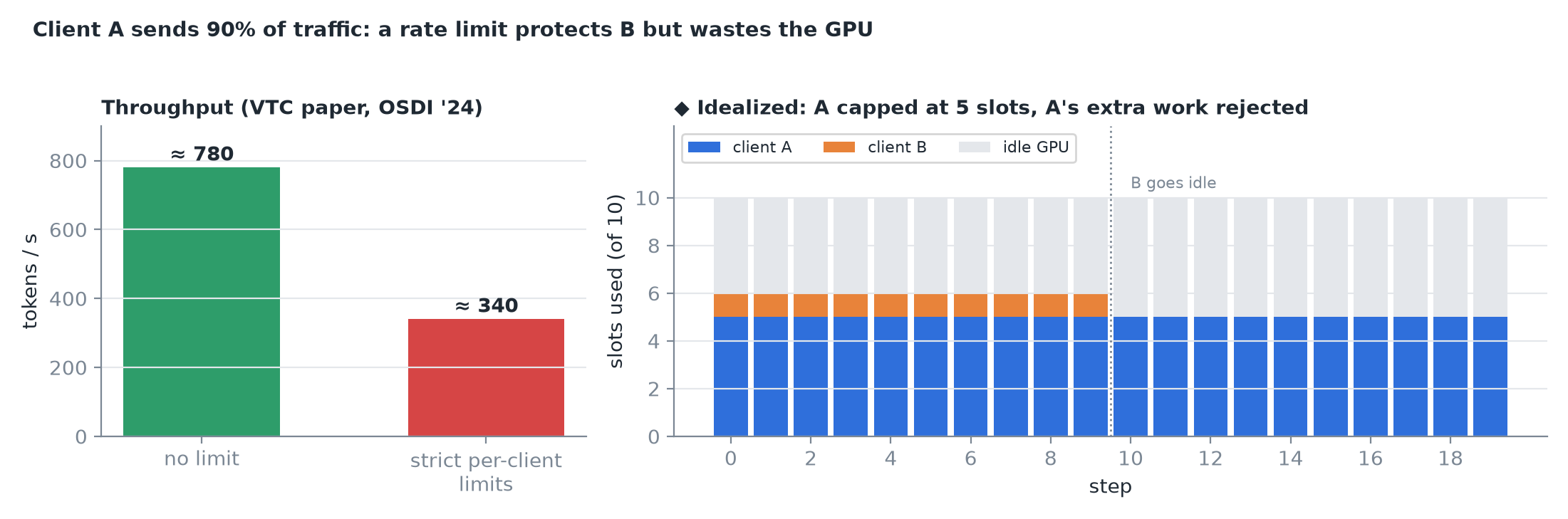 The blunt fix is a per-client rate limit (N requests/min). It rejects A's work even when the GPU has spare room: in the VTC paper (OSDI '24), strict limits cut throughput from ~780 to ~340 tokens/s.
Virtual Token Counter (VTC) borrows from network fair queueing:
- Keep a counter per client of the tokens it has been served, input and output weighted separately.
- Whenever there's room, admit the next request from the client with the lowest counter.
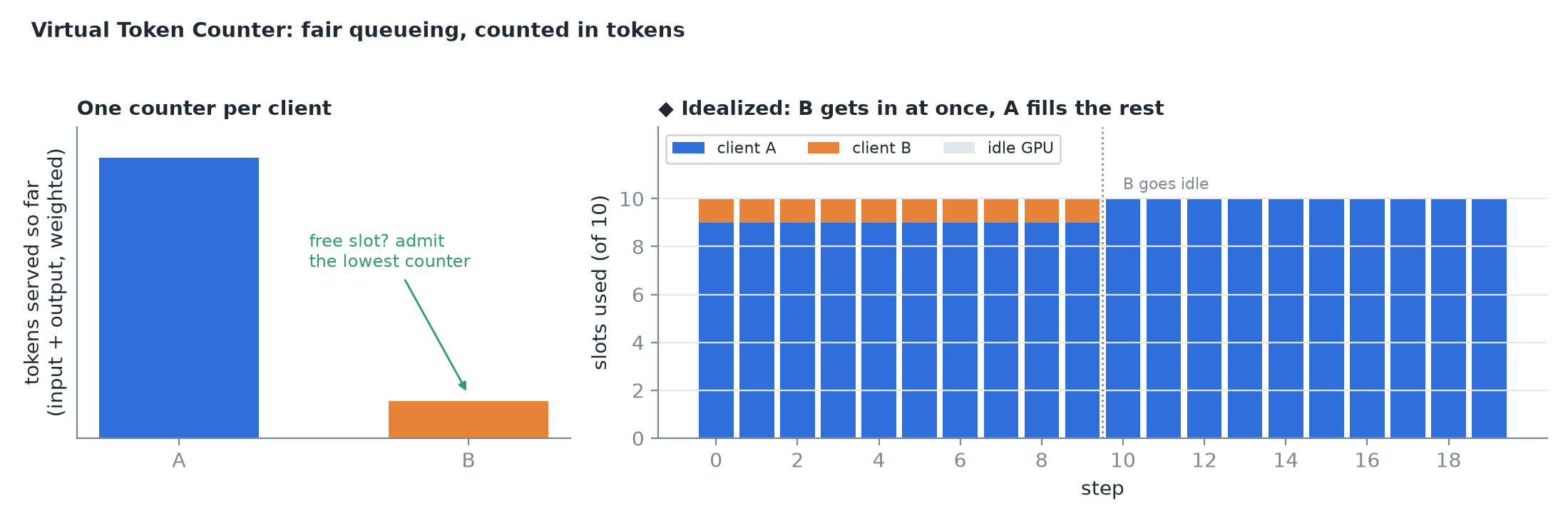 B's counter stays low, so B gets in right away; when B is idle, A can use the whole GPU. Nothing is left idle while someone has work.
- ◆ In the paper, a client returning from idle has its counter lifted to the lowest active counter, so idle time can't be banked as credit to starve others later.
3. Cancellation: stop work nobody is reading
- A user closes the tab halfway through the answer. If the engine doesn't notice, it keeps generating for nobody: real GPU time, and the request keeps holding its KV cache.
- A good server watches the connection. On disconnect or timeout it aborts the request, and on the very next step its slot and memory go to requests still wanted.
- Same for stop sequences and length limits: stop the moment you know, not at the end.
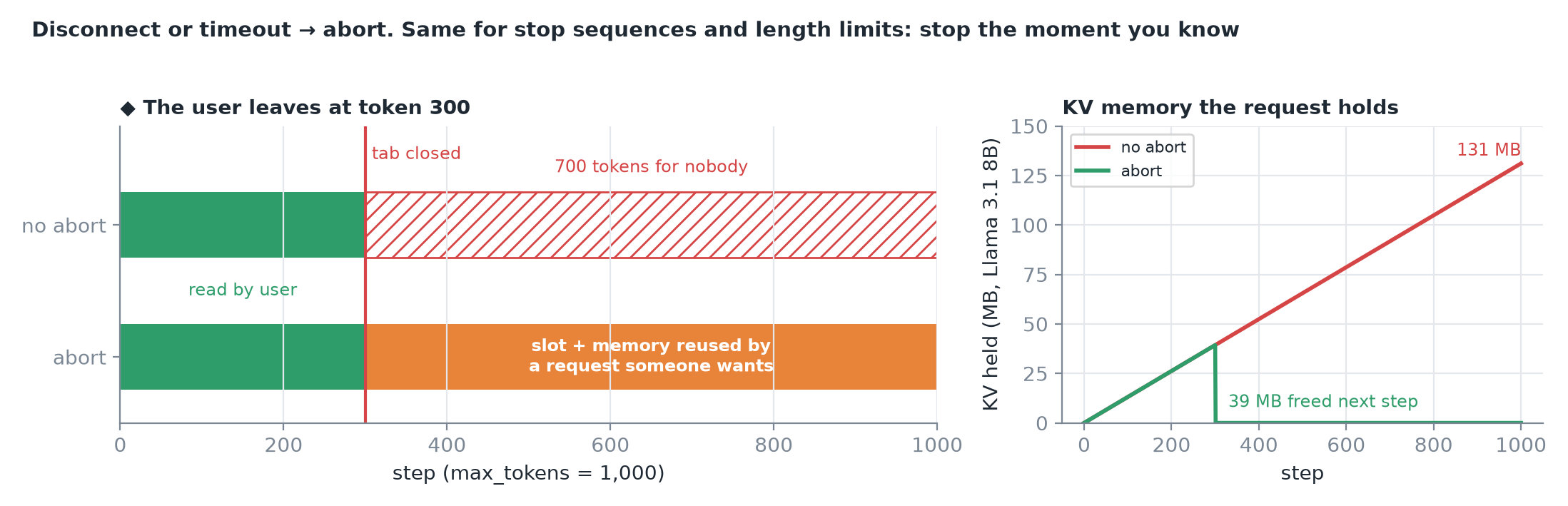 ◆ Example numbers: a 1,000-token answer abandoned at token 300. Without an abort, 700 tokens are wasted and KV grows to 131 MB; with one, 39 MB is freed on the next step.
4. Preemption: memory runs out mid-answer
Running requests keep growing. Llama 3.1 8B (K and V × 32 layers × 8 KV heads × 128 dims × 2 bytes):
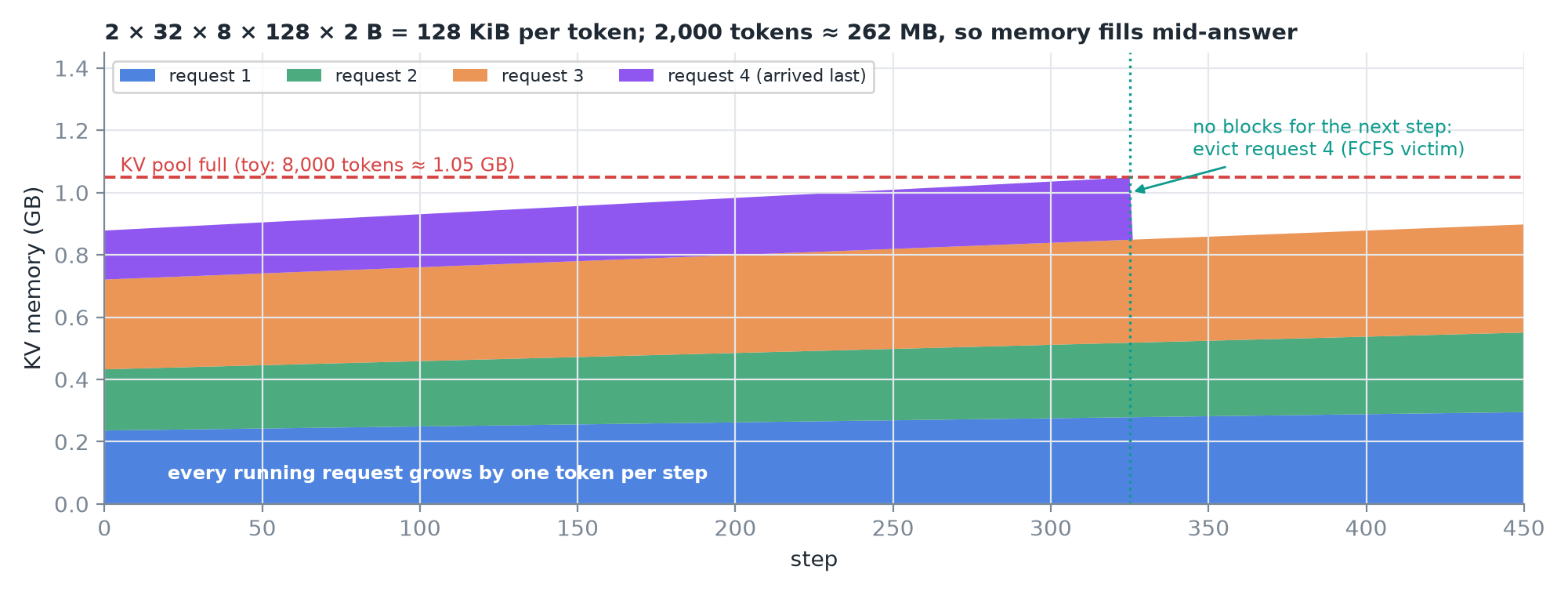 Toy pool. Memory fills while everyone is mid-answer; when the next step can't get blocks for everyone, the scheduler pushes someone out. Under FCFS the victim is usually the request that arrived last.
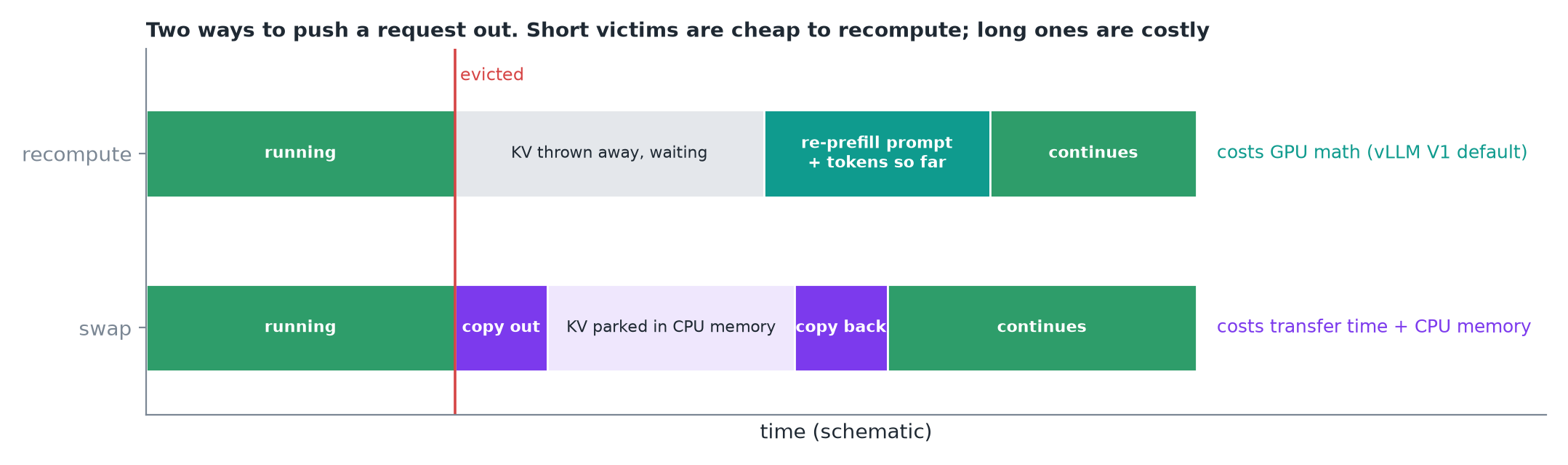 Recompute throws the KV away and later re-runs prompt + generated tokens as a fresh prefill. Swap copies the KV to CPU memory and back when there's room.
| Recompute | Swap | |
|---|---|---|
| Costs | GPU math | Transfer time + CPU memory |
- vLLM's current engine (V1) defaults to recompute.
- One study found recomputing short requests can even pay off, while evicting long ones costs a lot.
- ◆ Idealized costs for a 2,000-token victim: recompute ≈ 2,000 × 16 µs ≈ 32 ms of GPU math (the extra attention work makes it worse as requests get longer); swap moves 262 MB each way, ≈ 5 ms at ~50 GB/s PCIe, and parks 262 MB in CPU RAM. Real swaps copy many small blocks, so they run below peak bandwidth.
- ◆ With prefix caching, a recomputed request's freed blocks stay cached until reused, so part of its re-prefill can be a cache hit.
WARNING
Preemptions all the time are a sizing problem. Give the KV cache more memory, or admit fewer requests at once (lower max_num_seqs).
5. Recap