14 · Why Autoregressive Generation Recomputes Work
Source: fanout.sh / inference-eng / 03-01 · ~6 min
NOTE
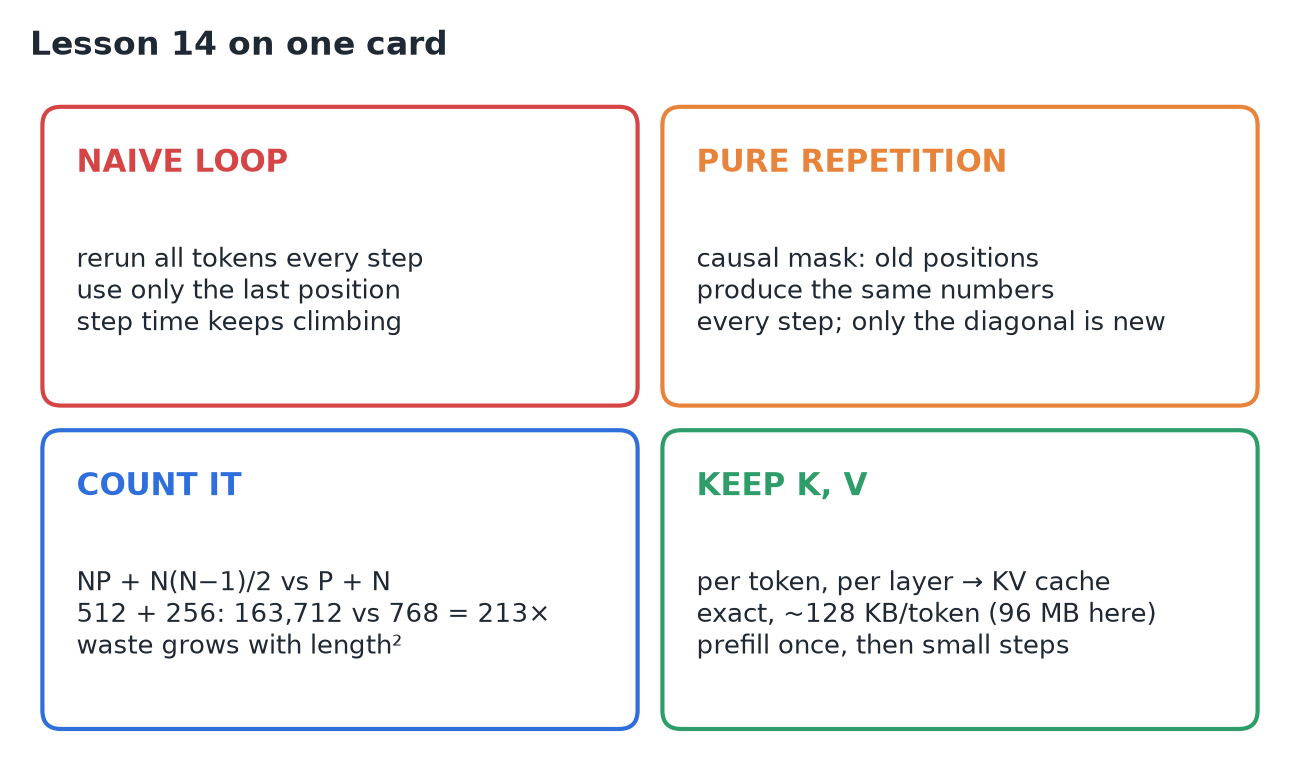
A 512-token prompt plus a 256-token reply is 768 tokens of text, but the obvious generation loop pushes 163,712 tokens through the model: 213× more. The loop reruns the whole sequence every step yet uses only the last position's logits. Because of the causal mask, every old position produces exactly the same numbers every step, so the waste is pure repetition, and it grows with the square of the length. The newest token only needs every old token's keys and values, in every layer. Save those (the KV cache) and each token goes through the model once. The cache is exact, and costs ~128 KB per token (≈ 96 MB here).
1. The obvious loop
Run the model on all tokens so far, take the logits at the last position, pick a token, append it, repeat.
while not done:
    logits = model(tokens)          # full pass over everything so far
    nxt = sample(logits[-1])        # only the last position is used
    tokens.append(nxt)
Draw the work as a grid: rows are steps, columns are positions. Step 1 covers the prompt, step 2 the prompt plus one token, and so on. The rows grow into a staircase.
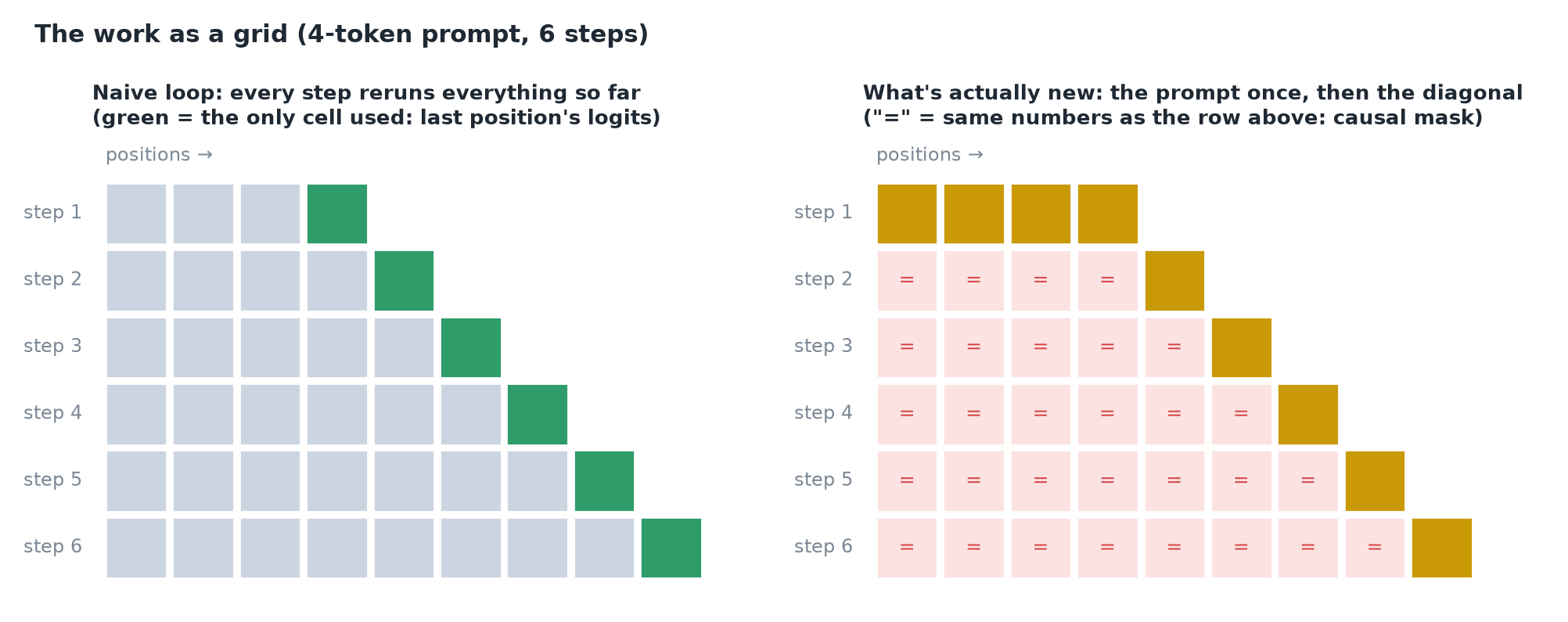 Left: each step uses only its last cell; the rest is computed and thrown away. Right: only the diagonal is genuinely new.
2. The thrown-away work is the same work
Recall the causal mask: a token sees only itself and earlier tokens. So everything the model computes at position 5, in every layer, depends only on tokens 1–5. Adding token 6 can't change it.
IMPORTANT
Column 5 holds identical numbers in step 1, step 2 and every step after, and so does every old column. Only one cell per row is new: the diagonal, where the newest token enters. Everything left of it is recomputation.
3. Count it
With a prompt of P tokens and a reply of N, the naive loop processes P, then P + 1, then P + 2, … The total is NP + N(N − 1)/2. The work actually needed is P + N: each token once.
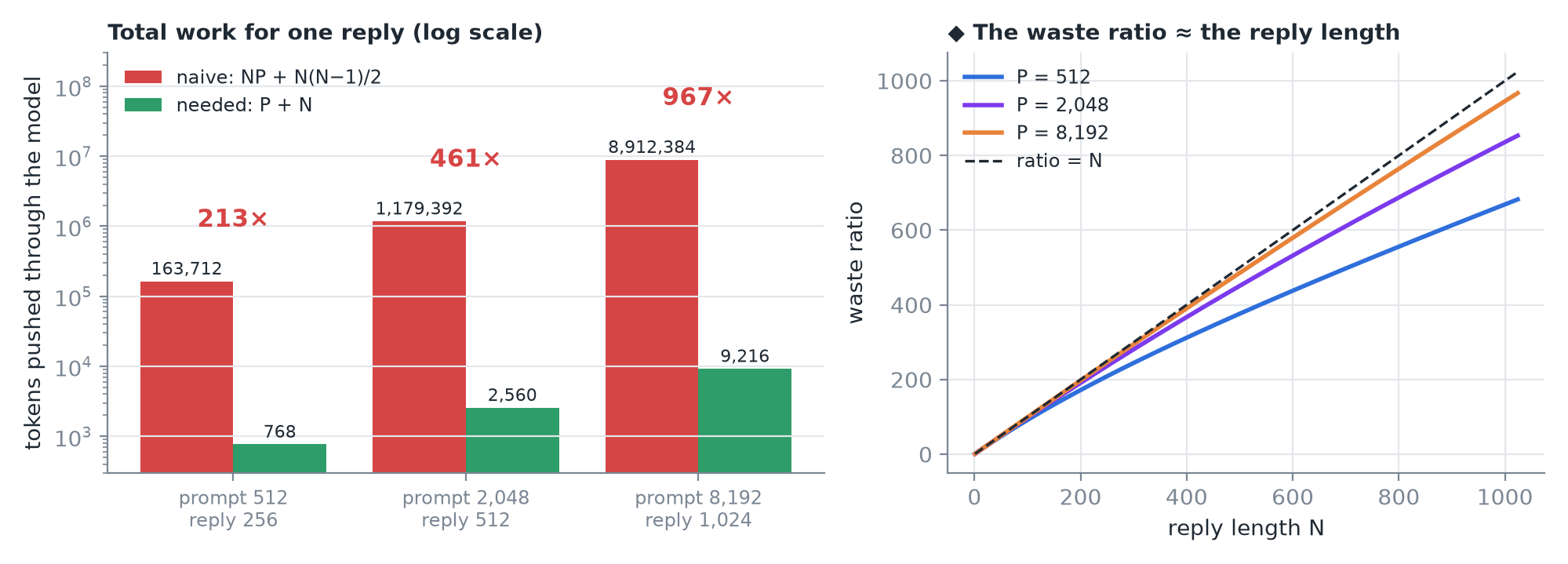 The video rounds the middle and right cases to "2,000 + 500" and "8,000 + 1,000"; its 461× and "almost 1,000×" come from 2,048 + 512 and 8,192 + 1,024. Right (◆): the ratio sits a bit under N and approaches it as the prompt grows.
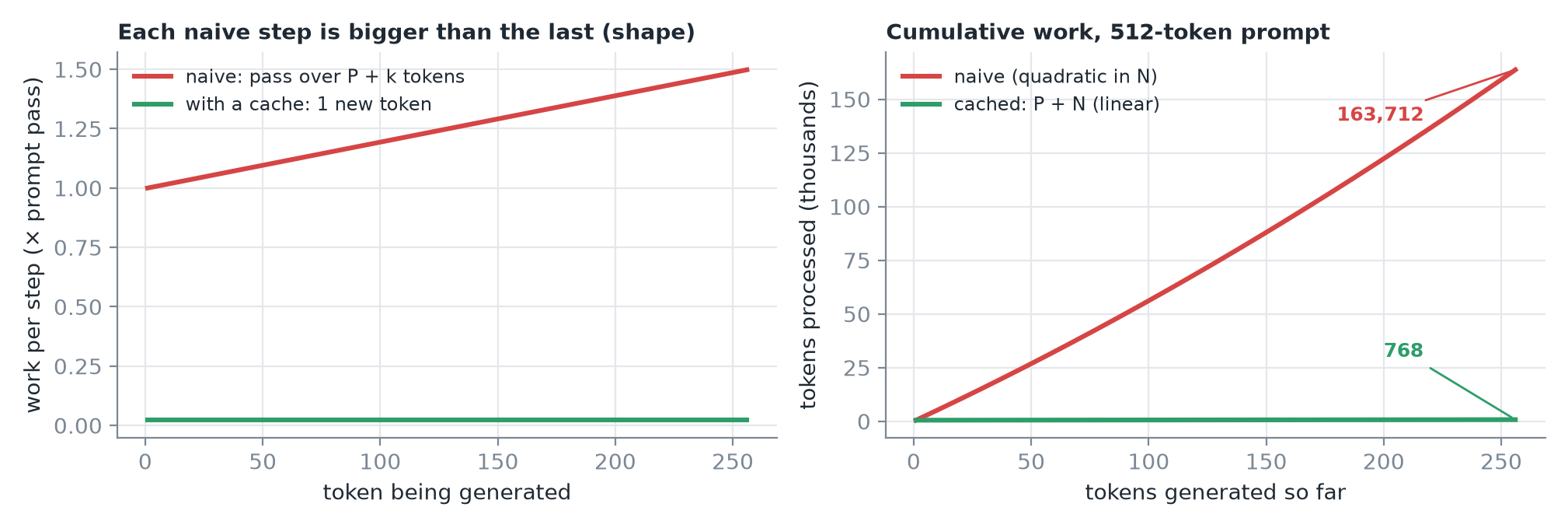
You feel it in latency too: each naive step is a bigger pass than the last, so time per token keeps climbing as the reply grows.
4. What the newest token actually needs
Trace the new token through one layer. It needs its own query, key and value (from its own hidden state), then compares its query with every earlier token's key and blends their values.
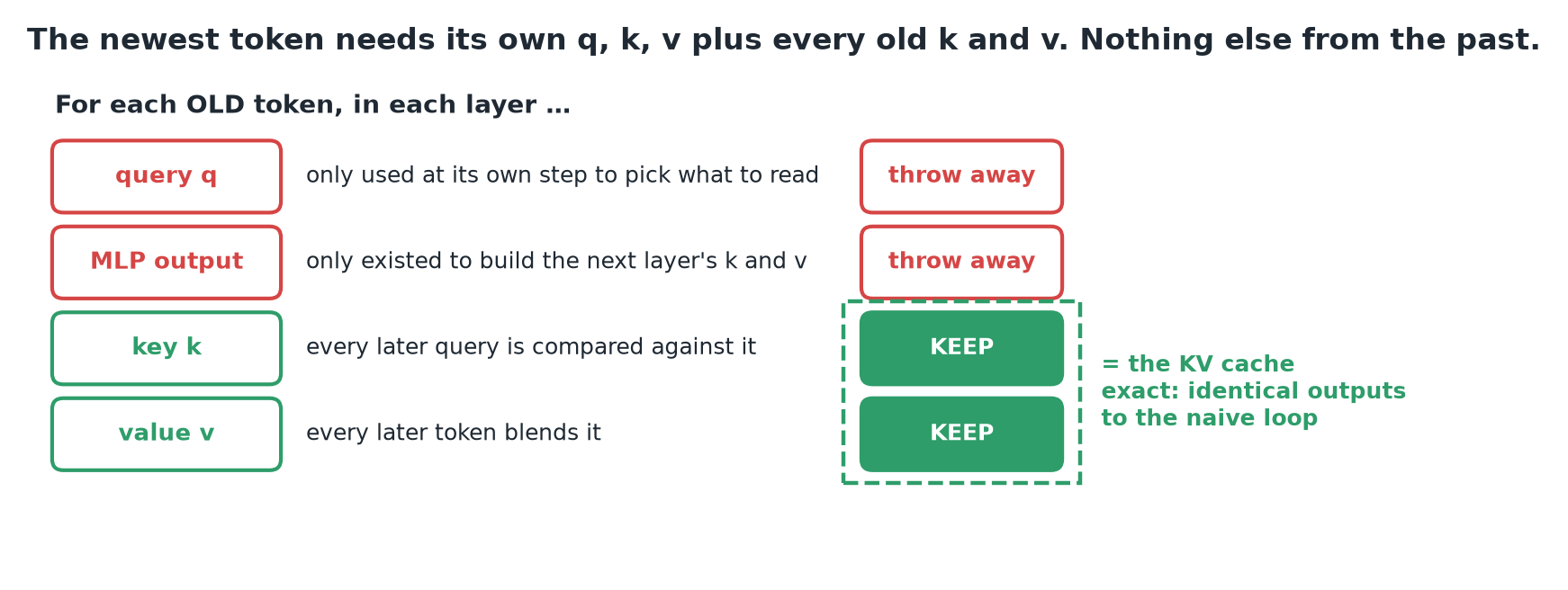 Old queries and old MLP outputs only existed to produce the old tokens' keys and values one layer up.
Save each old token's keys and values in every layer, and the new token has everything it needs. Each token then goes through the model once, adds its K and V to the store, and is never recomputed. That store is the KV cache.
TIP
The cache is exact: outputs are identical to the naive loop. The price is memory.
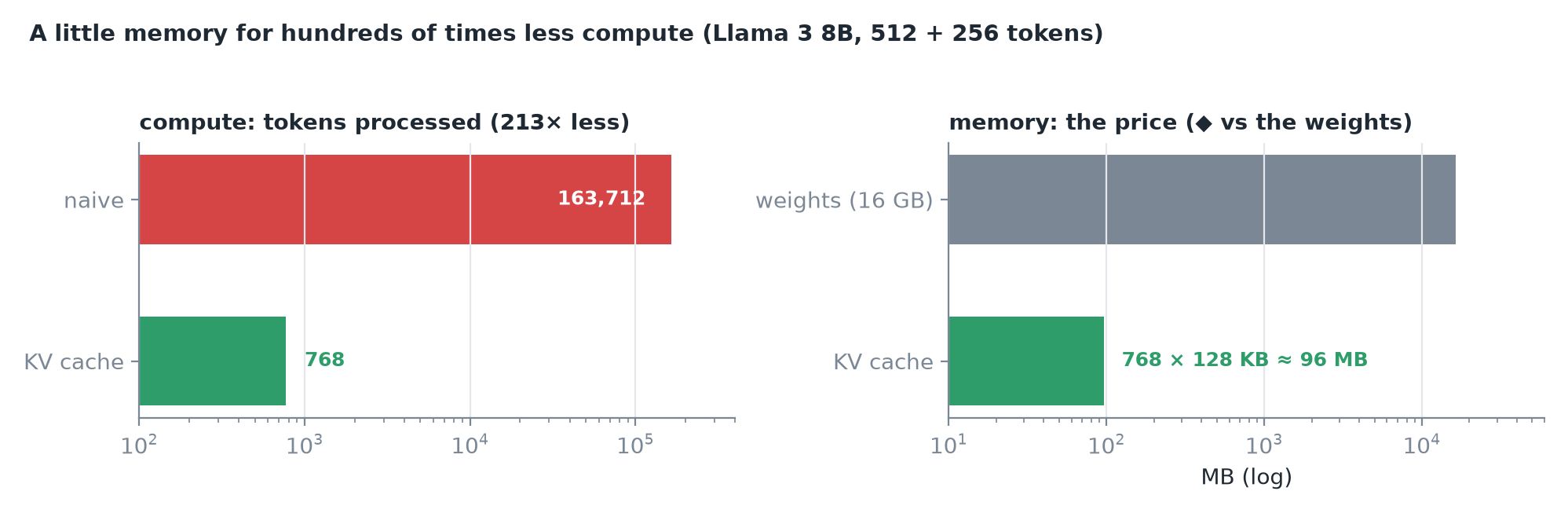 ~128 KB per token for Llama 3 8B (derived in 05). 768 tokens × 128 KB ≈ 96 MB.
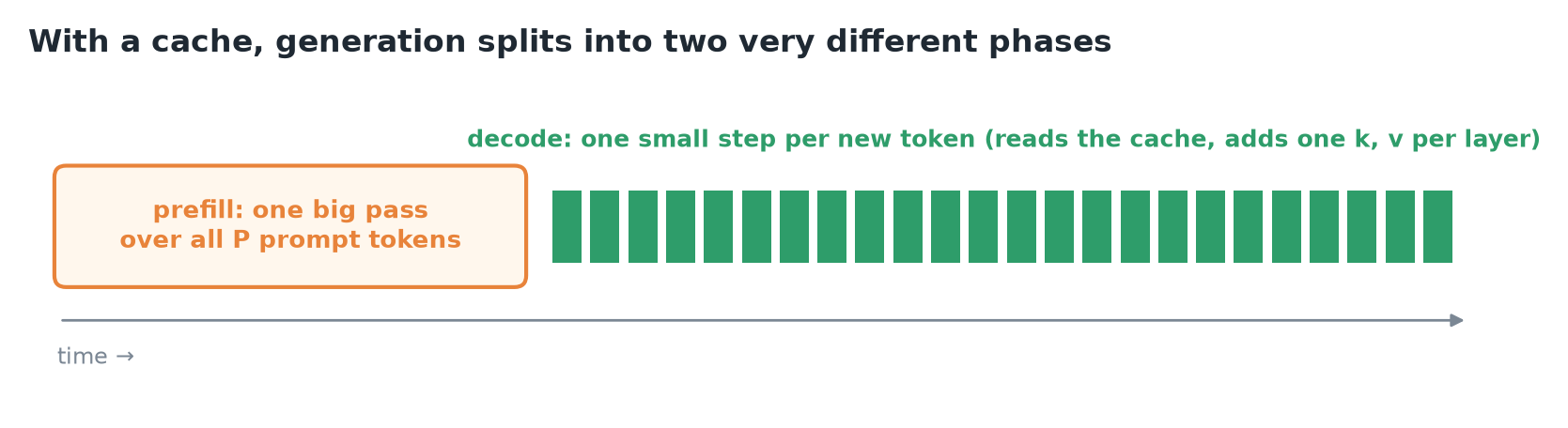
With a cache, generation splits into two very different phases:
5. Recap