53 · Quantized GEMM & Dequantization Overhead
Source: fanout.sh / inference-eng / 11-04 · ~5 min
NOTE
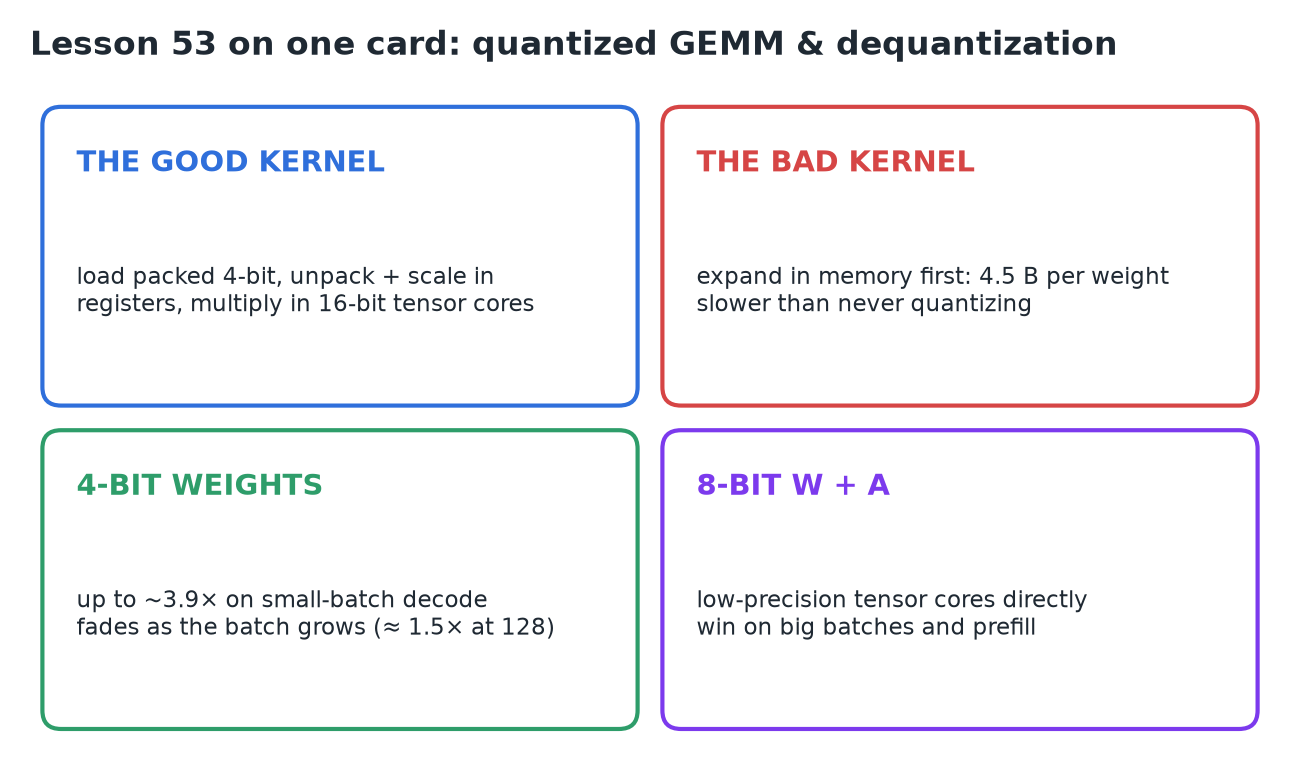
A 4-bit model is 4× smaller, but its matrix multiplies are only sometimes 4× faster: it depends on what the GPU does with the 4-bit numbers and how many tokens you multiply at once. Most GPUs can't multiply 4-bit weights by 16-bit activations directly, so a good kernel unpacks and scales each tile in registers and feeds 16-bit tensor cores; the weights cross the memory bus at half a byte. Expanding them in memory first costs 4.5 bytes per weight, worse than plain 16-bit. Good kernels (Marlin) hold near the ideal ≈ 3.9× up to batches of 16–32, fall to ≈ 1.5× at 128 and break even on large prefills. W8A8 skips the unpacking and uses 8-bit tensor cores (≈ 2× math), so it wins on big batches and prefill.
1. Inside a good 4-bit kernel
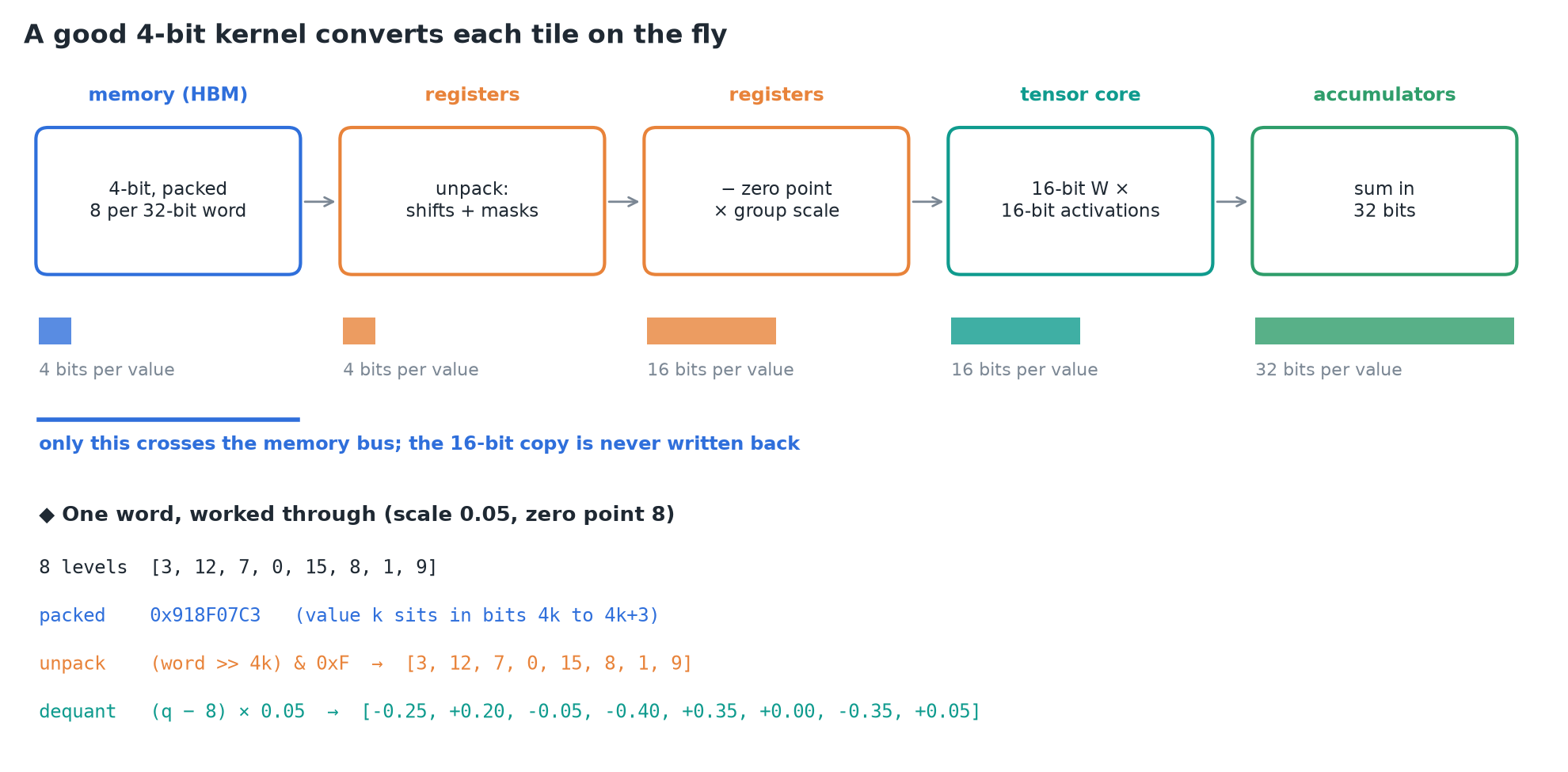 The bars show bits per value at each stage. ◆ The worked word is my example.
- Most GPUs have no tensor-core instruction for 4-bit × 16-bit, so the kernel converts the weights on the fly, one tile at a time:
- Load a tile of packed weights: eight 4-bit values per 32-bit word.
- In registers, unpack them with a few shifts and masks.
- Subtract the zero point and multiply by the group's scale: 16-bit weights.
- Feed them to the tensor cores with the 16-bit activations.
- Add the products up in 32-bit accumulators.
- The key point: weights cross the memory bus at 4 bits and are never written back in 16 bits.
2. The naive alternative
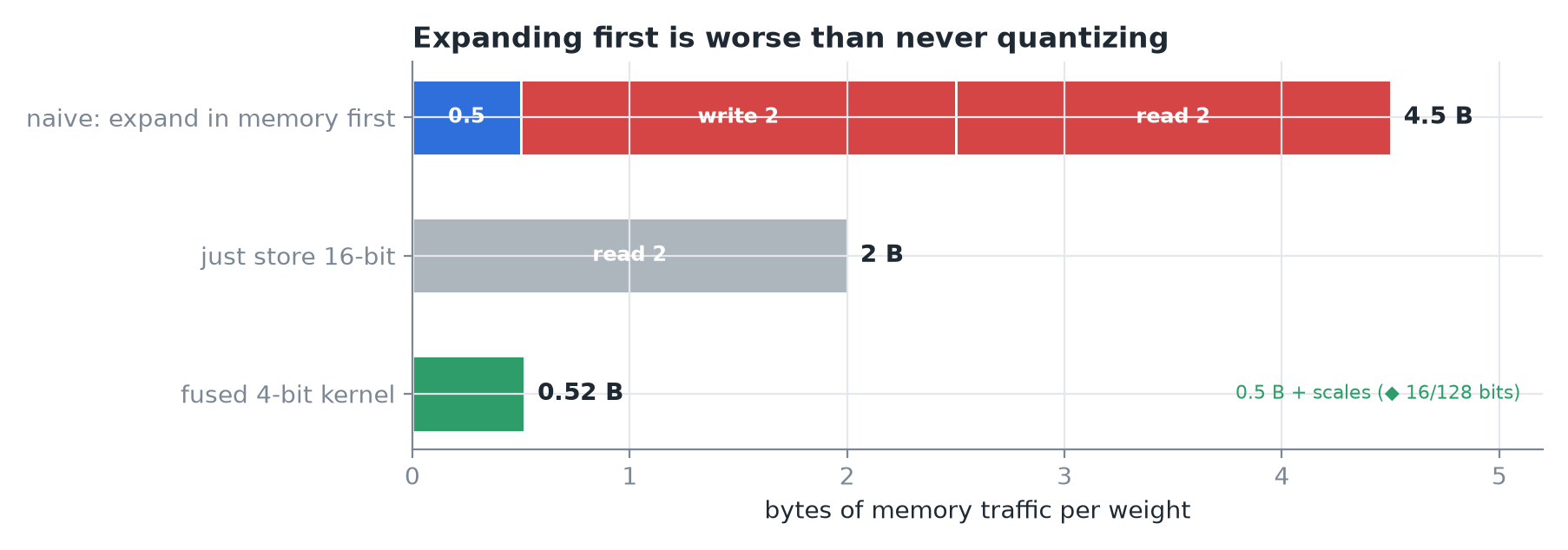 Memory traffic per weight for each approach.
- Expanding the whole matrix to 16 bits in memory first reads half a byte, writes two bytes, and reads those two bytes again.
3. How much faster: it depends on the batch
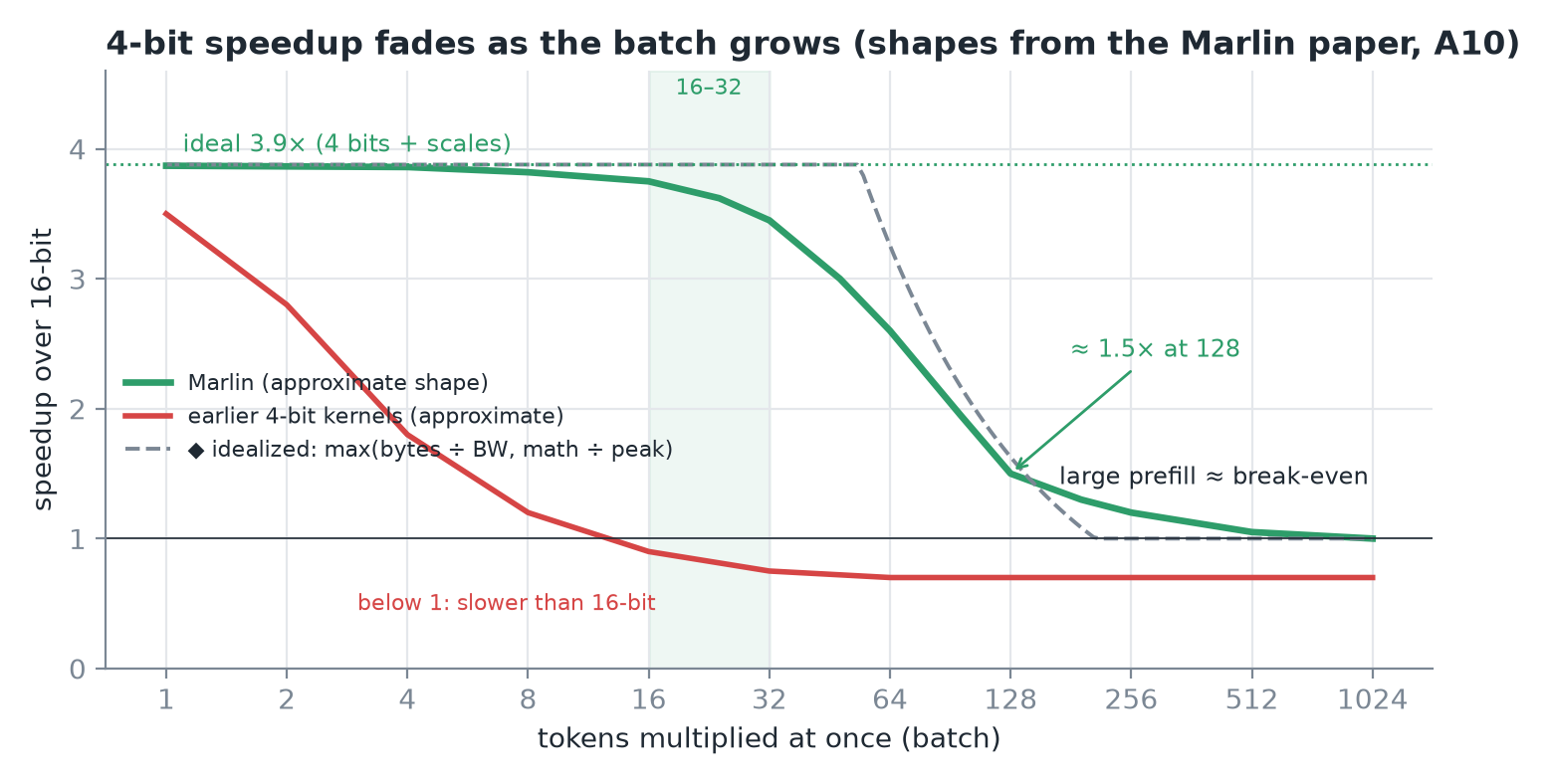 Curve shapes approximate the Marlin paper (A10, large layer). ◆ The dashed line is a roofline with no unpacking cost (A10: 125 TFLOPS, 600 GB/s).
- Batch of 1: limited by reading weights, so 4× fewer bytes gives almost 4×; with scale factors, ≈ 3.9× ideal.
- As the batch grows, each weight is used for more multiplications. A modern GPU can do 100–200 operations per byte it reads, so there's room to hide the unpacking and a few dozen multiplications behind each weight load.
- Marlin stays close to the ideal up to batches of 16–32 tokens.
- Beyond that the math is the limit: weights still need unpacking and scaling, and the tensor cores still multiply in 16 bits. By a batch of 128 the gain is ≈ 1.5×; for large prefills, roughly break-even.
- Before Marlin, most 4-bit kernels lost their speedup beyond a batch of 1 or 2. In vLLM, Marlin delivered up to ≈ 2.8× faster end-to-end.
TIP
◆ 100–200 operations per byte fits A10/A100-class GPUs (A10 ≈ 208 FLOPs per byte, A100 ≈ 156). An H100 is ≈ 295 (989 TFLOPS ÷ 3.35 TB/s). The roofline puts the 4-bit gain at 1.6× by 128, close to Marlin's 1.5×. The gap at 32–64 is the unpacking and other overhead the roofline ignores.
4. Eight-bit weights and activations work differently
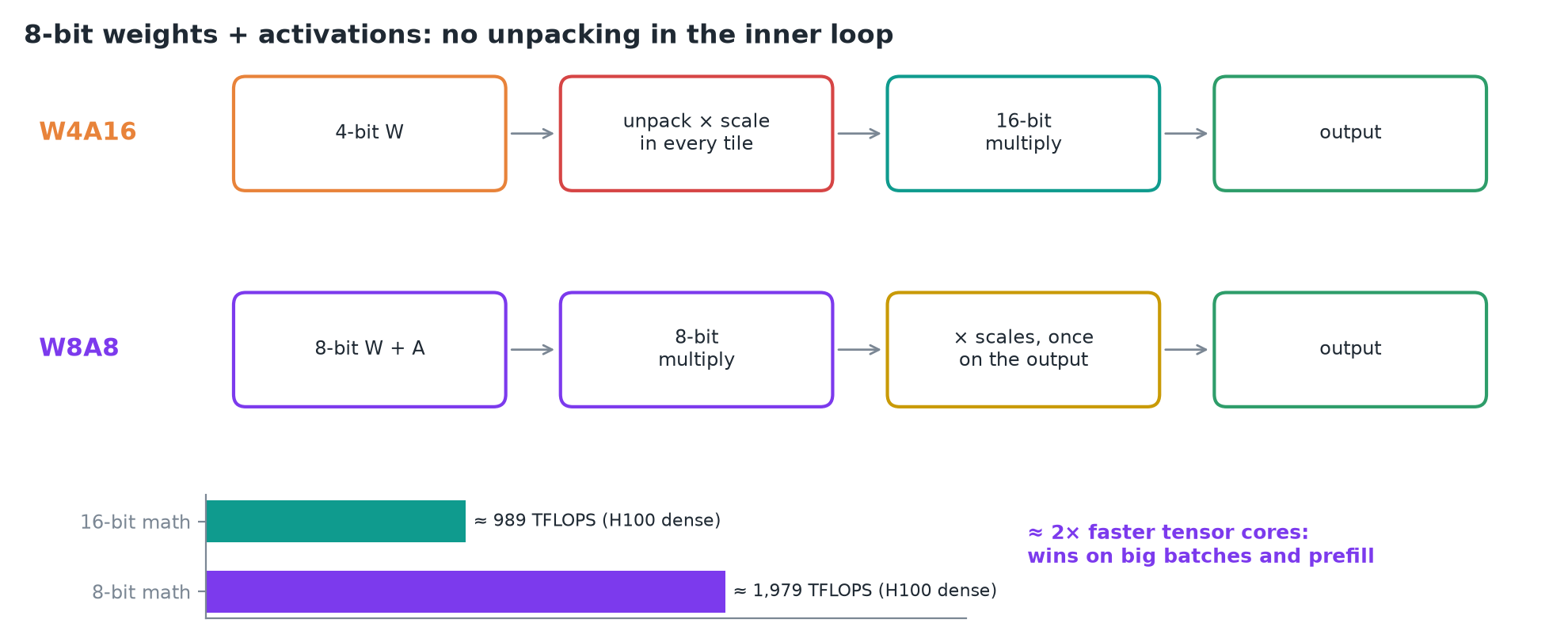 W4A16 converts in every tile; W8A8 scales once, at the end.
- On GPUs with FP8 or INT8 tensor cores, both inputs go straight into the tensor cores in 8 bits: no unpacking in the inner loop.
- The scales are applied once, to the finished output.
- The tensor cores run about 2× faster in 8 bits than in 16.
- So W8A8 speeds up the compute-bound work, large batches and prefill, exactly where 4-bit weight-only runs out of steam.
IMPORTANT
4-bit weight-only for small batches and low latency; 8-bit weights + activations for high throughput. The reason is the kernel: 4-bit saves bytes, 8-bit W+A saves math.
5. Recap