38 · KV Blocks, Fragmentation & Block Tables
Source: fanout.sh / inference-eng / 08-02 · ~5 min
NOTE
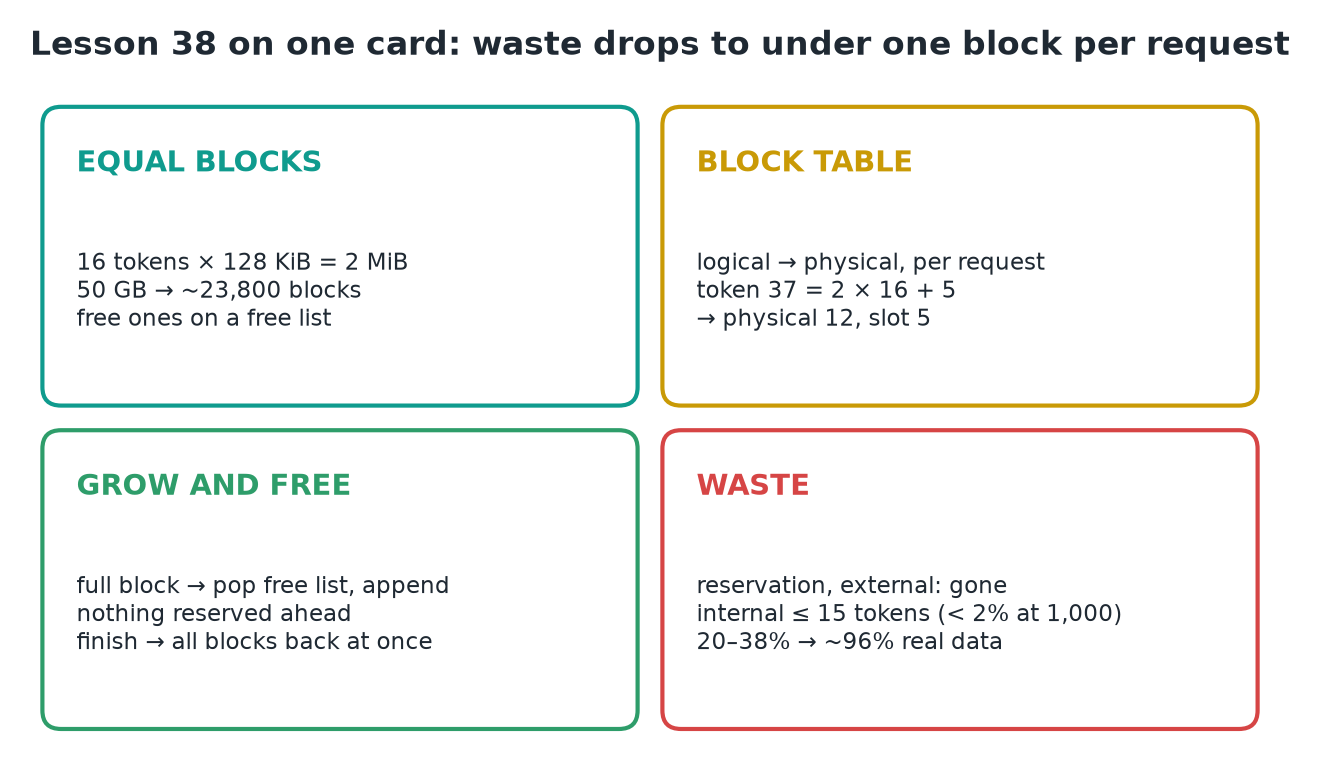
vLLM fixes contiguous slabs the way operating systems fixed memory decades ago: paging. Cut the KV pool into equal blocks of 16 tokens (2 MiB each on Llama 3.1 8B, so 50 GB ≈ 23,800 blocks), hand them out from a free list, and give each request a block table mapping its logical blocks to physical ones anywhere in the pool. Finding a token is one division: 37 = 2 × 16 + 5 → logical block 2, slot 5. Blocks are allocated as the request grows and returned the moment it finishes. Reservation and external fragmentation disappear; internal waste is at most 15 tokens per request, and the vLLM paper measured ~96% of KV memory holding real data, up from 20–38%.
1. Paging, applied to the KV cache
Give every program the illusion of one neat, contiguous address space, but store it in small fixed-size pages scattered anywhere in physical memory.
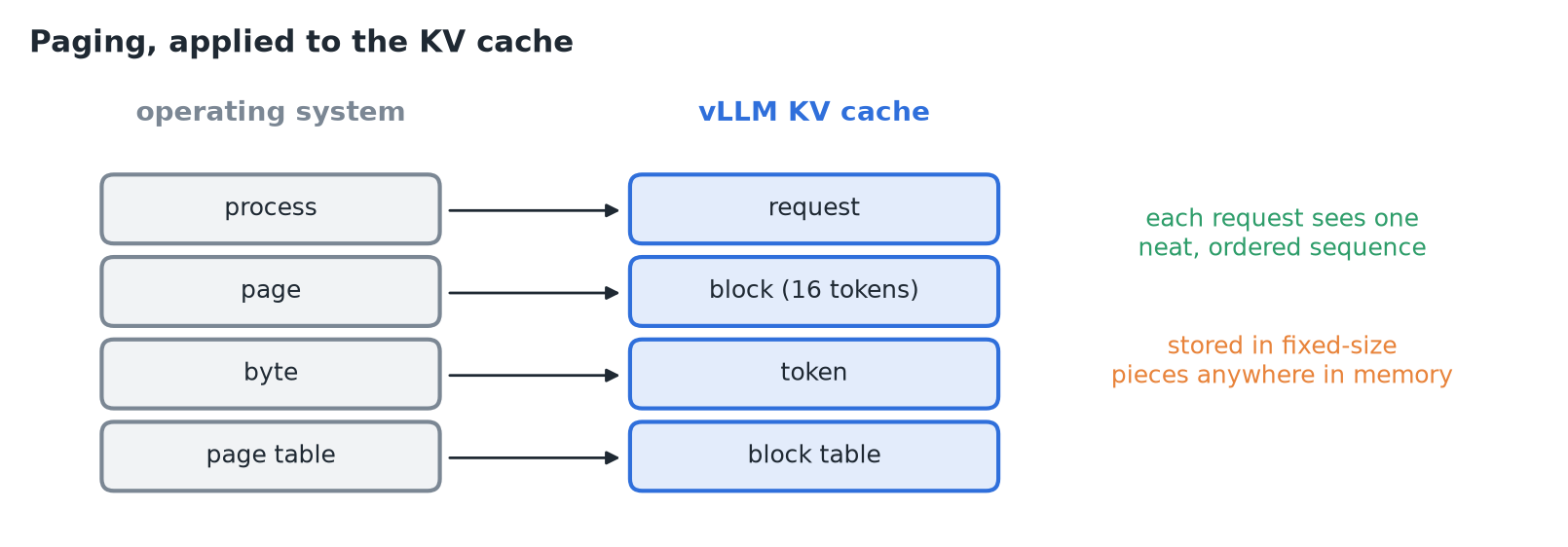 A request is like a process, a block like a page, a token like a byte.
2. Equal blocks and a free list
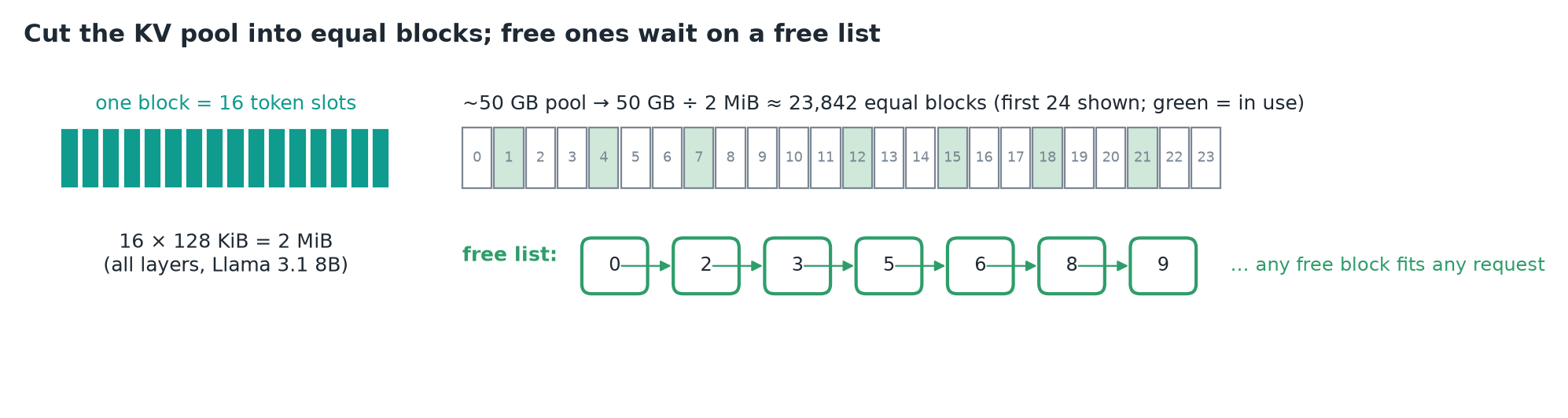 vLLM's default block holds 16 tokens' keys and values across all layers. Every block is the same size, and every free one sits on a free list, ready to hand out.
3. The block table
A request with 60 tokens sees them in order in logical blocks 0–3 (16 each, the last only 12 full). Physically they live in blocks 7, 1, 12 and 4; that small list is the request's block table.
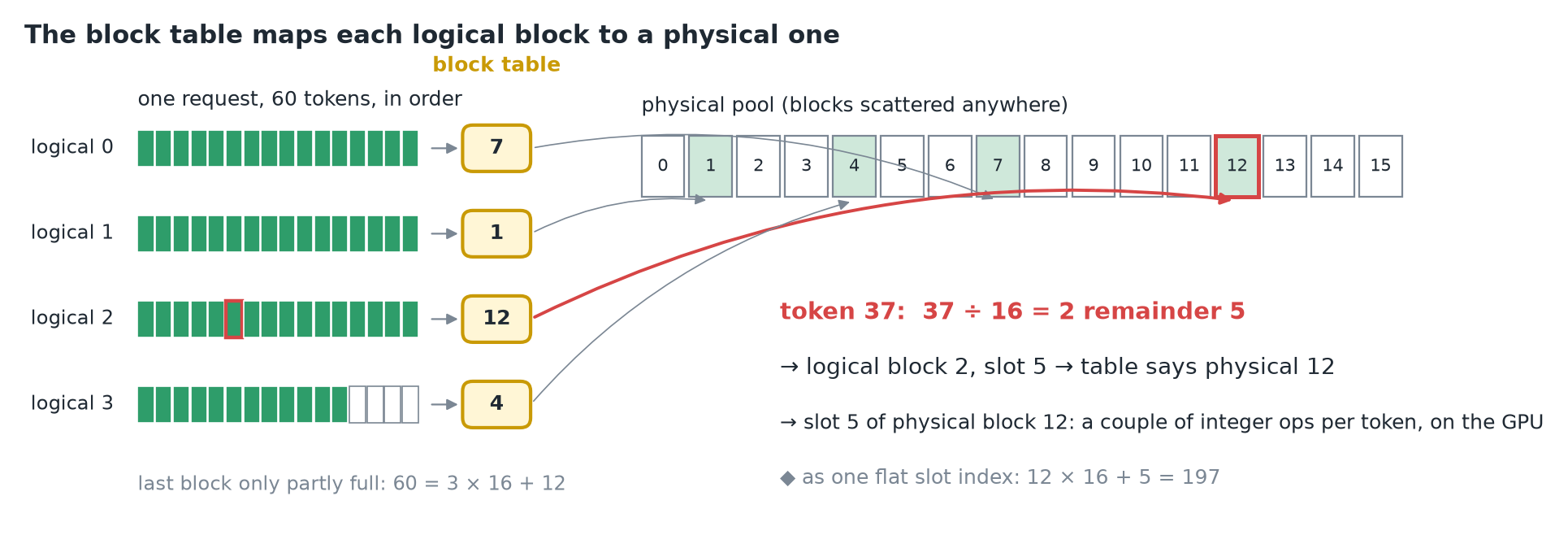 To find any token, divide its position by 16: the quotient picks the logical block, the table gives the physical one, the remainder is the slot. A couple of integer operations, done for every token on the GPU.
4. Grow and free
- Each new token goes into the next slot of the last block. When that block fills, the manager pops one block off the free list and appends its number to the block table.
- Nothing is reserved ahead: a request holds only its filled blocks plus one partly full.
- When it finishes, all its blocks go straight back to the free list; the next request can use them even though they're scattered.
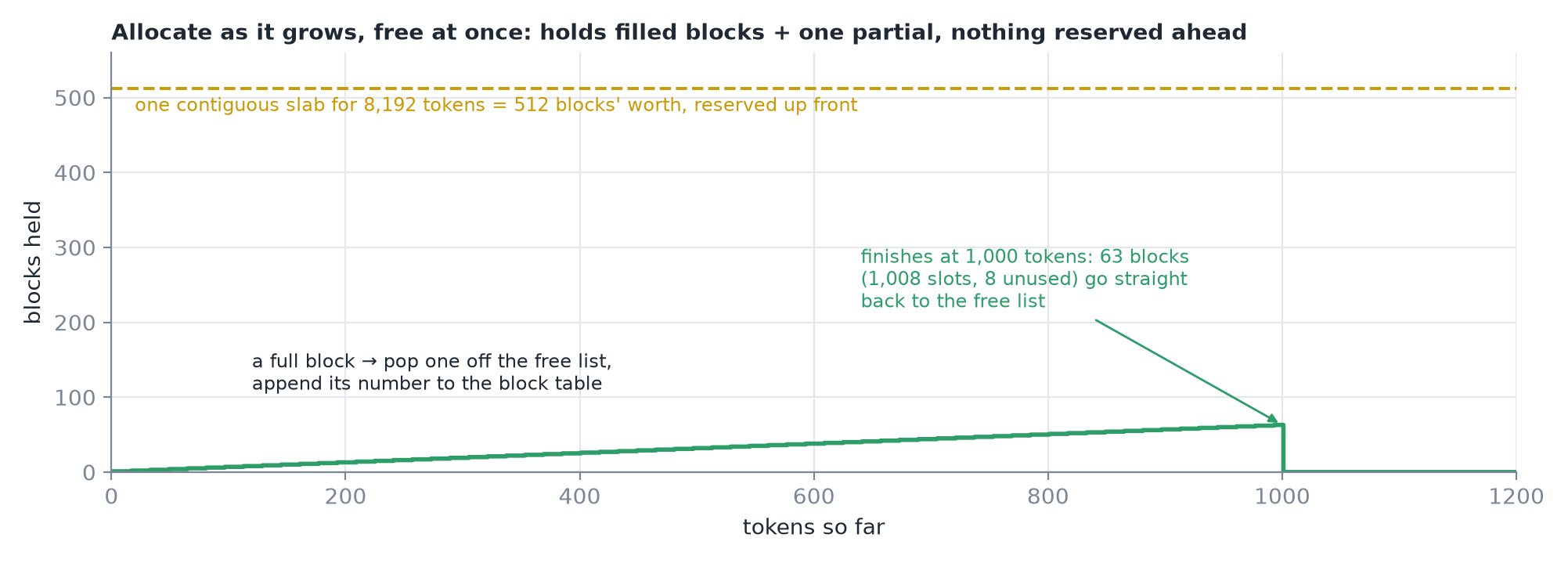 ◆ One request growing to 1,000 tokens holds at most 63 blocks (1,008 slots, 8 unused), versus 512 blocks' worth for an 8,192-token slab reserved up front.
5. The three wastes, revisited
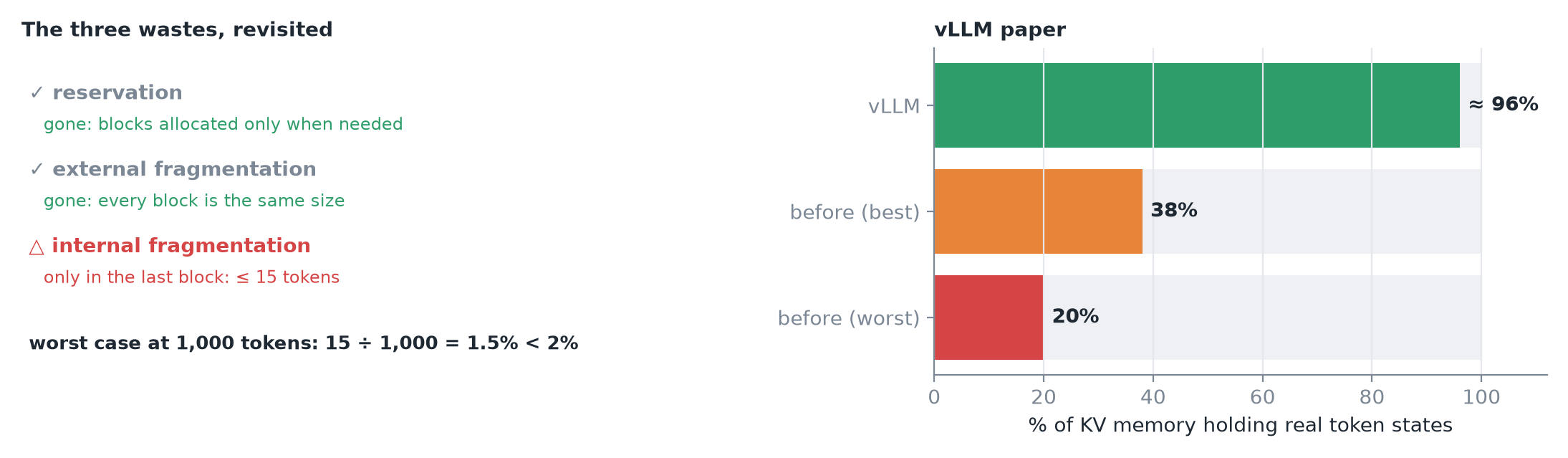 Reservation is gone (blocks allocated only when needed); external fragmentation is gone (any free block fits any request); internal fragmentation shrinks to the last block's unused slots.
IMPORTANT
The vLLM paper measured ~96% of KV memory holding real token states, up from 20–38% with contiguous slabs.
6. Block size is a trade-off
| Small blocks | Large blocks | |
|---|---|---|
| Tail waste | Less | More at the end of each request |
| Block table | Longer | Shorter |
| Memory reads | Less efficient | More efficient |
16 tokens has held up well as a default.
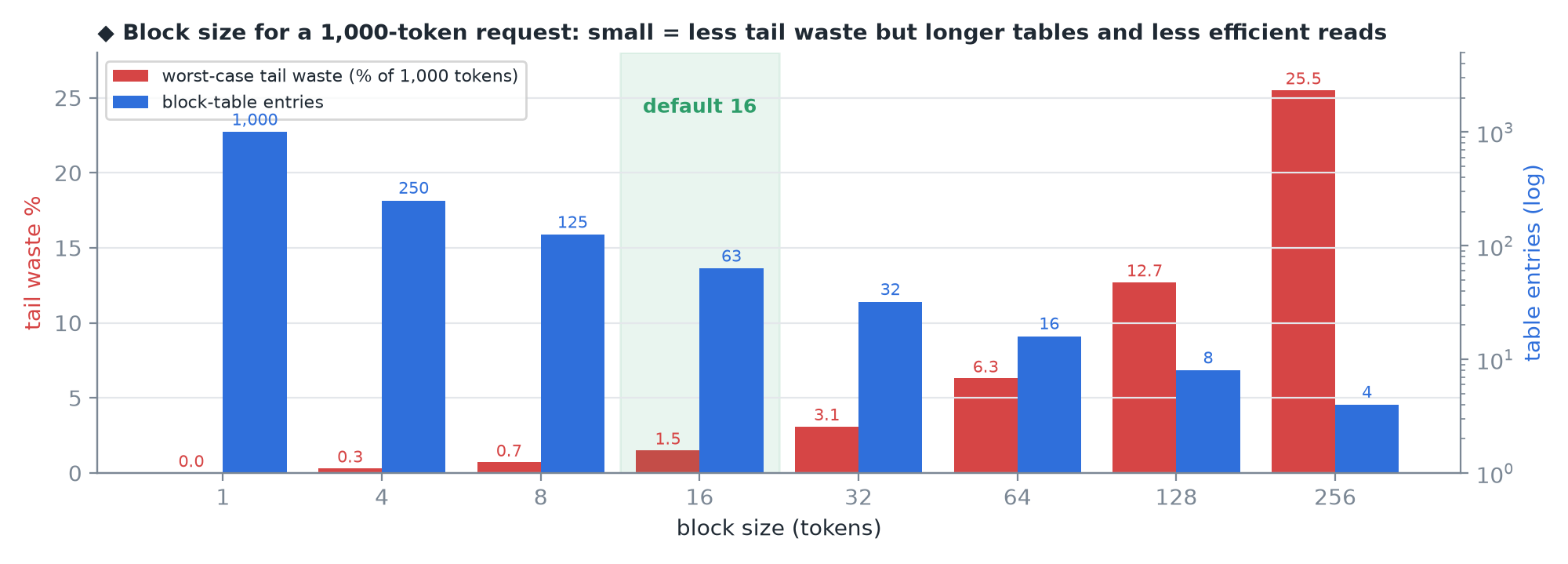 ◆ Worst-case tail waste is (block − 1) ÷ length, and the table needs length ÷ block entries (rounded up). At 16, a 1,000-token request wastes ≤ 1.5% with 63 entries.
7. Recap