31 · Follow a Request Through vLLM
Source: fanout.sh / inference-eng / 06-05 · ~5.5 min
NOTE
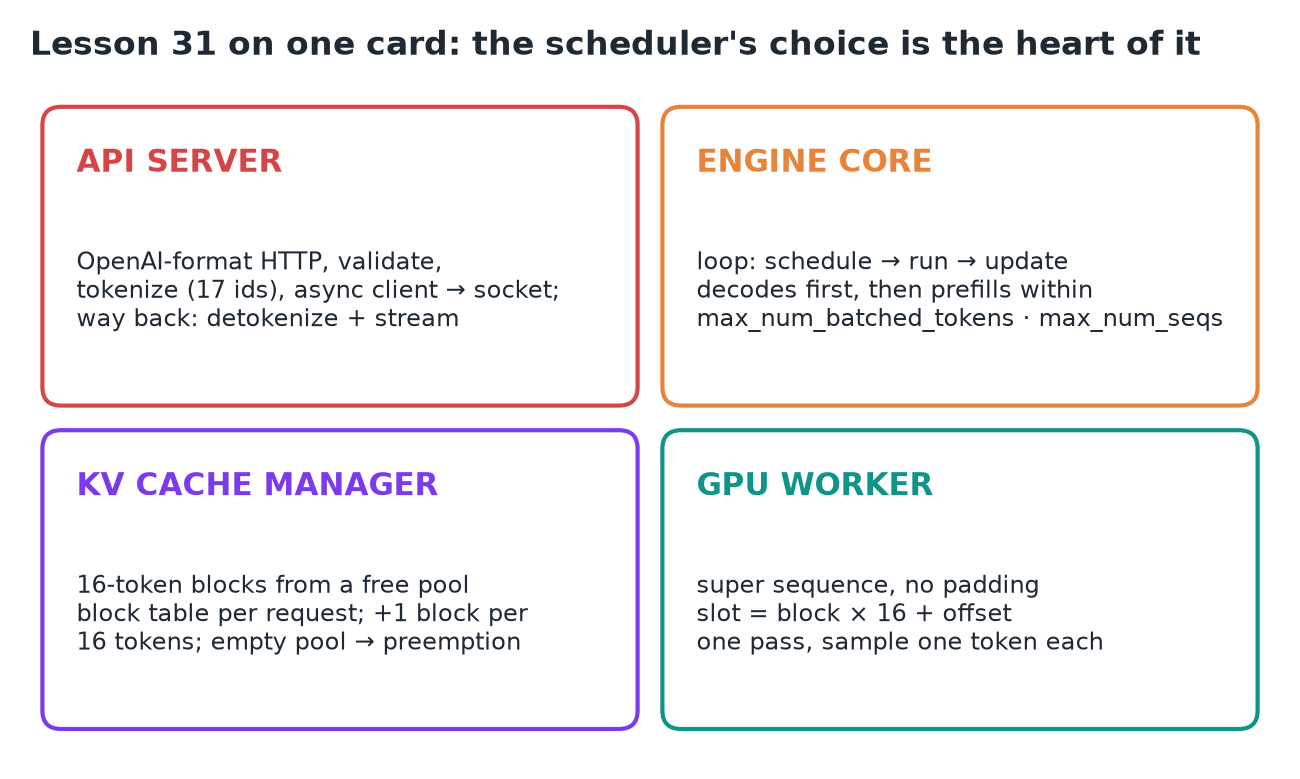
One request ("Explain the KV cache in one sentence") crosses three processes, two queues, a memory manager, and one GPU step shared with other requests. The API server handles HTTP and tokenization in its own process so it never blocks the GPU loop. The engine core loops forever (schedule → run → update): decodes first, then prefills within two budgets. The KV cache manager hands out 16-token blocks tracked in a block table. The GPU worker packs every request into one super sequence with no padding and runs a single forward pass. The heart of it all is the scheduler's choice of what runs each step.
1. The whole path
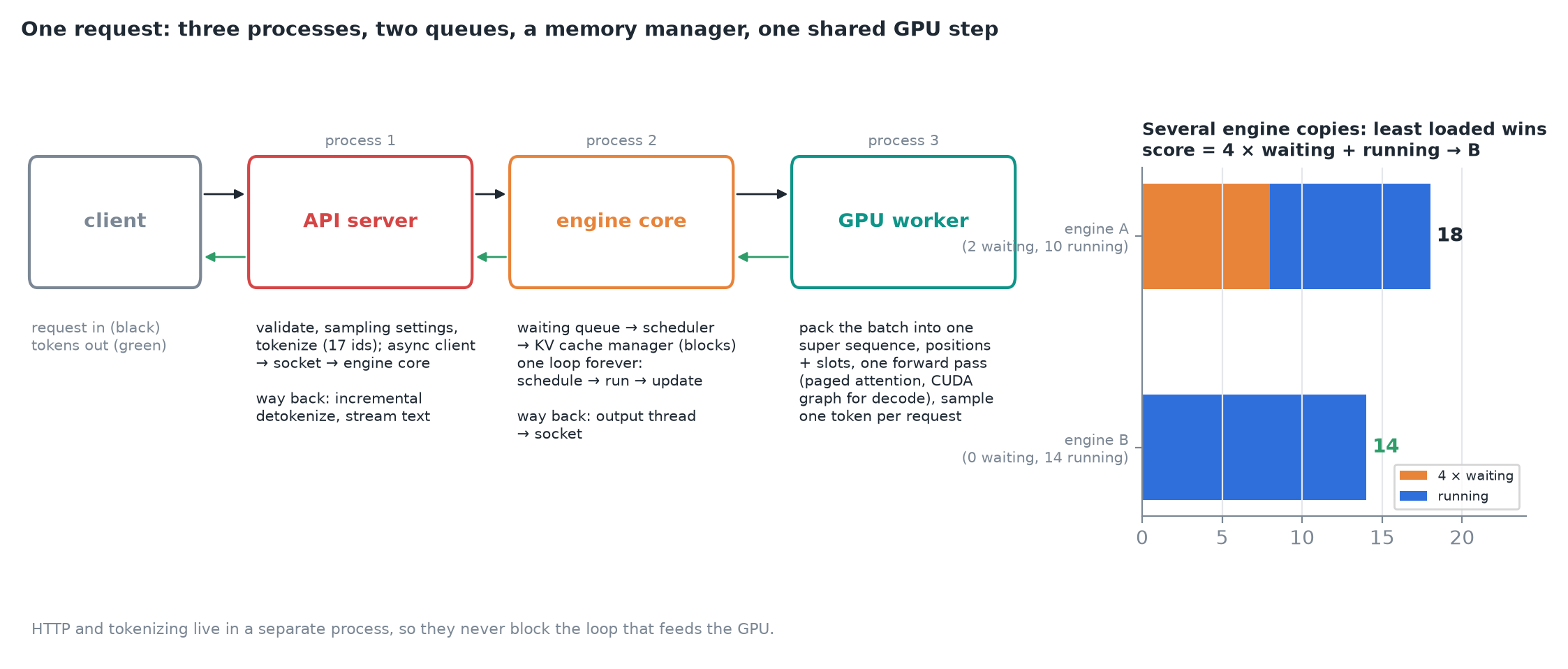 Request in (black arrows), tokens out (green). With several engine copies, the async client picks the least loaded: waiting requests count four times as heavily as running ones.
2. Stop one: the API server
- A Python web server speaking the OpenAI HTTP format. It validates the request, reads the sampling settings and runs the tokenizer: our prompt becomes 17 token IDs.
- It hands the request to an async client, which forwards it over a socket to a separate process, the engine core.
- Why separate: the CPU-overhead problem. HTTP handling and tokenization must not block the loop that feeds the GPU.
3. Stop two: the engine core
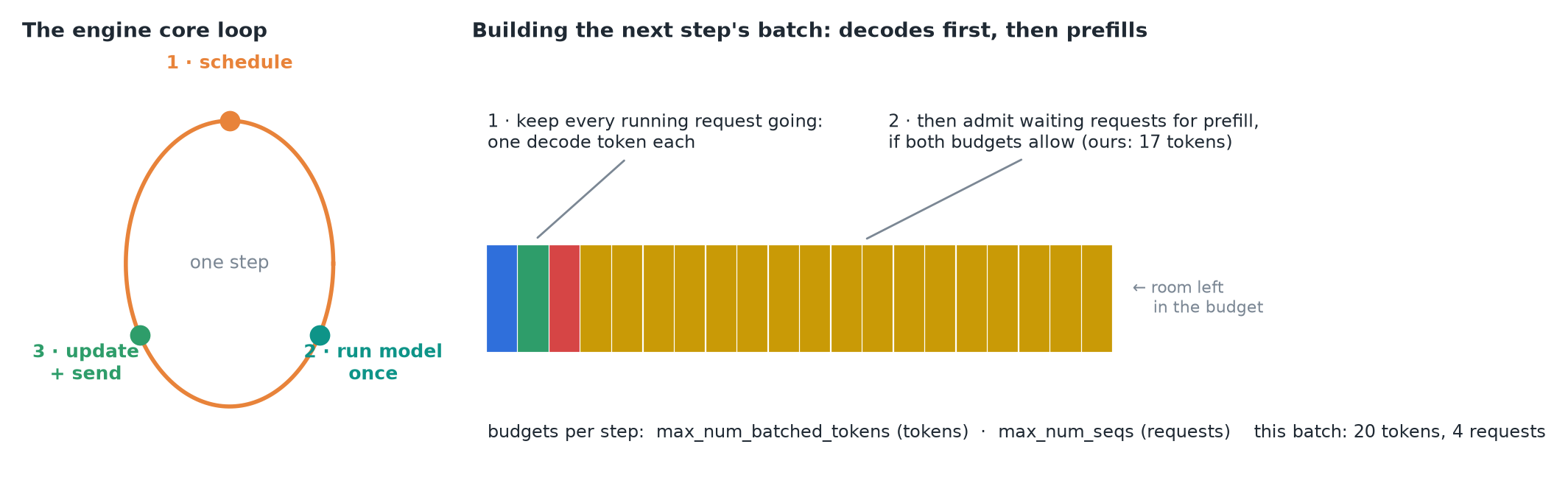 Each turn of the loop is one step: schedule, run the model once, then update and send out results.
- Our request lands in the waiting queue.
- The scheduler builds the next step's batch: first it keeps every running request going (one decode token each), then, if there's room, it admits waiting requests for prefill.
- Room means two budgets: a max number of tokens per step (
max_num_batched_tokens) and a max number of sequences (max_num_seqs). Our 17-token prompt fits, so it joins this step.
4. The KV cache manager
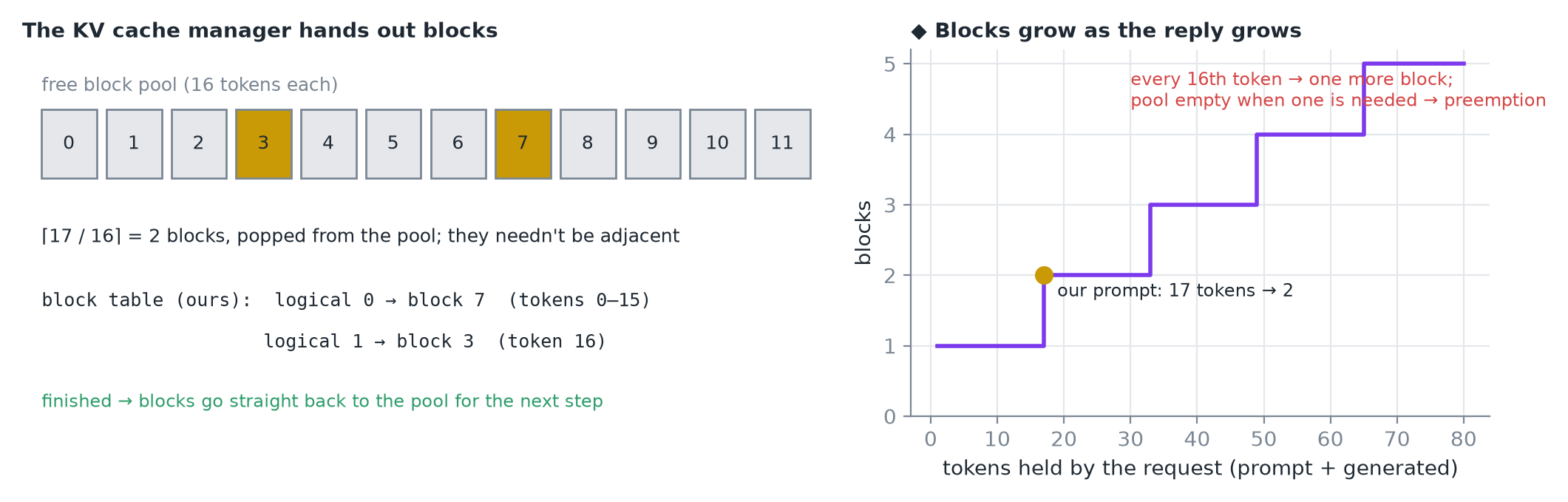 vLLM stores the cache in blocks of 16 tokens; the manager pops free blocks from its pool and records them in the request's block table.
- The two blocks needn't be adjacent: here block 7 (tokens 0–15) and block 3 (token 16).
- As the reply grows, every 16th token triggers one more block.
- If the pool is empty when a running request needs a block, that's when preemption happens.
- ◆ My server's
/metricsshowsblock_size="16"andnum_gpu_blocks="33298": 33,298 × 16 = 532,768 tokens, exactly its reported cache size.
5. Stop three: the GPU worker
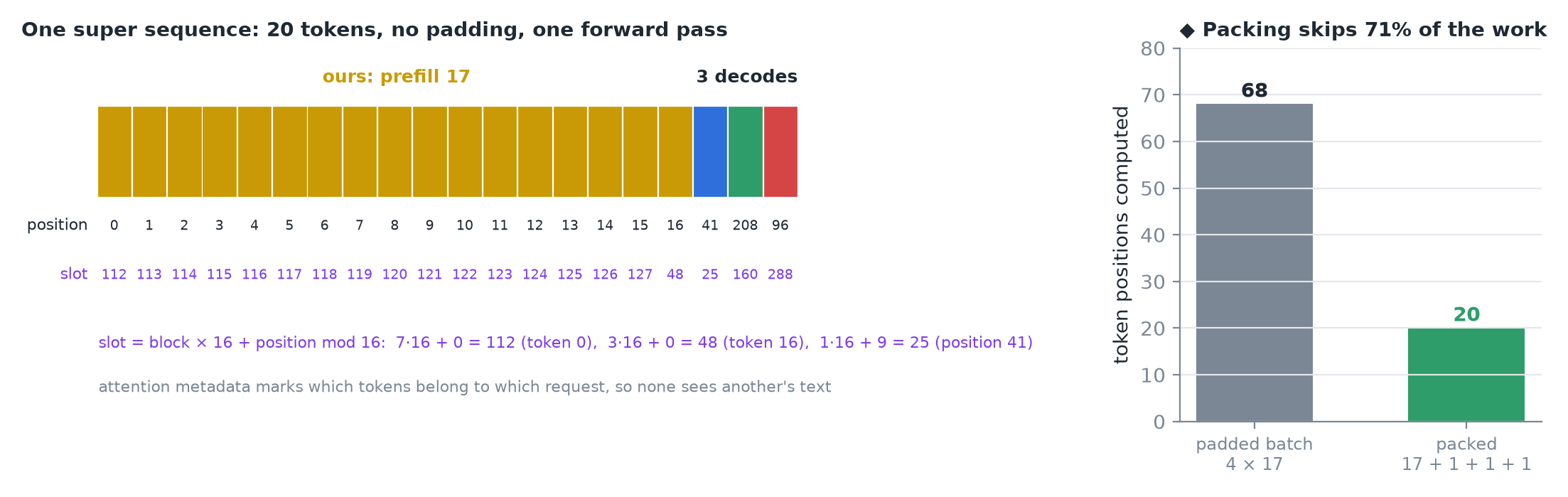 This step's batch: our 17 prompt tokens plus one decode token from each of three other requests, packed into one 20-token super sequence with no padding. ◆ The video's decode slots 171 and 300 don't match positions 208 and 96 (a slot's offset within its block must equal position mod 16), so the figure uses consistent ones.
- For each token the runner computes a position and a slot: exactly where that token's key and value will be written.
- Attention metadata tells the kernel which tokens belong to which request, so no request sees another's text.
- One forward pass runs over the whole super sequence using paged attention kernels. For decode steps, a pre-captured CUDA graph replays instead of launching kernels one by one.
- The runner takes the last position of each request, computes logits, and samples one token each.
6. Stop four: the way back
- The sampled token IDs go to the engine core's output thread, then over a socket back to the API server.
- An output handler detokenizes them incrementally and streams each new piece of text to the client. Our first token has arrived: that was its TTFT.
- Next step it's a running request, so it gets one decode token per loop until it produces an end token or hits its limit.
- When it finishes, its blocks go straight back to the free pool, ready for another request on the very next step.
7. Recap