10 · Trace the Transformer Forward Pass
Source: fanout.sh / inference-eng / 02-01 · ~5 min
NOTE
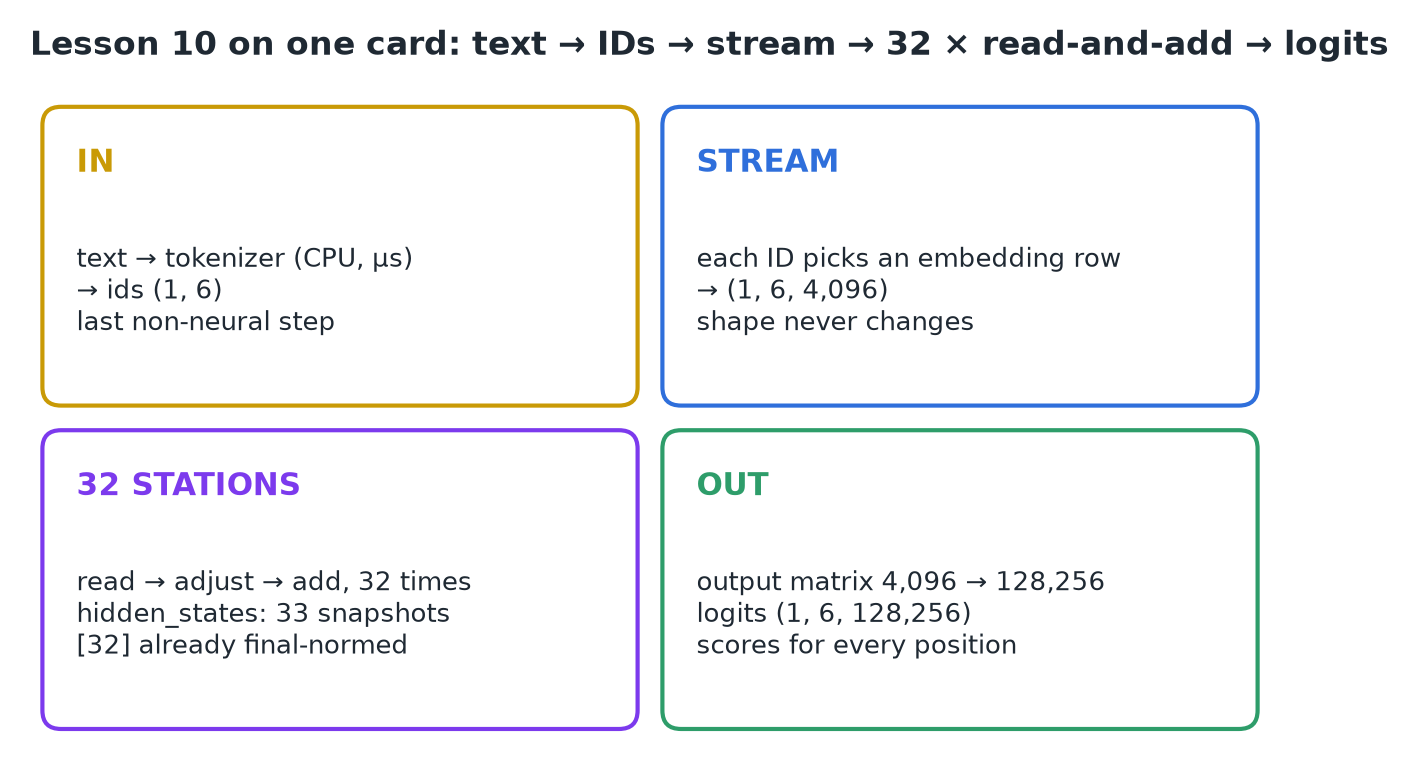
Every generated token is one forward pass: tensors in, tensors out. Trace "The capital of France is" through Llama 3.1 8B and you get three things back: 6 token IDs, logits of shape (1, 6, 128,256), and 33 hidden states of shape (1, 6, 4,096). Text becomes IDs, IDs become one residual stream whose shape never changes, 32 blocks read-and-add to it, and one projection turns it into a score for every vocabulary entry, at every position.
1. Skip the wrapper, call the model
model.generate() is a convenience wrapper; underneath is the forward pass, run once per token. Call the model directly and ask it to keep intermediate results:
enc = tok("The capital of France is", return_tensors="pt")
out = model(**enc, output_hidden_states=True)
enc.input_ids.shape        # (1, 6)
out.logits.shape           # (1, 6, 128256)
len(out.hidden_states)     # 33, each (1, 6, 4096)
The whole trace is in those three results.
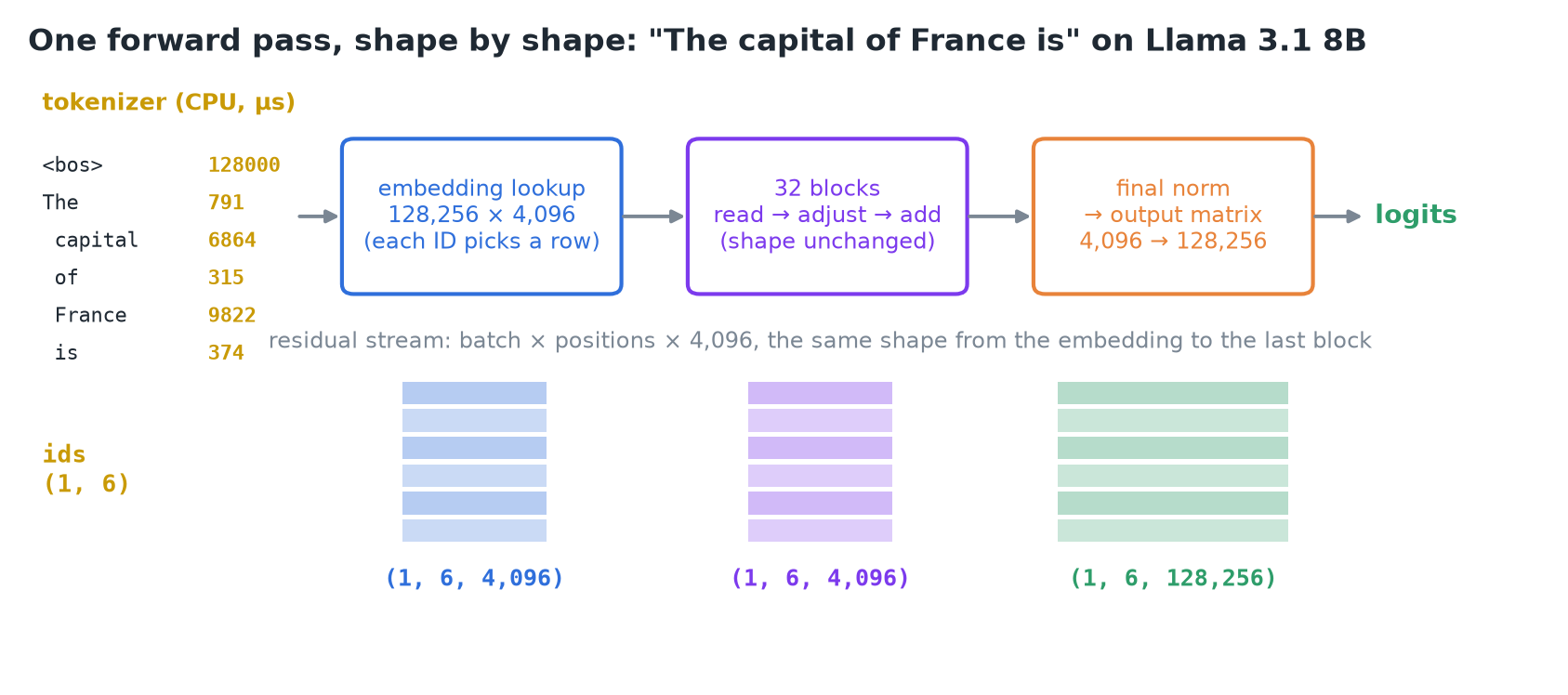 From six token IDs to a (1, 6, 4,096) stream to (1, 6, 128,256) logits.
2. In: tokenizer and embedding
- Tokenizer: 5 words + a begin-of-text marker → 6 IDs (128000, 791, 6864, 315, 9822, 374). It's the last non-neural step: a lookup table plus merge rules, running on the CPU in microseconds. After it, the request is only tensors.
- Embedding: each ID selects its row of the 128,256 × 4,096 embedding matrix. Six rows stacked = (1, 6, 4,096): batch, positions, numbers per position.
IMPORTANT
That tensor is the residual stream, and from here to the far end of the model its shape never changes.
3. Through: 32 read-and-add stations
Each of the 32 blocks reads the stream, computes an adjustment, and adds it back: same shape in, same shape out. Inside each block, attention lets the six positions inform one another under a backward-only (causal) mask, and the MLP (where most parameters live) works per position, with normalization around both.
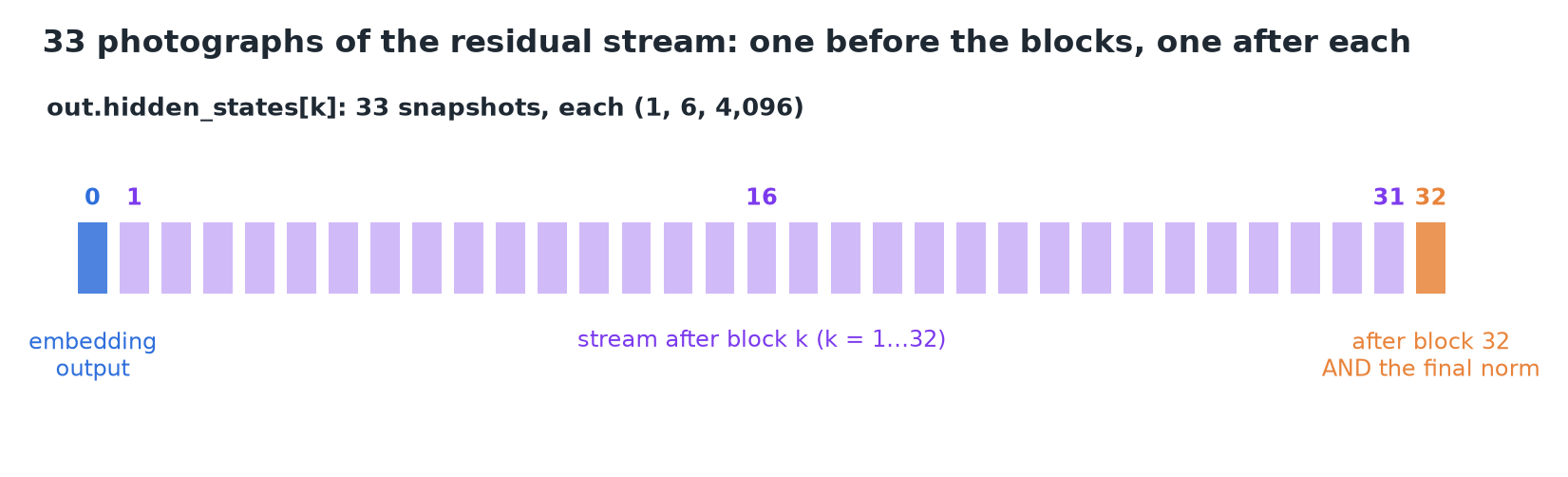 Index 0 is the embedding output; 1–32 are the stream after each block. The last one has the final norm already applied.
hidden_states[0]= embedding output (before any block);hidden_states[k]= stream after block k.- Wrinkle: the library returns the last snapshot after the final norm has been applied.
- Compare the last position's first few numbers at index 0 and index 32: same position, same shape, different numbers. That difference is the model's reading of the prompt.
4. Out: logits for every position
After the last block and the final norm, an output matrix (the same size as the embedding) projects each position's 4,096 numbers onto the vocabulary: 128,256 scores, called logits.
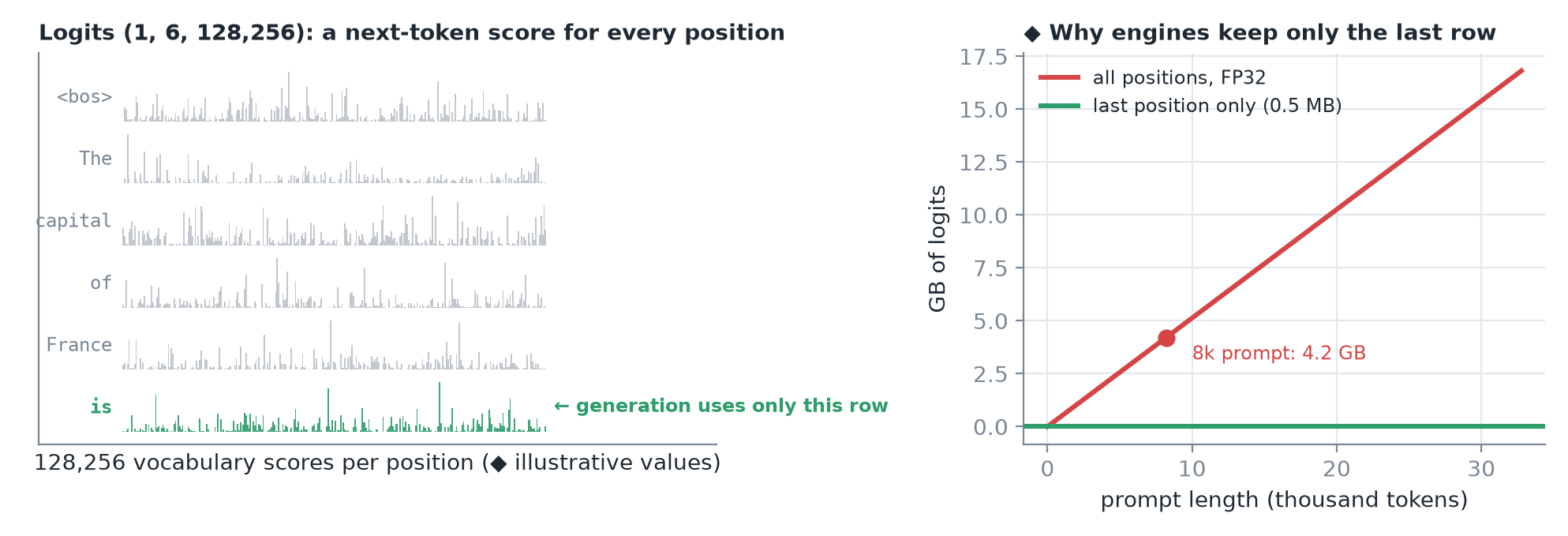 Left: the model scored a next token at all six positions. Right (◆): keeping every position's logits gets expensive for long prompts.
IMPORTANT
The shape is (1, 6, 128,256): the model scored a next token for all six positions, not just the last. Generation uses only the last position's row.
5. Recap