28 · Why Plain PyTorch Serving Breaks Down
Source: fanout.sh / inference-eng / 06-01 · ~6 min
NOTE
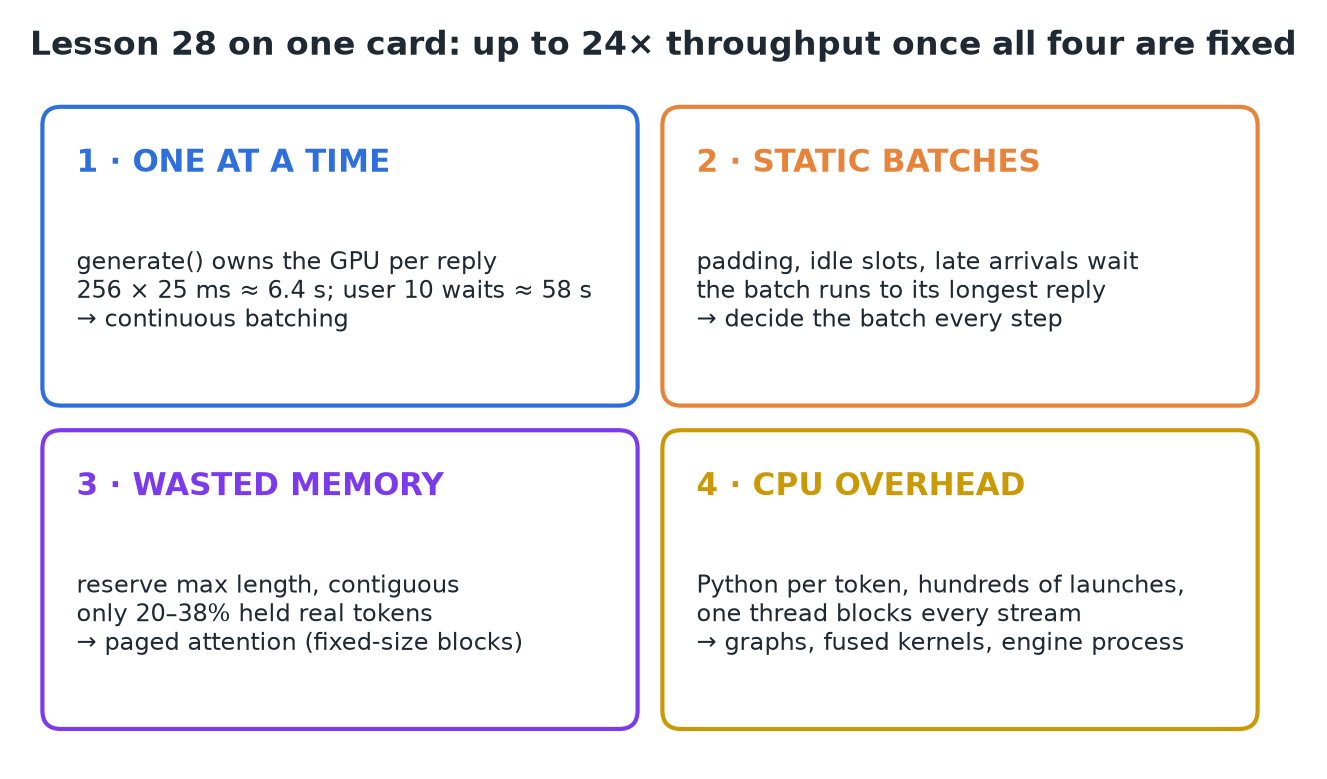
A ten-line server that calls model.generate() works for one user and falls apart at fifty, for four reasons. Requests run one at a time, so latency and throughput are both terrible. Static batches pad, idle and make late arrivals wait. Contiguous max-length KV reservations waste most memory (only 20–38% held real tokens in earlier systems). Python per-token overhead eats into every step. An inference engine replaces each with a better idea (continuous batching, per-step scheduling, paged blocks, graphs and a separate engine process), worth up to 24× the throughput of plain Hugging Face Transformers.
1. The simplest possible LLM server
from fastapi import FastAPI
from transformers import AutoModelForCausalLM, AutoTokenizer

app = FastAPI()
tok = AutoTokenizer.from_pretrained(MODEL)
model = AutoModelForCausalLM.from_pretrained(MODEL, device_map="cuda")

@app.post("/generate")
def generate(prompt: str) -> str:
    ids = tok(prompt, return_tensors="pt").to("cuda")
    out = model.generate(**ids, max_new_tokens=256)
    return tok.decode(out[0], skip_special_tokens=True)
Ten lines. With one user it works perfectly; with fifty it falls apart.
2. Problem 1: requests run one at a time
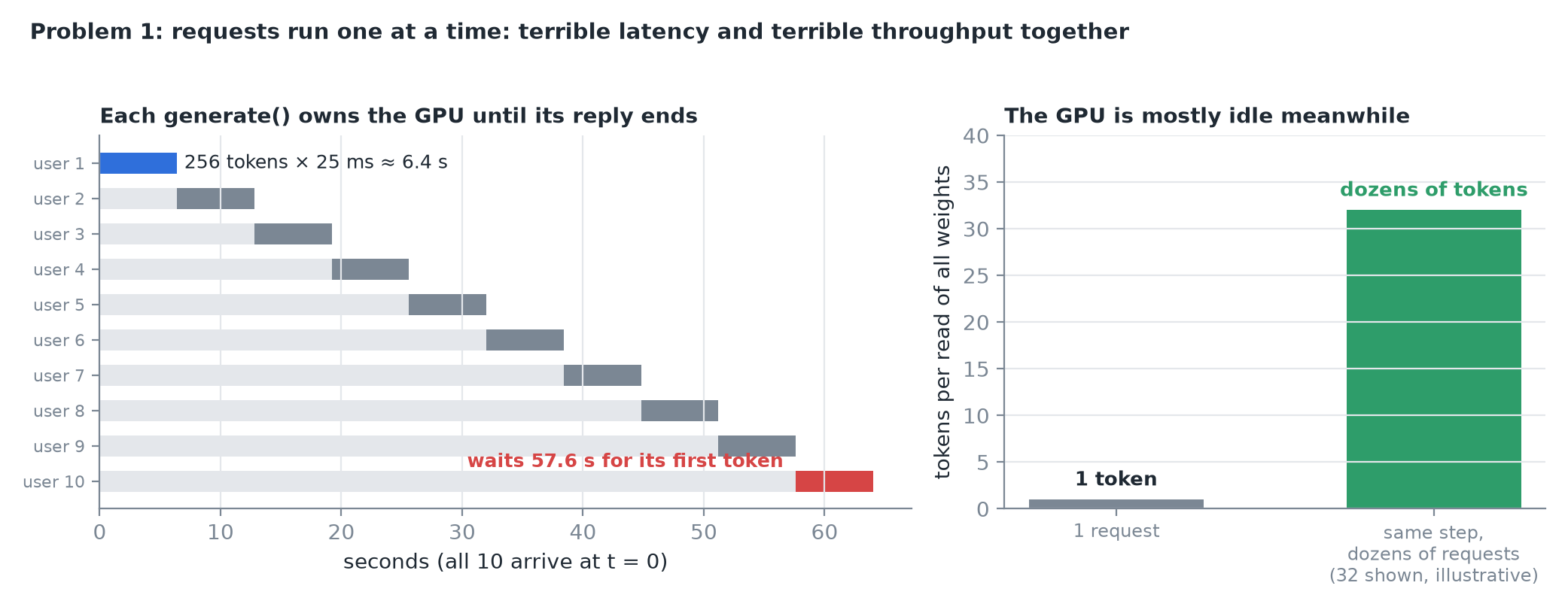 Each call to generate owns the GPU until its reply is finished, and every decode step reads all the weights to make a single token.
- The second user waits 6.4 s before their first token; the tenth waits almost a minute.
- Meanwhile the GPU is mostly idle: the same step could have served dozens of requests for nearly the same cost.
- So the naive server gives terrible latency and terrible throughput at the same time.
3. Problem 2: static batches
The obvious fix is batching: collect a few requests and run them together. But plain batching is static: the batch is formed once and runs until every request in it is done.
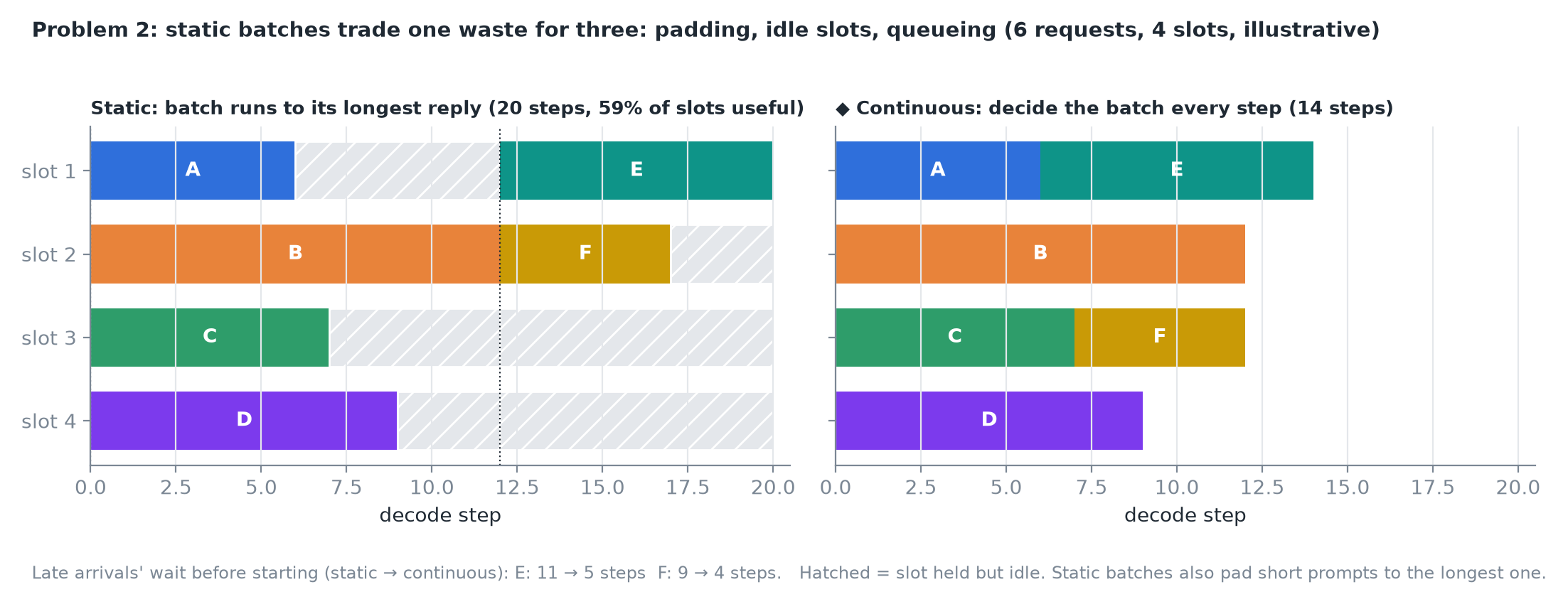 ◆ The same six requests on four slots: the static batch holds finished slots idle until its longest reply ends, and requests E and F wait for the whole batch.
| Waste | Why |
|---|---|
| Padding | Prompts differ in length, so short ones are padded to the longest; that padding is computed and thrown away |
| Idle slots | A request that finishes early keeps its slot, doing nothing, until the longest reply ends |
| Queueing | A request arriving one second after the batch started waits for the entire batch |
IMPORTANT
The engine decides the batch at every step: finished requests leave immediately and new ones join at the next step. That's continuous batching.
4. Problem 3: wasted memory
A plain implementation stores each request's KV cache as one contiguous tensor, and since the final length is unknown, it reserves room for the maximum length up front.
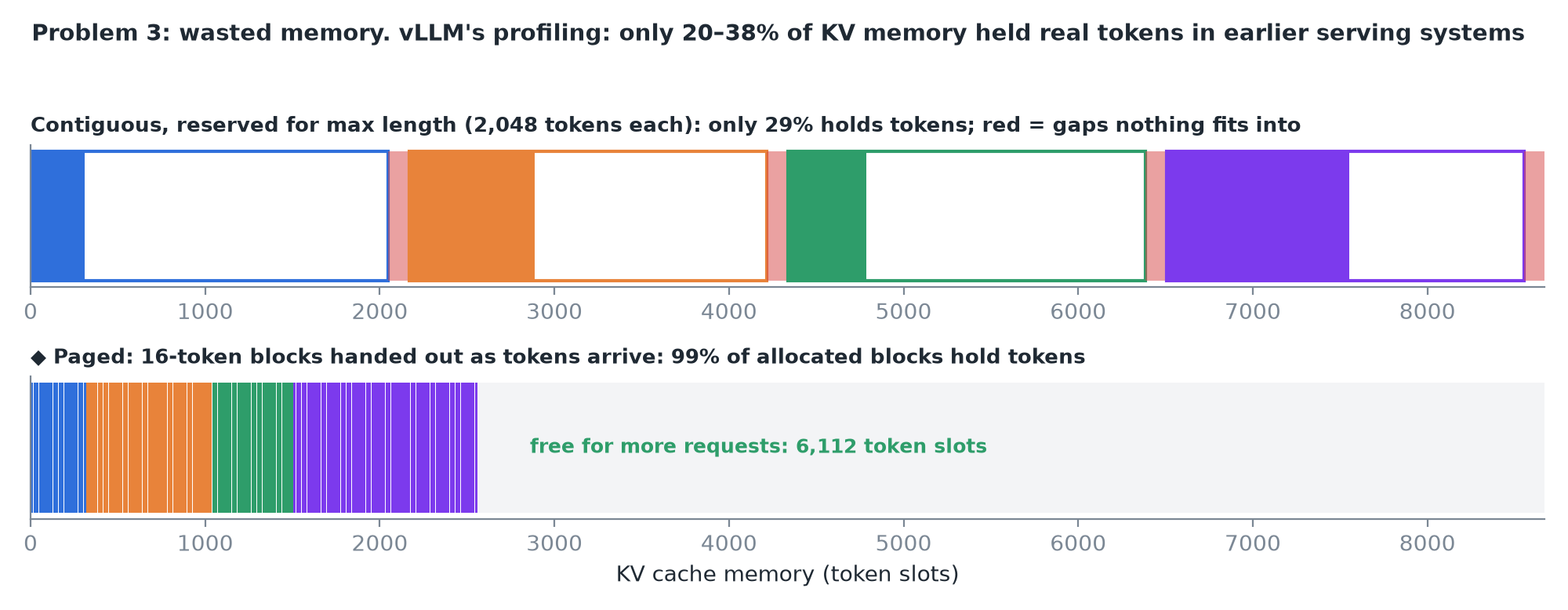 Most replies end long before the maximum, so most of the reservation is never used, and variable-sized reservations leave gaps nothing can fit into. ◆ Paged blocks waste at most part of one block per request.
- When the vLLM team profiled earlier serving systems, only 20–38% of KV cache memory held token data (vLLM paper, SOSP 2023).
- Wasted cache → fewer requests fit → smaller batches → lower throughput.
- The engine stores the cache in small fixed-size blocks, handed out only as tokens arrive. That's paged attention.
5. Problem 4: CPU overhead
A decode step on the GPU might take only a few milliseconds. In a plain Python loop, every step also runs sampling, stop checks and detokenization in Python, and launches hundreds of small GPU kernels one at a time.
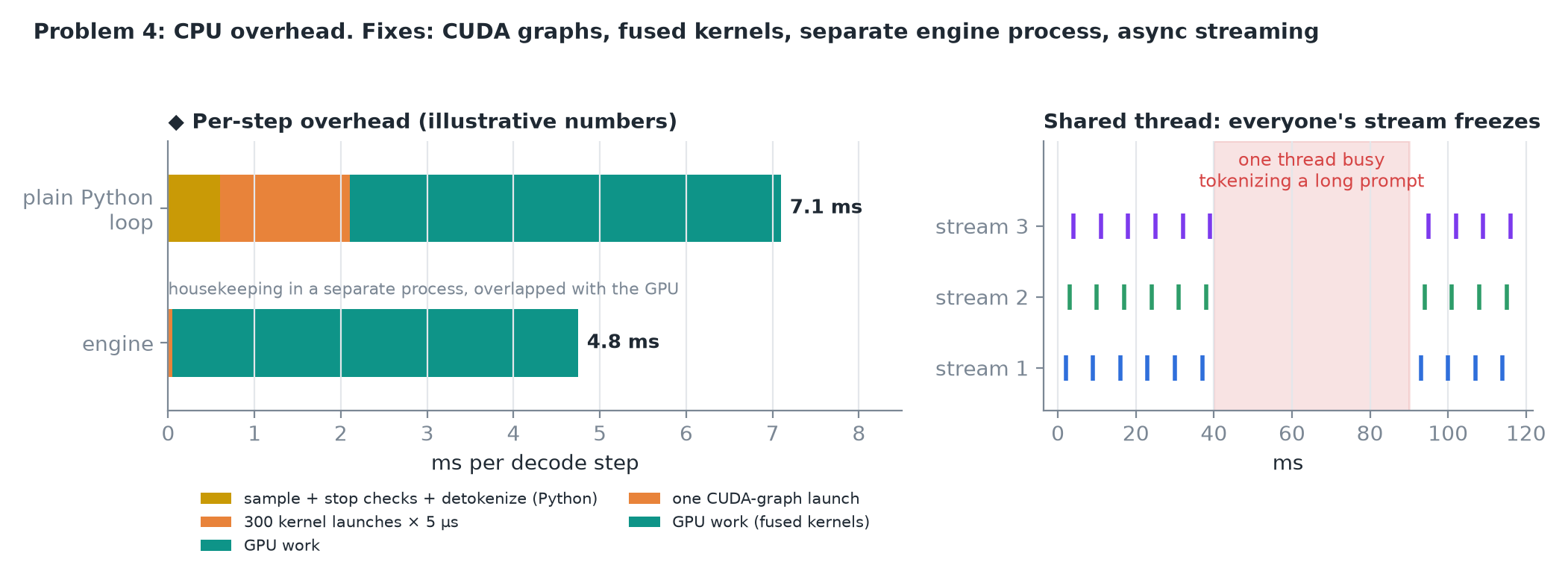 Each launch costs a few microseconds of CPU time; across hundreds of kernels that becomes a real slice of every step. If tokenization, HTTP handling and generation share one thread, tokenizing a long prompt blocks everyone's stream.
Engines attack it from several sides:
- CUDA graphs: capture a whole step and replay it with one launch.
- Fused kernels: fewer, bigger kernels.
- A separate engine process: the scheduler and GPU work run apart from HTTP and tokenization.
- Async streaming: tokens go out without blocking the loop.
6. What an engine changes
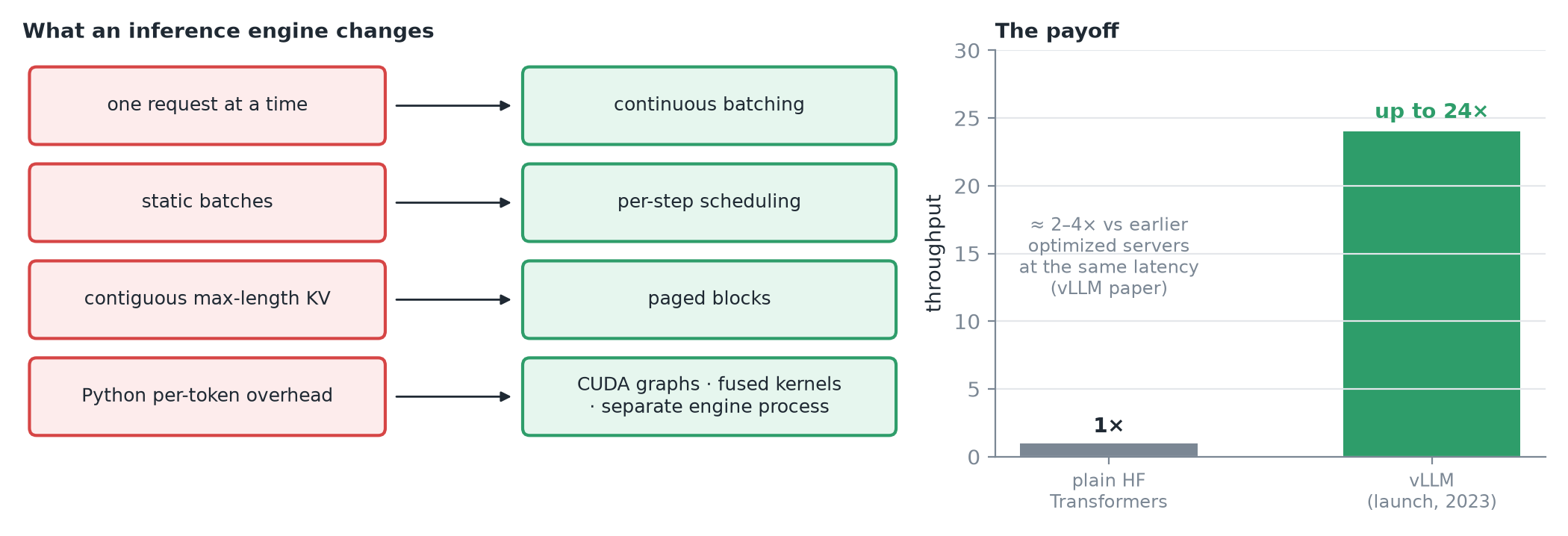 When vLLM launched (2023), its authors reported up to 24× the throughput of plain Hugging Face Transformers serving, and about 2–4× versus earlier optimized servers at the same latency.
7. Recap