46 · Find Repeated Prefix Computation
Source: fanout.sh / inference-eng / 10-04 · ~7 min
NOTE
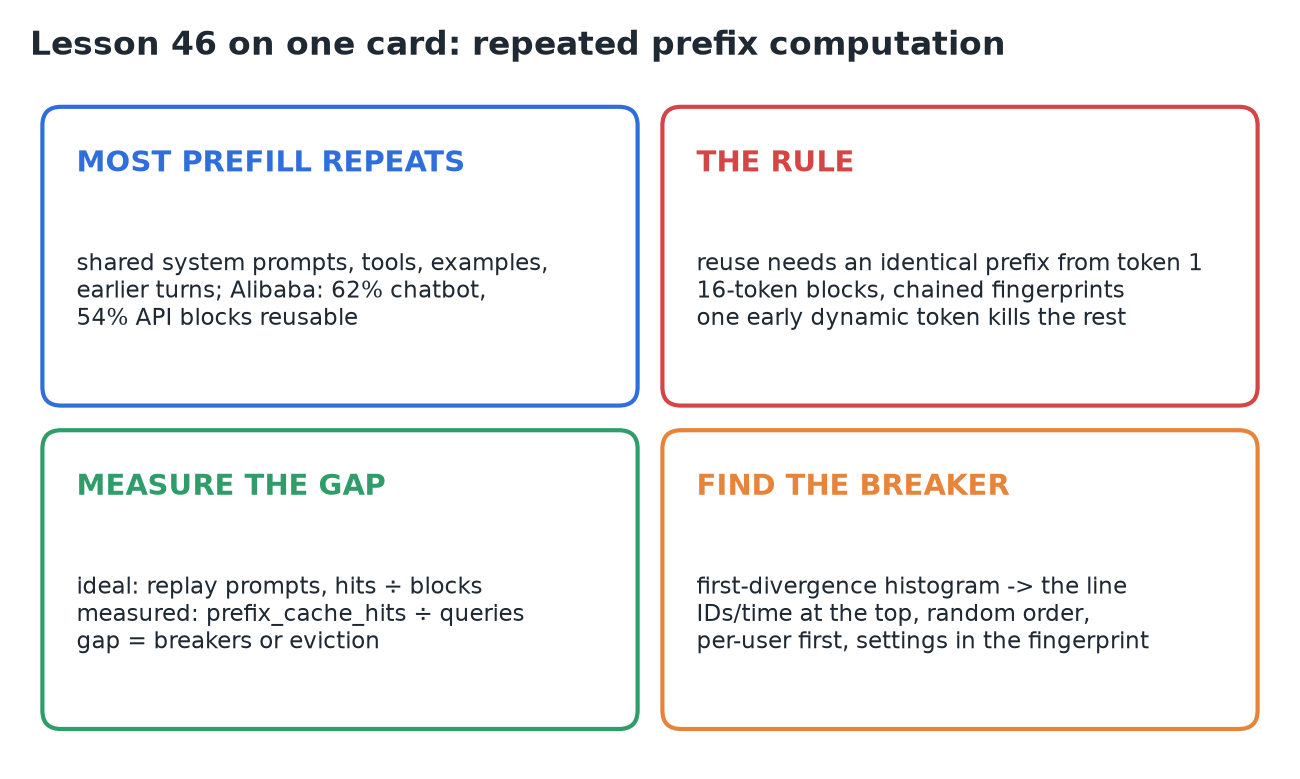
Most prefill in real traffic is repeated work: shared system prompts, tool definitions, examples and earlier turns (Alibaba's traces: 62% of chatbot blocks, 54% of API blocks reusable). But cached K/V can only be reused for an identical prefix from the very first token, checked in 16-token blocks with chained fingerprints, so 20 dynamic tokens near the top make 3,000 identical tokens behind them unreusable. Replay your prompts for the ideal hit rate, read the measured rate from vLLM's prefix_cache_hits ÷ prefix_cache_queries, and explain the gap; a first-divergence histogram points at the exact line that breaks the prefix. Our assistant: 1% → 78% by moving one line, cutting prefill 105 → 13 ms per request.
1. The same prefill, thousands of times an hour
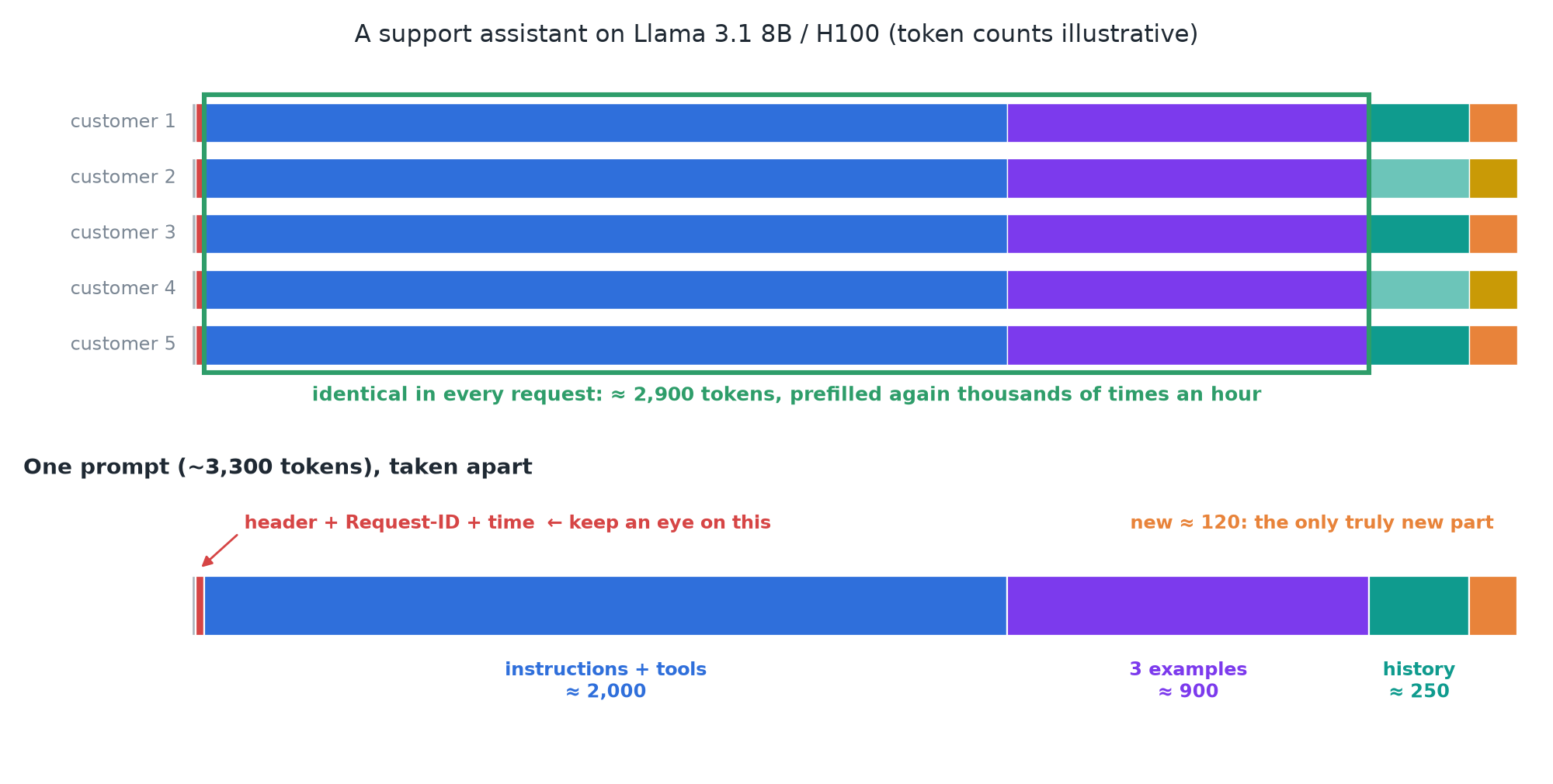 Five customers' prompts share ≈ 2,900 tokens; only the last ~120 are truly new.
- A support assistant on an H100: every request sends ~3,300 prompt tokens, and the GPU prefills all of them.
- Taken apart: the chat template's header, instructions + tool schemas ≈ 2,000, three worked examples ≈ 900, the conversation so far ≈ 250, then the new question ≈ 120.
- Everything above the new question has been sent before, by this user or by everyone.
- One more line near the very top: a request ID and the current time.
2. Real traffic looks like this too
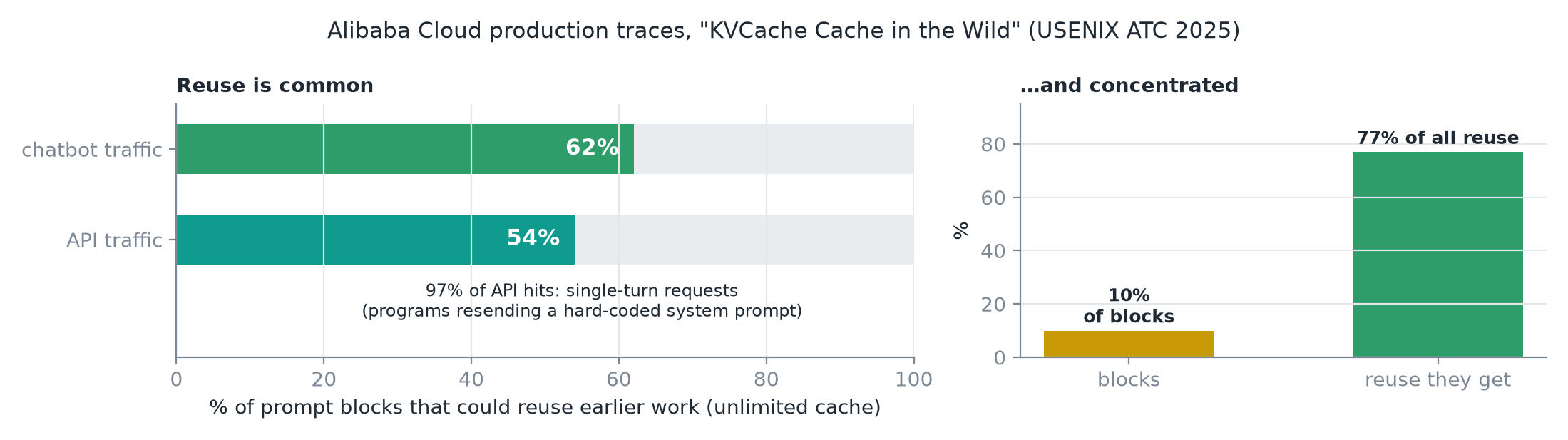 "KVCache Cache in the Wild", USENIX ATC 2025: production traces from Alibaba Cloud's LLM service.
- With unlimited memory, 62% of prompt blocks in chatbot traffic could reuse earlier work; 54% in API traffic.
- In API traffic, 97% of hits came from single-turn requests: programs sending the same hard-coded system prompt, often many times a second.
- Reuse is concentrated: 10% of blocks account for 77% of all reuse.
3. The strict rule: identical prefix, from token 1
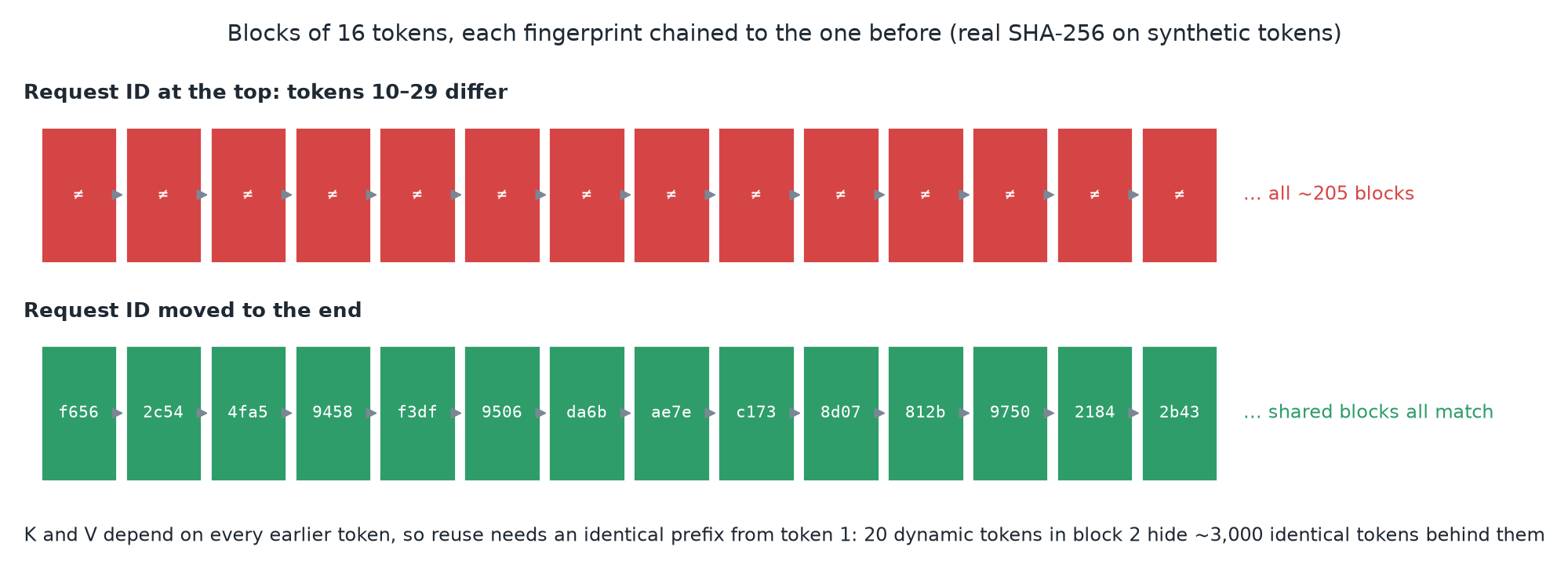 ◆ Real chained hashes on synthetic tokens; vLLM uses the same chaining idea.
- A token's K and V depend on every token before it, so cached work is only valid for an identical prefix from the very first token.
- vLLM checks this in blocks of 16 tokens, each block's fingerprint chained to the one before.
- The request ID differs every time, so block 2 differs, which makes block 3 differ, and every block after it. 20 dynamic tokens in the wrong place and ~3,000 identical tokens become impossible to reuse.
4. Measure what you're leaving on the table
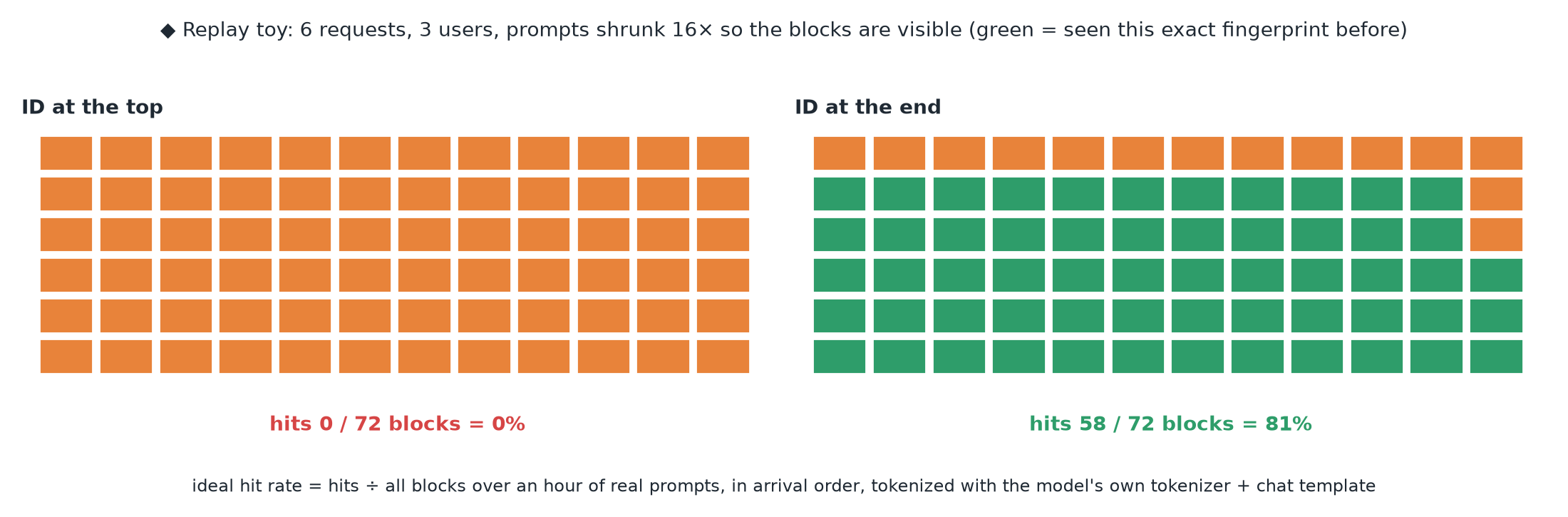 ◆ My toy replay: the same counting procedure on shrunken prompts.
Step 1, the ideal hit rate:
- Take an hour of real prompts in arrival order, tokenized with the model's own tokenizer and chat template.
- Cut each into 16-token blocks and fingerprint them the way the server does, chained.
- For each block, ask "have I seen this exact fingerprint before?" Ideal hit rate = hits ÷ all blocks: what an unlimited cache would get on your traffic.
- Our assistant, if the request ID weren't there: about 80%.
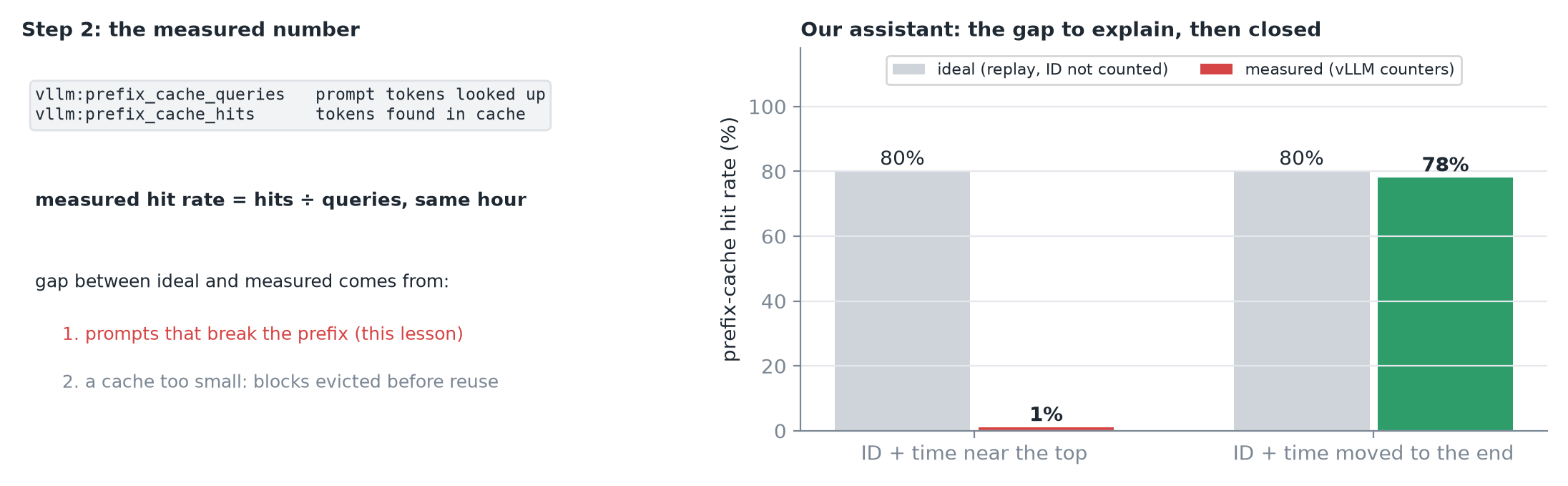 Lesson's numbers: 80% ideal vs 1% measured before the fix, 80% vs 78% after.
Step 2, the measured hit rate: vLLM exports vllm:prefix_cache_queries (prompt tokens looked up) and vllm:prefix_cache_hits (tokens found). Divide hits by queries over the same hour. Our assistant gets about 1%.
The gap has two sources: prompts that break the prefix (this lesson), or a cache too small, evicting blocks before they're reused.
WARNING
◆ The 80% is only "ideal" if you replay with the request ID left out. Replay the prompts exactly as sent, fingerprinted like the server, and the ID breaks them in the replay too: you'd get ≈ 1%, the same as measured. So read the two numbers this way:
- Ideal low (on prompts as sent): the prompts break the prefix. Find the line with the histogram below.
- Ideal high but measured low: eviction, or a setting the replay didn't copy.
5. Find where prompts break
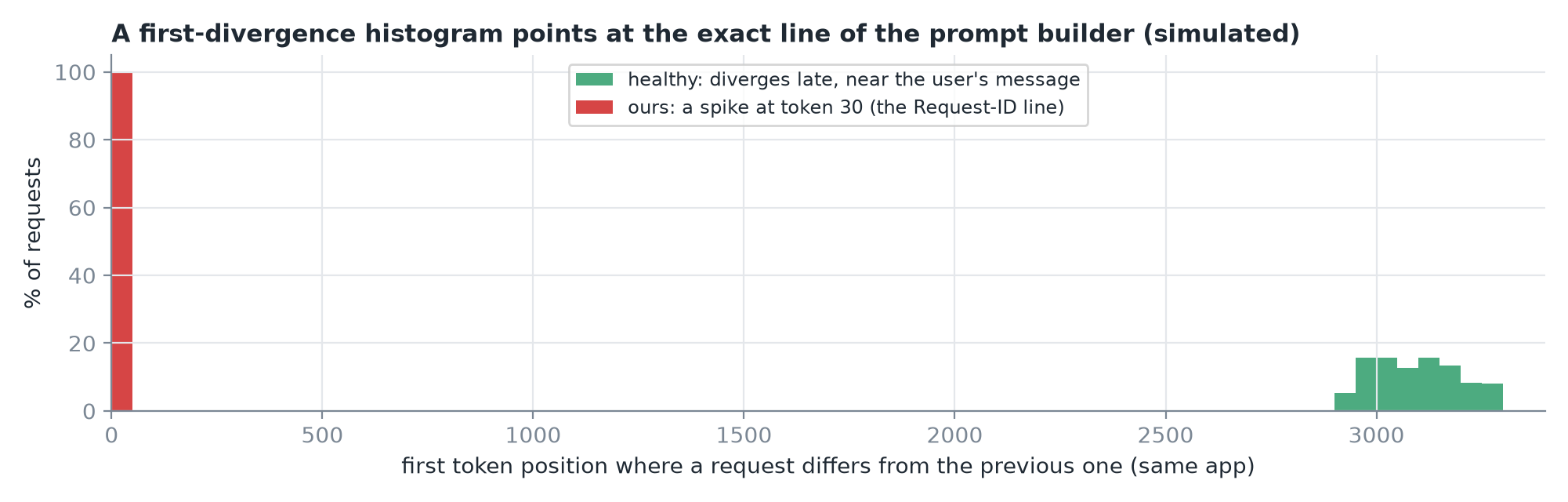 Simulated distributions; the lesson's is illustrative too.
- Compare each request with the previous one from the same app and record the first token position where they differ. Plot the histogram.
- Healthy traffic diverges late, near the user's message, a few thousand tokens in.
- Our assistant has a tall spike at position 30: the request ID. The spike tells you which line of your prompt builder to look at.
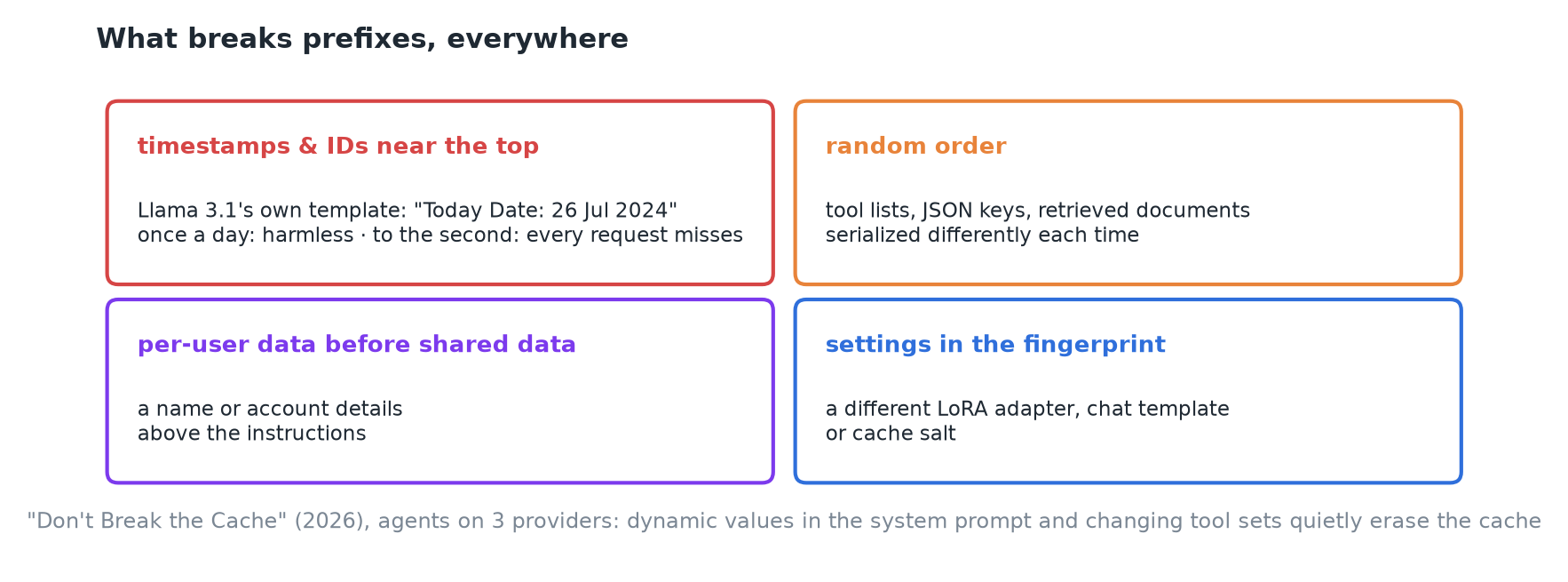 The same handful of things break prefixes everywhere.
- Even Llama 3.1's own chat template puts today's date in its header: harmless once a day, disastrous with seconds.
- A study of prompt caching in agents ("Don't Break the Cache", 2026) found the same: dynamic values in the system prompt and changing tool sets quietly erase the cache.
6. Size the prize
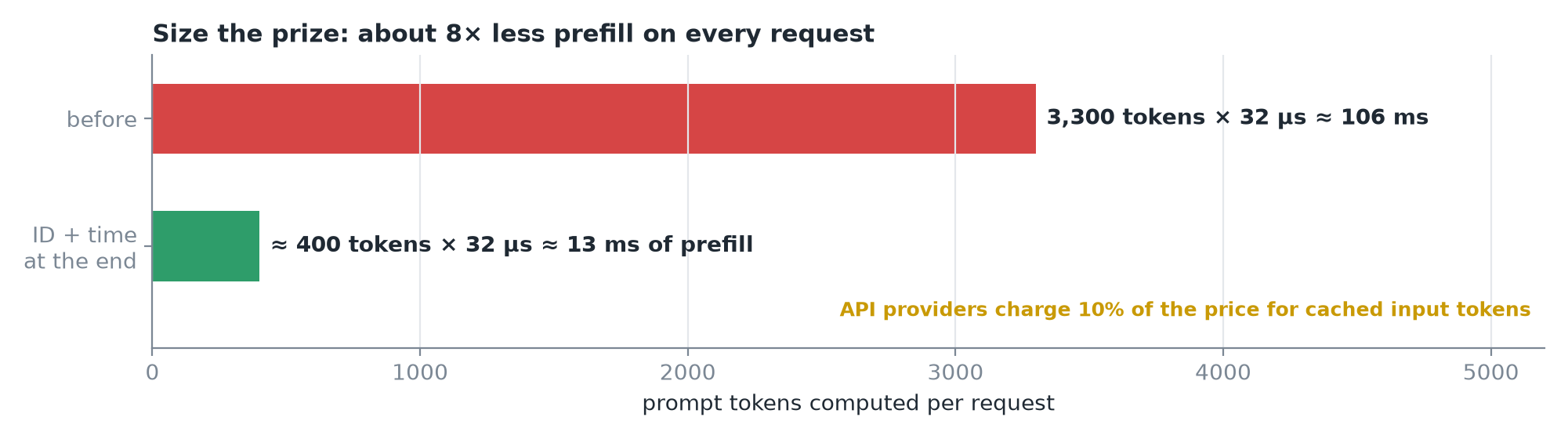 Move the request ID and time to the end of the prompt; ideal and measured come together (80% and 78%).
- Each request now computes about 400 new tokens instead of 3,300: ≈ 105 → 13 ms of prefill, on every request.
- API providers charge a tenth of the price for cached input tokens. That's how real the saving is.
TIP
◆ 32 µs per prompt token is about 2× the 16 µs that 16 GFLOP takes at H100 peak, which means roughly 50% of peak FLOPs in practice.
7. Recap