05 · Dot Products, Softmax & Attention Math
Source: fanout.sh / inference-eng / 00-03 · ~11 min
NOTE
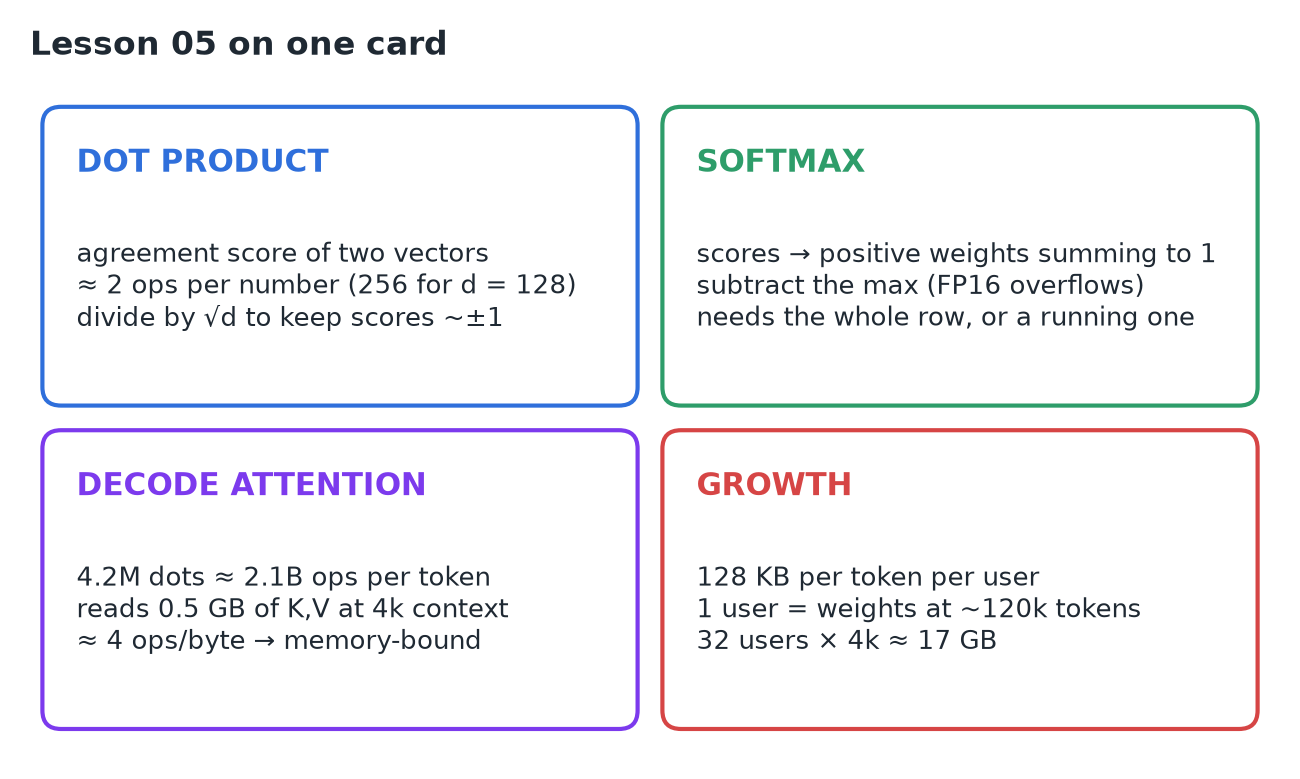
To write one new token at 4,096 tokens of context, Llama 3 8B's attention does about 4.2 million dot products (~2.1B operations) but must read about 0.5 GB of stored keys and values. That's ~4 operations per byte, far below the ~300 an H100 needs, so decode attention is memory-bound. The K/V data grows with every token and every user until it outweighs the model. Softmax needs the whole row, which is why fast kernels use a running (online) softmax.
1. The dot product: an agreement score
Multiply two equal-length lists pair by pair, then add:
- In attention each list has 128 numbers: 128 multiplies + ~128 adds ≈ 256 operations.
- The result says how much two vectors point the same way:
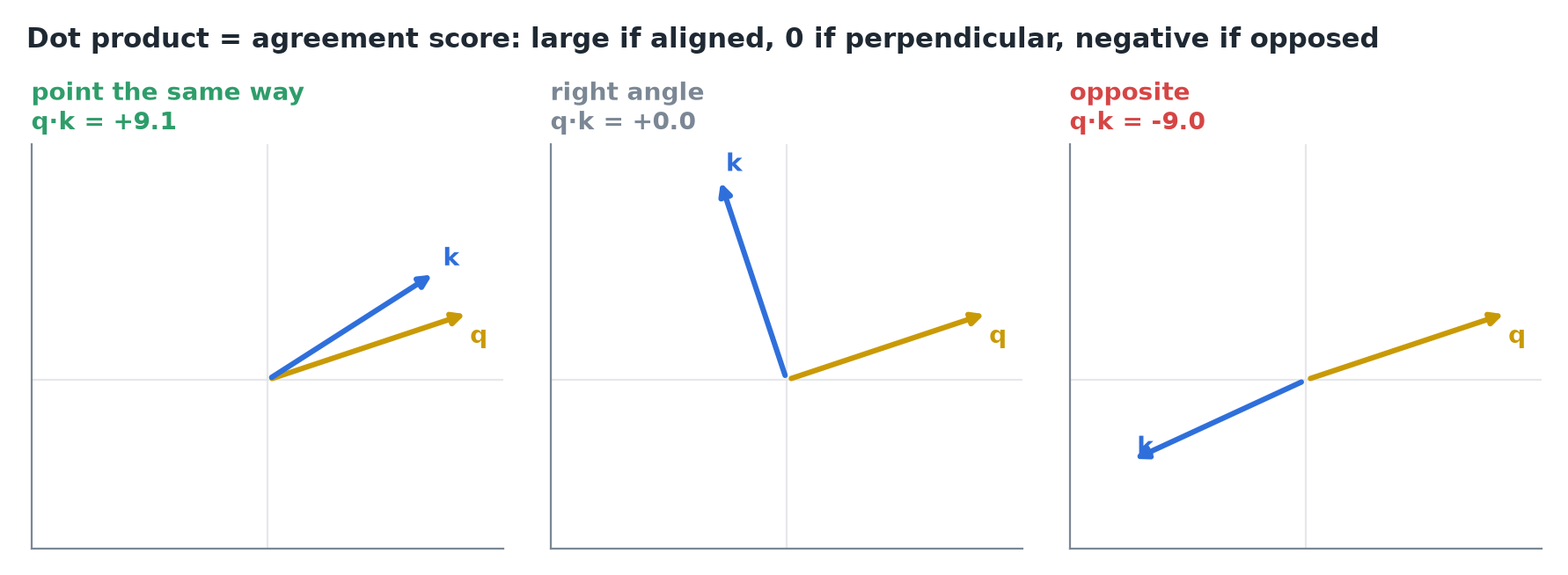 Aligned vectors give a large positive score, perpendicular ones zero, opposed ones negative.
- Attention uses it as a relevance score: the current token's query asks, each past token's key answers, and q·k says how well they match.
Why divide by √128
If query and key entries are random with mean 0 and variance 1, their dot product has variance = length (footnote in Attention Is All You Need). For 128 numbers, scores spread to about ±11, and softmax then puts nearly all weight on one token: attention stops blending and just picks.
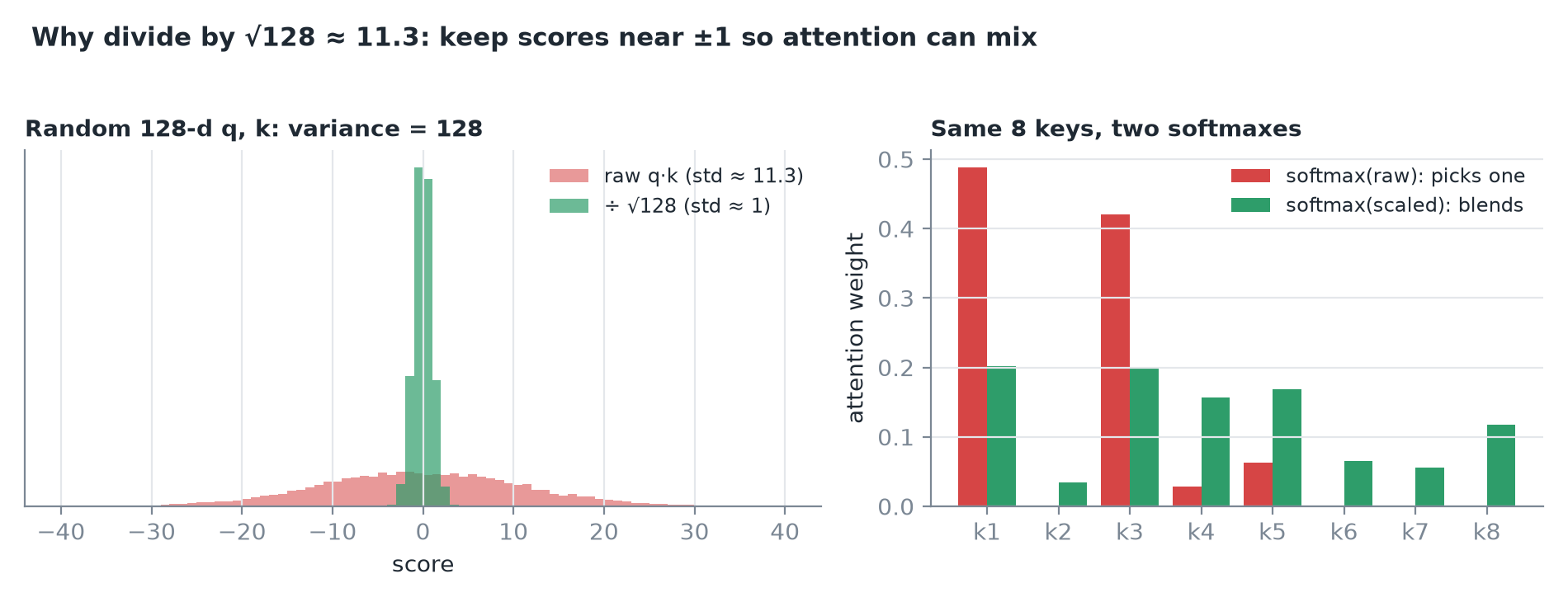 Simulated: raw scores spread ±11 and softmax picks a winner; dividing by √128 ≈ 11.3 brings them to ±1 and the weights blend.
TIP
For inference the scaling is nearly free: one multiply per score, and fast kernels fold it into work they already do.
2. Softmax: scores into weights
Softmax makes scores positive and summing to 1: raise e to each score, divide by the total.
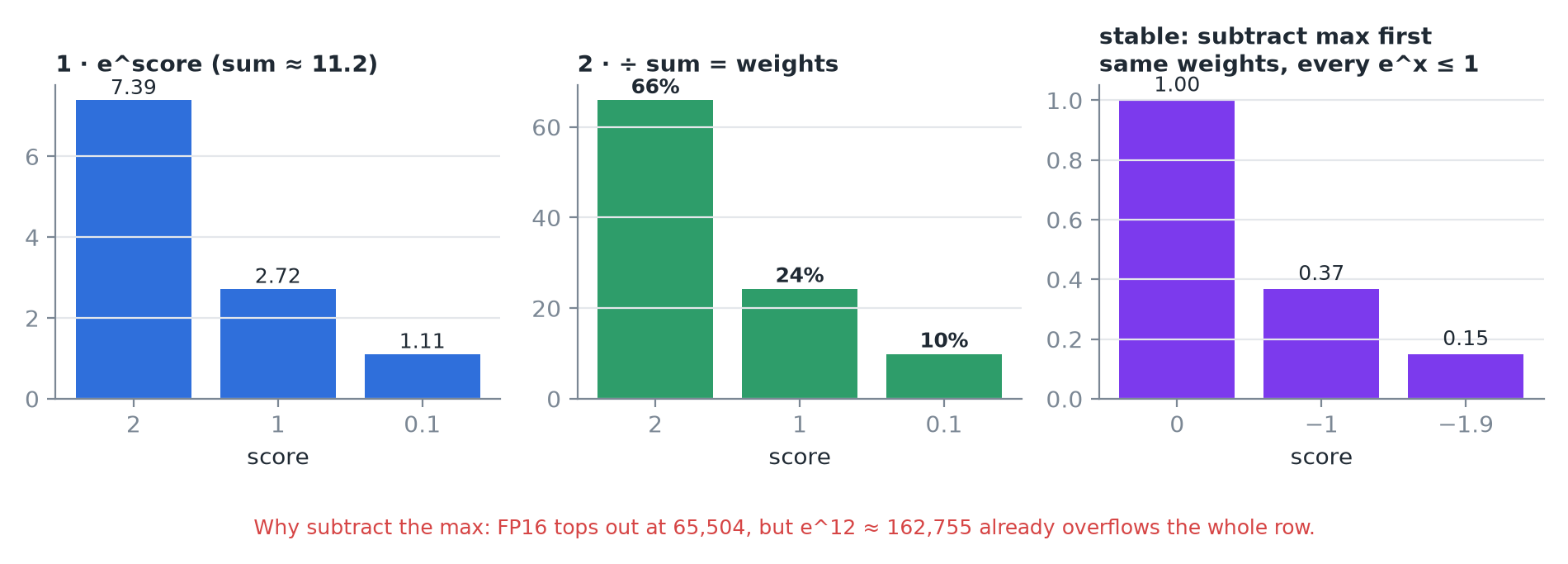 Scores 2, 1, 0.1 → e^x ≈ 7.39, 2.72, 1.11 (sum ≈ 11.2) → 66%, 24%, 10%. The biggest score wins most, but nothing gets zero.
- Overflow trap: FP16's largest value is 65,504, but e¹² ≈ 162,755. One large score turns the whole row into garbage.
- Fix: subtract the row's maximum first (2, 1, 0.1 → 0, −1, −1.9). Same weights, and every exponent is ≤ 1.
IMPORTANT
Softmax needs the max and the sum over the entire row before any weight is final. This shapes how every fast attention kernel is built (section 6).
3. One head, one new token
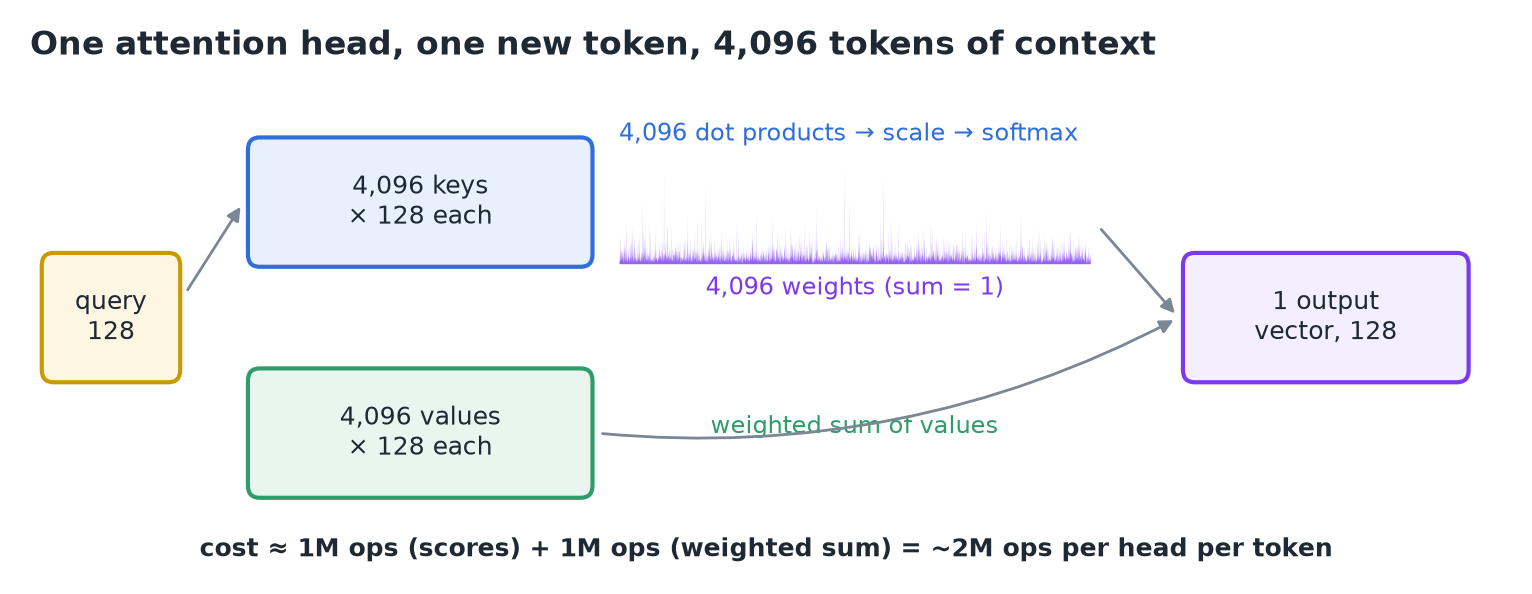 Query · 4,096 keys → scale → softmax → weighted sum of 4,096 values → one 128-number summary of the conversation, as seen from the new token.
Work: ~1M ops for the scores + ~1M ops for the weighted sum = ~2M ops per head.
4. The bill for one token: ops vs bytes
Scale to the whole model: 32 layers × 32 query heads × 4,096 = 4,194,304 dot products ≈ 2.1B operations. The weight matrices cost ~15B ops per token, so at this context attention's arithmetic is only ~1/8.
Where 2.1B comes from: two equal halves, the scores and the weighted sum of values (scaling and softmax add only a few million).
Where ~15B comes from: each weight does one multiply and one add per token, so ~2 ops per parameter. The ~0.5B-parameter input embedding table (128,256 vocab × 4,096) is a lookup, not a matmul, so ~7.5B parameters do work:
Now count bytes. Llama 3 uses grouped-query attention (GQA): the 32 query heads share just 8 sets of keys and values.
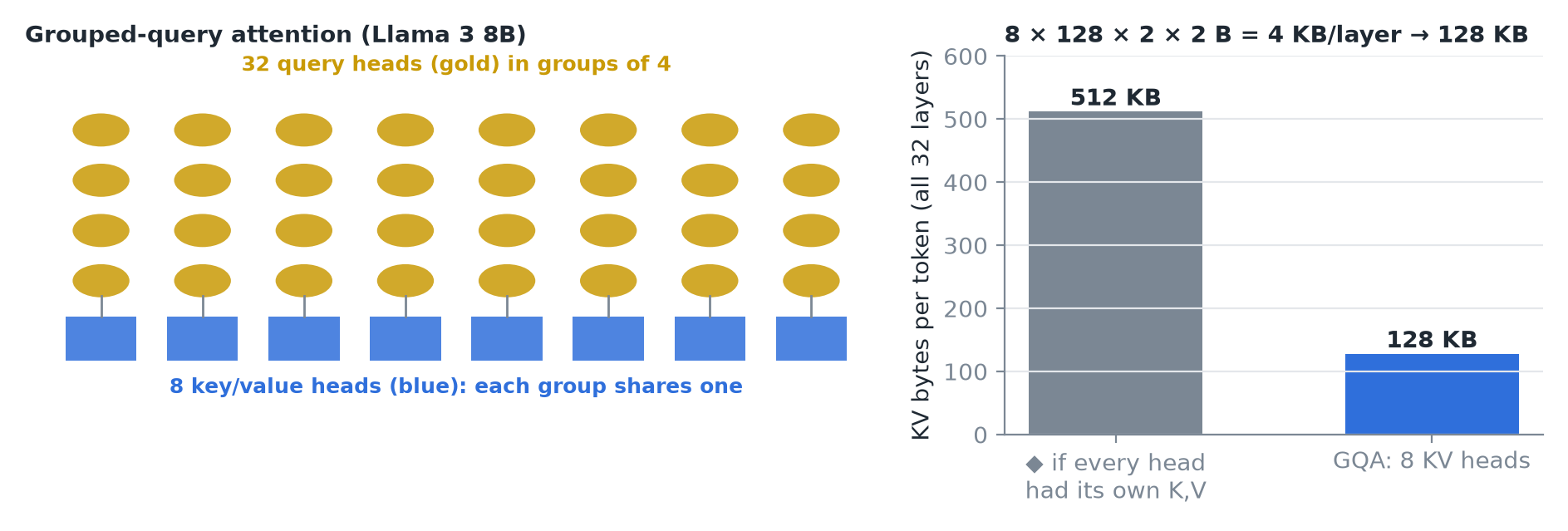 Four query heads share each K/V head, so each layer stores 8 keys + 8 values per token.
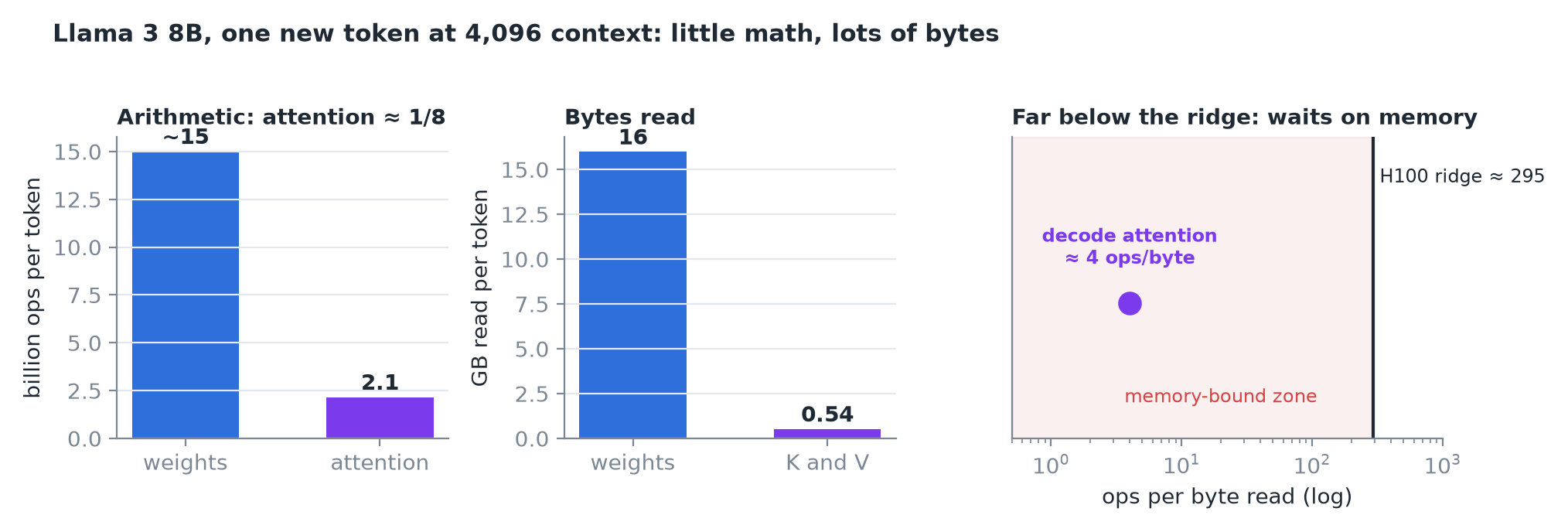 2.1B ops over ~0.54B bytes ≈ 4 ops/byte; an H100 needs ~295 (989 TFLOPS ÷ 3.35 TB/s) to keep its math units busy.
IMPORTANT
Four is nowhere near 300: decode attention spends almost all its time waiting on memory.
5. The memory bill grows
- Weights: a fixed 16 GB, read once per step however long the conversation.
- Keys and values: +128 KB per token, per user.
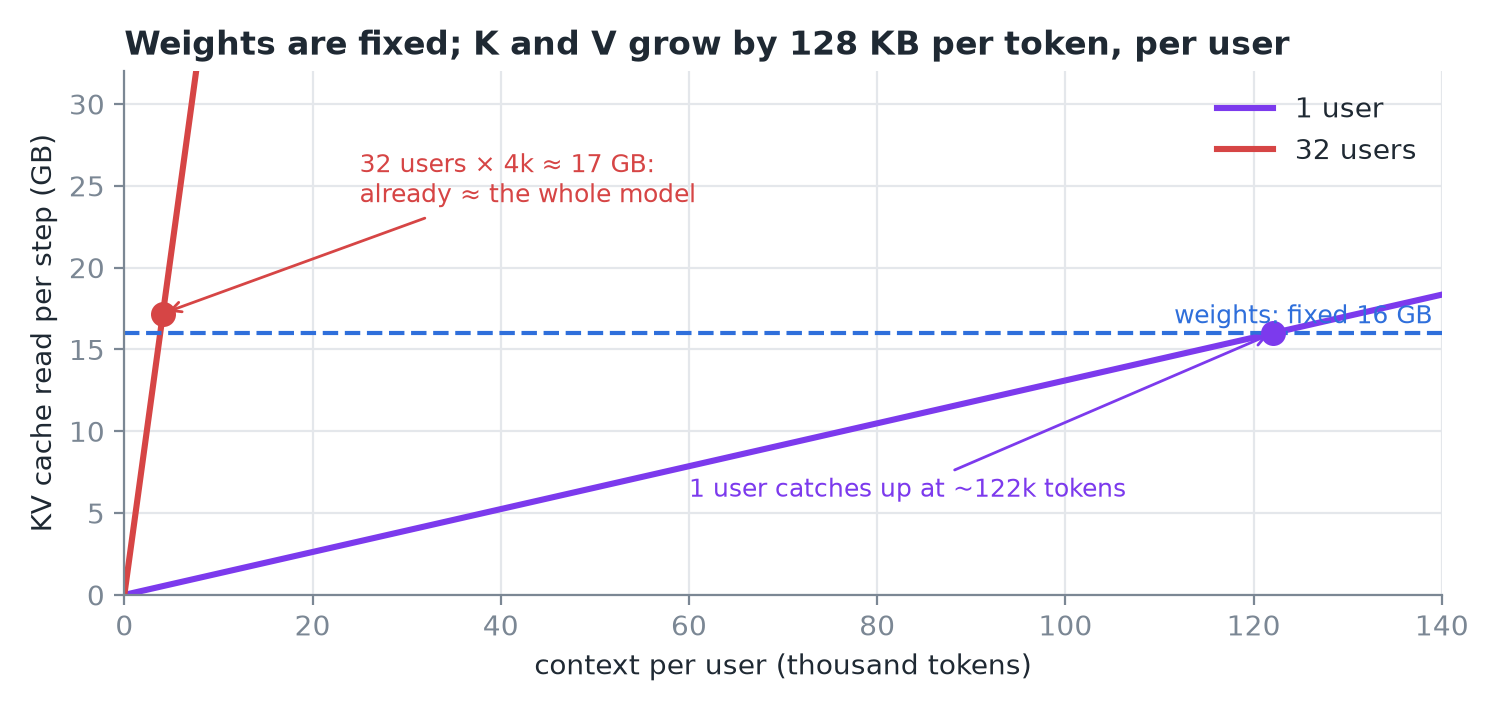 One user's K/V catches the weights at ~120k tokens; 32 users at 4k tokens each already hold ~17 GB.
Prefill has a different problem: every prompt token is a query at once, so the scores form an n × n square.
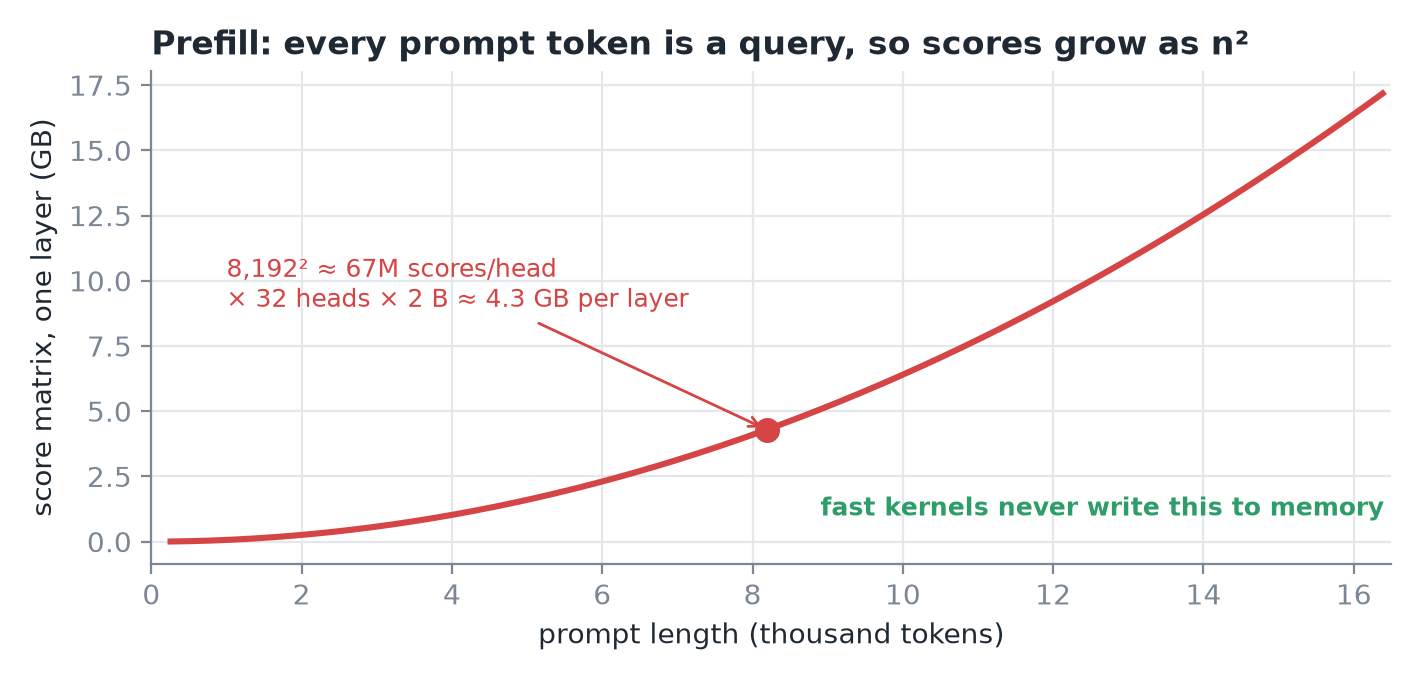 An 8,192-token prompt: ~67M scores per head; × 32 heads × 2 bytes ≈ 4.3 GB of scratch per layer.
6. Online softmax: never write the square
Fast attention kernels walk the keys in blocks and keep a running max and running sum. When a new block raises the max, rescale the old sum by e^(old max − new max), then add the new terms.
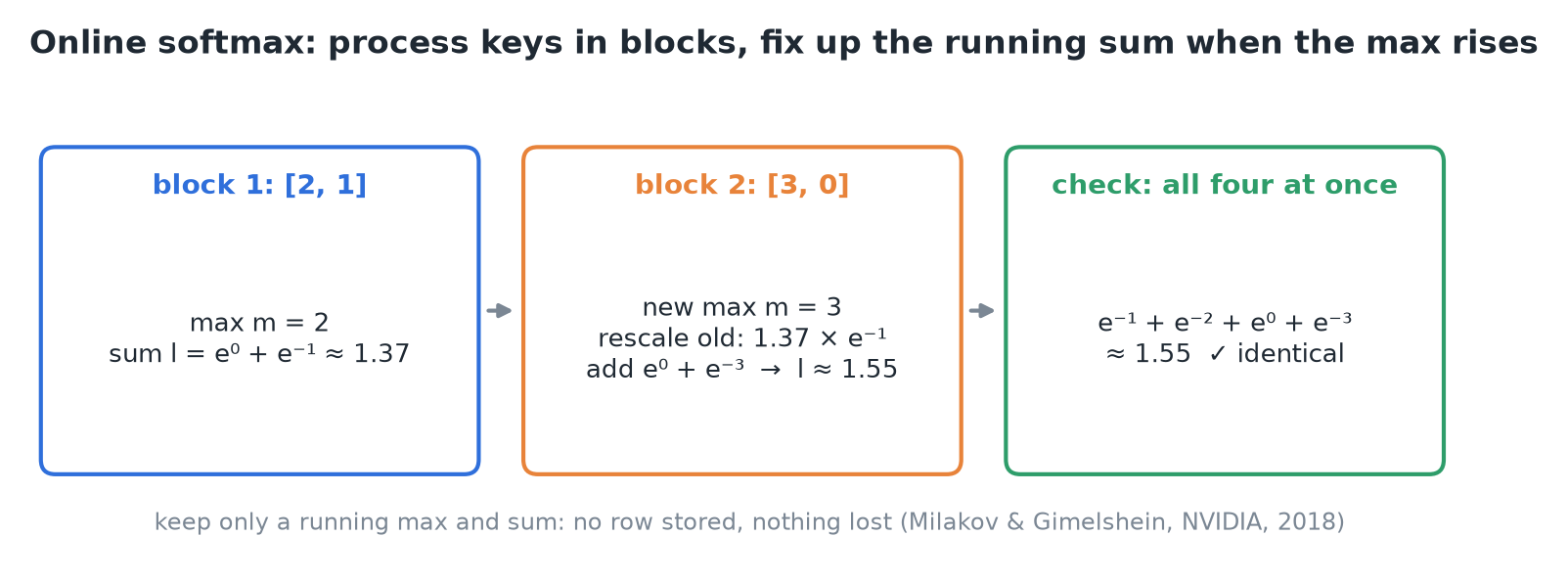 Blocks [2, 1] then [3, 0] give a running sum of ~1.55, exactly the full-row result. Nothing stored, nothing lost.
This is the online softmax (two NVIDIA engineers, 2018), the foundation of FlashAttention; the attention module builds on it.
7. Two misconceptions
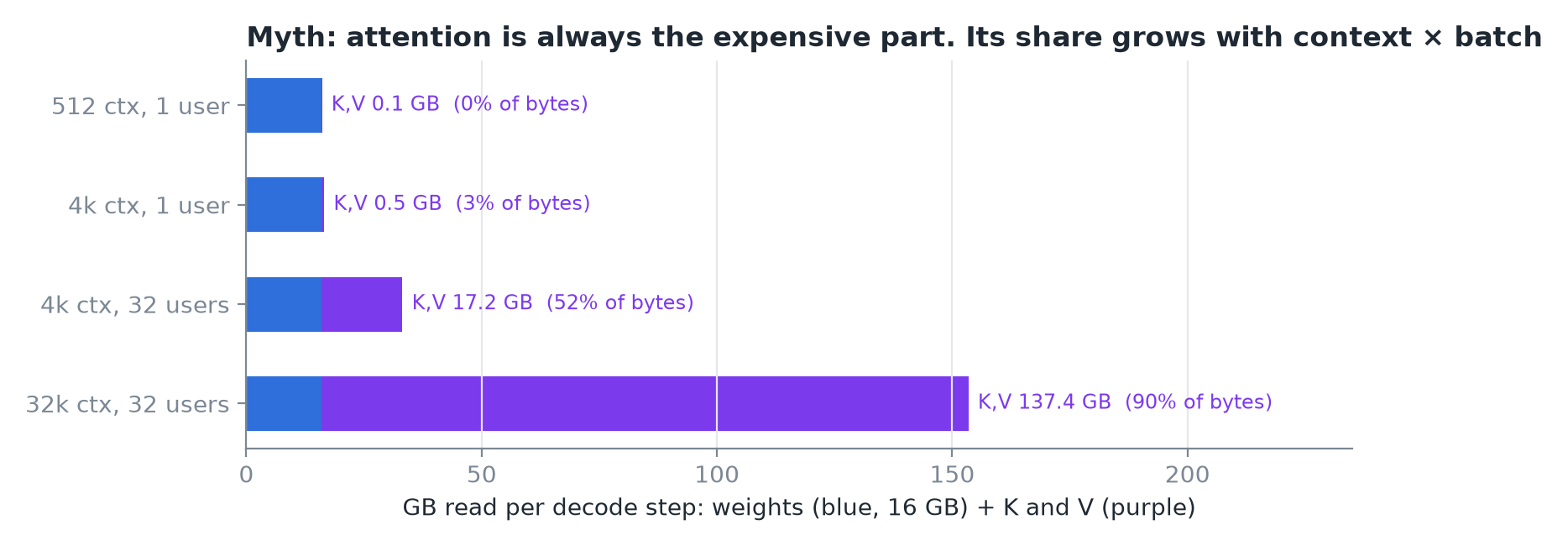 At short context and small batch the weights dominate the bytes; attention's share grows with context × batch, mostly through memory.
WARNING
- "Attention is always the expensive part": not at short contexts and small batches.
- "Softmax is cheap, so it doesn't matter": the arithmetic is cheap, but needing the whole row shapes every fast kernel.
8. Recap