45 · Chunked Prefill & Choosing the Chunk Size
Source: fanout.sh / inference-eng / 10-02 · ~5.5 min
NOTE
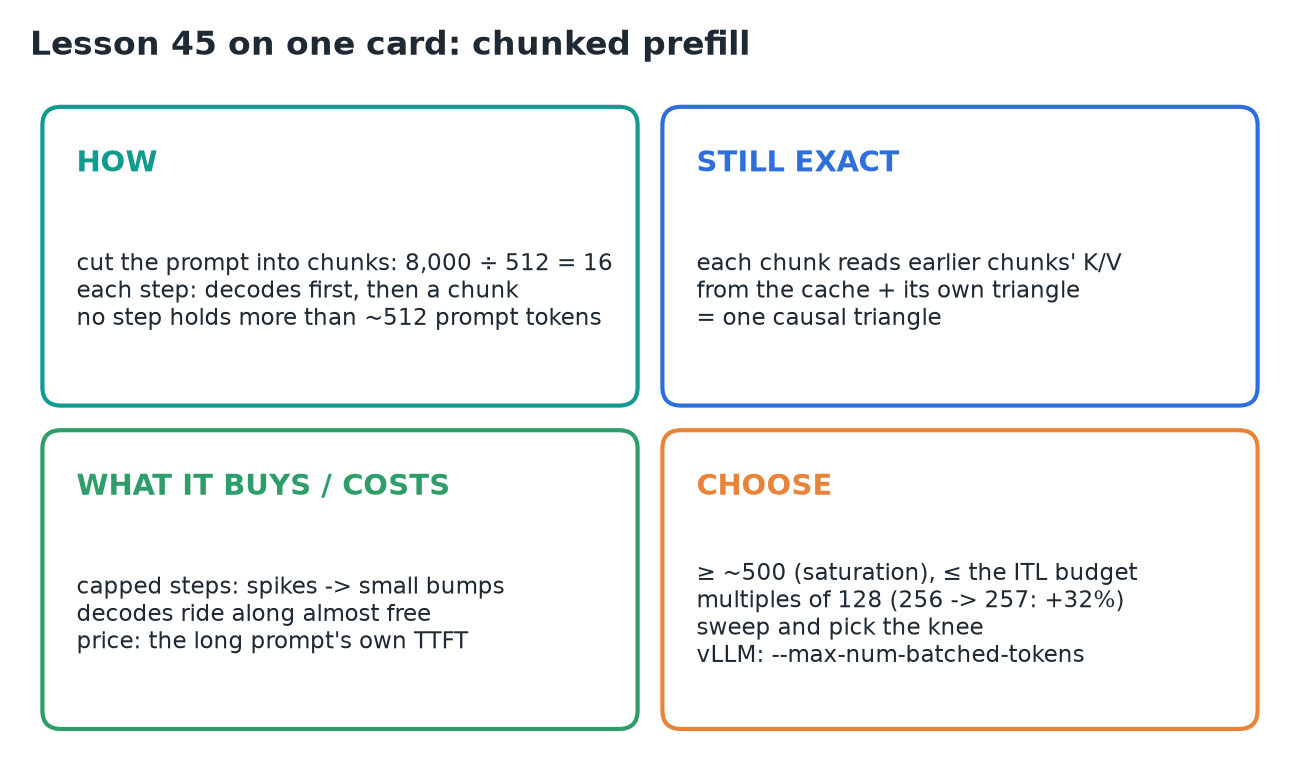
Don't process a long prompt in one step: cut it into chunks and spread them over several steps, with every running request's decode token scheduled first. An 8,000-token prompt in chunks of 512 takes 16 steps, and no step holds more than ~512 prompt tokens. The chunked attention mask makes it exactly equivalent to one big prefill. Steps are capped, so ITL spikes collapse to small bumps, and decodes ride along almost free; the price is the long prompt's own TTFT. Chunks that are too small waste the GPU (64 tokens ≈ 5× slower prefill), and chunks that are too big bring the spikes back: stay ≥ ~500, under your ITL budget, in multiples of 128, then sweep and pick the knee.
1. How it works
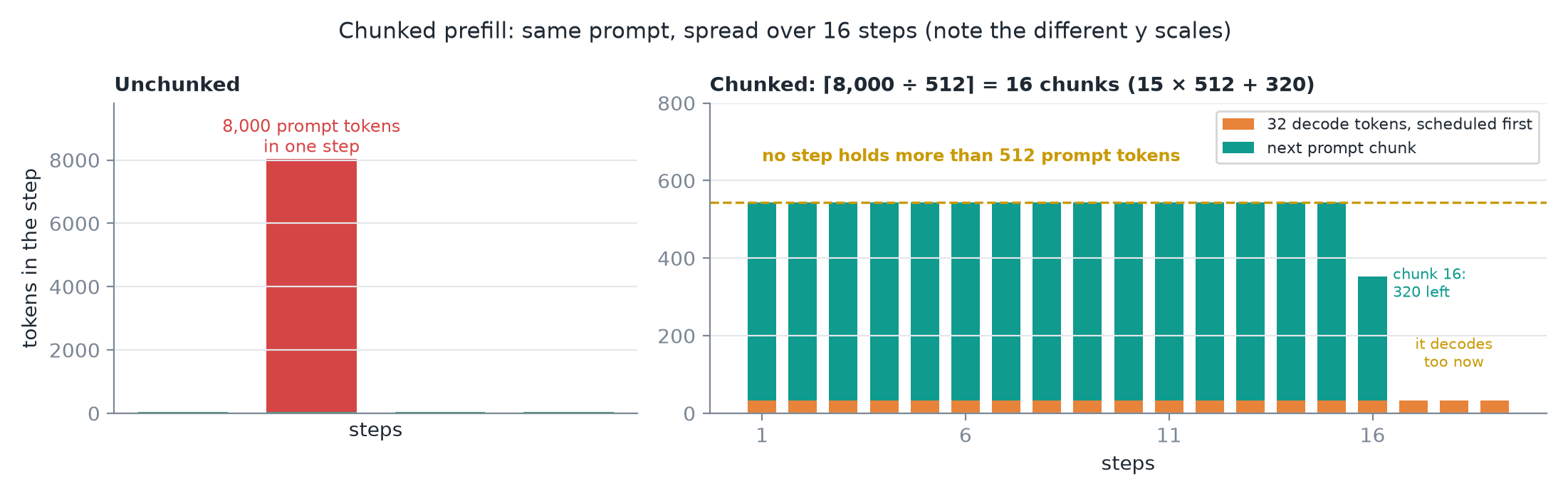 Tokens per step. The last chunk holds the remaining 320 tokens; then the prompt starts decoding like everyone else.
- Build every step the same way: first, every running request gets its one decode token; then top the step up with the next chunk of the long prompt.
- Sixteen steps later the prompt is fully processed. No step is ever long.
2. Why it stays exactly right
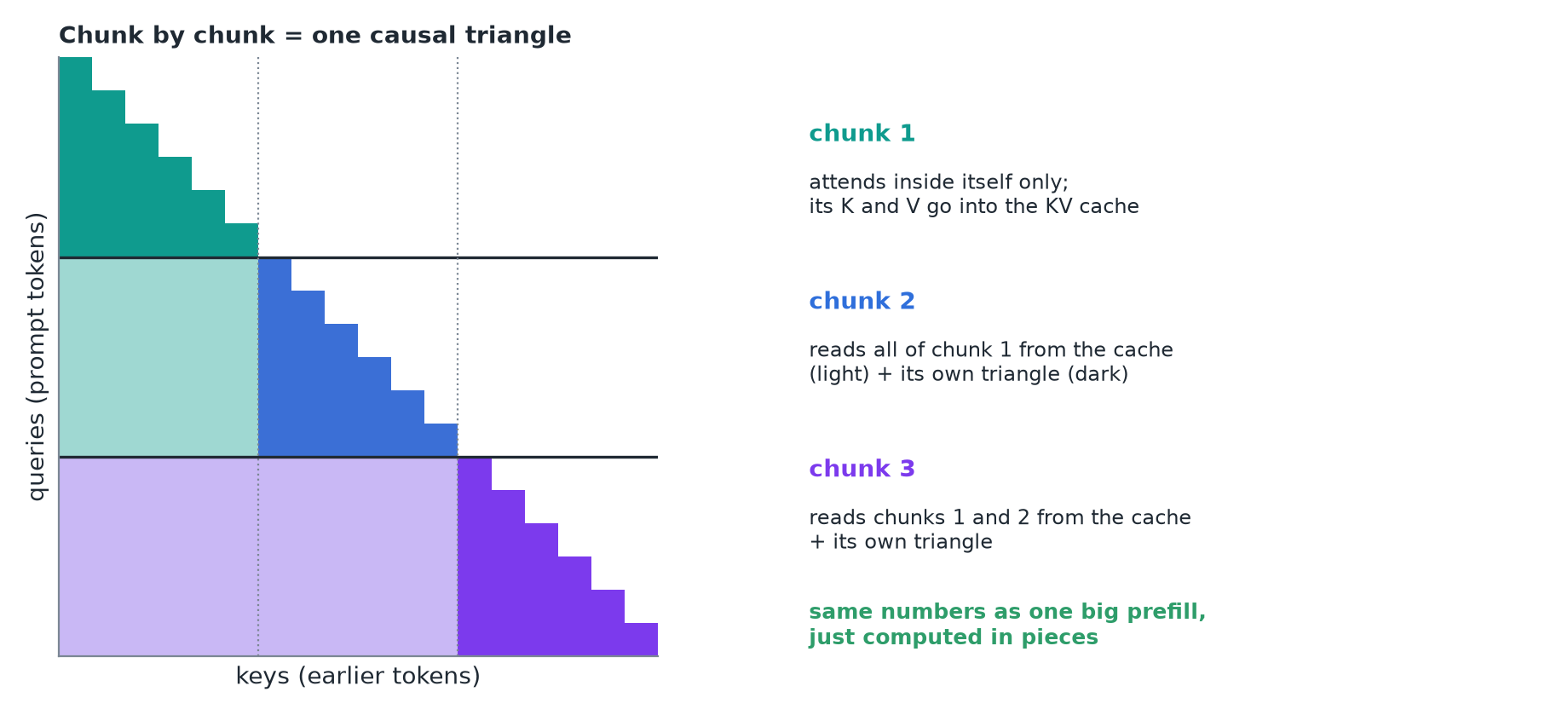 Three chunks of six tokens. Light cells are keys read back from the KV cache.
- Chunk 1's tokens attend to earlier tokens inside chunk 1; its K and V are then saved in the KV cache.
- Chunk 2 attends to all of chunk 1 (read from the cache) plus earlier tokens in chunk 2. Chunk 3 sees chunks 1 and 2, and so on.
- Put together, that's the same causal triangle as processing the prompt all at once: same numbers, computed in pieces.
3. What it buys, and what it costs
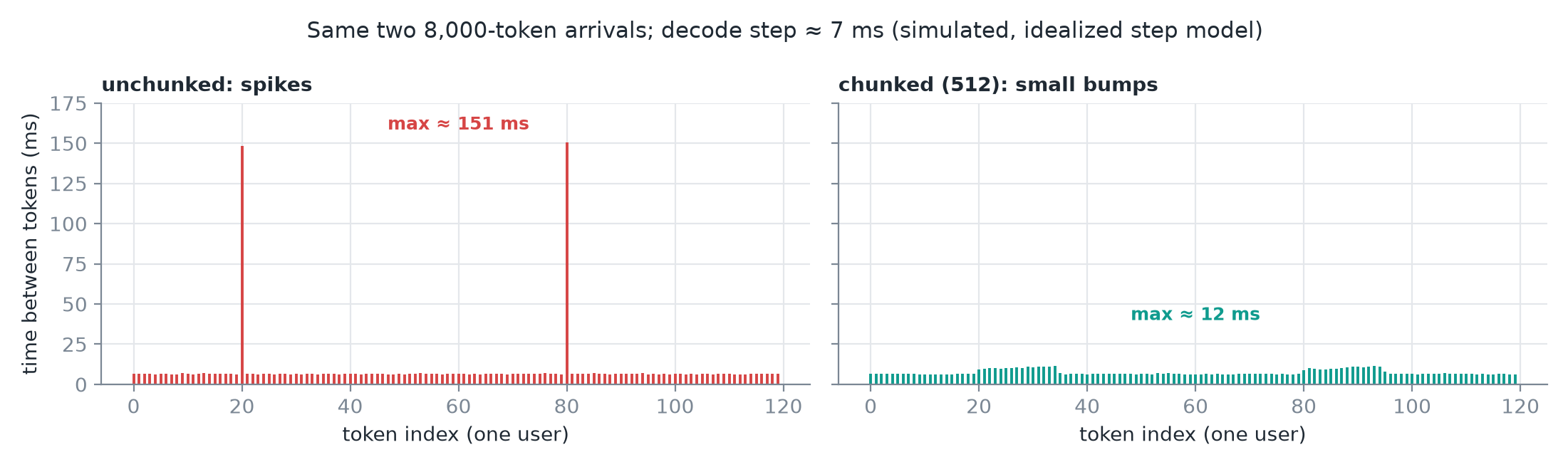 ◆ Simulated with an idealized step model (Llama 3.1 8B on H100, 32 decodes): spikes of ~150 ms become bumps of ~12 ms.
- Each step is capped, so the huge ITL spikes collapse to small bumps.
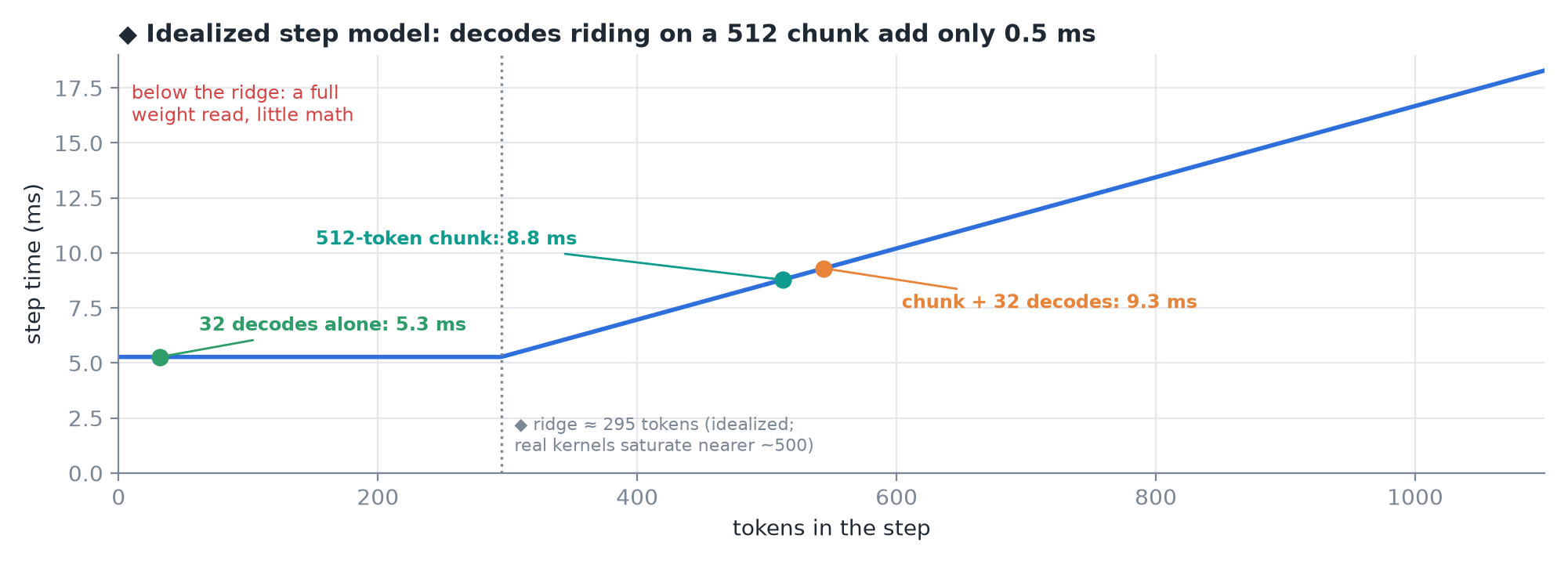 ◆ The same idealized model: step time is the slower of reading the weights or doing the math.
- Bonus: a ~500-token chunk already keeps the math units busy, so the decode tokens riding along cost almost nothing extra. They piggyback on work the GPU was doing anyway.
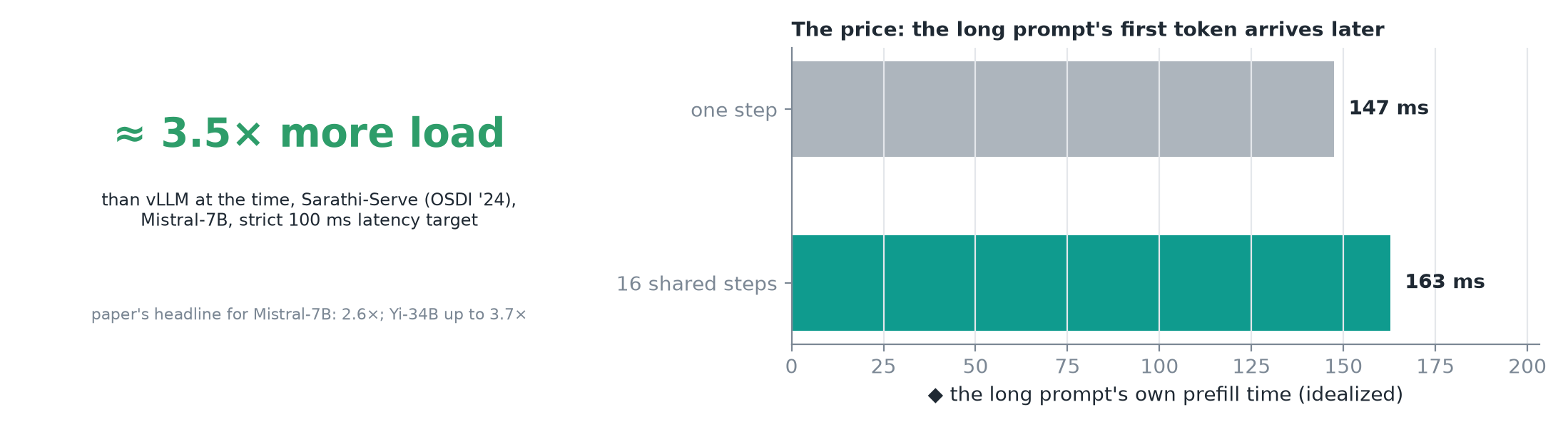 ◆ The prefill times are from the idealized model; the lesson only says "a bit later".
- Sarathi-Serve, which popularized this approach, served ≈ 3.5× more load than vLLM did at the time (Mistral-7B, strict 100 ms latency target). The paper's abstract gives 2.6× for Mistral-7B and up to 3.7× for Yi-34B; 3.5× is probably one workload's bar.
- The price is paid by the long prompt itself: its prefill is spread over 16 steps it shares with others, so its own first token arrives a bit later.
4. Why not tiny chunks?
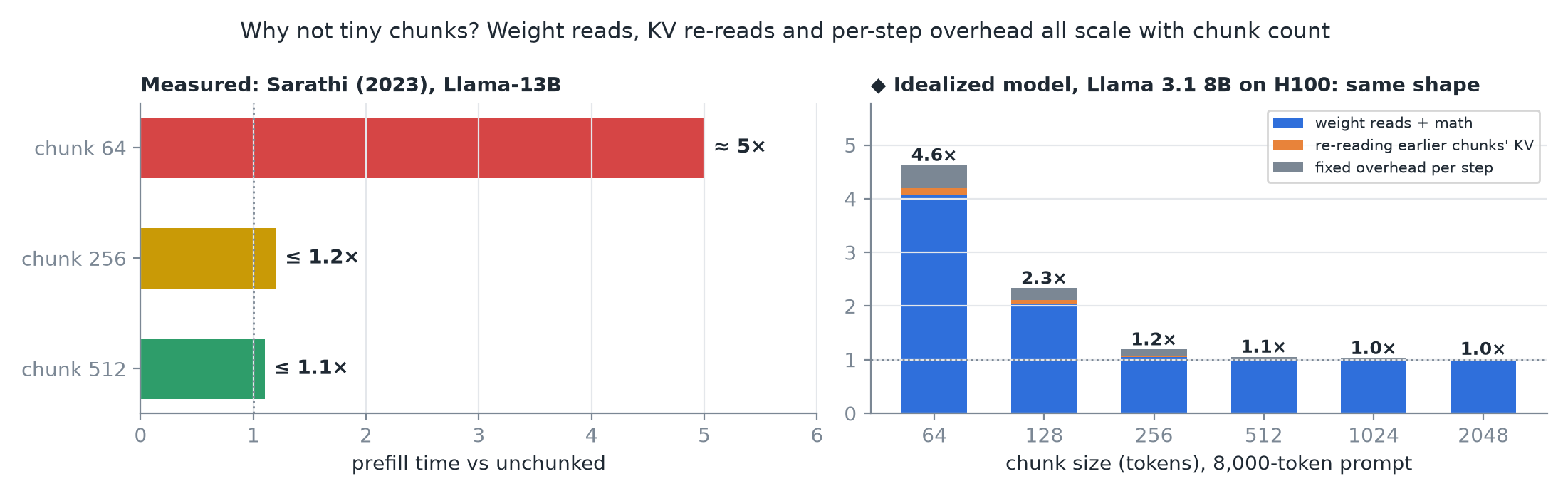 Left: Sarathi (2023), Llama-13B. ◆ Right: my idealized model gives the same shape, 4.6× at 64 tokens; for an 8k prompt the weight re-reads dominate.
Three reasons:
- Small chunks leave the GPU idle. Below a few hundred tokens a step is limited by reading the weights: you pay for a full read and get little work done.
- Every chunk re-reads the K/V of all chunks before it. Chunk 2 reads chunk 1, chunk 3 reads 1 and 2, and it keeps growing: more chunks, more re-reading.
- Fixed overhead every step: scheduling and kernel launches.
In the original Sarathi experiments, chunks of 64 made prefill about 5× slower; 256 and 512 stayed within about 20% and 10%.
5. Choosing the chunk size
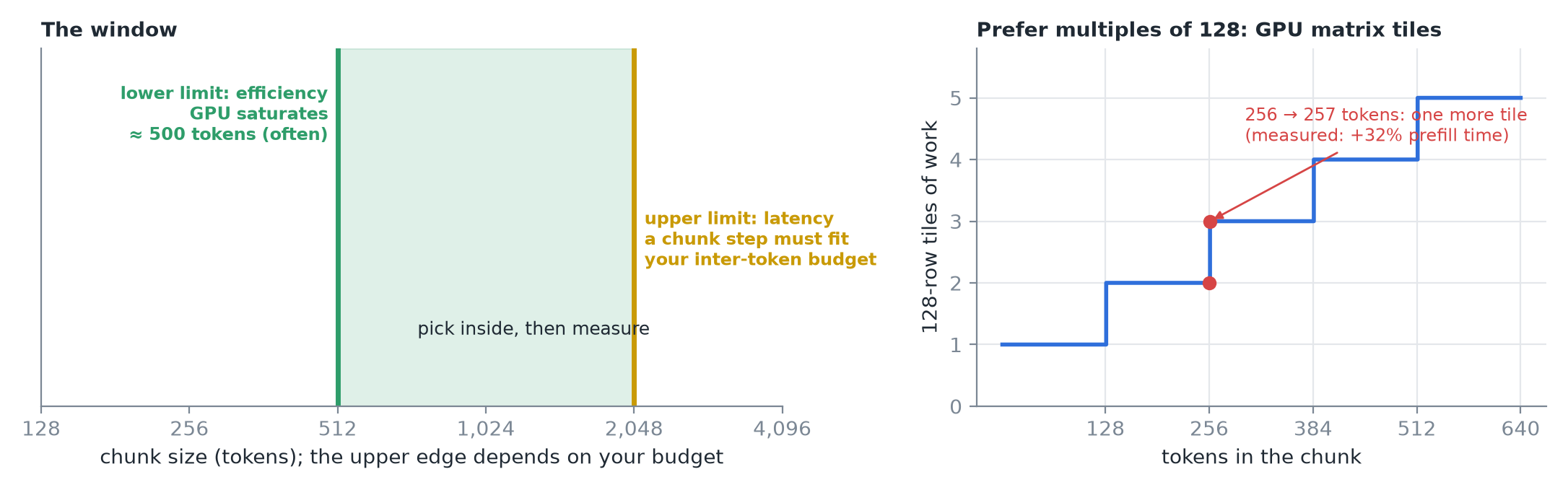 The 2,048 upper edge is illustrative; yours comes from your ITL budget.
- Upper limit, from latency: the step carrying a chunk must still finish within your inter-token budget.
- Lower limit, from efficiency: stay at or above where the GPU saturates, often around 500 tokens.
- Prefer multiples of 128: GPU matrix tiles come in that size. One study found 256 → 257 tokens made prefill 32% slower.
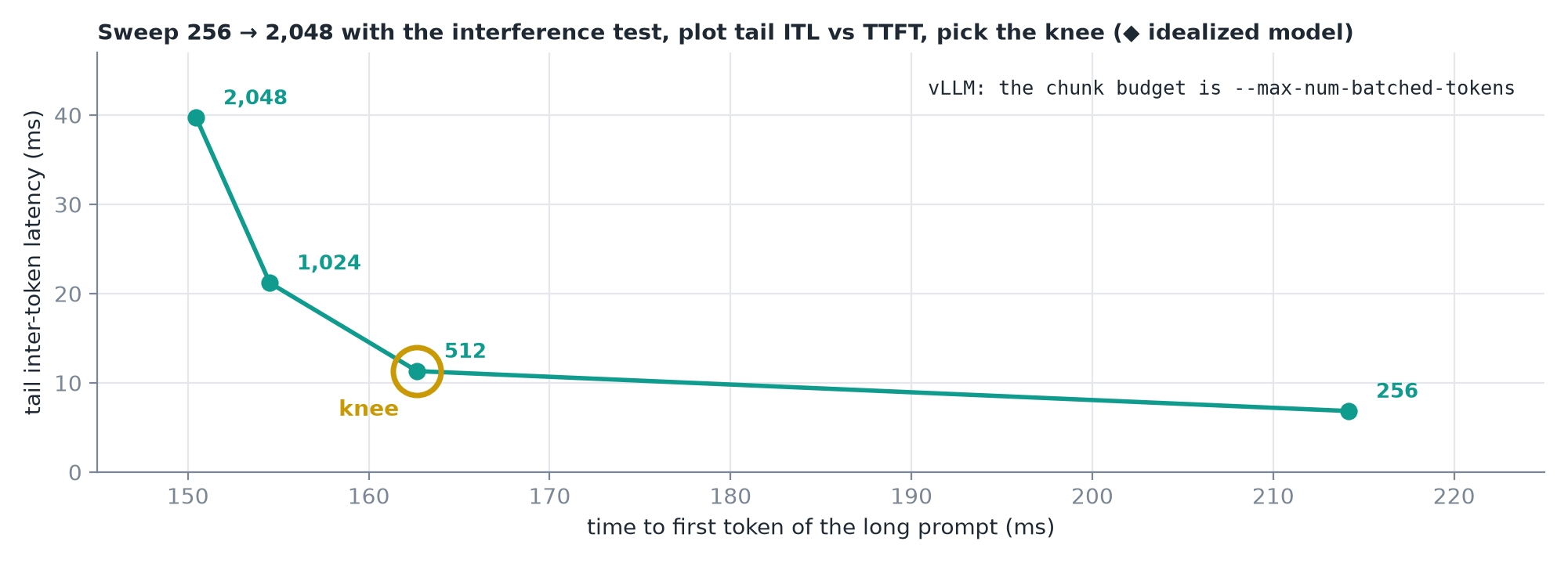 ◆ Points come from the idealized model; on real hardware, measure.
- Then measure: rerun the long-prompt interference test at chunk sizes from 256 to 2,048, plot tail ITL vs TTFT, and pick the knee.
- In vLLM the chunk budget is
--max-num-batched-tokens.
6. Recap