19 · Calculate KV Memory, Context & Concurrency Limits
Source: fanout.sh / inference-eng / 03-06 · ~6 min
NOTE
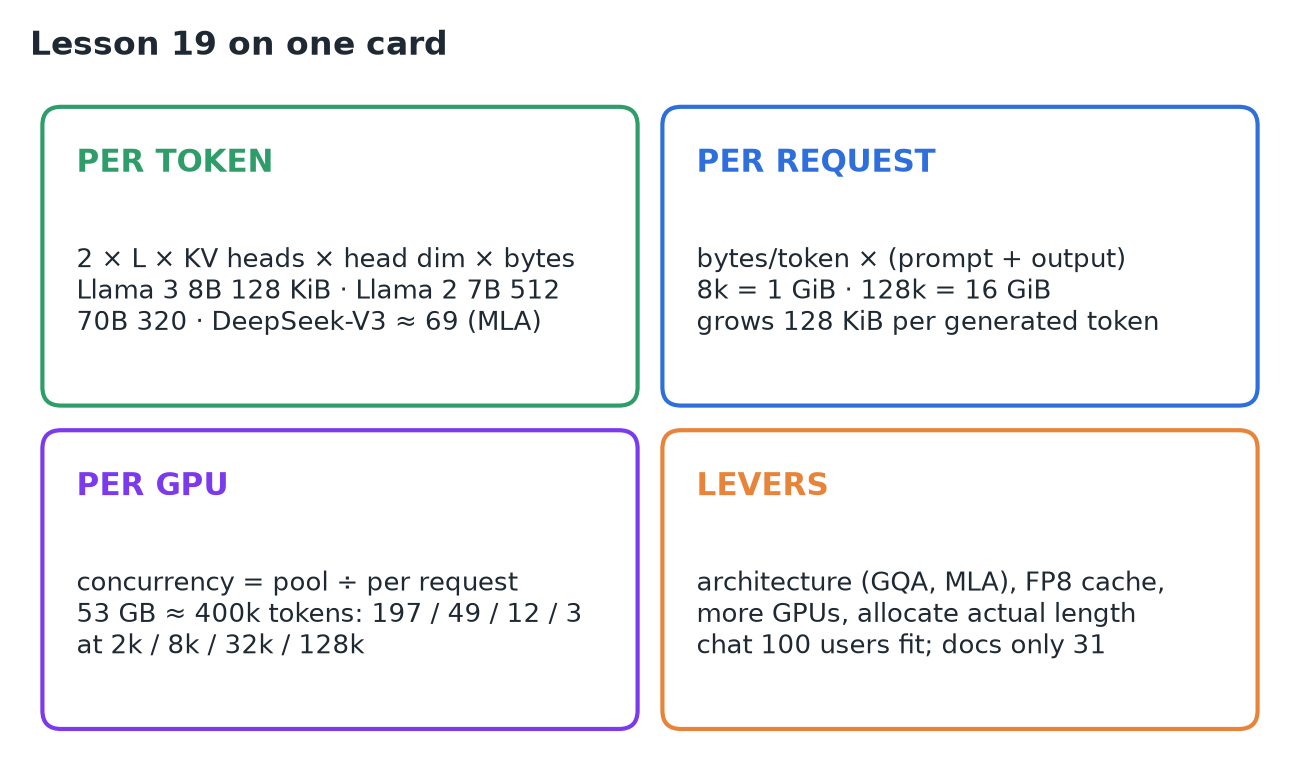
Two questions decide what a deployment can promise: how long can one conversation be, and how many can run at once? Both come from the same KV pool and one division. Per token: 2 × layers × KV heads × head dim × bytes (Llama 3 8B: 128 KiB). Per request: that × (prompt + output) (8k = 1 GiB, 128k = 16 GiB). Per GPU: pool ÷ per-request: ~53 GB ≈ 400k tokens fits 197 requests at 2k, 49 at 8k, 12 at 32k, 3 at 128k. Context and concurrency trade one for one. The same model serves 100 chat users but only 31 document users on one H100: the workload sets the bill. Levers: architecture (GQA, MLA), FP8 cache, more GPUs, and allocating actual rather than maximum length.
1. Per token: the architecture decides
For every layer, the cache stores one key and one value vector for every KV head, so bytes per token = 2 × layers × KV heads × head dim × bytes per number.
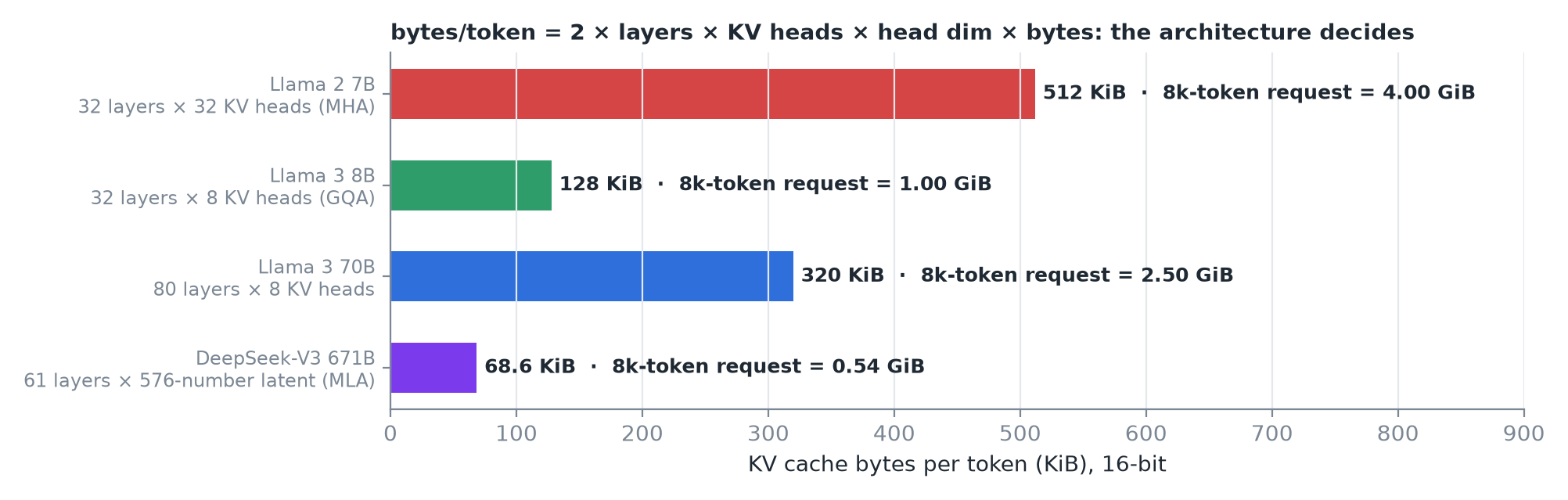 Llama 2 7B gives every head its own K/V (32 heads). Llama 3 8B shares 8 KV heads across 32 query heads: a quarter as much. 70B has 80 layers. DeepSeek-V3 compresses K/V into a small latent vector per layer: ~69 KiB/token for a 671B model.
2. Per request: everything it has seen
A request's cache holds the whole prompt plus every token generated so far, so per-request memory = bytes per token × total length.
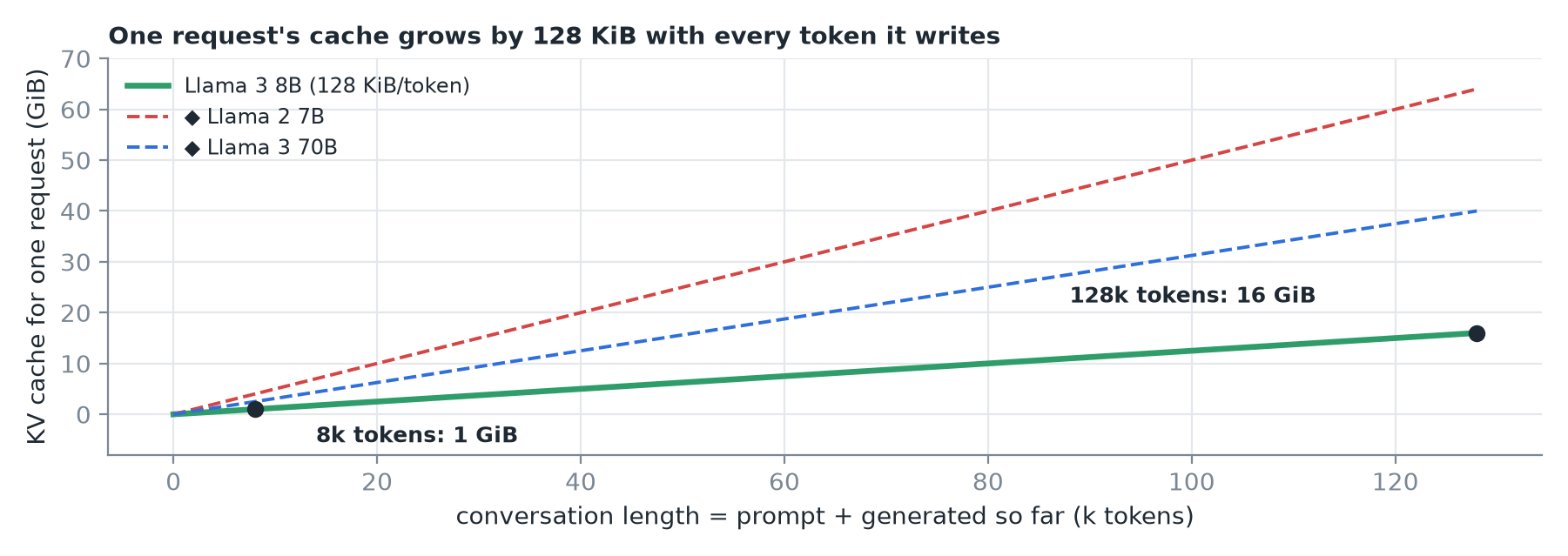 Llama 3 8B: an 8k conversation holds 1 GiB; a 128k one holds 16 GiB, all for one user.
3. Per GPU: one division
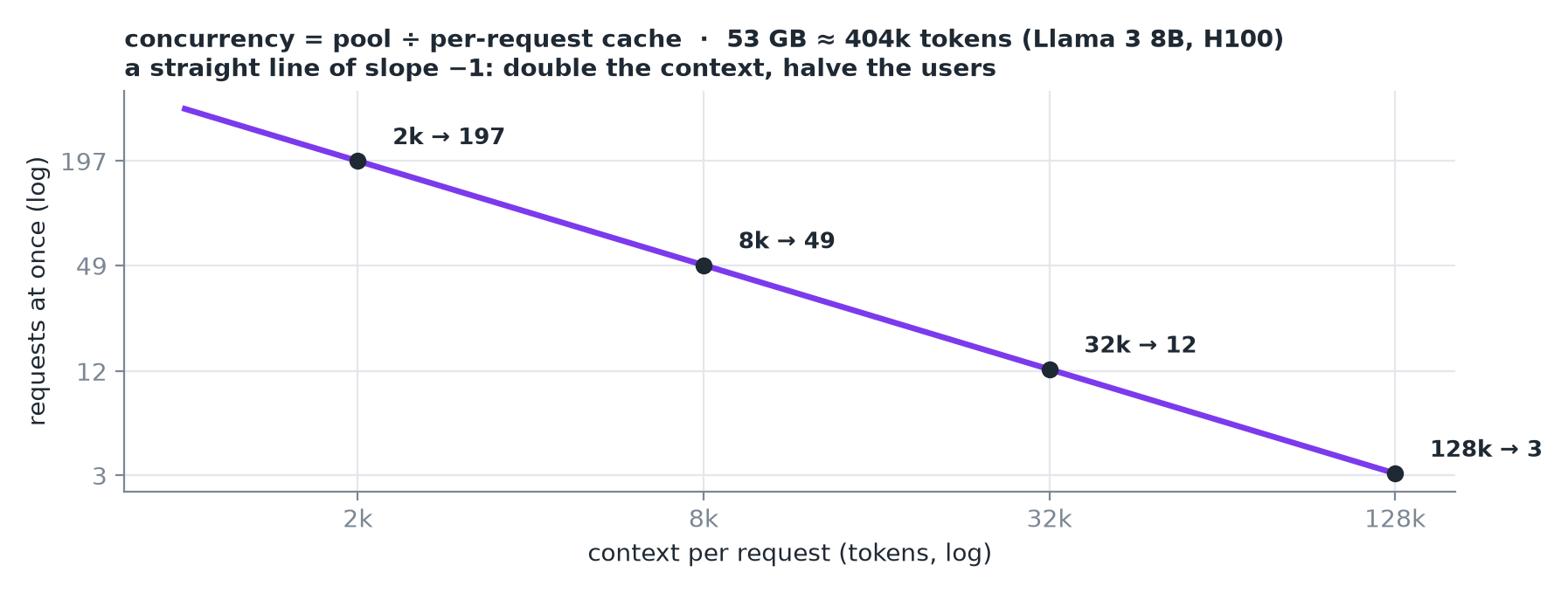
The engine found ~53 GB of cache on an H100 (lesson 18), about 400k tokens. Divide the pool by each request's length:
IMPORTANT
Context length and concurrency trade off directly: double one and you halve the other. A huge context window is expensive because every user who fills it takes the seat of many others.
4. Plan two real services on one H100
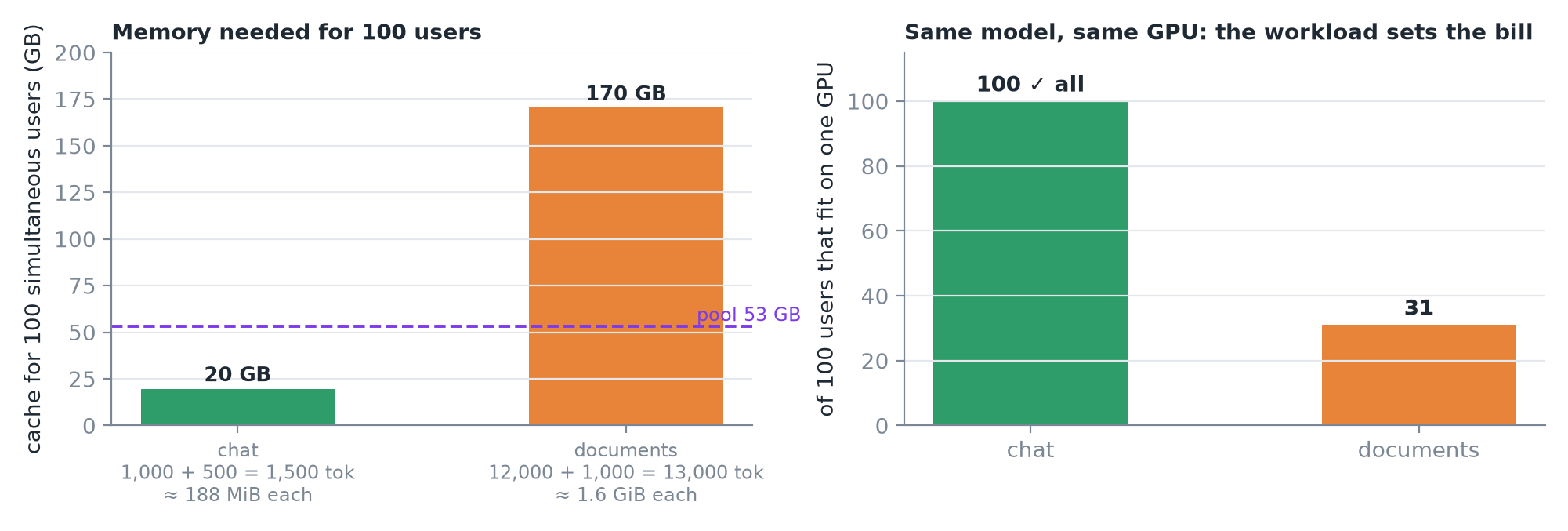 Chat: 1,500 tokens ≈ 190 MB each; 100 users ≈ 20 GB fits easily. Documents (retrieval QA): 13,000 tokens ≈ 1.6 GiB each; 100 users would need ≈ 170 GB, and the pool holds ~31.
TIP
Same model, same GPU: the workload, not the model, sets the hardware bill.
5. What moves the curve
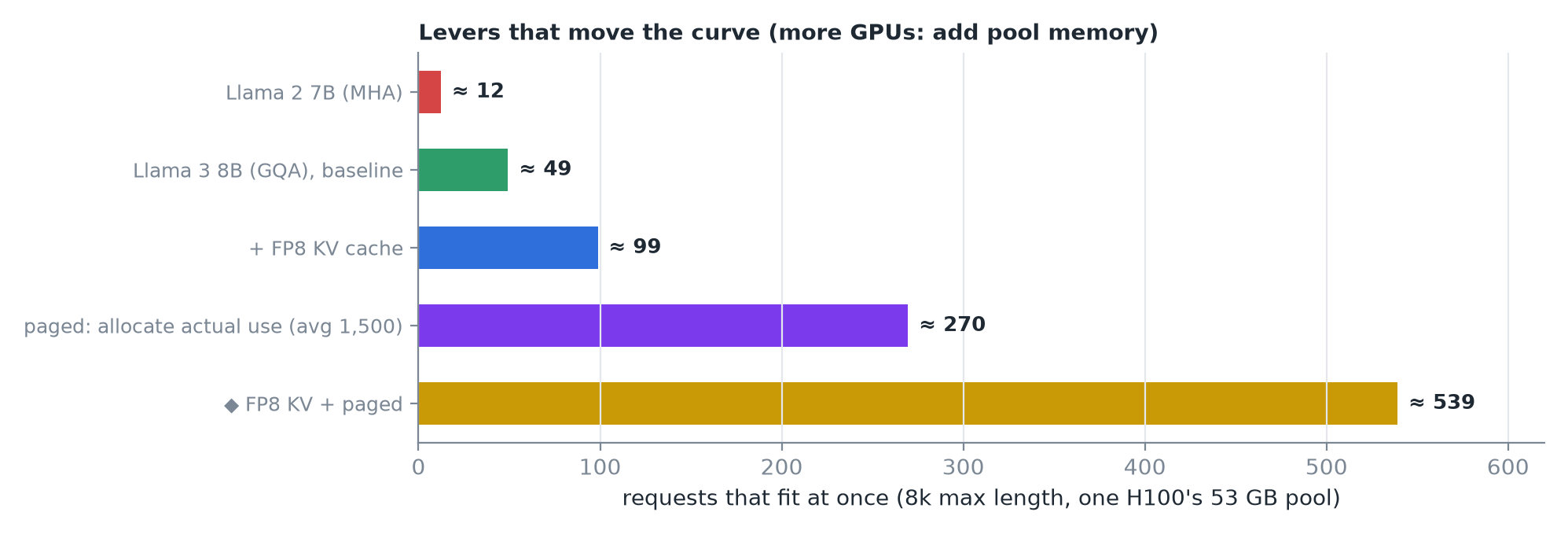
- The model: at 8k each, Llama 2 7B fits ~12 requests; Llama 3 8B fits 49, mostly thanks to grouped-query attention.
- Cache precision: store K/V in 8-bit instead of 16 and the pool doubles to ~800k tokens, at a small risk to quality.
- More GPUs: more memory for the pool.
- Allocation: stop reserving the maximum length for every request. Real conversations rarely hit the limit: at an average of 1,500 tokens, handing out memory as tokens actually arrive fits ~270 requests. That's the idea behind paged KV memory.
Engines like vLLM print this at startup as the maximum concurrency for a given request length; now you can check it by hand.
6. Recap