34 · Continuous Batching
Source: fanout.sh / inference-eng / 07-03 · ~5.5 min
NOTE
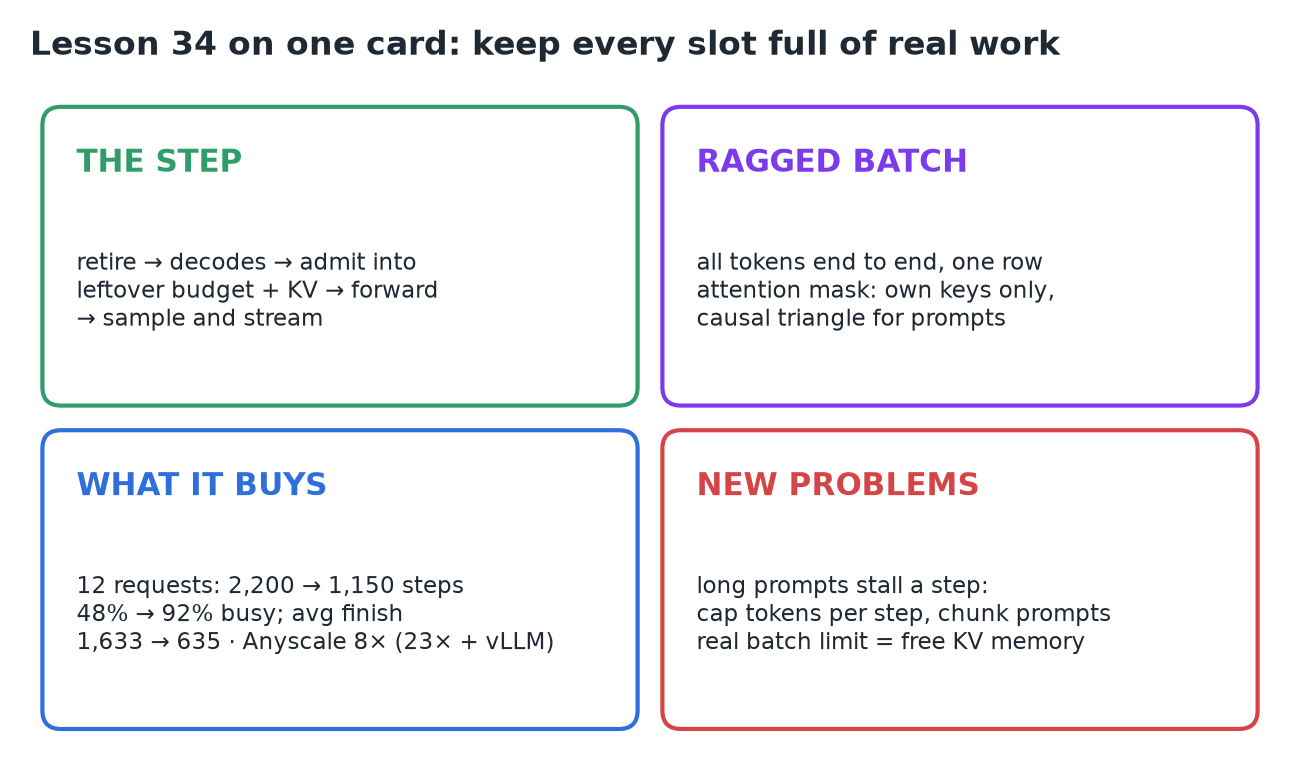
Continuous batching uses per-step scheduling for one goal: keep every slot full of real work, all the time. It's the default everywhere: vLLM, SGLang and TGI call it continuous batching, TensorRT-LLM calls it in-flight batching. Each step retires finished requests, schedules every running decode first, admits new prompts into leftover token budget and KV memory, runs one forward pass over a ragged batch (no padding; the attention mask keeps requests apart), then samples and streams. On 12 uneven requests it halves the total time (2,200 → 1,150 steps) and delivers answers ~2.6× sooner; Anyscale measured 8× over naive batching, 23× with vLLM's memory management. Two new problems follow: long prompts stall a step, and KV memory, not slot count, is the real batch limit.
1. The step recipe
The engine keeps two lists: a waiting queue of requests that haven't started and a running set that's already generating.
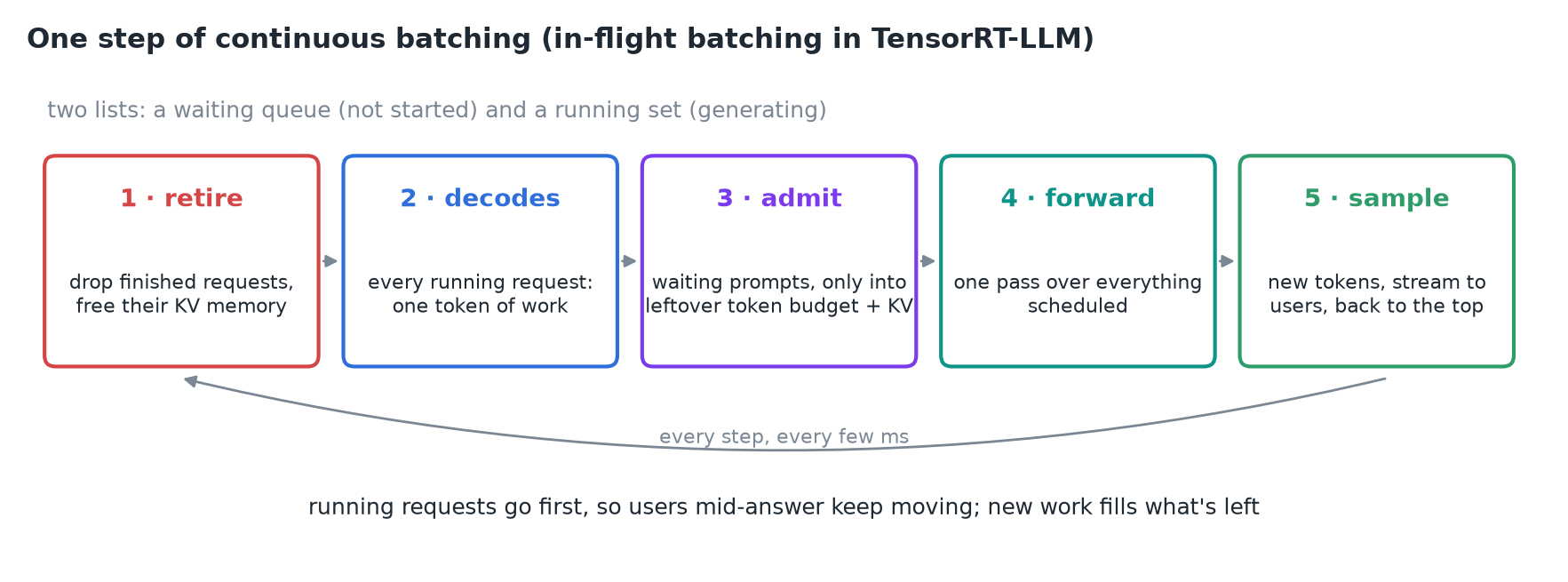 Retire, schedule decodes, admit, forward, sample and stream; then back to the top.
IMPORTANT
Running requests go first, so users already mid-answer keep moving; new work fills whatever is left.
2. What the GPU actually receives: a ragged batch
Three requests are decoding (one token each) and a new five-token prompt is joining. Instead of a padded rectangle, all eight tokens lie end to end in one row.
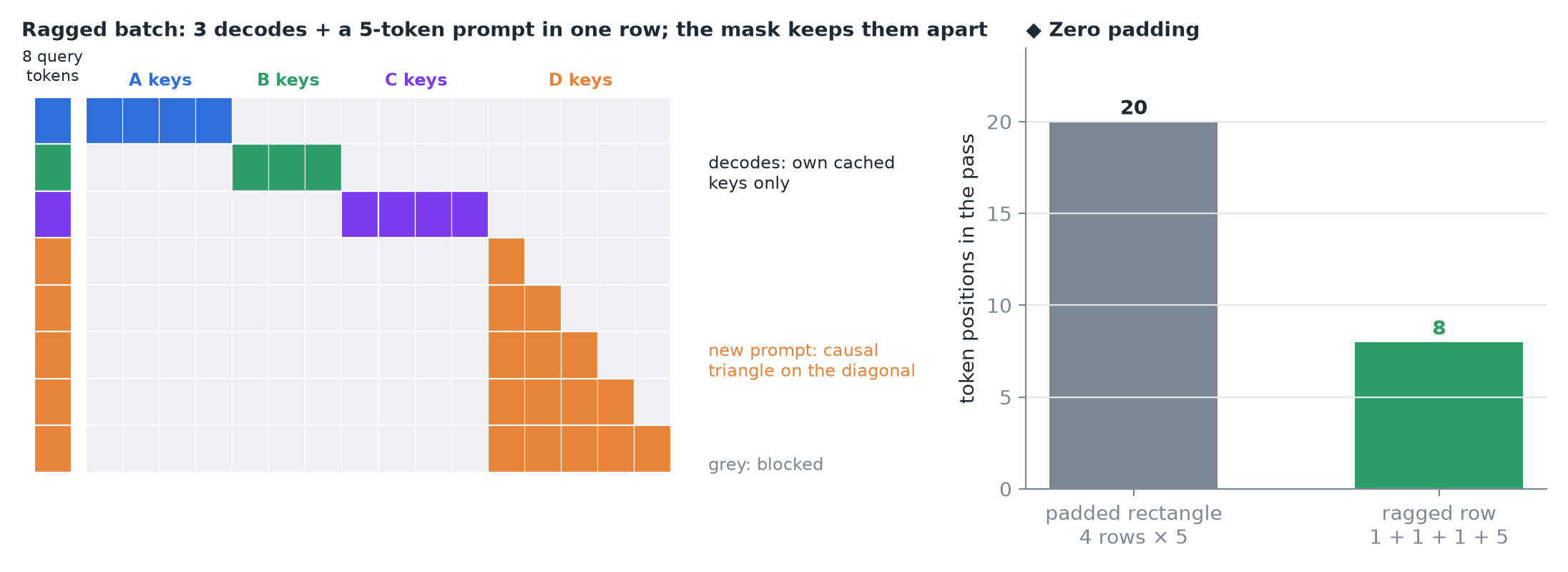 The only thing keeping requests apart is the attention mask: each decode token sees its own request's cached keys; the new prompt's tokens see only earlier tokens of the same prompt (a causal triangle on the diagonal); everything else is blocked.
So requests of any length, in any phase, ride in the same pass with zero padding.
3. What it buys
Twelve queued requests with output lengths from 100 to 1,000 tokens, four slots, every step taking the same time (illustrative).
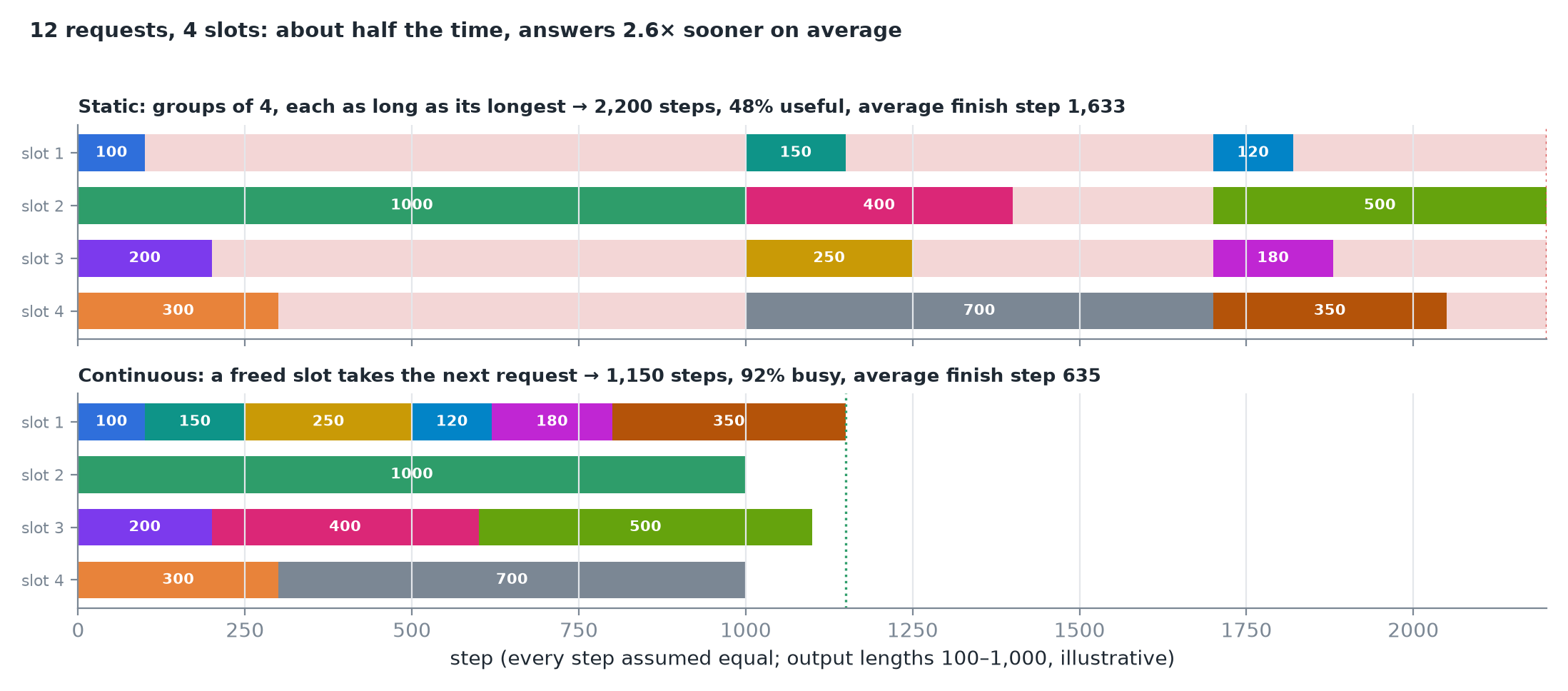 Static batching takes them four at a time, each group as long as its longest member; continuous batching hands a freed slot to the next request in the queue.
| Static | Continuous | |
|---|---|---|
| Total steps | 1,000 + 700 + 500 = 2,200 | 1,150 |
| Useful slot time | 4,250 ÷ (4 × 2,200) = 48% | 4,250 ÷ (4 × 1,150) = 92% |
| Average finish | 1,633 steps | 635 steps |
Same GPU, same model, same requests: roughly half the time, and answers arrive about 2.5× sooner on average (1,633 ÷ 635 ≈ 2.6).
Real measurements tell the same story: on a 13B model, Anyscale found continuous batching alone gave about 8× the throughput of naive batching, and about 23× with vLLM's memory management on top.
4. Two new problems
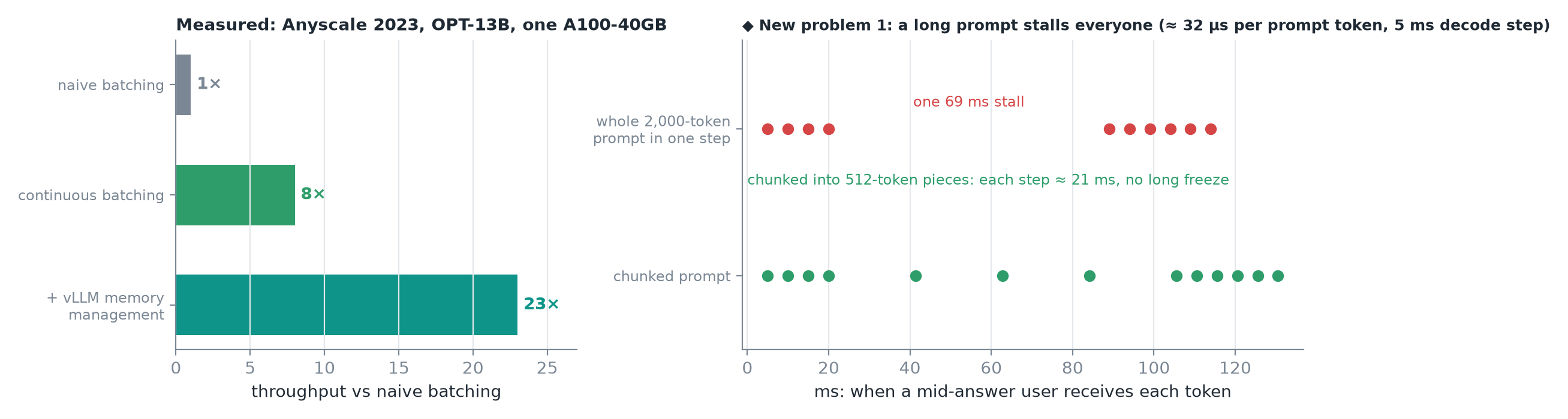 Left: Anyscale 2023, OPT-13B on one A100-40GB. Right: ◆ illustrative timing for a mid-answer user when a 2,000-token prompt joins, whole vs chunked.
- Prompts. When a new request joins, its whole prompt runs inside that step. A 2,000-token prompt makes that step much longer than a normal decode step, so every user mid-answer sees a stall. That's why engines cap the tokens per step and cut long prompts into chunks.
- Memory. Every running request holds a growing KV cache, so the real limit on the batch isn't the slot count, it's how much KV memory is free, and how that memory is laid out decides how many requests fit.
5. Recap