15 · Understand & Measure the Prefill Phase
Source: fanout.sh / inference-eng / 03-02 · ~6 min
NOTE
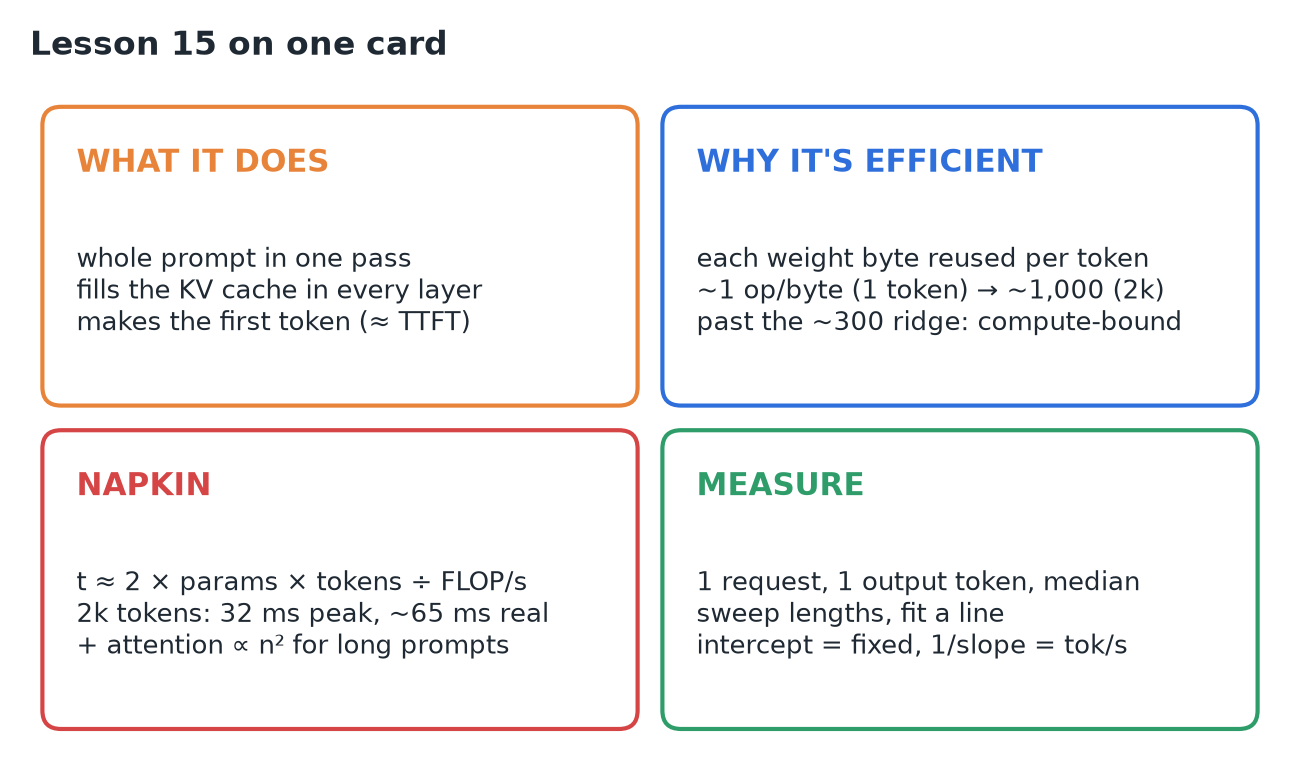
Most of the pause before the first word is prefill: one pass of the model over every prompt token at once, which fills the KV cache in every layer and produces the first token. So TTFT ≈ prefill + a little networking and queueing. Prefill is efficient because each weight byte read is reused by every prompt token: ~1 op/byte for one token, ~400 for 500, ~1,000 for 2,000, past the H100's ~300 ridge, so it's compute-bound. Napkin: time ≈ 2 × params × tokens ÷ achievable FLOP/s: 2,000 tokens on Llama 3 8B ≈ 32 ms at peak, ~65 ms real (~30k tokens/s). Attention adds a term ∝ n² that only matters for long prompts. Measure it with one request, one output token, a length sweep and a line fit.
1. What prefill does
With a KV cache, generation has two phases, and prefill is the first. The whole prompt is known up front, so no token waits for another: all 2,000 tokens flow through all 32 layers together.
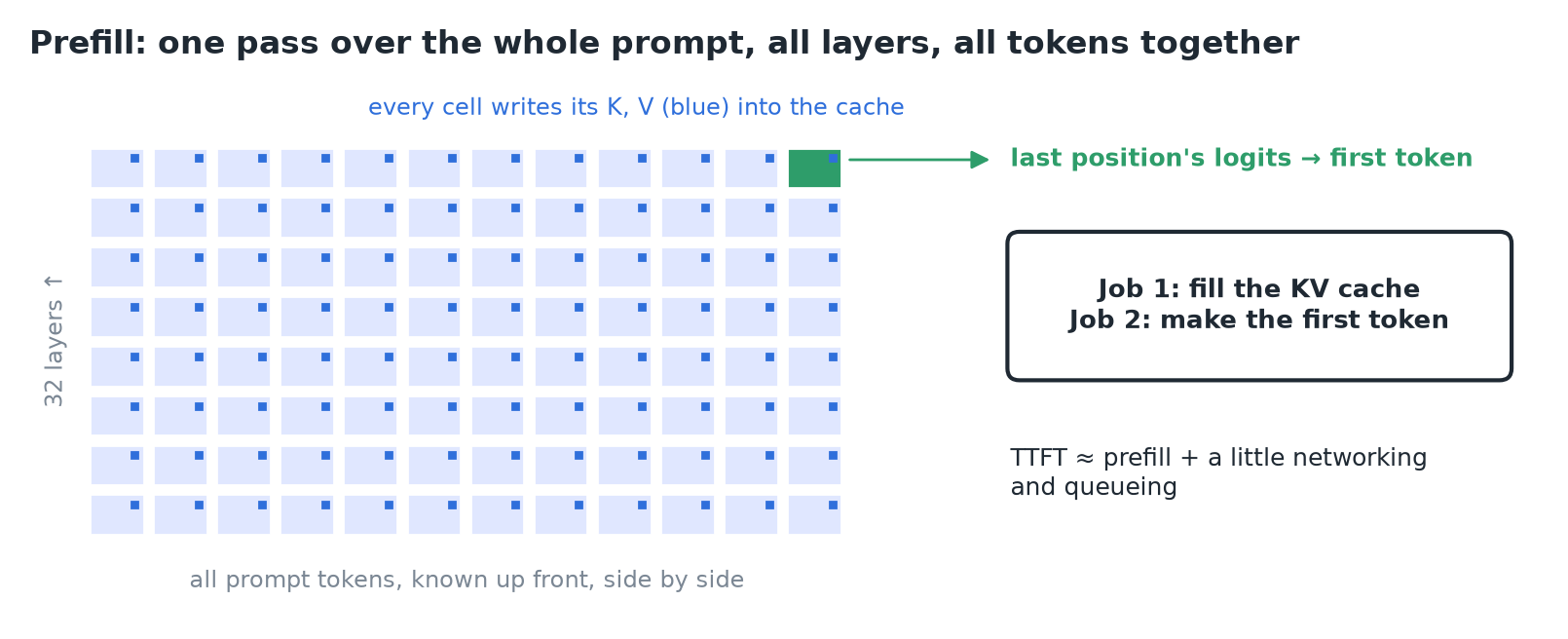 Each layer writes keys and values for every prompt token into the cache. At the end, only the last position's logits are used.
IMPORTANT
Prefill does two jobs: fill the cache, and make the first token. That's why TTFT is mostly prefill, plus a little networking and queueing.
2. Why prefill is so efficient
Take one 4,096 × 4,096 weight matrix: about 34 MB that the GPU must read from memory to use it.
- Decode: one token passes through it. 34 MB read for one small vector of work.
- Prefill: 2,000 tokens pass through, and it's read once. Every byte is reused 2,000 times.
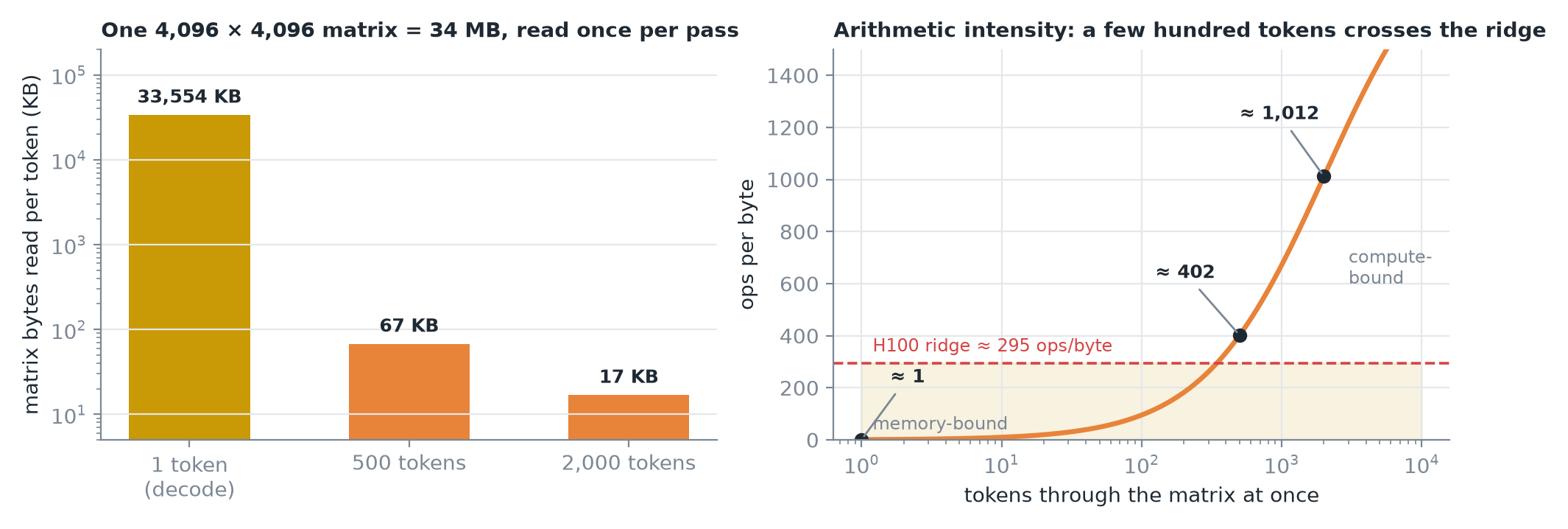 Arithmetic intensity = math operations ÷ bytes read. Below ~300 ops/byte an H100 waits on memory; above it, the math units are the limit.
TIP
A prompt of a few hundred tokens is already enough to make prefill compute-bound.
3. The napkin estimate
A forward pass costs about 2 operations per parameter per token.
- Llama 3 8B, 2,000-token prompt: 2 × 8B × 2,000 ≈ 32 trillion operations.
- H100 peak ≈ 1,000 trillion/s (16-bit) → ~32 ms at peak.
- Real kernels reach maybe half of peak → expect ~65 ms, around 30,000 prompt tokens/s.
One more term: attention compares every token with every earlier one, so its work grows with the square of the prompt length.
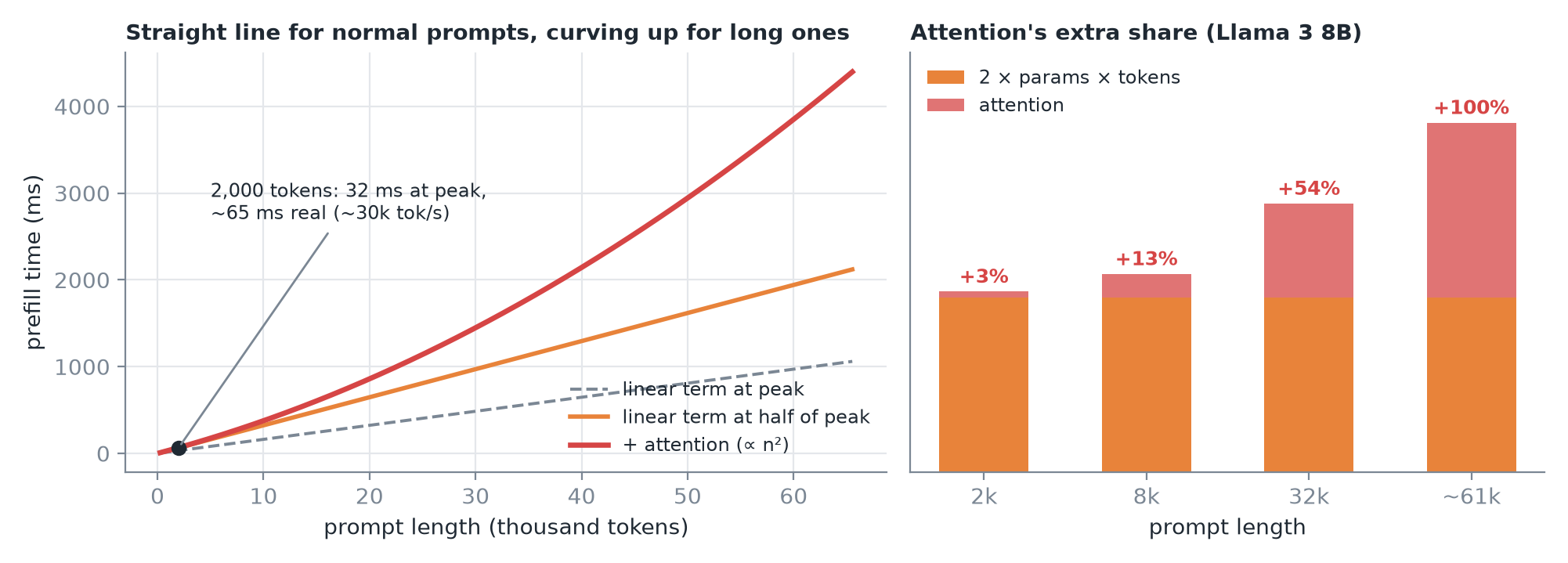 ≈ +3% at 2k tokens, more than half again at 32k, and equal to everything else around 60k. Prefill time is a straight line for normal prompts, curving upward for very long ones.
4. Measure it for real
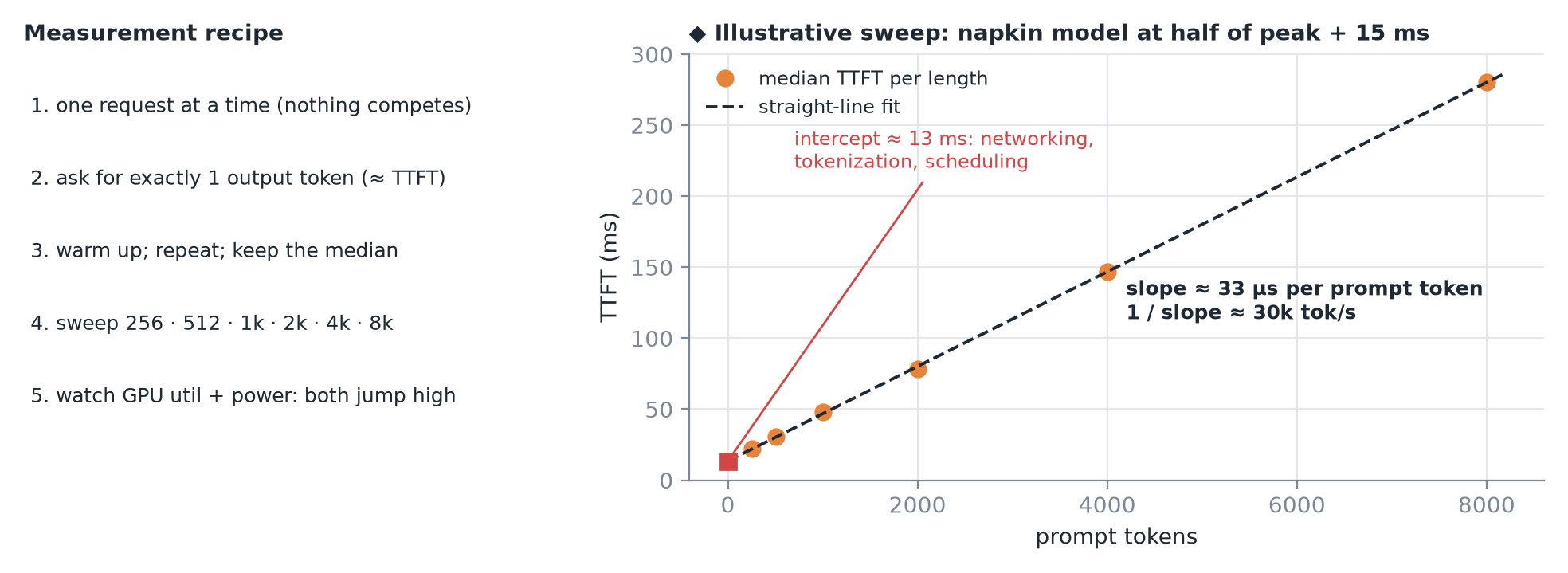 The intercept is the fixed cost (networking, tokenization, scheduling); the slope is time per prompt token, and 1 / slope is your prefill throughput.
Compare the result with the napkin estimate: far below half of peak means something's wrong. Watch the GPU too: during a long prefill, utilization and power draw jump high, the signature of compute-bound work.
5. Why prefill matters in practice
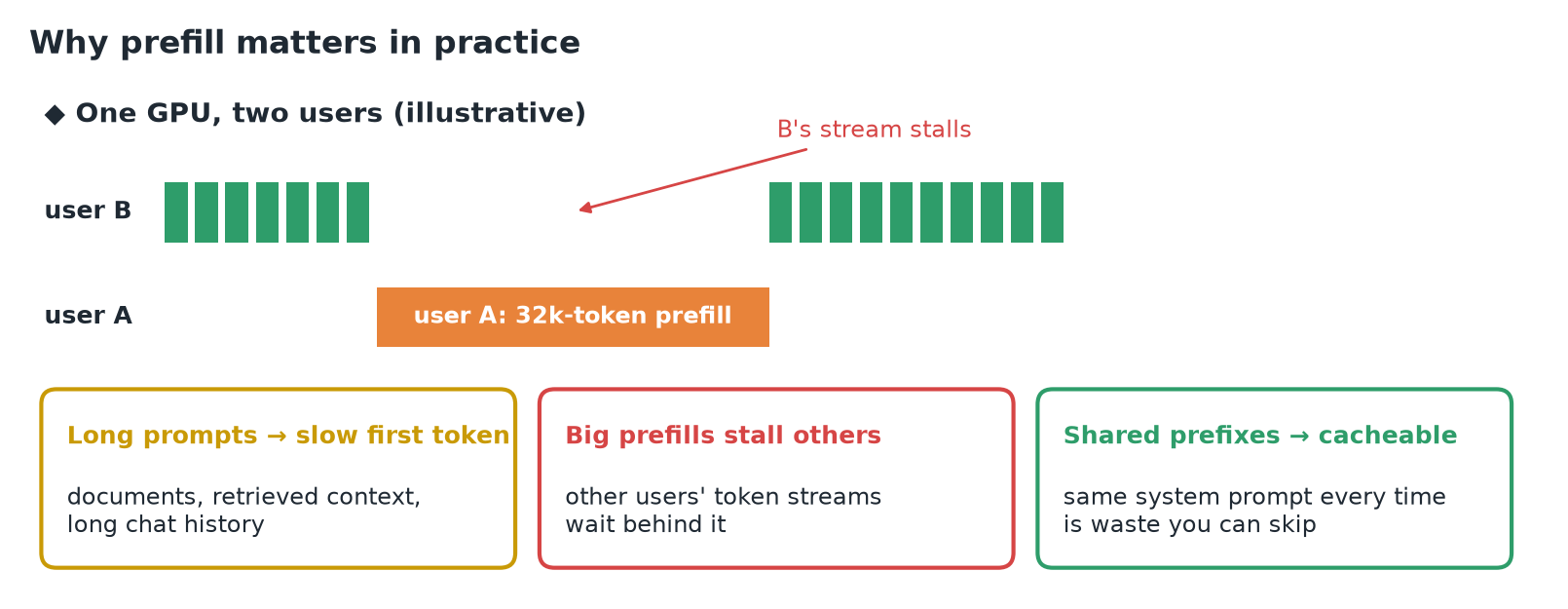 The fixes are known as chunked prefill and prefix caching.
6. Recap