52 · AWQ, GPTQ & SmoothQuant
Source: fanout.sh / inference-eng / 11-03 · ~6 min
NOTE
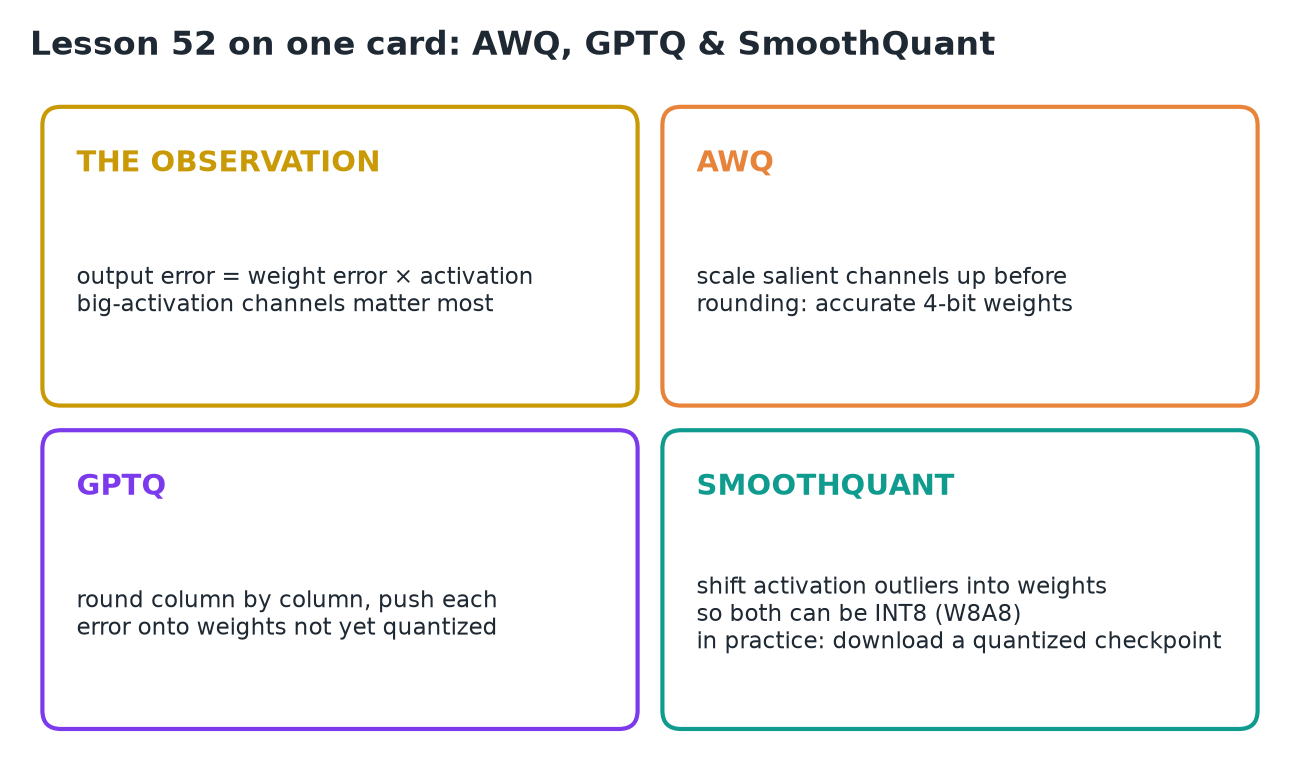
Plain rounding can break a model: at 3 bits it more than doubled OPT-6.7B's perplexity (10.9 → 23.5). What matters is the error in the layer's output, and a weight's error gets multiplied by the input it meets, so weights on the few big activation channels matter most. AWQ scales those salient channels up before rounding (23.5 → 11.9); GPTQ rounds column by column and pushes each error onto the weights not yet quantized (175B in ≈ 4 GPU hours); SmoothQuant moves activation outliers into the weights so both can be INT8 (up to ≈ 1.5× faster, half the memory). All three run after training on a small calibration sample, in minutes to hours.
1. Why plain rounding isn't enough
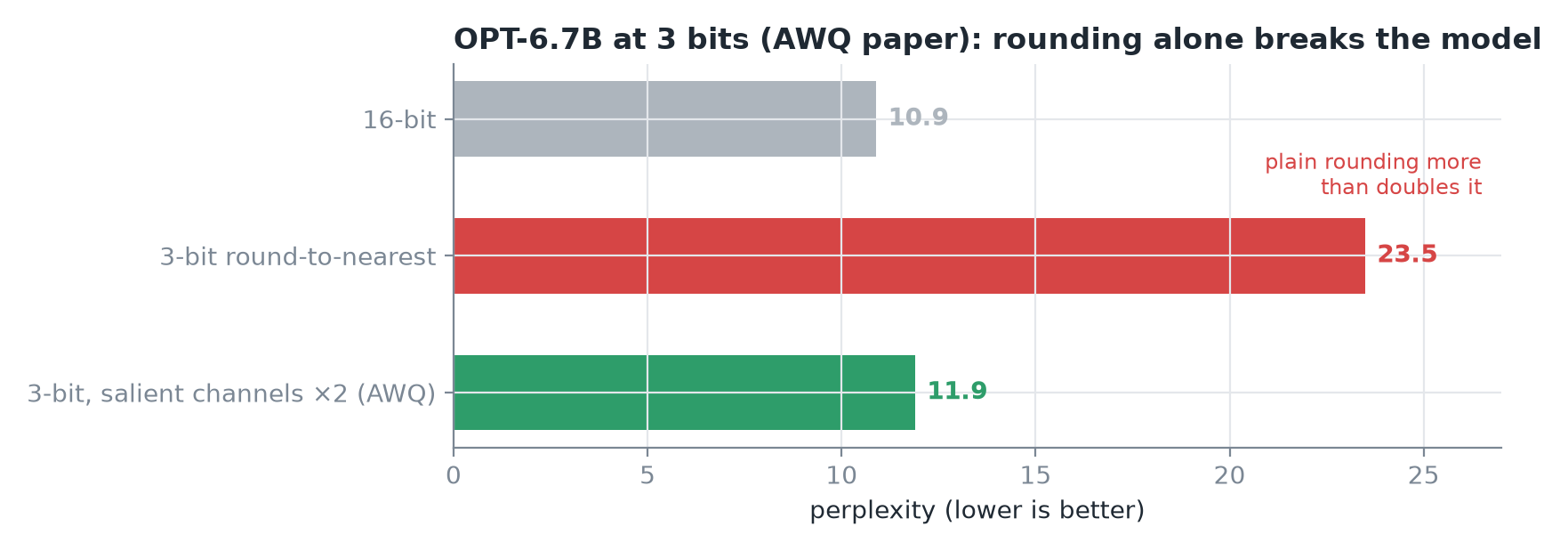 Perplexity from the AWQ paper; the third bar comes up again in section 3.
- Rounding every weight to the nearest 4-bit level can badly damage a model. At 3 bits, plain rounding took a 6.7B model from 10.9 to 23.5 perplexity.
- The standard fixes: AWQ, GPTQ and SmoothQuant. All three work after training, need only a small set of sample inputs, and take minutes to hours, not a retraining run.
2. The shared observation
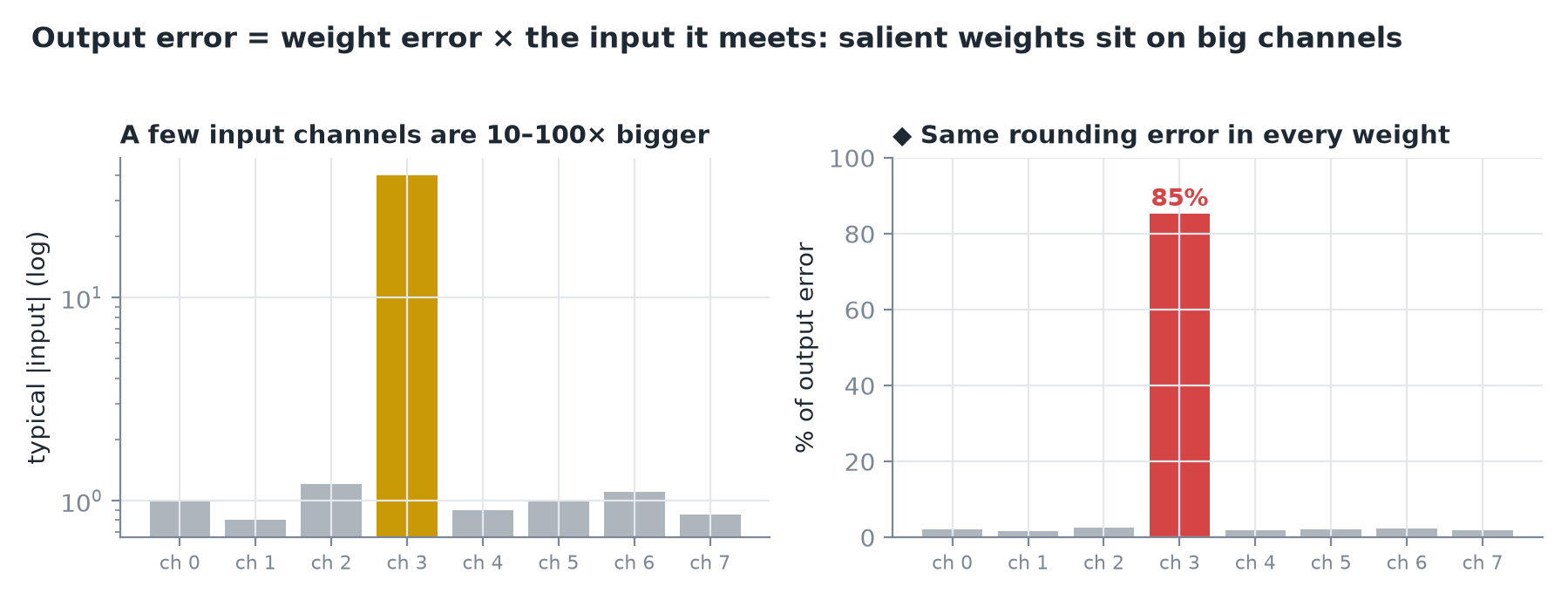 ◆ Right: if every weight had the same rounding error, the one big channel would cause 85% of the output error.
- We don't care about the error in each weight; we care about the error in the layer's output.
- Output = weights × inputs, so a weight's rounding error gets multiplied by its input.
- Most input channels are small, but a few carry values 10–100× bigger. Errors in the weights that meet them are amplified by the same factor.
- Those are the salient weights, and you find them by looking at the activations, not at the weights.
3. AWQ: protect the salient weights
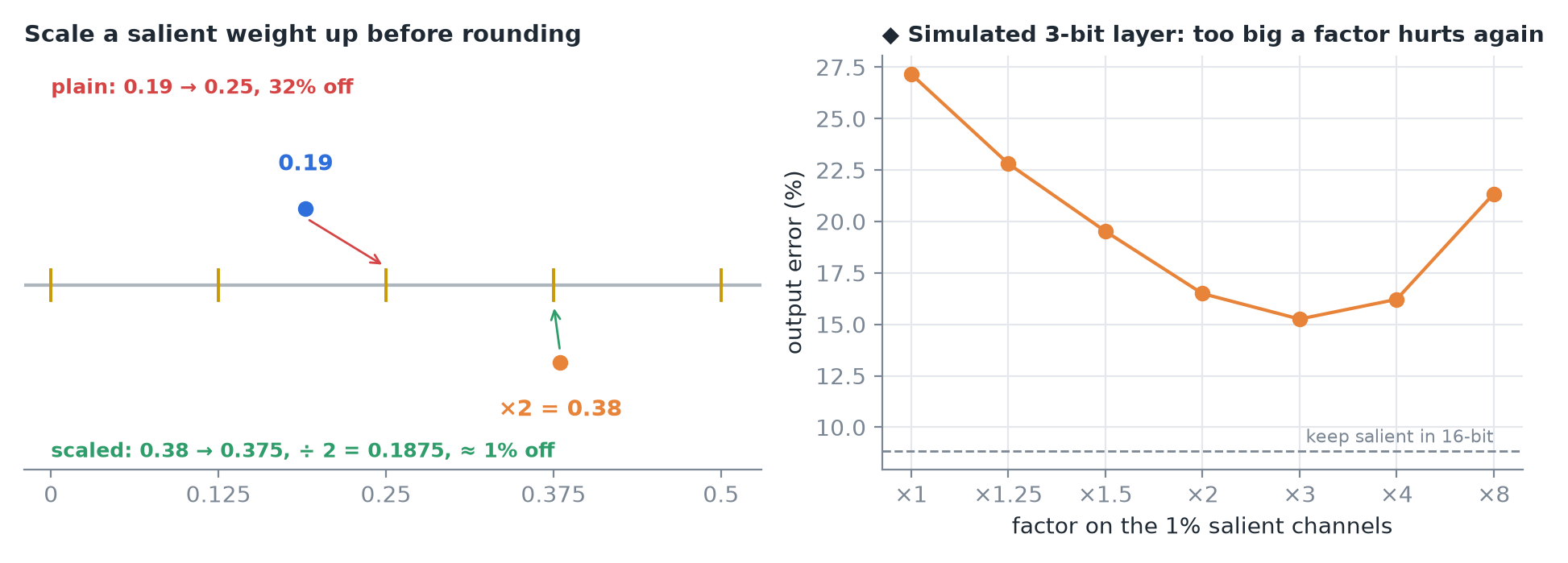 Left: the lesson's example on an illustrative grid with steps of 0.125. Right ◆: my simulation of a 3-bit layer with groups of 128.
- Activation-aware weight quantization. Only ~1% of weight channels are salient. Keeping them in 16 bits would help, but mixing precisions inside one matrix is awkward for GPU kernels.
- Instead: multiply each salient weight channel by a factor (say 2) and divide its input by the same factor. The math is unchanged (2 × ½ = 1), but the salient weights are now bigger relative to the rounding step, so their relative error shrinks.
- Example: 0.19 rounds to 0.25, 32% off. Doubled, 0.38 rounds to 0.375, and halved back that's 0.1875, ≈ 1% off.
- In the paper, scaling the top 1% by 2 cut perplexity from ≈ 23.5 to ≈ 11.9.
- The factors come from a quick search using average activation sizes. No backpropagation, so it tends not to overfit its sample data.
TIP
◆ Why the factor can't just grow: once the salient weights are big enough to set their group's maximum, the step grows for every other weight in that group. In my simulation, error falls until about ×3, then rises again.
4. GPTQ: fix mistakes as you go
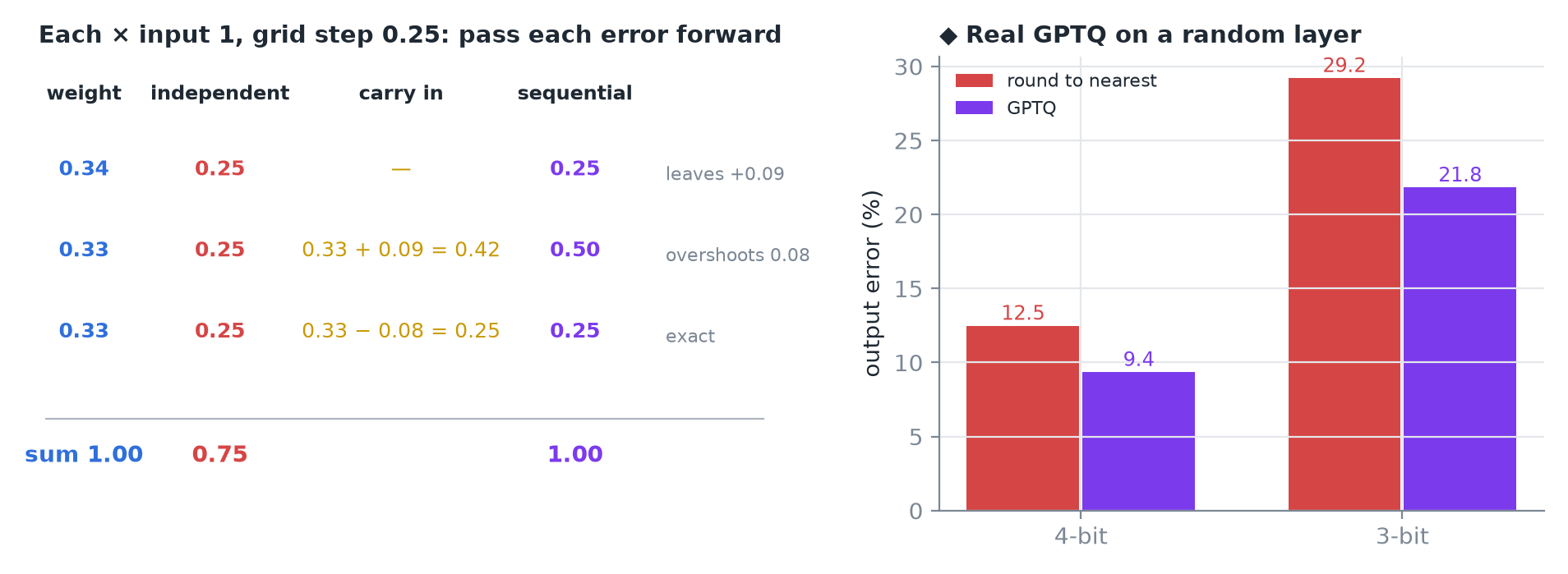 Left: the lesson's three weights. Right ◆: real GPTQ (per-row scales, correlated random inputs) vs plain rounding.
- Three weights, 0.34, 0.33, 0.33, each times an input of 1: true output 1.00.
- Round each independently to steps of 0.25: all become 0.25, output 0.75, a quarter too low.
- Round one at a time and pass each error forward: 0.34 → 0.25 leaves +0.09; the next becomes 0.42 → 0.50, overshooting by 0.08; the last becomes 0.25 → 0.25. Total: exactly 1.00.
- GPTQ does this column by column across whole matrices, using second-order statistics of real inputs to decide how to spread each error.
- Fast enough to quantize a 175B model in about 4 GPU hours.
5. SmoothQuant: 8-bit weights and activations
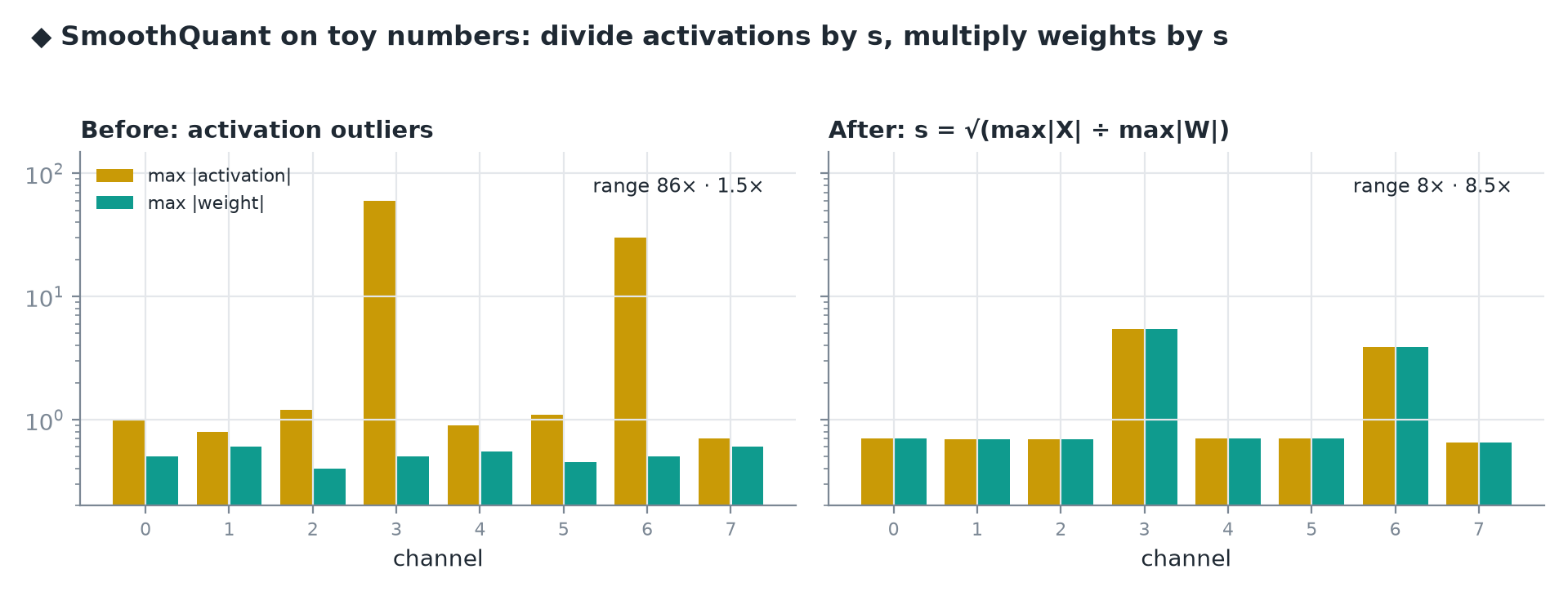 ◆ Toy maxima with two outlier channels; s balances each channel exactly.
- A different problem: quantize activations as well as weights, so the math itself runs in INT8.
- Weights are easy: their values are fairly even across channels. Activations are hard: a few channels have huge outliers, so one shared scale crushes everyone else.
- Move some of the difficulty into the weights: divide each activation channel by a factor and multiply the matching row of weights by the same factor. The product doesn't change.
- Pick the factor to balance the two, typically the square root of their ratio. Both end up with moderate ranges, so both can be INT8.
- The scaling is folded into the previous layer ahead of time, so it costs nothing at runtime.
- The paper reported up to ≈ 1.5× faster inference and half the memory, with negligible accuracy loss.
6. Side by side
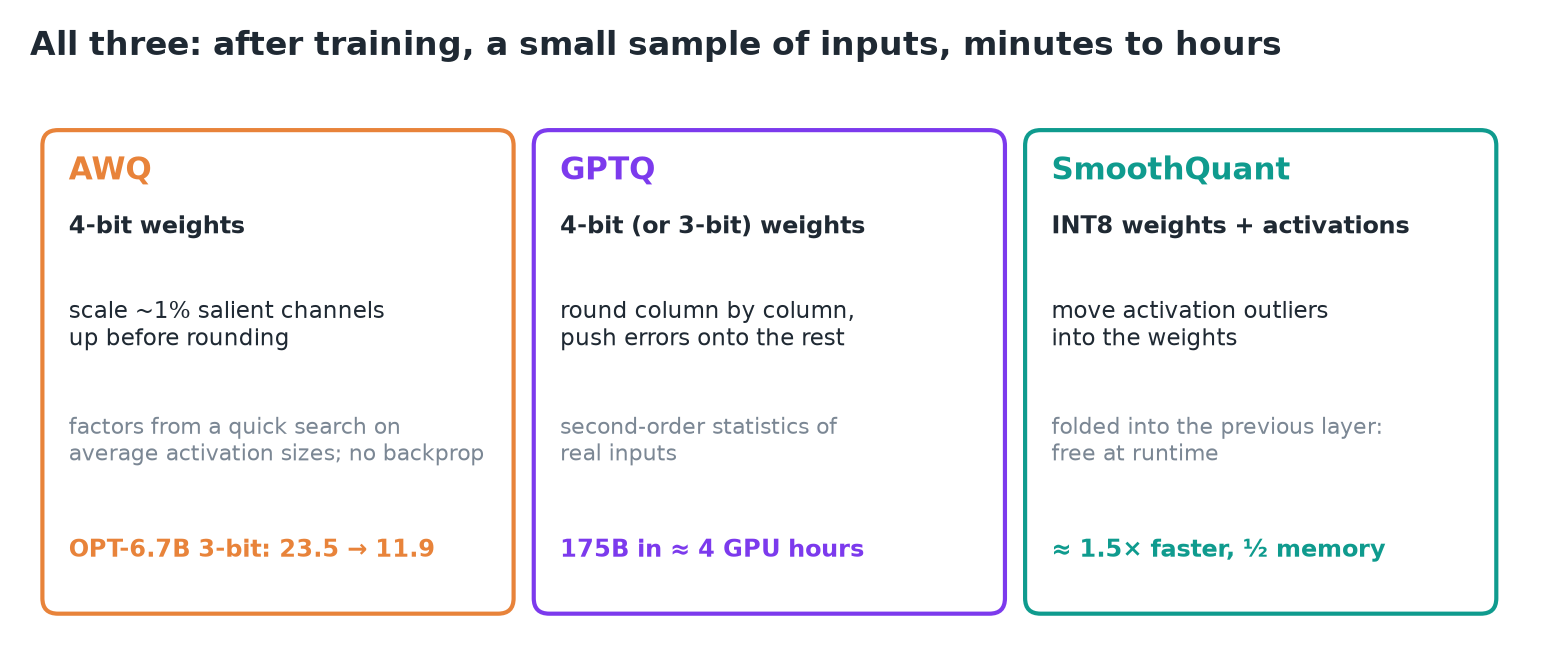
- In practice you'll usually download a checkpoint already quantized with one of these, and vLLM loads it directly.
7. Recap