40 · Allocate, Share & Reclaim KV Blocks
Source: fanout.sh / inference-eng / 08-04 · ~5 min
NOTE
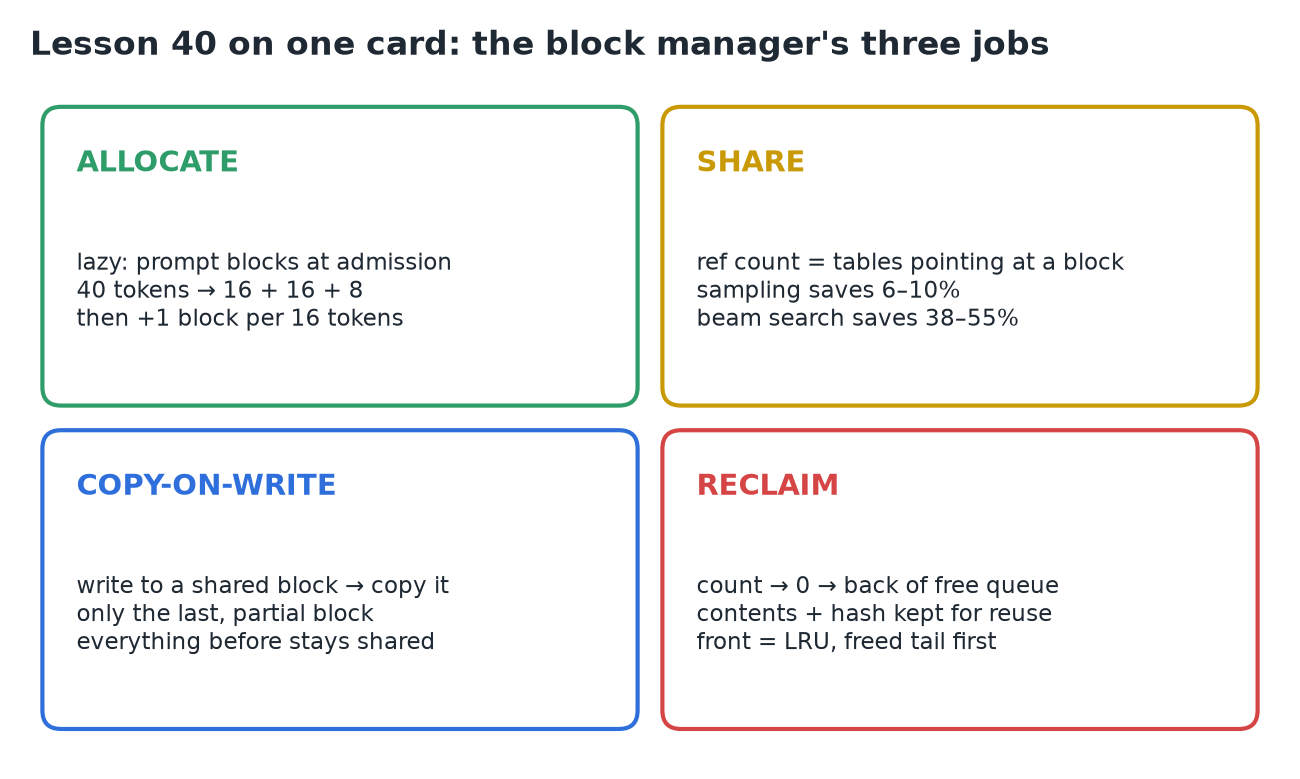
Blocks and block tables give the engine a small block manager that owns every KV block on the GPU and does three jobs. It allocates lazily: enough blocks for the prompt, then one more every 16 tokens. It shares blocks through reference counts, copying a shared block only when someone writes to it (copy-on-write); sharing saved 6–10% of KV memory for parallel sampling and 38–55% for beam search in the vLLM paper. It reclaims blocks whose count reaches zero into a free queue, and in vLLM it keeps their contents so a later request with the same tokens can reuse them.
1. Allocate: lazily
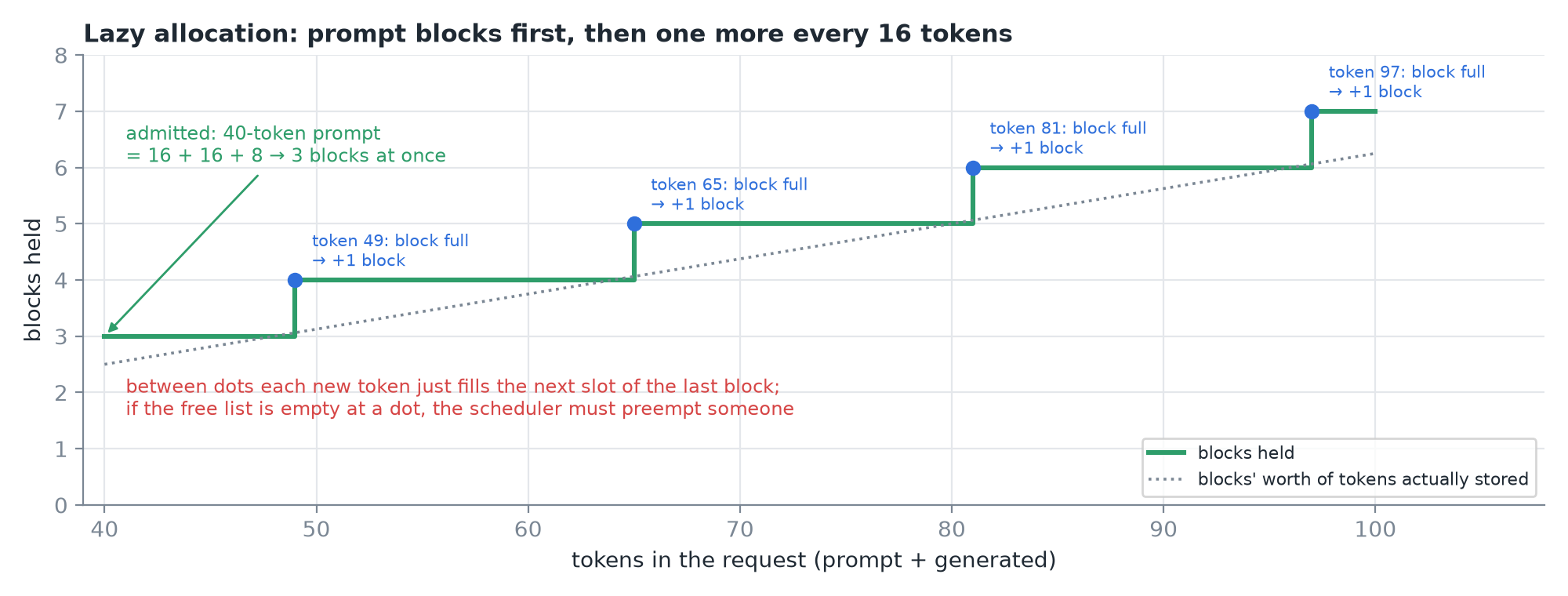 A 40-token prompt gets 3 blocks at admission; after that a block is added only when the last one fills.
- At admission: just enough blocks for the prompt. 40 tokens = 16 + 16 + 8 → 3 blocks.
- Then each new token fills the next slot of the last block; only a full block triggers a new one.
- So a request asks for a block once every 16 tokens, not once per token, and never for tokens it hasn't produced.
- If no free block is left at that moment, the scheduler has to preempt someone.
◆ For 40 prompt tokens plus 1,000 generated:
2. Share: reference counts and copy-on-write
Two different answers to the same prompt (parallel sampling) have identical KV for the prompt. Instead of storing it twice, both block tables point at the same physical blocks, and each block keeps a reference count: how many tables point at it.
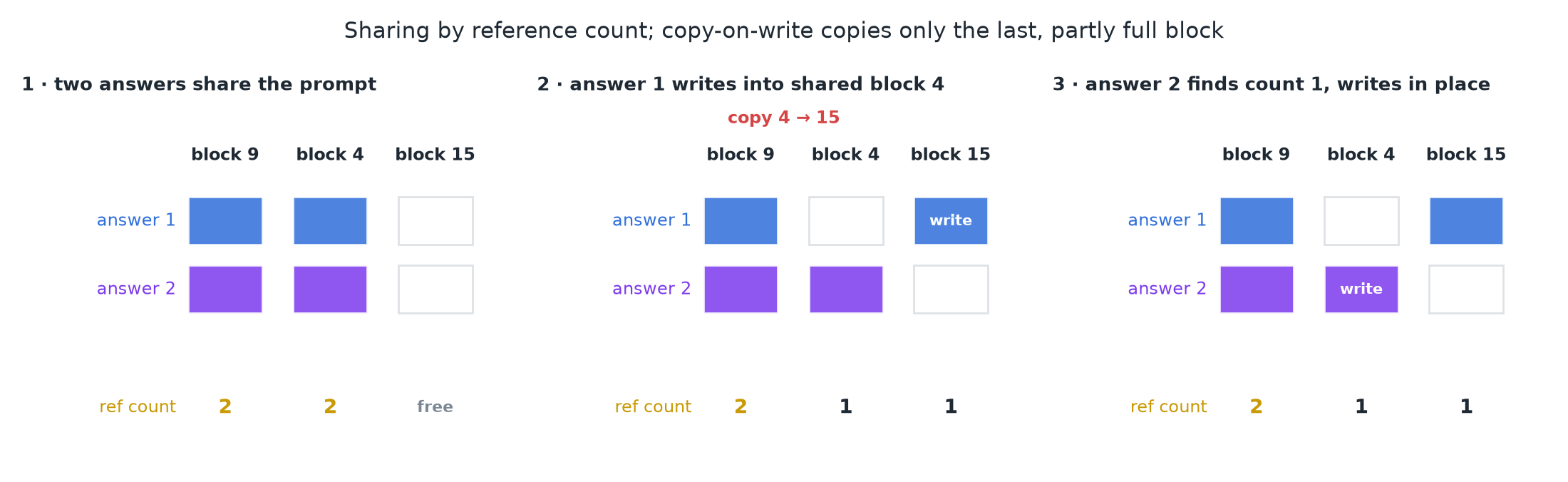 Both answers start on blocks 9 and 4 (count 2 each). Answer 1's first write into the partly full block 4 triggers a copy to block 15; answer 2 then writes into block 4 directly.
- Answer 1 wants to write its first new token into the last prompt block, which isn't full. But it's shared, and answer 2 still needs the original.
- So the manager copies that one block to a fresh block, points answer 1 at the copy, and drops the old block's count to 1.
- Answer 2 now sees count 1 and writes straight in. This is copy-on-write, the same trick an operating system uses when a process forks.
- Only the last, partly full block ever gets copied; everything before it stays shared for the rest of the request.
◆ One copy for Llama 3.1 8B is a single block, 16 × 128 KiB = 2 MiB, however long the shared prompt is.
Beam search
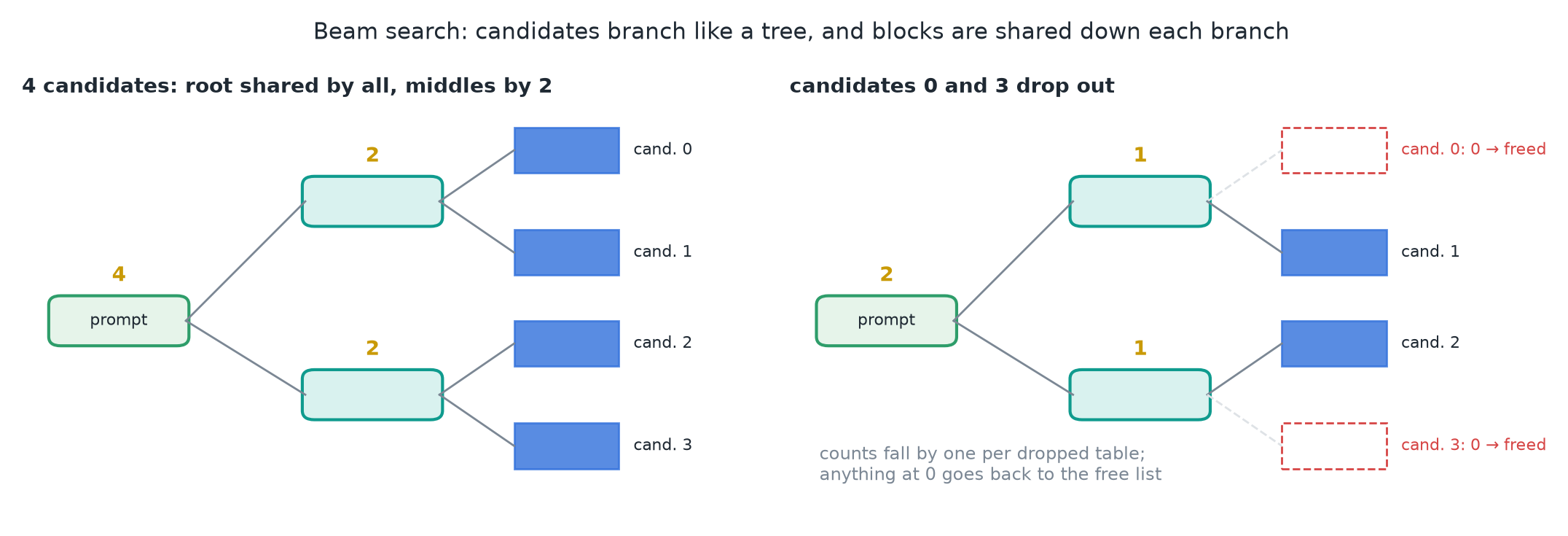 Blocks near the root are shared by every candidate, deeper ones only by the candidates that went that way. When a candidate drops out, every block on its path loses one count.
- Beam search keeps several candidate answers alive, branching off each other like a tree.
- When a candidate drops out of the beam, its blocks' counts go down, and any block that reaches zero is freed.
WARNING
The video's frame keeps the root block at 4 after candidates 0 and 3 drop out. With only two block tables left pointing at it, its count should read 2, as drawn here.
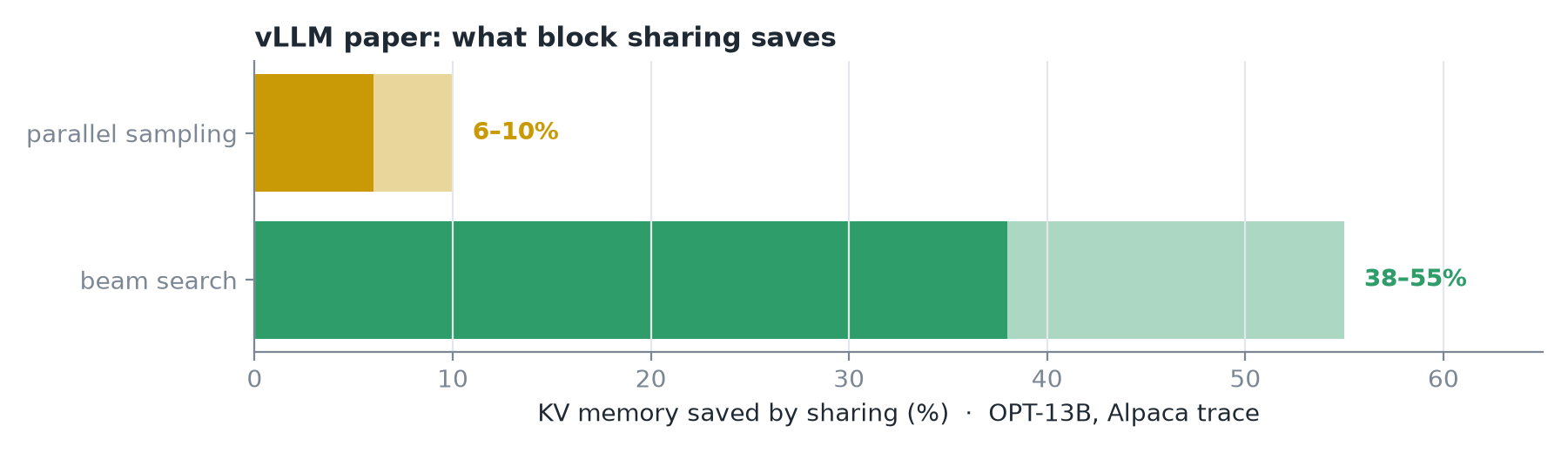 KV memory saved by sharing in the vLLM paper (OPT-13B, Alpaca trace). ◆ Beam search saves more because its candidates share whole branches, not just the prompt.
- The same mechanism lets completely different requests share a common prefix, like a long system prompt. That's prefix caching.
3. Reclaim: free at zero, but keep the contents
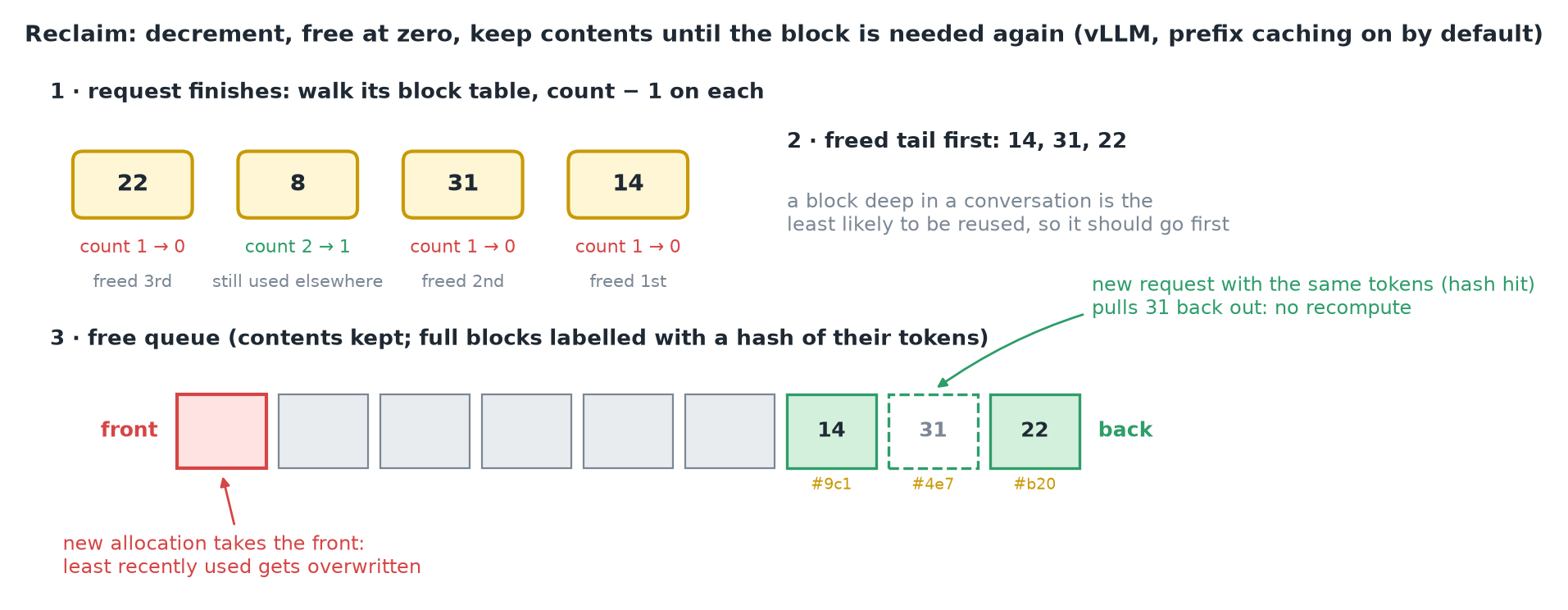 A finished request with table 22, 8, 31, 14. Block 8 is still used elsewhere; the other three go to the back of the free queue. Hash labels are illustrative.
- When a request finishes, the manager walks its block table and decrements each count. Blocks that reach zero go back to the free queue.
- In vLLM, with prefix caching on (the default), a freed block isn't wiped. It joins the back of the free queue still holding its keys and values, and a full block is labelled with a hash of its tokens.
- A new request with the same tokens can pull that block right back out and skip recomputing it.
- New allocations take blocks from the front, so the least recently used ones get overwritten first.
- A request's blocks are freed tail first, because a block deep in a conversation is the least likely to be reused.
IMPORTANT
A freed block is only a candidate for overwriting. Until something takes it from the front of the queue, it's a free cache hit.
4. Recap