51 · BF16, FP8, INT8 & 4-Bit Inference
Source: fanout.sh / inference-eng / 11-02 · ~5.5 min
NOTE
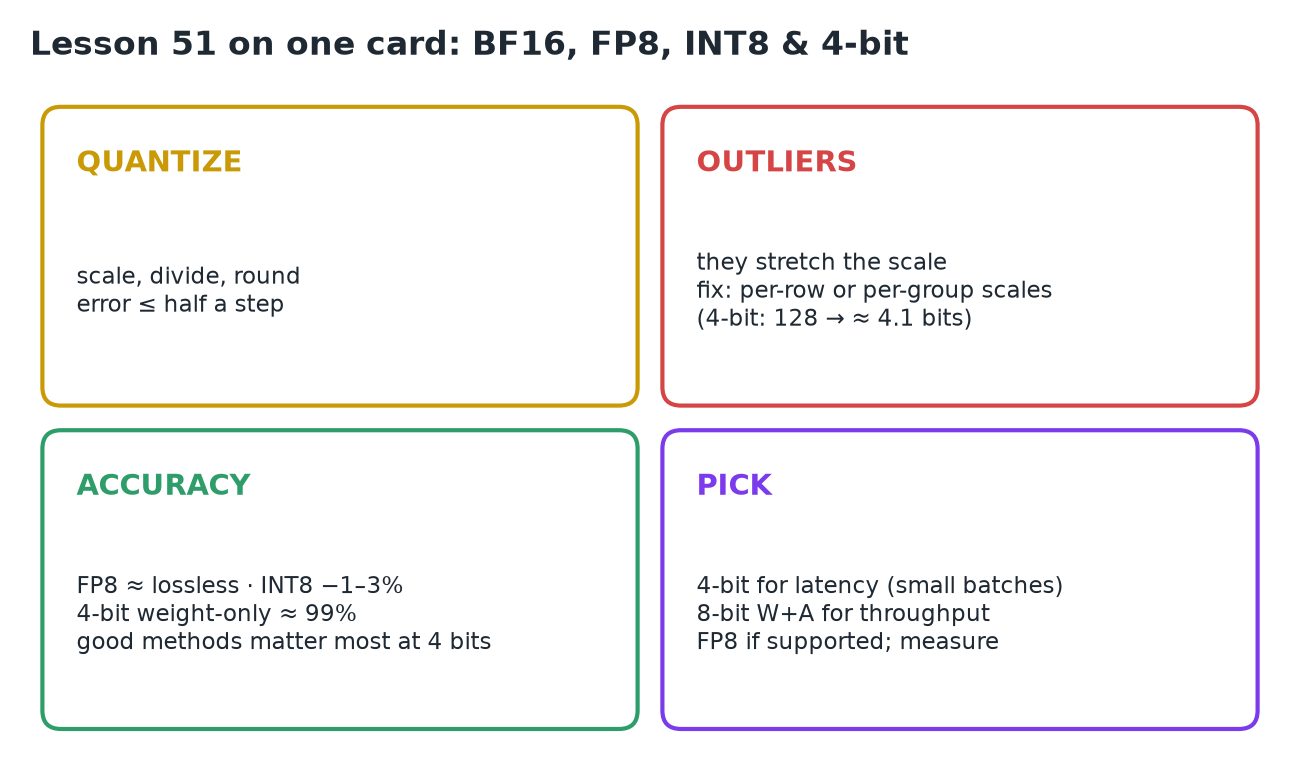
Quantizing is a scale, a divide and a round, with error of at most half a step. One outlier stretches the scale and wipes out everyone else, so use per-row or per-group scales (4-bit: one per 128 weights, ≈ 4.1 bits per weight). On Llama 3.1, FP8 weights + activations are essentially lossless, INT8 W+A loses ~1–3%, and 4-bit weight-only recovers ~99% with a good method. 4-bit suits latency (small batches), 8-bit W+A suits throughput (big batches), and FP8 is the safe default where supported. Measure on your own tasks.
1. What quantizing a number involves
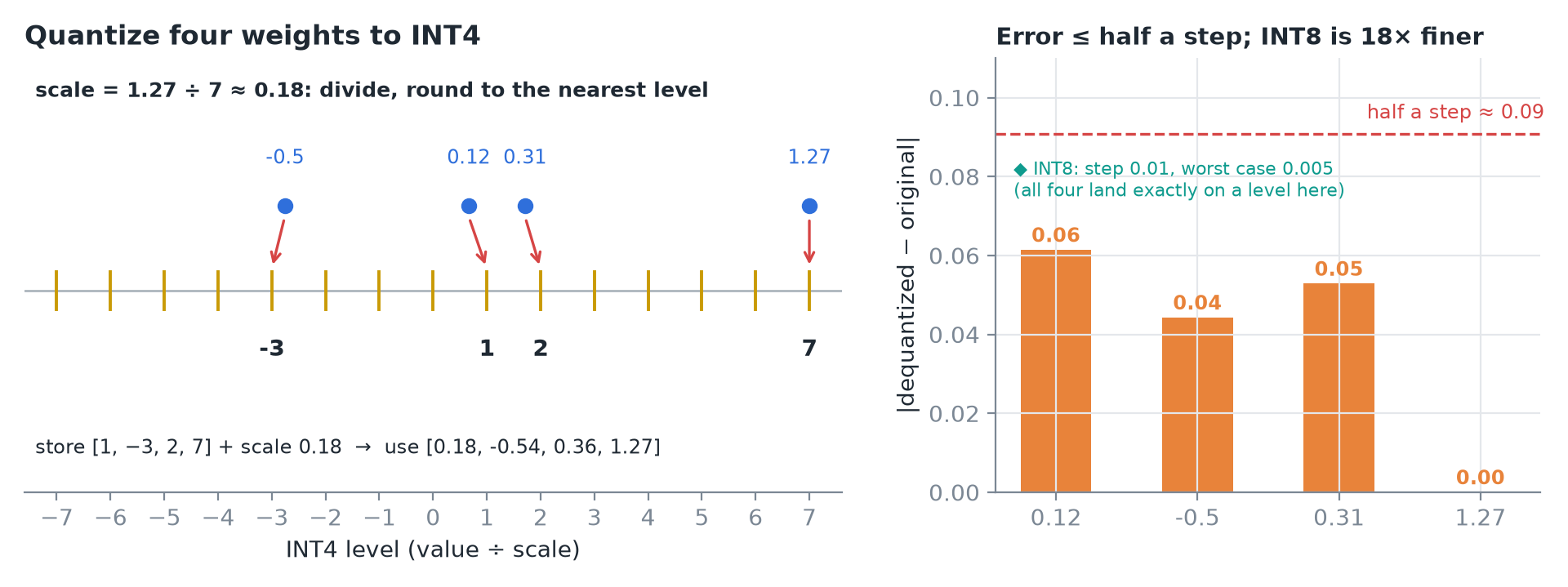 Four weights onto the signed INT4 grid, and how far each one moves.
- Signed INT4 here uses levels −7 to 7. Pick the scale so the largest value lands on the top level.
- Divide and round: [1, −3, 2, 7]. That's what you store: four small integers plus one scale.
- To use them, multiply back: [0.18, −0.54, 0.36, 1.27]. Every value moves, but never by more than half a step (≈ 0.09).
- INT8 has 127 levels on each side, so its steps are 18× finer.
2. Outliers, and finer granularity
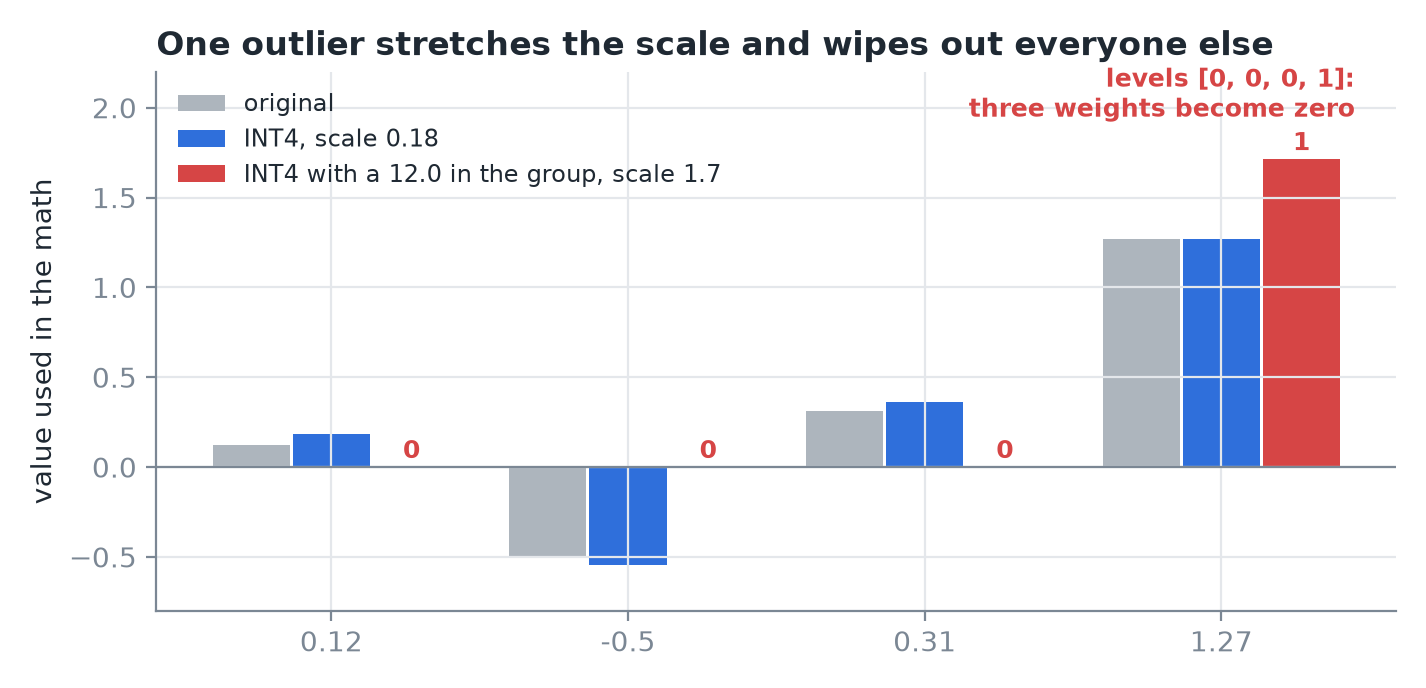 The same four weights, quantized alone and with a 12.0 in their group.
- Add one big value, 12.0, to the group: the scale stretches to 12 ÷ 7 ≈ 1.7, and the four normal weights round to [0, 0, 0, 1].
- LLMs do have outliers, in both weights and activations.
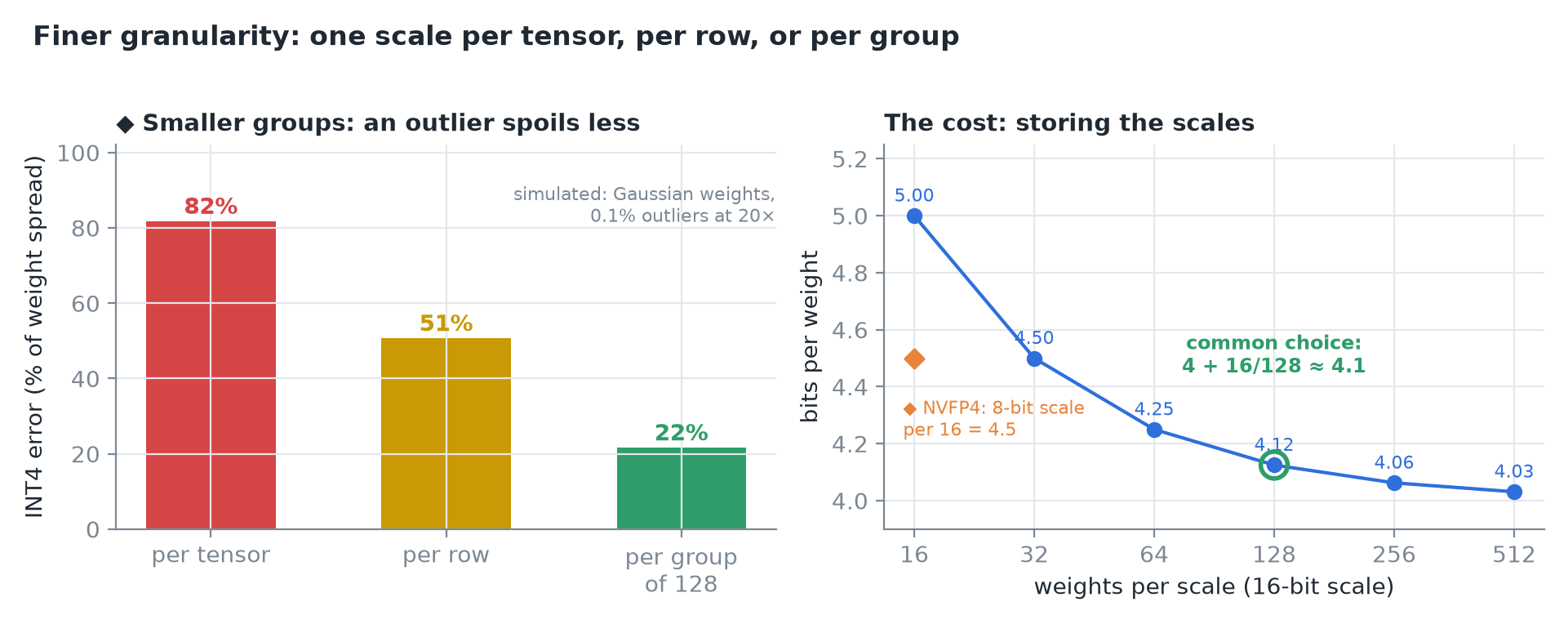 ◆ Left is my simulation; right is the scale overhead at different group sizes.
- The fix is finer granularity: instead of one scale per tensor, use one per row or one per small group. The outlier then only spoils its own group.
- A common choice for 4-bit weights: one scale per 128.
3. The four formats
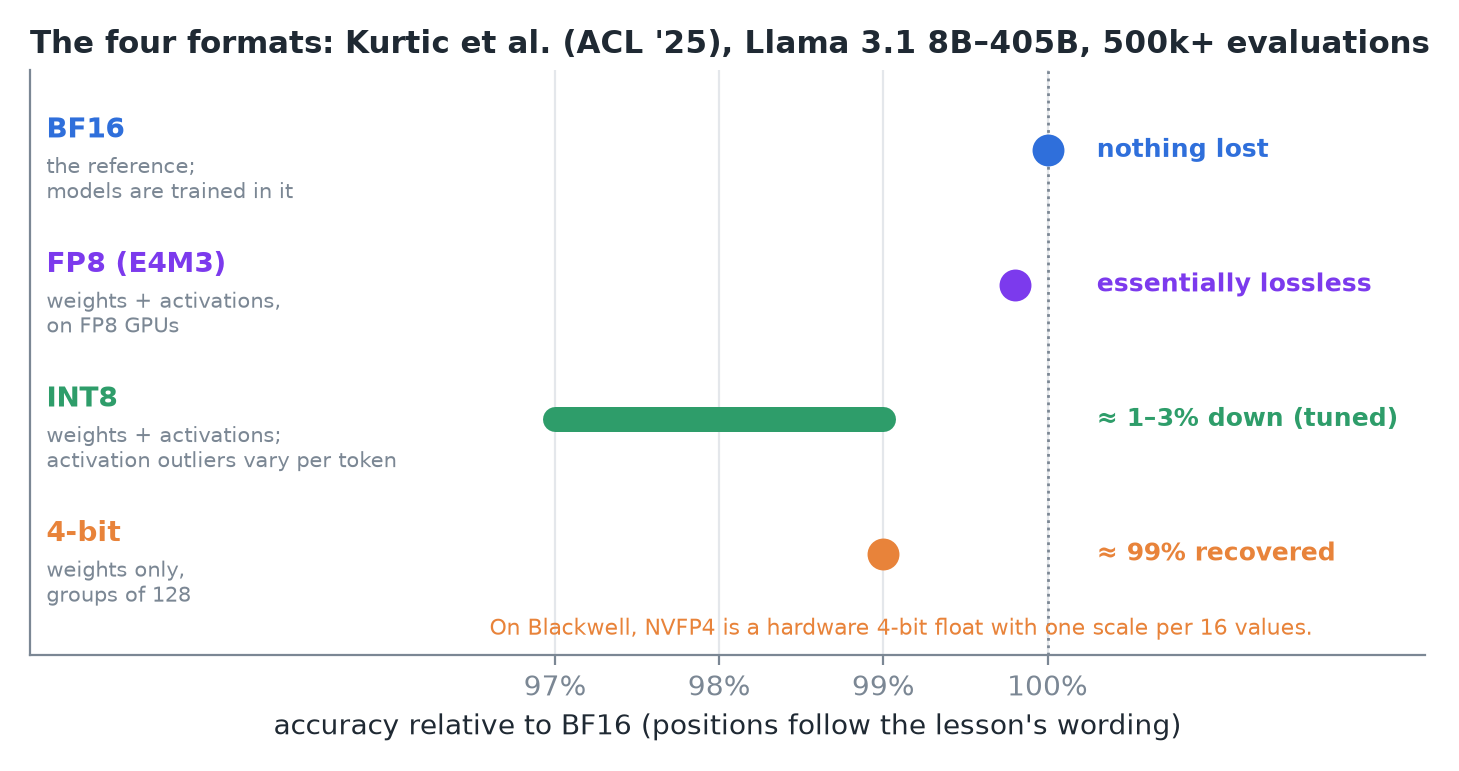 Accuracy from Kurtic et al., "Give Me BF16 or Give Me Death?" (2024, ACL '25): Llama 3.1 8B–405B, 500k+ evaluations.
- BF16 is the reference: most modern models are trained in it, so serving in it loses nothing.
- FP8 (E4M3) is a float grid, dense near zero and sparse far out, which suits bell-shaped weights. With a scale, on GPUs that support it, both weights and activations go to FP8: essentially lossless.
- INT8 weights + activations lost about 1–3% when carefully tuned. Weights are easy; activations have outliers that change with every token.
- 4-bit is mostly weight-only, with activations kept in 16 bits. With a good algorithm and groups of 128 it recovered ~99% of the original accuracy.
- On Blackwell, NVFP4 is a hardware 4-bit float with one scale per 16 values.
4. Which one to pick
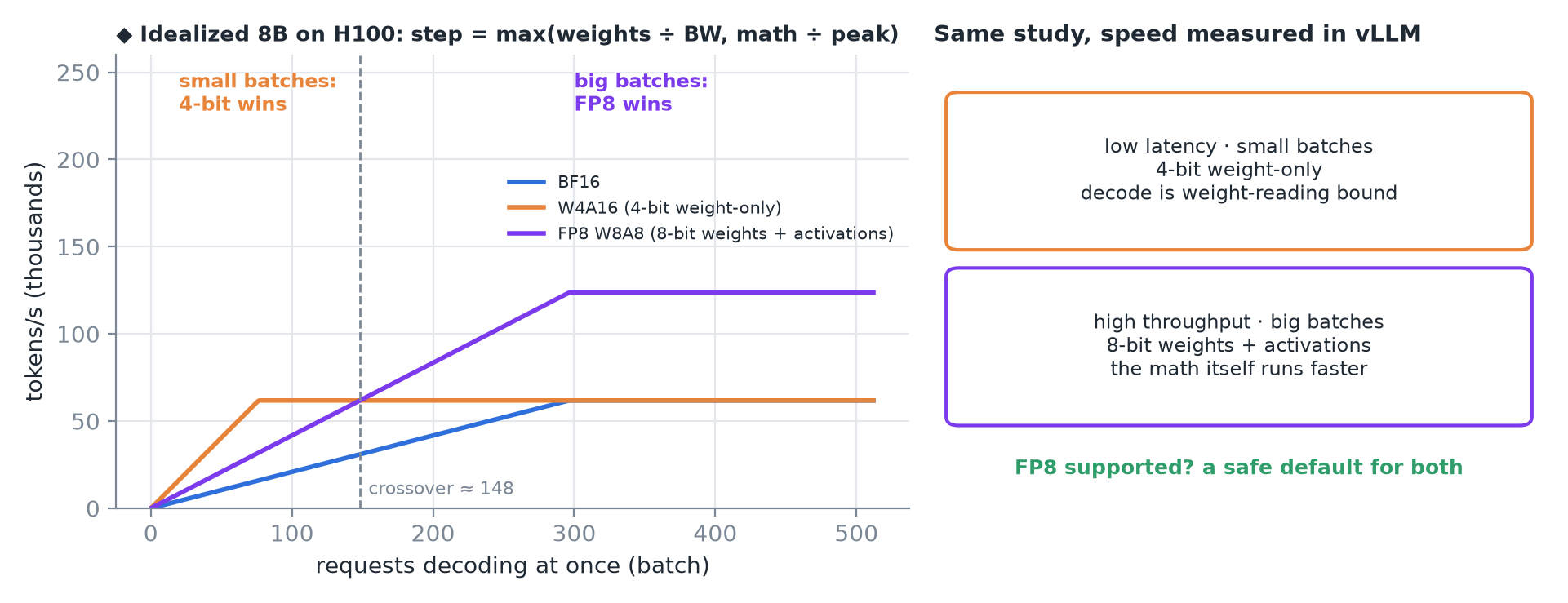 ◆ The left panel is an idealized model, not the study's measurements; it shows why the two regimes differ.
| Serving | Winner in the study (vLLM) | Why |
|---|---|---|
| Low latency, small batches | 4-bit weight-only | decode is limited by reading weights |
| High throughput, big batches | 8-bit weights + activations | the math itself runs faster |
| GPU supports FP8 | FP8 | a safe default for both |
TIP
◆ In the idealized model, 4-bit weight-only wins until about 148 requests per step. Beyond that, decoding is limited by math, and FP8's 2× faster math pulls ahead.
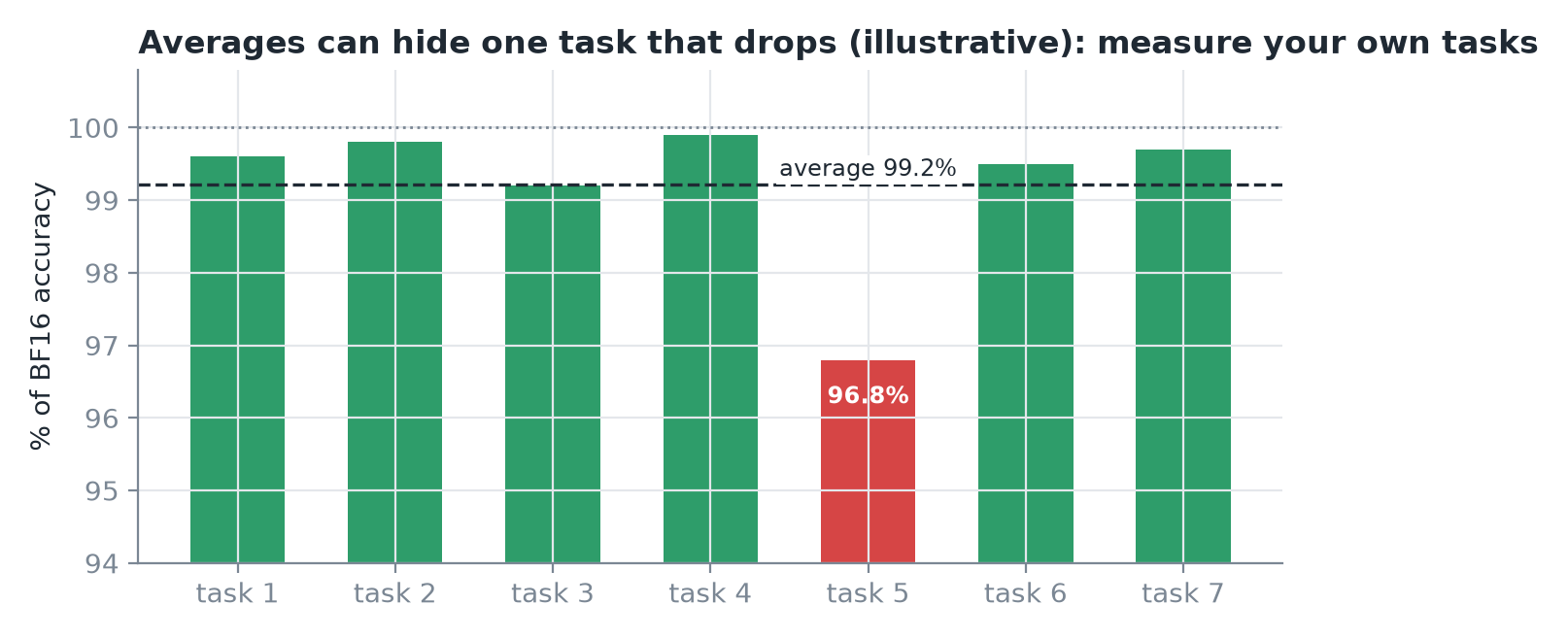 Whatever you pick, look at every task, not just the average.
5. Recap