11 · Q, K, V & Causal Attention During Inference
Source: fanout.sh / inference-eng / 02-02 · ~7 min
NOTE
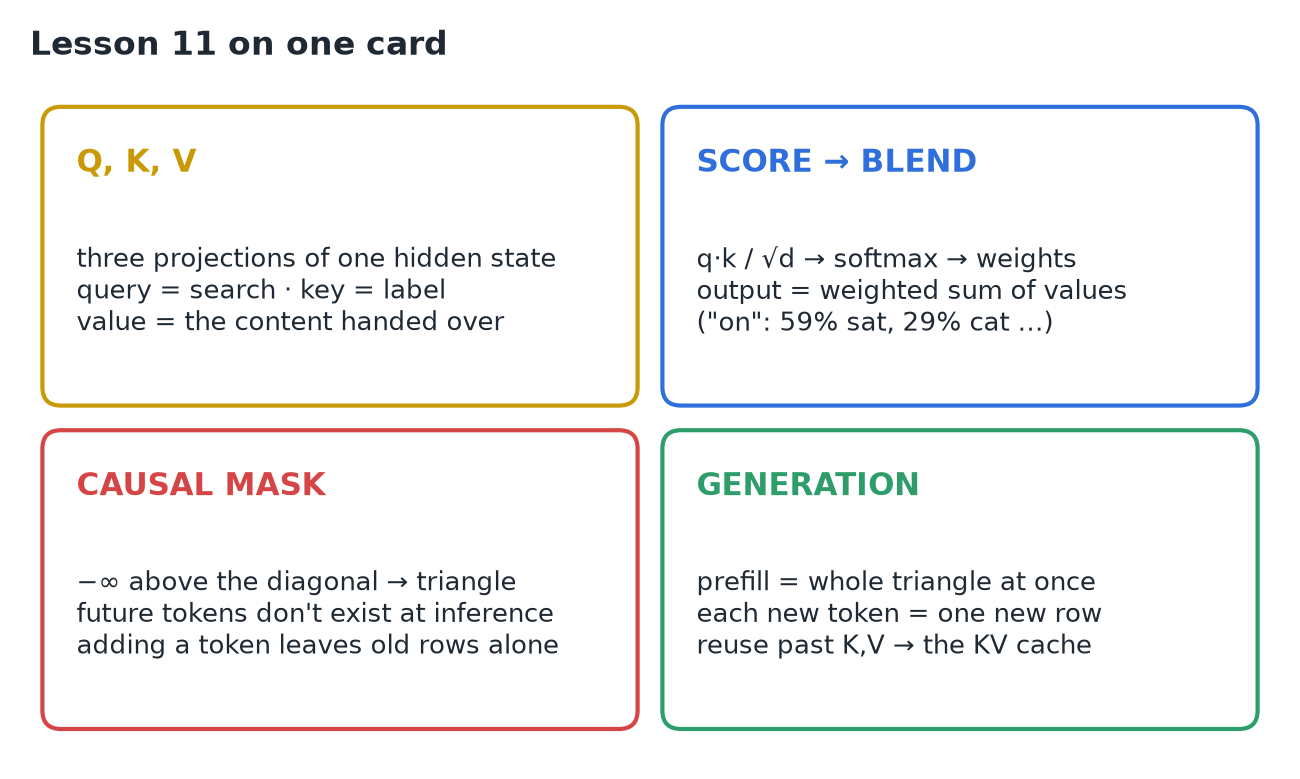
Attention lets each token pull in information from earlier tokens. Every token's hidden state is projected three ways: a query (what I'm looking for), a key (what I offer for matching) and a value (what I hand over). Scores are q·k, scaled and softmaxed into weights, and the output is a weighted blend of values. A causal mask blocks the future, so the score grid is a triangle. During generation, each new token adds one new row. Its query is used once, but every past key and value is read again by every later token. That is why the KV cache exists, and why decode is memory-bound.
1. Why tokens need to look back
In "the animal didn't cross the street because it was too tired", the word "it" means nothing on its own. To be understood it has to look back and find "animal". Attention is the mechanism that lets each position gather what it needs from earlier positions.
2. Query, key, value
Each token's hidden state (4,096 numbers) is multiplied by three learned matrices, W_Q, W_K and W_V, giving three new vectors.
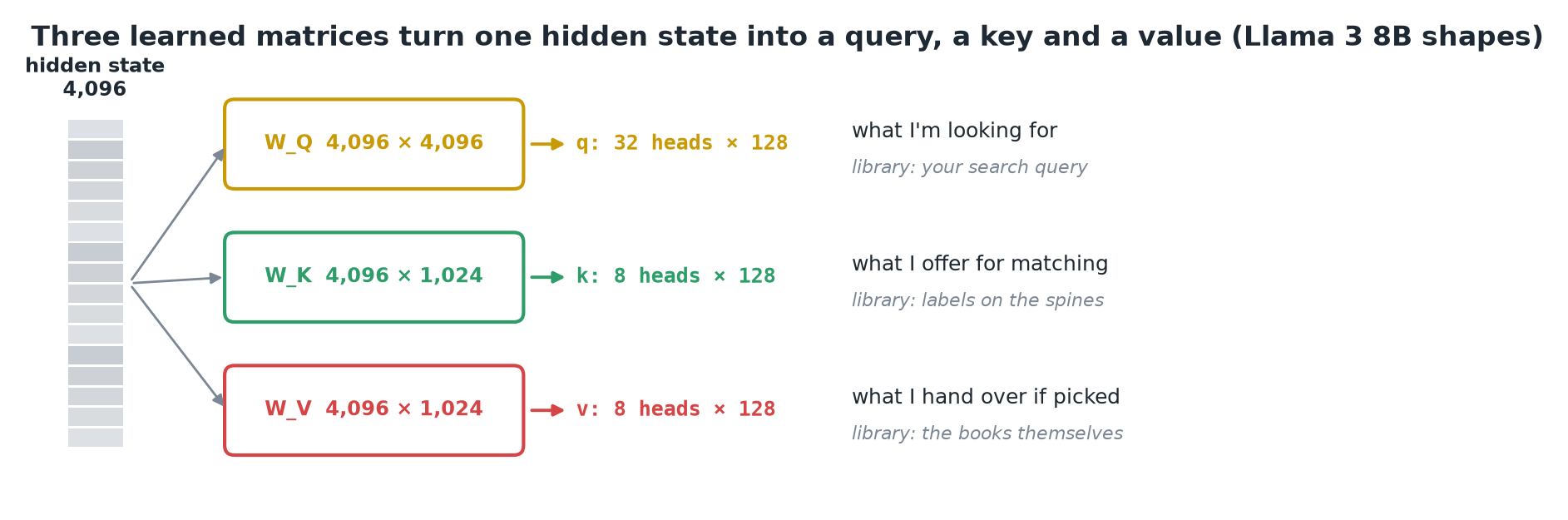 Library analogy: the query is your search, keys are the labels on the spines, values are the books you take home. ◆ W_K and W_V are 4,096 × 1,024 because Llama 3 8B keeps only 8 KV heads × 128.
TIP
Keys decide who gets attention; values decide what gets passed along. They are separate so a token can be easy to find for one reason and contribute something different.
3. Attention by hand
Tokens the, cat, sat, on, with 2-D vectors. The current token is "on", query q = (1, 2).
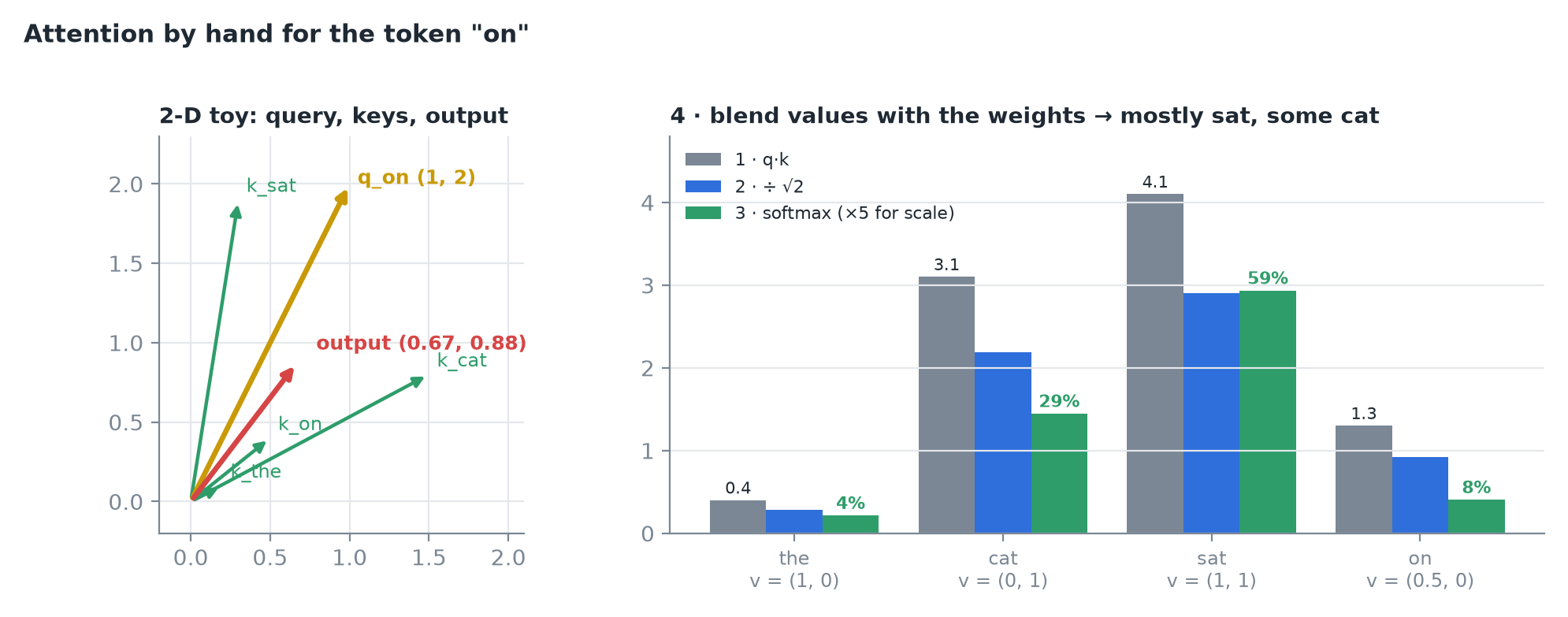 Scores are divided by √2 (the head size here is 2) before softmax.
| Token | Key | q·k | Weight | Value |
|---|---|---|---|---|
| the | (0.2, 0.1) | 0.4 | 4% | (1, 0) |
| cat | (1.5, 0.8) | 3.1 | 29% | (0, 1) |
| sat | (0.3, 1.9) | 4.1 | 59% | (1, 1) |
| on | (0.5, 0.4) | 1.3 | 8% | (0.5, 0) |
Output = 0.04·(1, 0) + 0.29·(0, 1) + 0.59·(1, 1) + 0.08·(0.5, 0) ≈ (0.67, 0.88): mostly sat's value, with some of cat's.
4. The score grid and the causal mask
Do this for every token and you get a grid of scores: rows are queries, columns are keys. A token must never see the future, so every cell above the diagonal gets −∞ before softmax. Since exp(−∞) = 0, those cells get exactly zero weight, and each row still sums to 1.
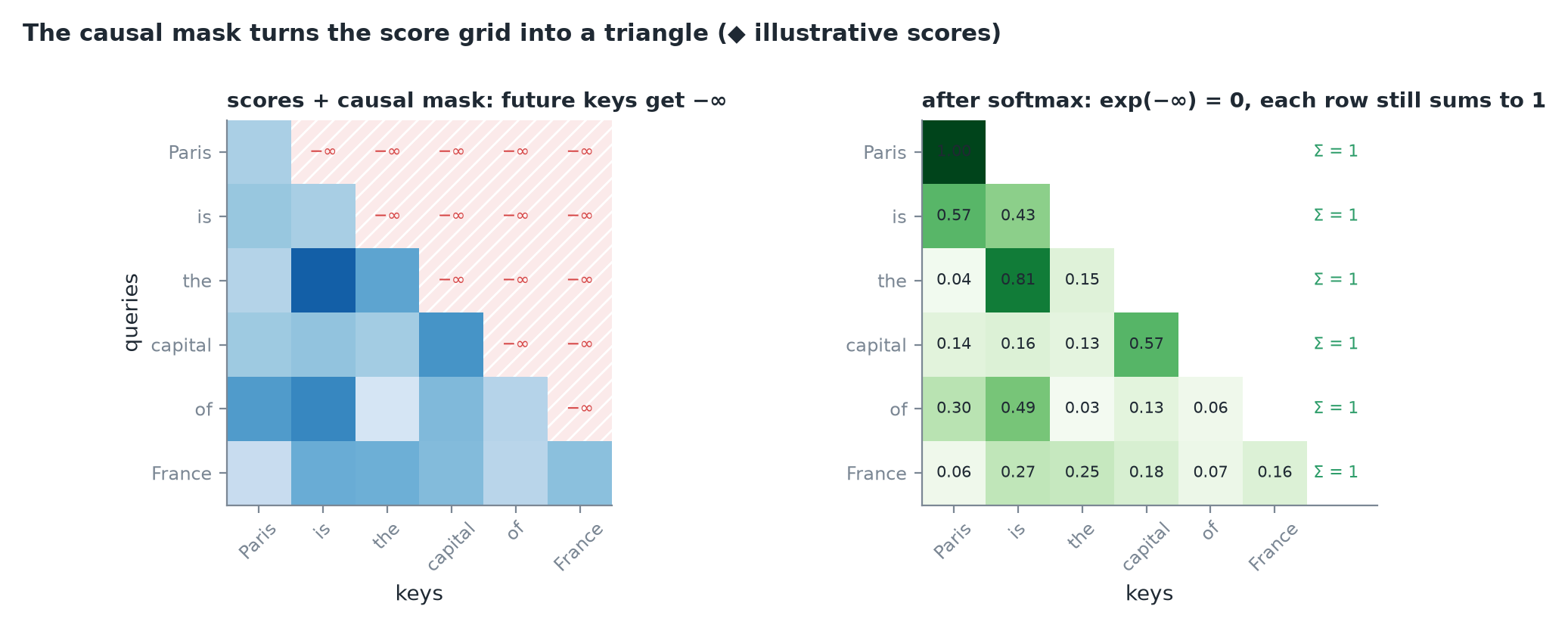 The grid becomes a triangle: row i only mixes tokens 1 … i.
- In training, the mask stops the model from cheating by peeking at the answer.
- At inference, the future doesn't exist yet anyway.
- Consequence: appending a token never changes earlier rows. Their masks already excluded it.
5. Many heads, many layers
One set of Q/K/V is one head. The model runs many heads side by side, and each learns its own pattern: one may track the previous word, another may find a matching name far back.
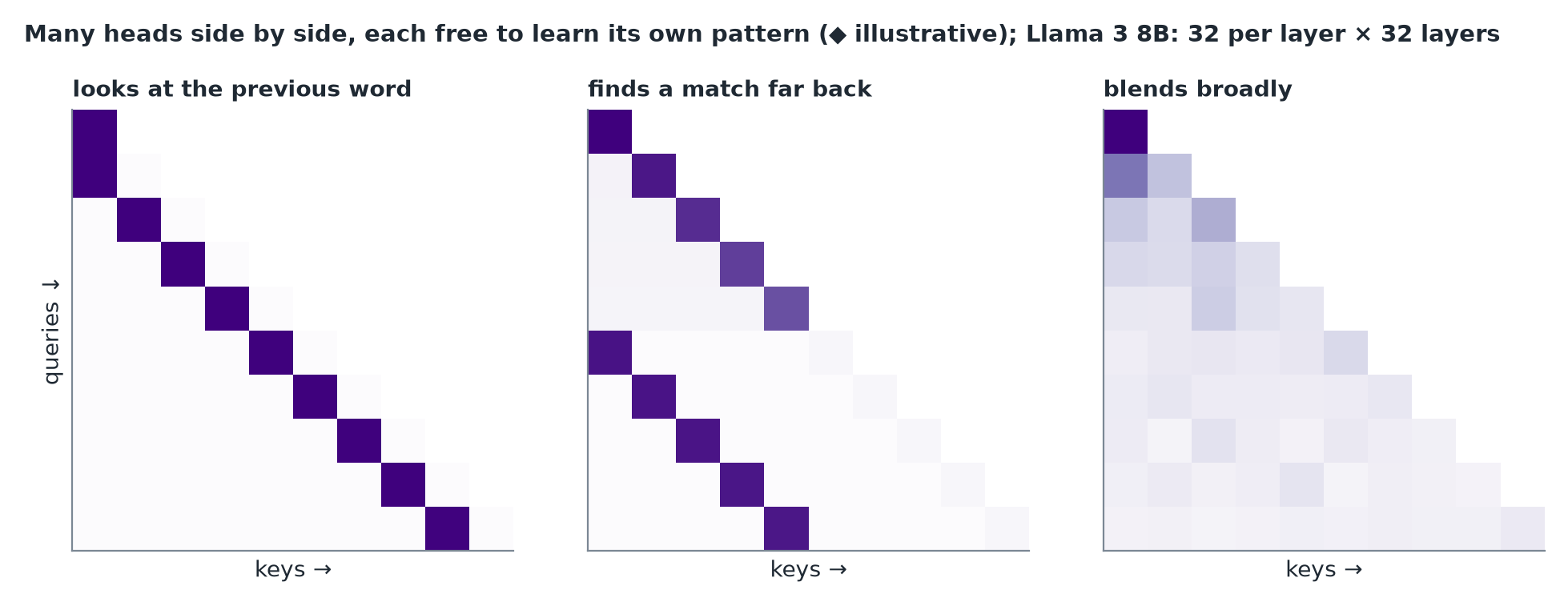 ◆ Illustrative patterns. Each head's outputs are concatenated back to 4,096.
Llama 3 8B: 32 query heads of 128, but only 8 KV heads, each shared by a group of 4 query heads (grouped-query attention, GQA). Stored K/V is 4× smaller. The whole thing repeats in 32 layers (GQA details in 05 and 07).
6. What happens during generation
- Prefill: all prompt tokens are known, so the whole triangle is computed at once in big matrix multiplies.
- Decode: each new token adds one row: 1 query against all keys so far. Earlier rows are untouched (section 4).
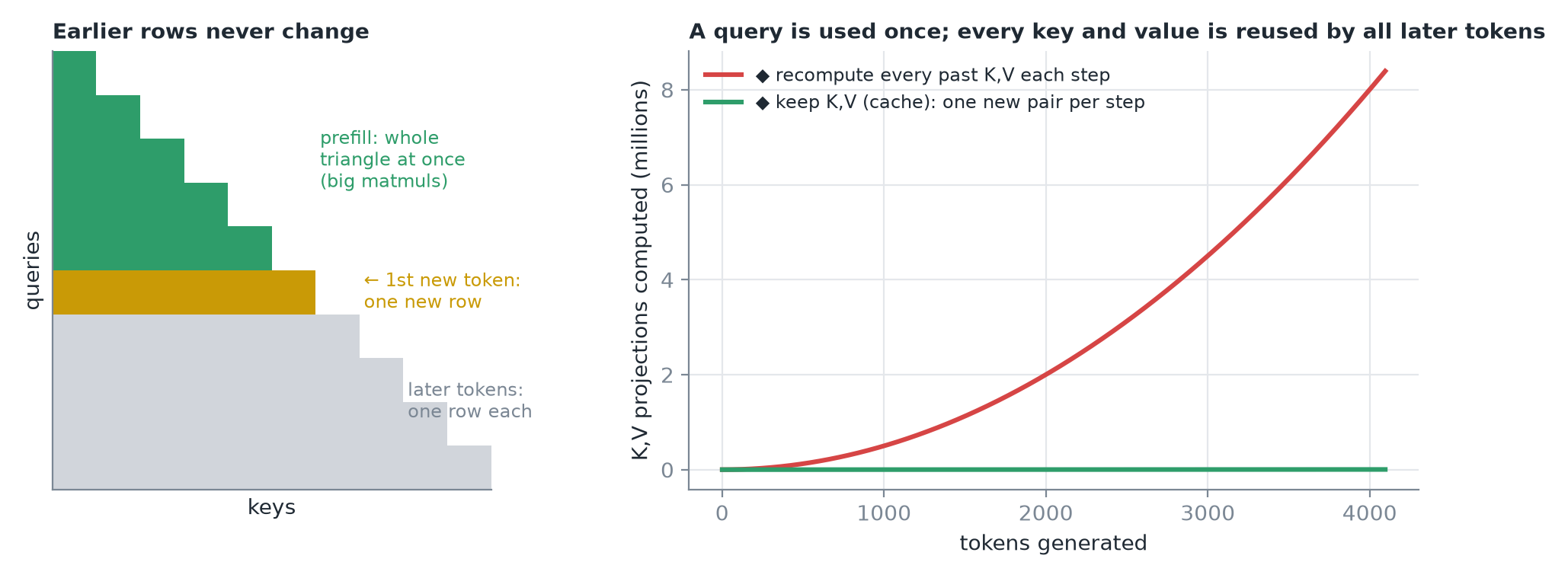 Right (◆): projecting every past K and V again at each step grows like N²/2; keeping them grows like N.
IMPORTANT
A token's query is used once, at its own step. Its key and value are needed by every later token. So engines store K and V instead of recomputing them: the KV cache. At 4,000 tokens × 128 KB ≈ 500 MB of K/V read for every generated token, so decode is memory-bound.
7. Recap