29 · OpenAI-Compatible APIs & Streaming
Source: fanout.sh / inference-eng / 06-03 · ~8 min
NOTE
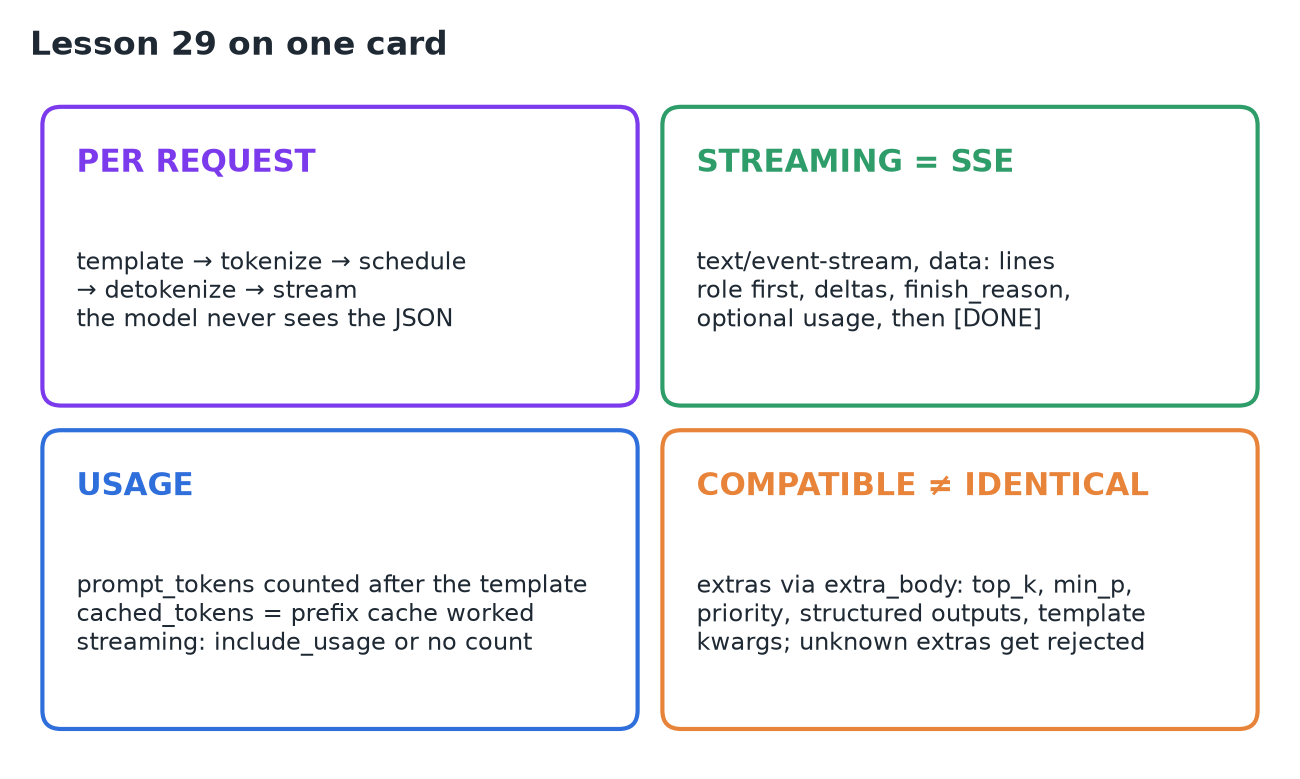
"OpenAI-compatible" is a contract about the wire, not the engine: the same /v1/chat/completions bytes get the same-shaped answer from vLLM, llama.cpp's server or TensorRT-LLM's. Per request the server runs template → tokenize → schedule → detokenize → stream; the model never sees the JSON. Streaming is Server-Sent Events: role first, deltas, a finish reason, optionally usage, then [DONE]. Usage is counted after the chat template, and cached_tokens shows the prefix cache working. Most "weird answer" bugs live in the template step.
1. The contract
A request is a URL ending in /v1/chat/completions, a JSON body with a list of messages, and stream: true. Send it to vLLM and you get an answer; send the exact same bytes to llama.cpp's server or TensorRT-LLM's and you get an answer of the same shape.
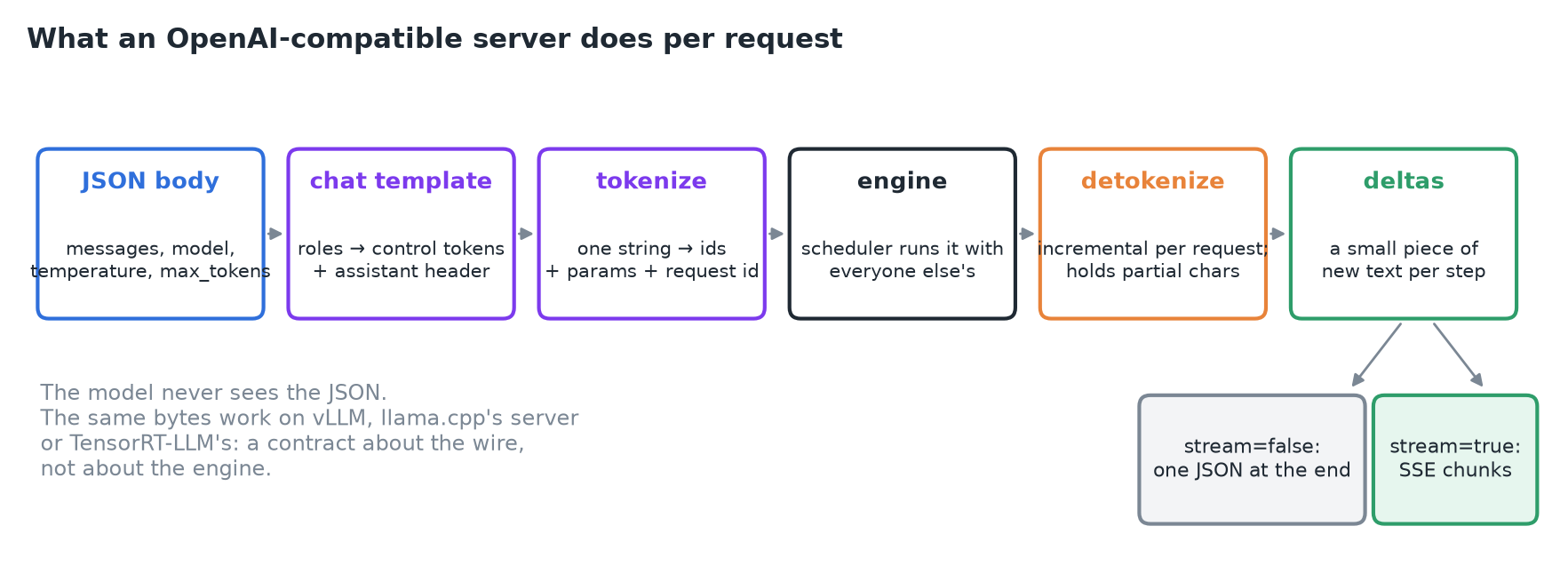 What a compatible server does for every request to keep the contract.
2. From JSON to tokens: the chat template
- The body holds messages (roles and contents), the model name, and sampling knobs: temperature, top-p, a token budget.
- The server runs the message list through the model's chat template, stored in
tokenizer_config.json. Roles become control tokens. For Llama 3.1: a begin-of-text marker, then per message a header with the role, the content, and an end-of-turn marker. add_generation_promptis on by default, so one more header follows: assistant, the cue to reply.- The resulting string is tokenized into ids; those ids, the sampling parameters and a fresh request id go to the engine.
- vLLM requires the model to include a chat template in its tokenizer config; if it lacks one, supply it with
--chat-template.
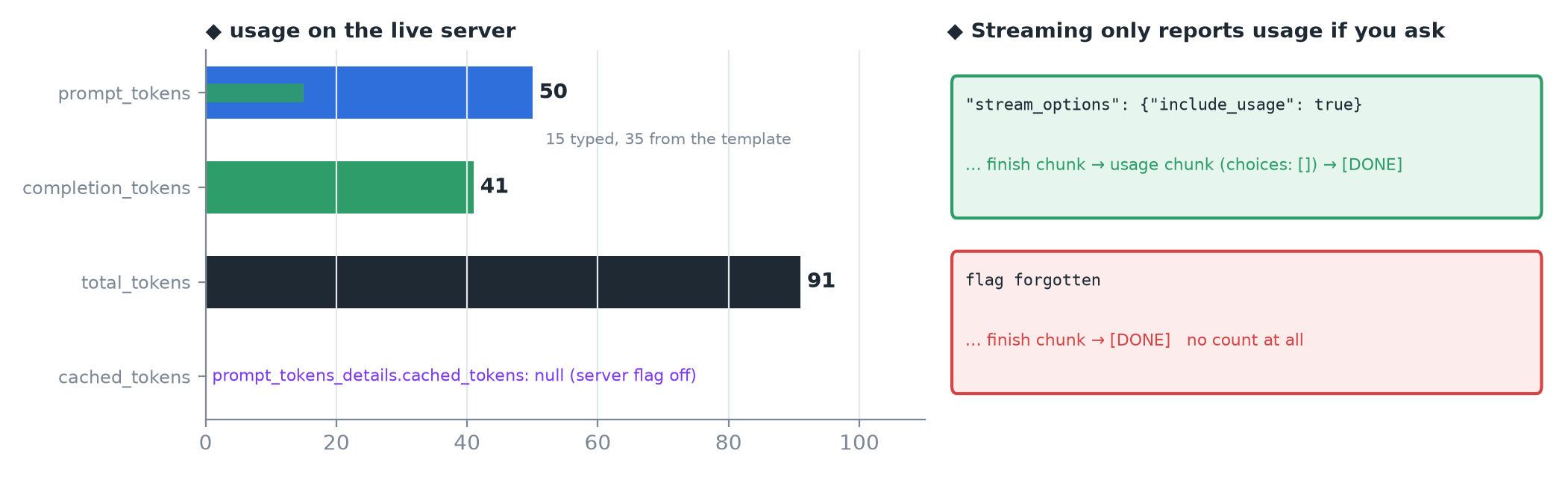
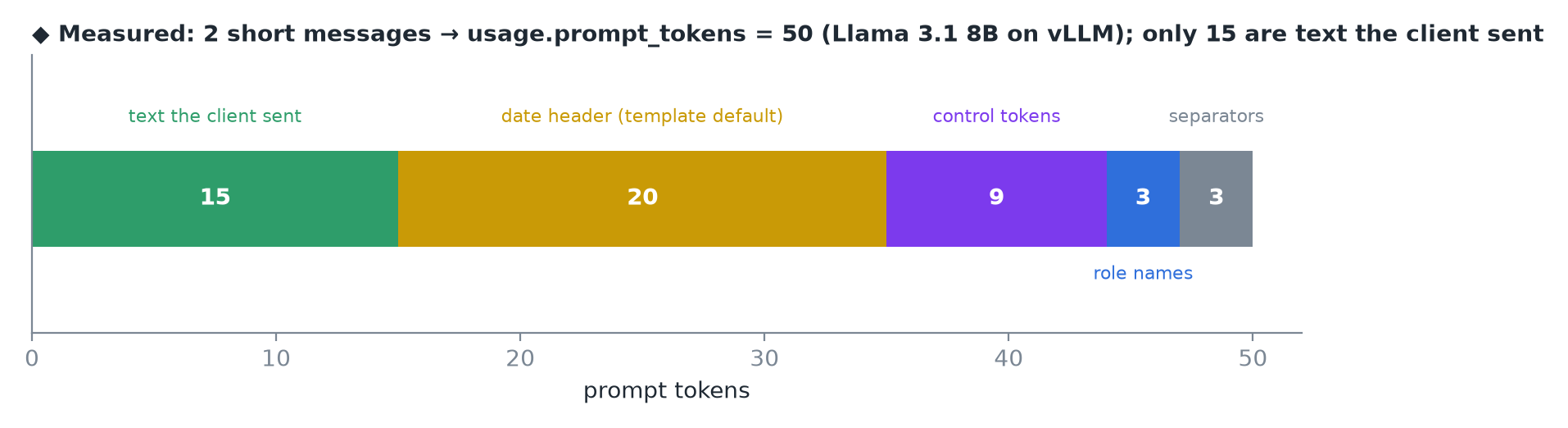 ◆ Measured on my vLLM server: "You are a support assistant." plus "Explain the KV cache in one sentence." become 50 prompt tokens. Llama 3.1's template also injects a "Cutting Knowledge Date / Today Date" header into the system message by default.
WARNING
Most "it answers strangely" bugs live in this step. Wrong template, wrong tokens, and the model is politely continuing a conversation you didn't intend.
3. Into the engine and back
- The server hands the request to the scheduler, which decides when it runs alongside everyone else's.
- Every step returns one new token id for this request.
- The server keeps an incremental detokenizer per request: it turns ids into text as they arrive and holds back bytes that don't yet form a whole character.
- So each step the server has a small piece of new text: the delta.
4. Without streaming: one JSON
The server collects deltas until the request finishes, then sends one object:
{
  "id": "chatcmpl-…", "object": "chat.completion",
  "choices": [{"index": 0,
               "message": {"role": "assistant", "content": "A KV (Key-Value) cache is …"},
               "finish_reason": "stop"}],
  "usage": {"prompt_tokens": 50, "completion_tokens": 41, "total_tokens": 91}
}
finish_reason | Meaning |
|---|---|
stop | An end token or a stop string |
length | Hit the token budget (max_tokens) |
tool_calls | The model asked to call a function |
One JSON, one round trip: fine for short answers, but for a long one the user stares at nothing for ten seconds.
5. Streaming: Server-Sent Events
Streaming changes the wire, not the loop. The server answers with Content-Type: text/event-stream: the connection stays open and the server pushes lines, each data: <json chunk> followed by a blank line.
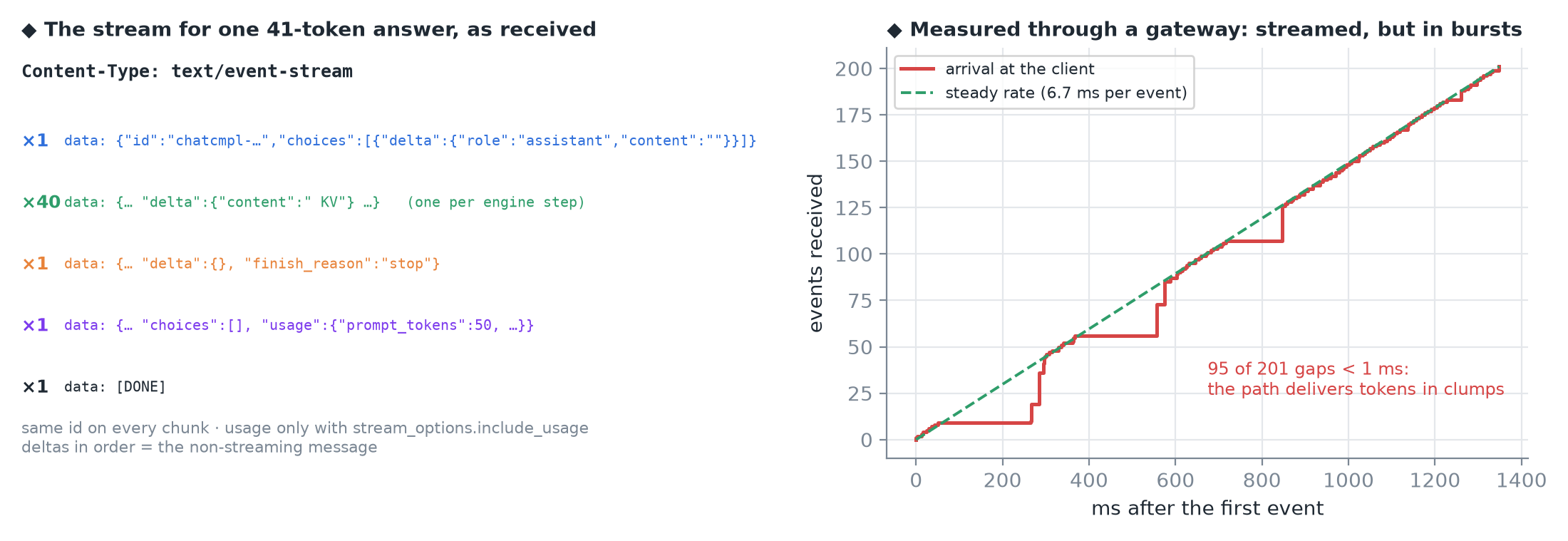 Left: the events for one answer as received (◆ from my server). Right: ◆ through a gateway, 200 tokens arrived in clumps (about half the gaps under 1 ms) even though the server generates at a steady pace.
- The first chunk carries the role,
assistant, with empty content. - Each engine step yields a chunk whose
delta.contentis the new text. Every chunk shares the same id. Empty deltas from chunked prefill are skipped, so the client only sees real text. - The last content chunk carries the
finish_reason. - If you asked for usage, one more chunk arrives with
choicesempty and the usage object filled. - Finally the literal line
data: [DONE], and the client closes.
Reassemble the deltas in order and you get exactly the message the non-streaming call would have sent.
6. Usage accounting
Usage is how you get billed and how you notice a cache.
prompt_tokensis counted after the template: it includes the system prompt and all the control tokens, not just what the user typed.completion_tokensis what the model produced.- vLLM adds
prompt_tokens_details.cached_tokens: how many prompt tokens were served from the prefix cache instead of recomputed. - In streaming you only get usage if you ask:
stream_options: {"include_usage": true}. The OpenAI spec says the usage chunk is streamed right before[DONE], with an emptychoicesarray.
 ◆ On my server
cached_tokens comes back null: vLLM only fills prompt_tokens_details when started with --enable-prompt-tokens-details (off by default). Without include_usage, the stream ended with no count at all.
7. Compatible doesn't mean identical
Engines add knobs the OpenAI API never had. From vLLM's request schema:
| vLLM extra | What it does |
|---|---|
top_k, min_p, repetition_penalty | Sampling beyond the OpenAI set |
priority | Lower runs earlier, if the server uses priority scheduling |
structured_outputs | Constrain output: JSON schema, regex, grammar, or a fixed set of choices |
chat_template_kwargs | Template switches (e.g. thinking on/off) |
continue_final_message | Prefill the start of the reply |
A client sends them through extra_body, alongside the standard fields:
client.chat.completions.create(
    model="llama-8b", messages=messages, stream=True,
    extra_body={"top_k": 40, "priority": 1},
)
A server that doesn't know them rejects them, so extras are the one place engines differ on the wire. Two server flags shape the contract from the other side: --max-model-len caps prompt plus output, and --chat-template overrides the model's own.
8. Three bugs, all visible on the wire
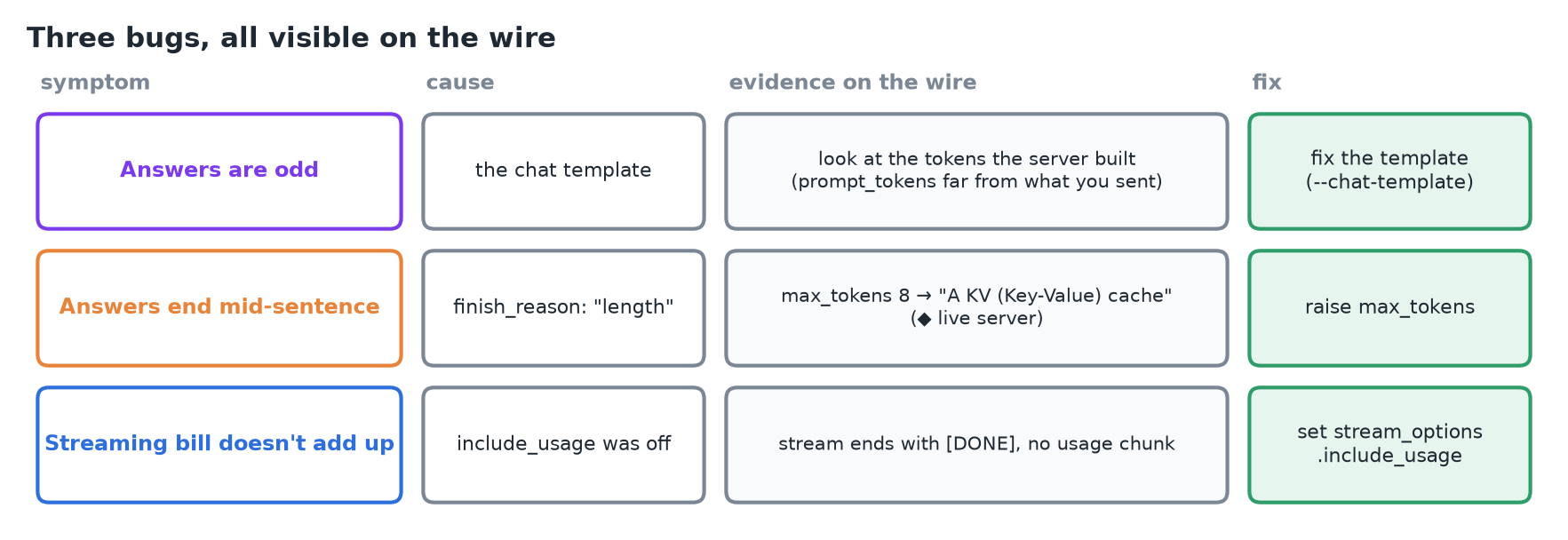 Odd answers: inspect the tokens the server actually built. Mid-sentence endings:
finish_reason says length. A streaming bill that doesn't add up: include_usage was off.
9. Recap