07 · Transformer Architecture Refresher
Source: fanout.sh / inference-eng / 00-06 · ~9 min
NOTE
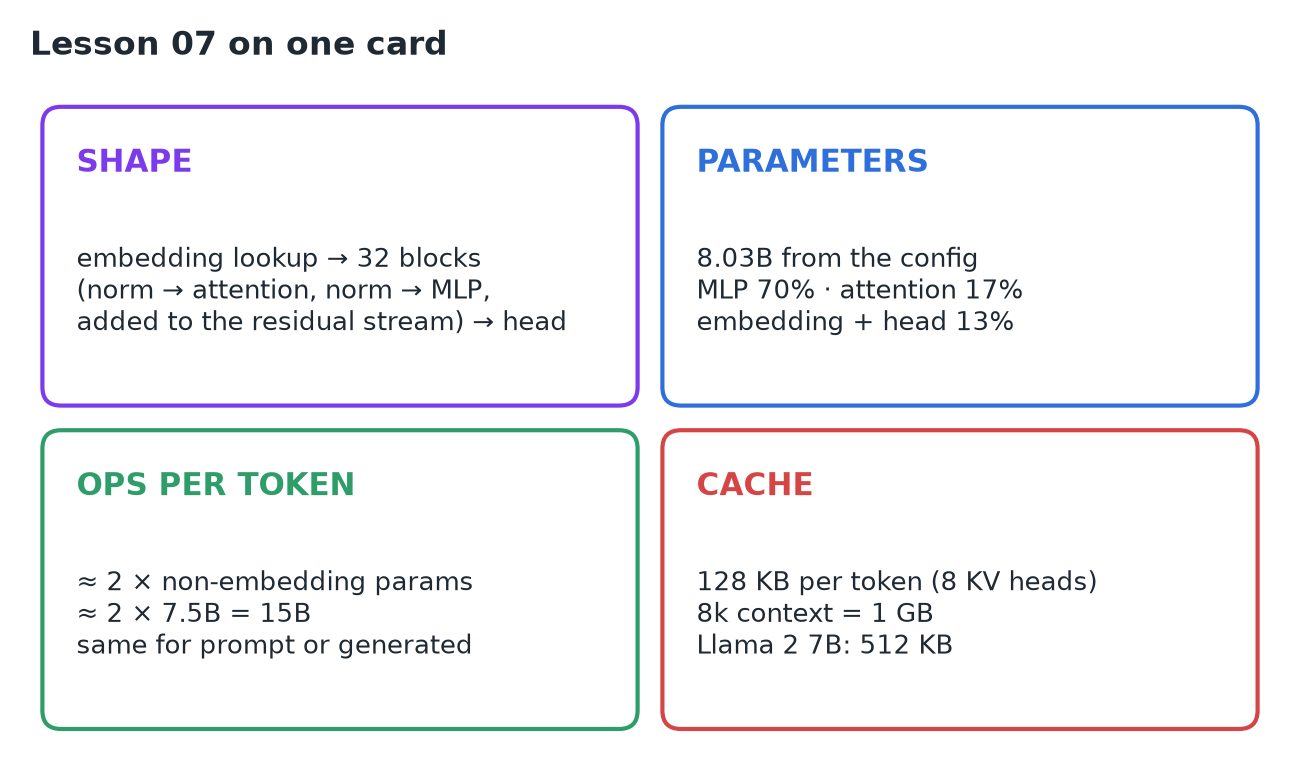
A transformer is an embedding lookup, a stack of identical blocks (attention + MLP, each adding onto a running vector), and a head that scores the whole vocabulary. Seven numbers in Llama 3 8B's ~30-line config decide its whole bill: 8.03B parameters (70% in the MLPs), ~15B operations per token, and a KV cache of 128 KB per token. New models mostly swap parts of this skeleton, and each swap moves one line of the bill.
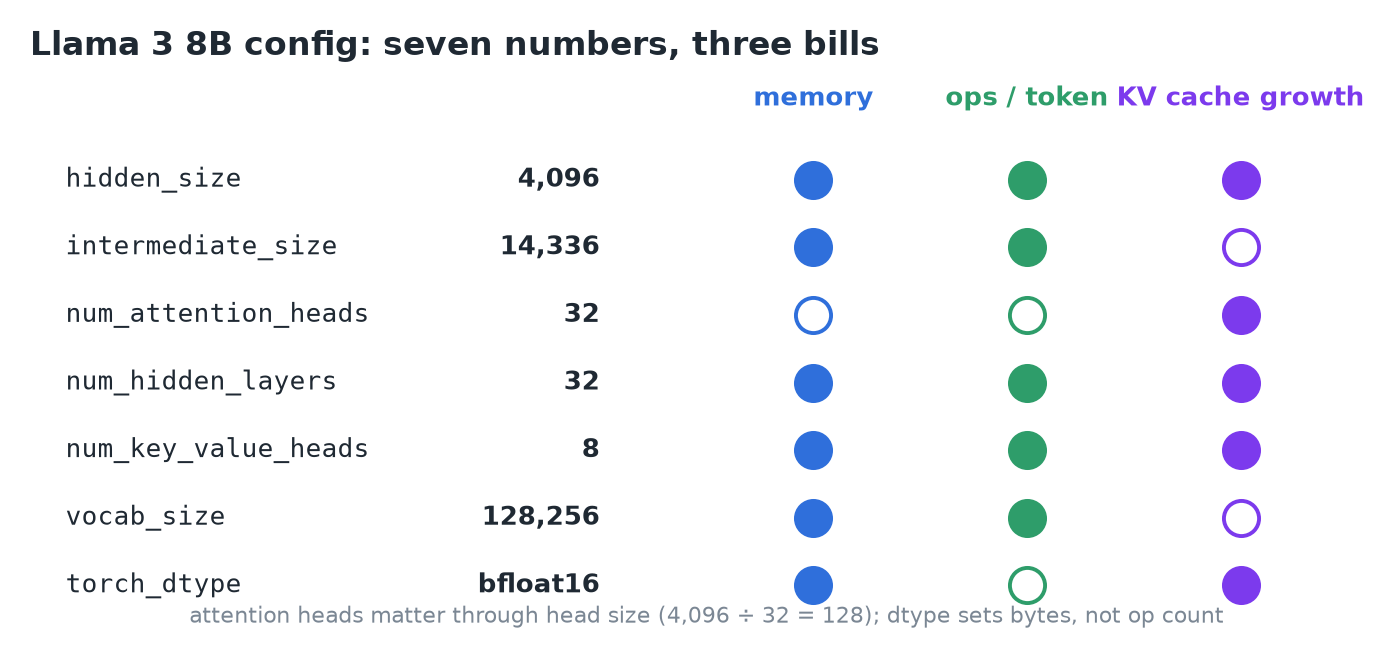 The seven config numbers that matter, and which bill each one feeds.
1. The whole machine
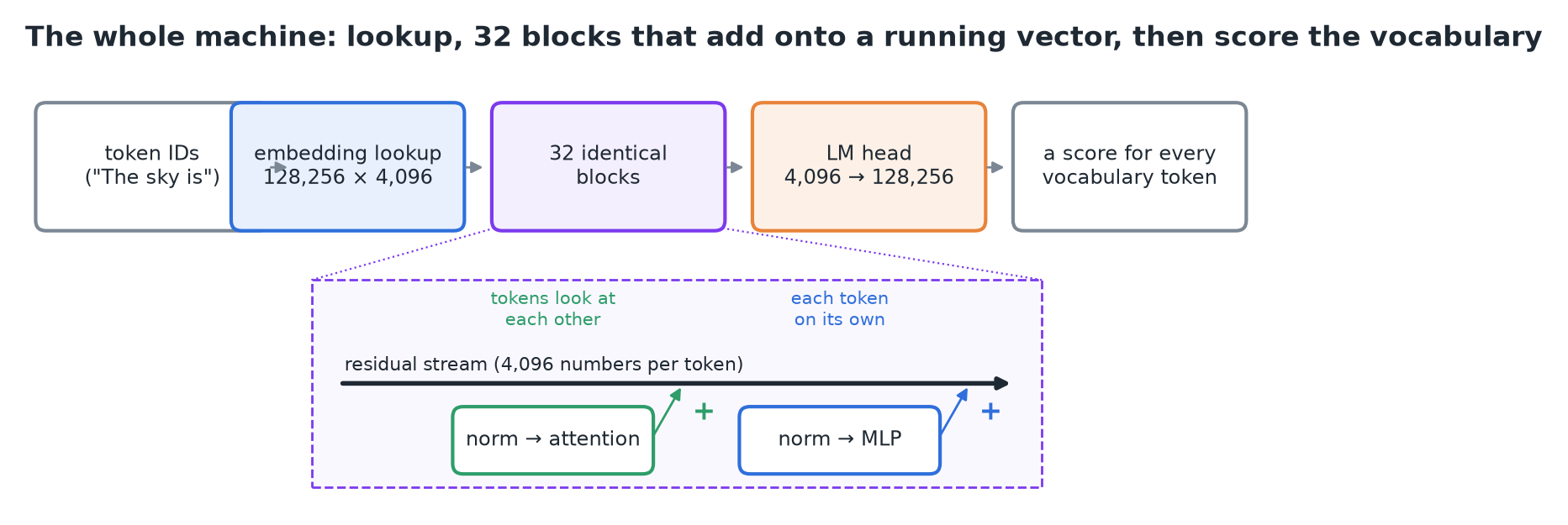 Token IDs pick rows of the embedding table; 32 blocks add their results onto the residual stream; the LM head scores all 128,256 tokens.
- Each token ID picks a row of the embedding table: a vector of 4,096 numbers.
- The vectors pass through 32 identical blocks. Each block has attention (tokens look at each other) and an MLP (each token processed on its own).
- Each part reads a normalized copy of the vector and adds its result back: that running vector is the residual stream.
- The LM head turns each final vector into a score for every vocabulary token (128,256).
IMPORTANT
That's the entire architecture. Everything an inference engine does is about running this stack faster.
2. Counting parameters from the config
| Piece | Shape | Parameters |
|---|---|---|
| Embedding table | 128,256 × 4,096 | ~525M |
| Attention Q, O (per block) | 4,096 × 4,096 each | ~17M each |
| Attention K, V (per block) | 4,096 × 1,024 each (8 KV heads × 128) | ~4M each |
| Attention total (per block) | ~42M | |
| MLP (per block) | 3 matrices of 4,096 × 14,336 | ~176M |
| One block | ~218M → × 32 ≈ 6.98B | |
| LM head (separate, not tied) | 4,096 × 128,256 | ~525M |
| Total | 8.03B (the "8B") |
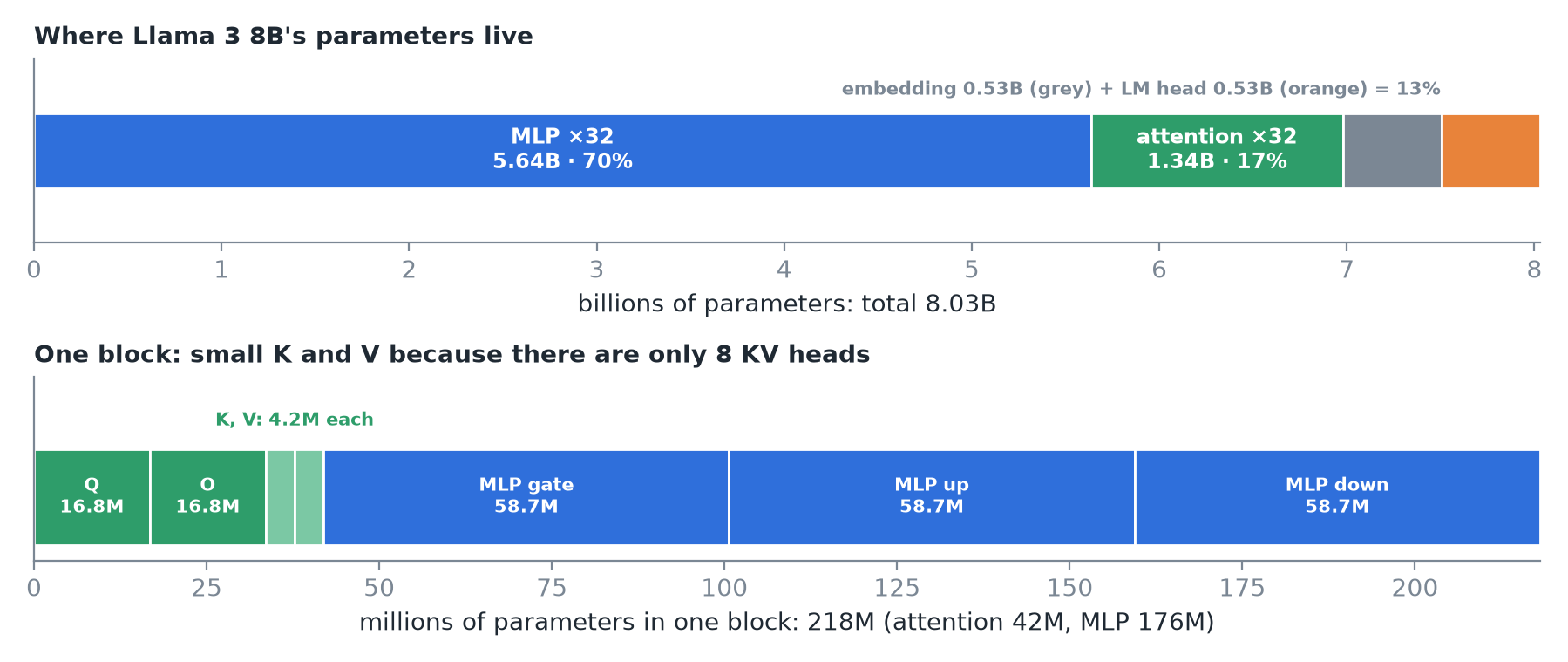 MLPs hold 70% of the weights, attention 17%, embedding + head 13%. Within a block, K and V are small because there are only 8 KV heads.
3. Parameters → bytes
Bytes = parameters × bytes per parameter (see 04): 16 GB at 16-bit, ~8 GB at 8-bit, ~4 GB at 4-bit (plus a little for scaling factors). Decode reads every byte every step, so precision is both a memory knob and a speed knob.
TIP
The MLPs' 70% is where quantization saves most of the bytes, and most of the time.
4. Parameters → operations
Each weight is used once per token as one multiply + one add, so a token costs ~2 operations per parameter, except the embedding table, which is a lookup (free). The LM head is a real matmul and one of the biggest matrices.
The same 15B whether the token is in the prompt or generated; what changes is how they arrive:
- Prefill: 500 prompt tokens together = 7.5 trillion ops in one batch, keeping the math units busy.
- Decode: 15B ops against 16 GB of weight reads ≈ 1 op per byte: the GPU mostly waits on memory (see 01, 04).
5. The KV cache: the line that grows
Every block keeps the keys and values of every token it has seen, so they're never recomputed. From the config: 8 KV heads × 128 × 2 (K, V) × 2 bytes = 4 KB per token per layer, × 32 layers = 128 KB per token. A full 8k context ≈ 1 GB, for one conversation.
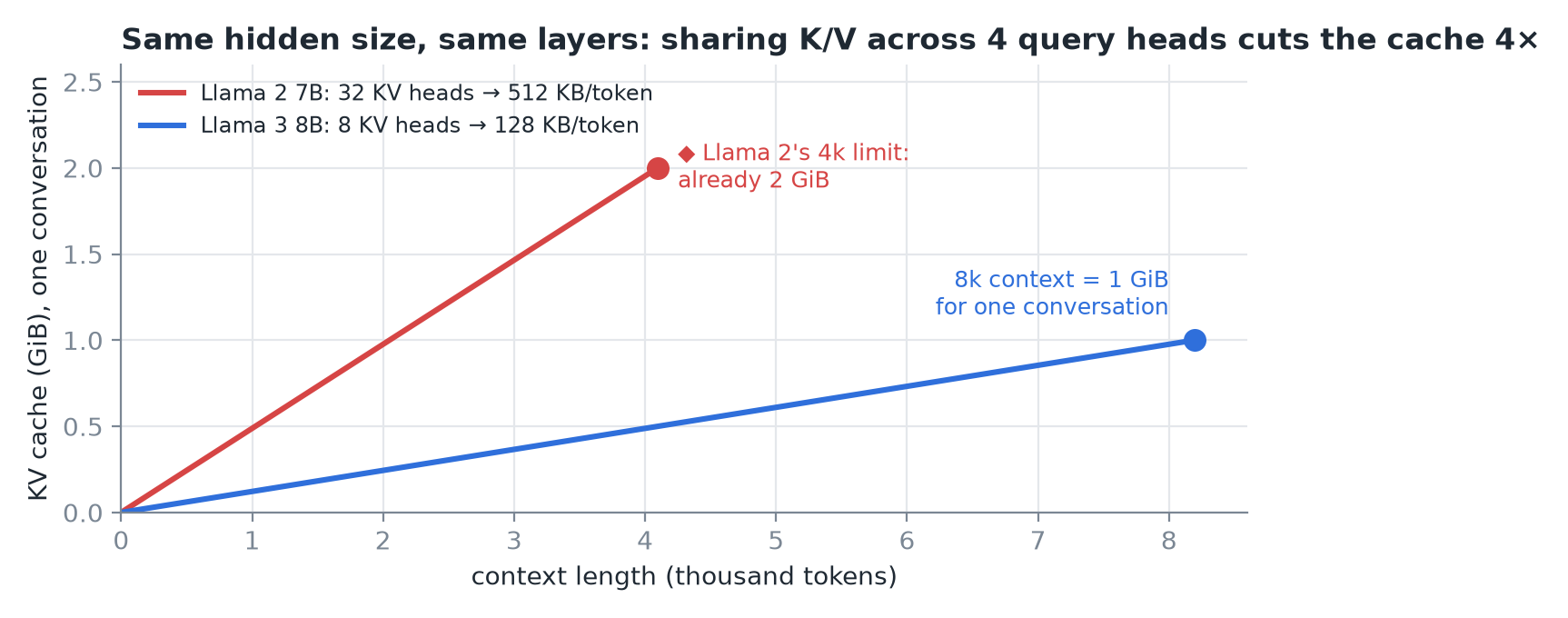 Llama 2 7B gave each of its 32 query heads its own K and V: 512 KB per token, 4× Llama 3 8B, with the same hidden size and layers.
IMPORTANT
Sharing keys and values across groups of query heads (GQA) is one of the cheapest wins in modern architectures.
6. Variants on the same skeleton
- Mixture of experts (MoE): replace the one big MLP with many smaller experts; a router picks a few per token.
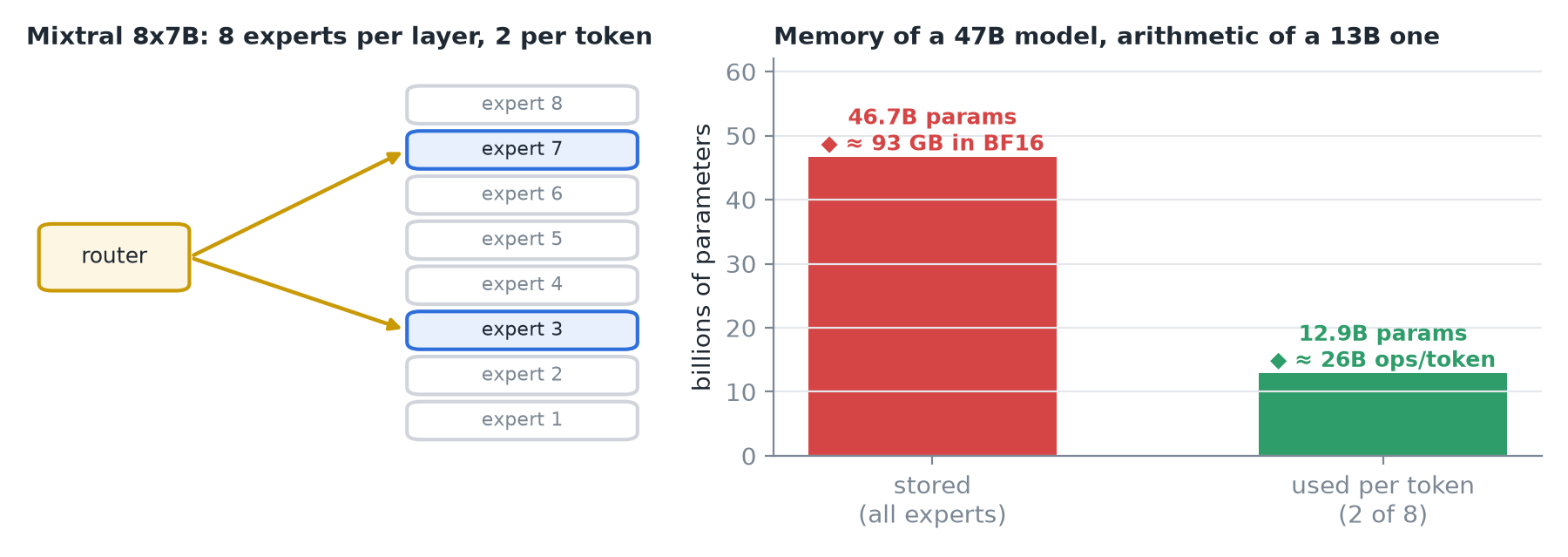 Mixtral 8x7B: 8 experts per layer, 2 per token. 46.7B parameters stored, 12.9B used per token: memory and compute come apart.
- Attention variants: fewer KV heads or compressed keys and values shrink the cache line directly.
- Positions: Llama rotates each query and key by a position-dependent angle (RoPE). With no position table to outgrow, this is part of how Llama 3.1 reached 128k tokens of context.
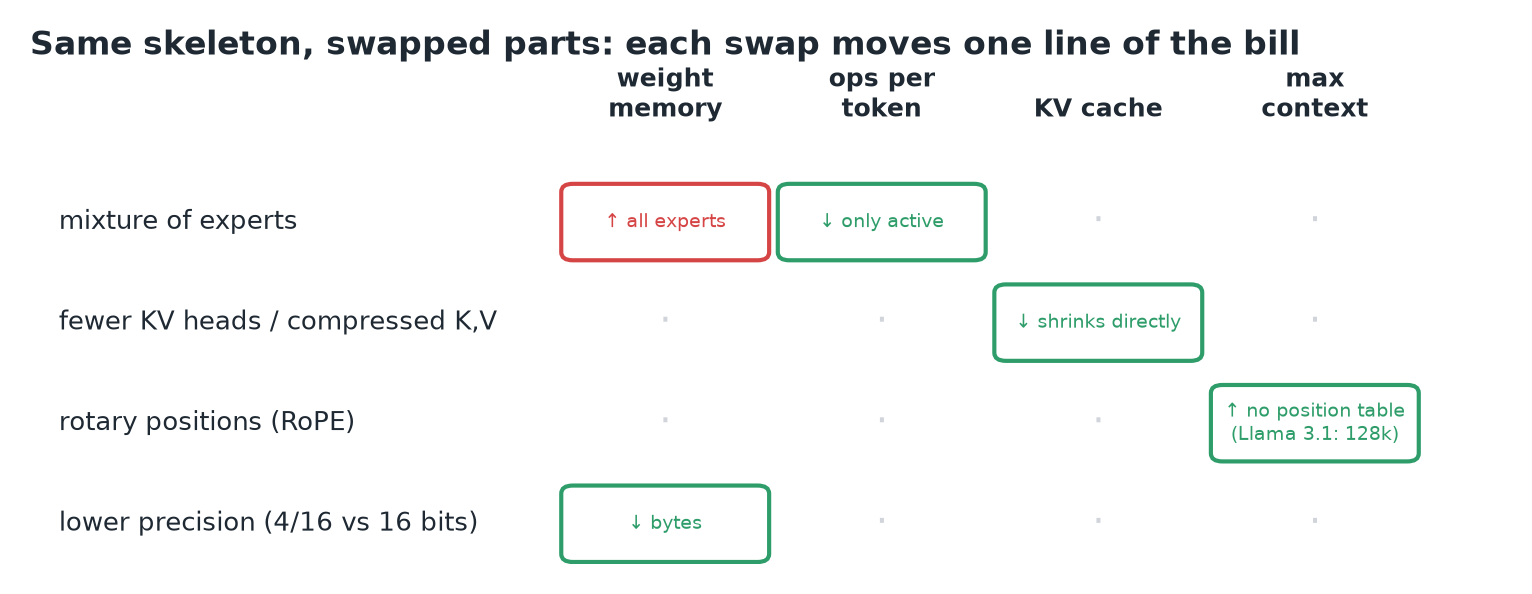 Each swap shows up on exactly one line of the bill.
7. Three corrections
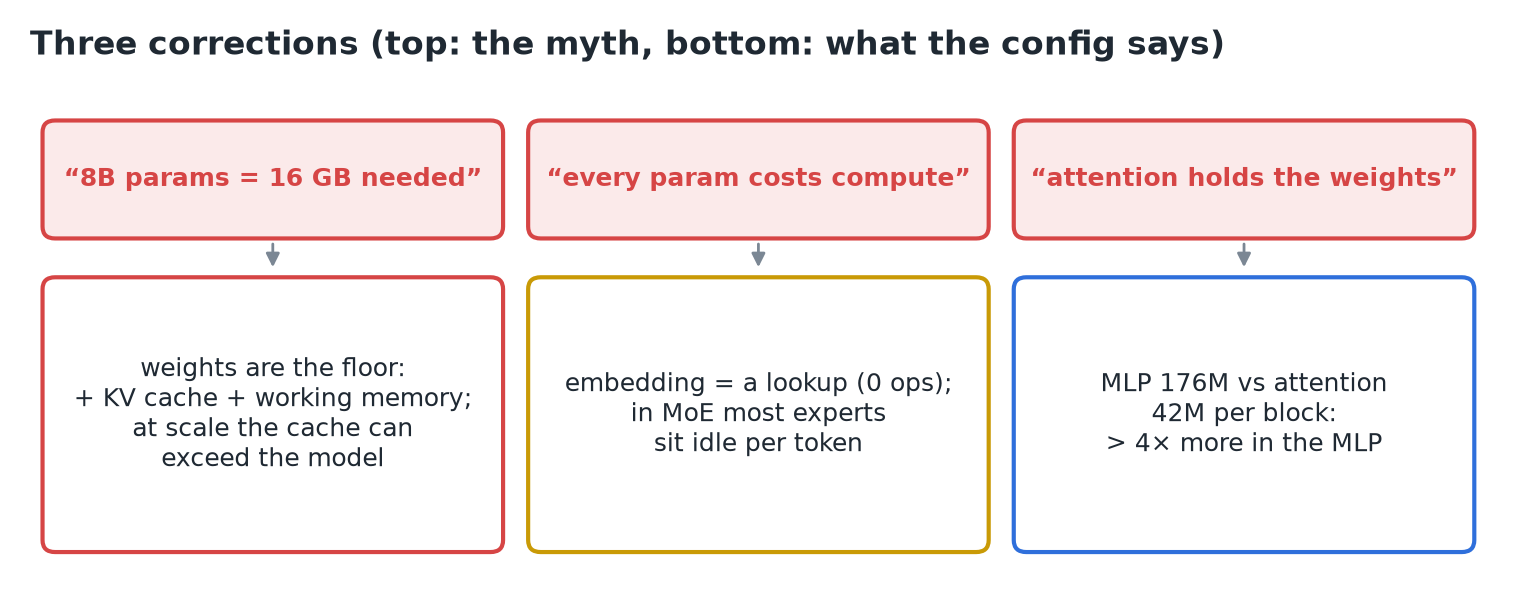 Parameter count isn't memory needed; not every parameter costs compute; the MLPs, not attention, hold most weights.
8. Recap