39 · PagedAttention
Source: fanout.sh / inference-eng / 08-03 · ~4.5 min
NOTE
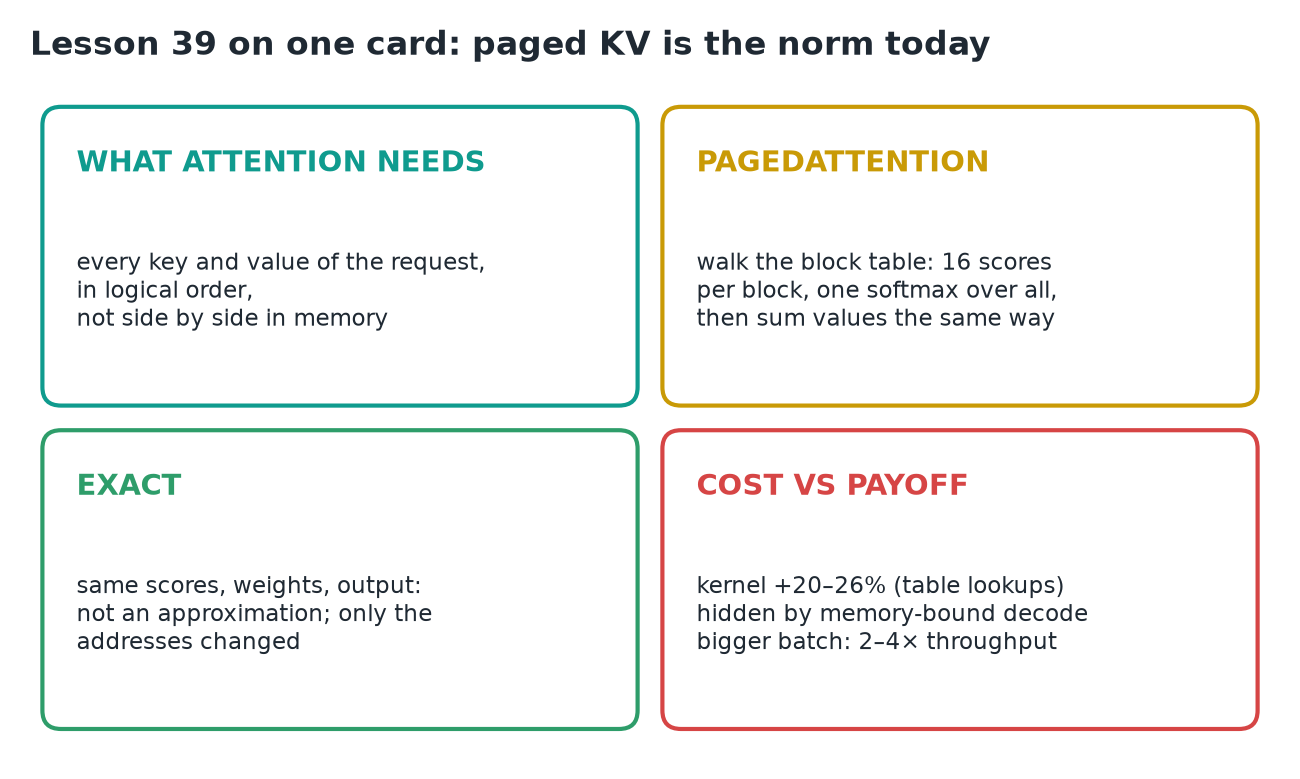
Attention is the one layer that reads the KV cache, and classic kernels expect a request's keys and values to sit side by side. But attention only needs them in logical order, never physically adjacent. PagedAttention reads them straight through the block table: score each block of 16 keys, apply one softmax over all scores, then sum the values block by block. The result is exactly ordinary attention, not an approximation. The kernel runs ~20–26% slower than a contiguous one, but decode is memory-bound and attention is only part of a step, while near-zero waste fits far more requests: 2–4× throughput at the same latency. Today FlashAttention and FlashInfer accept block tables directly.
1. What attention needs
For one new decode token: its query is compared with the key of every earlier token (dot product → one score each), a softmax turns scores into weights that sum to 1, and the output is the weighted sum of all value vectors.
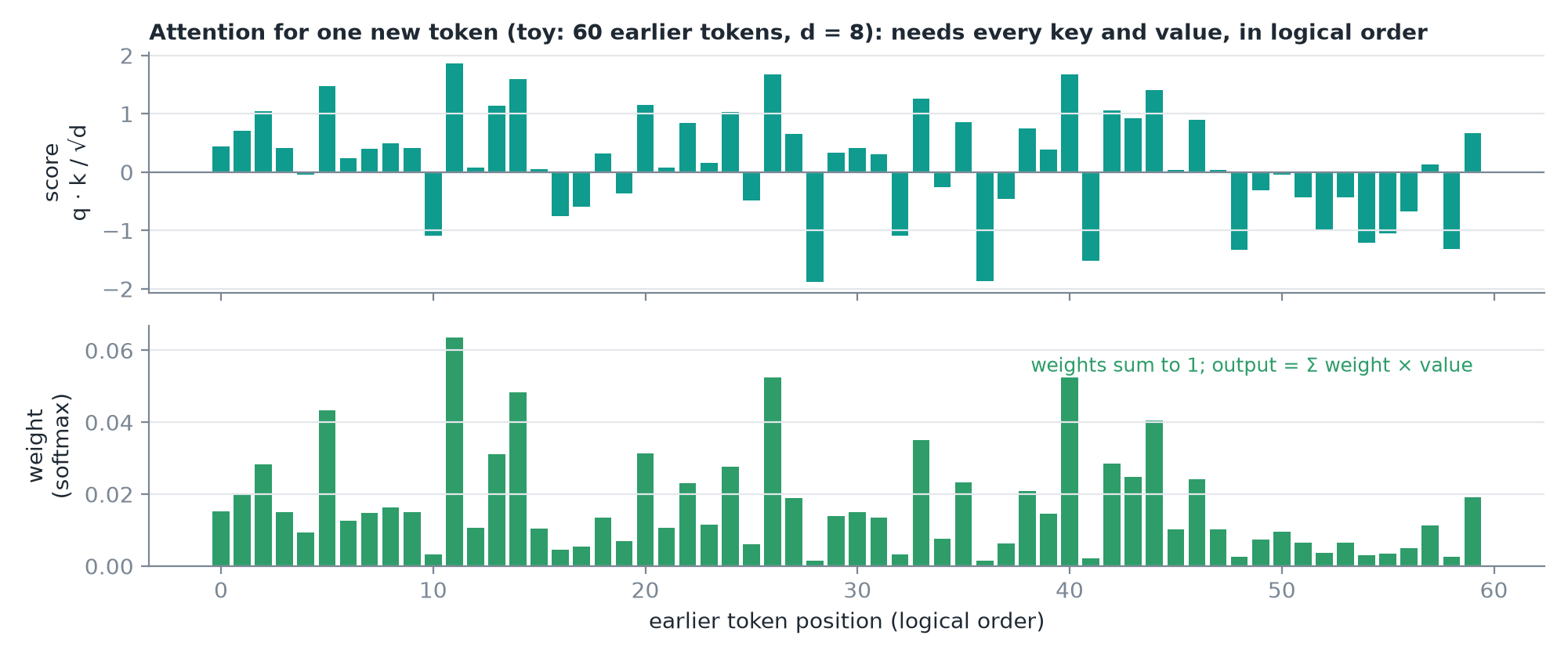 It needs every key and value of this request, token by token in logical order. It never needs them physically next to each other.
2. The paged version
For the 60-token request with block table 7, 1, 12, 4:
- Walk the logical blocks in order. Logical 0 → physical 7: load those 16 keys in one go, compute 16 scores. Then physical 1 (16 more), 12, and 4 (the last 12 tokens).
- With all 60 scores, apply one softmax across all of them.
- Walk the blocks again the same way to add up the weighted values.
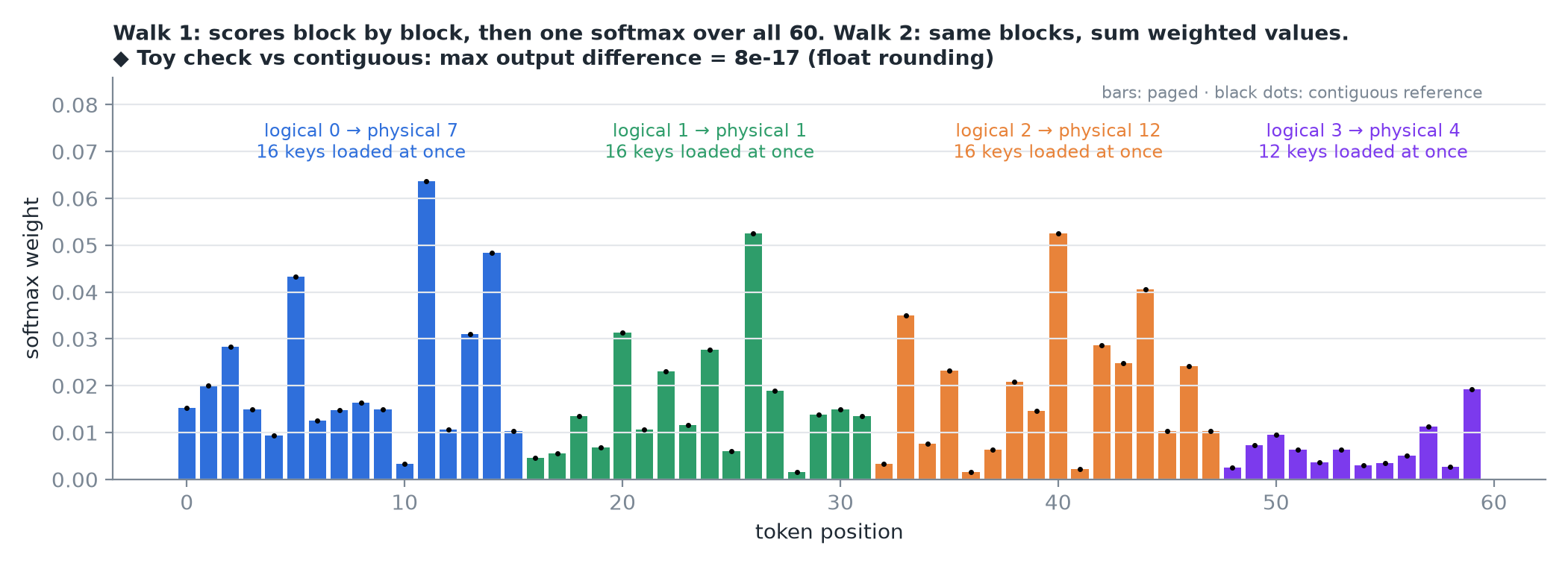 Same scores, same weights, same output: only the addresses it reads from changed. ◆ The toy check computes both versions in numpy; they agree to float rounding.
IMPORTANT
PagedAttention is not an approximation. It's ordinary attention with an extra indirection through the block table.
3. On the GPU
- Each (query, head) gets its own group of threads; inside it, different warps take different blocks at the same time.
- Within a block the 16 keys sit next to each other, so neighbouring threads read neighbouring memory in one sweep. The scattered jump happens only at block boundaries, 16 tokens at a time.
- The warps then combine their partial results, the largest score and the sum of exponentials, into one softmax.
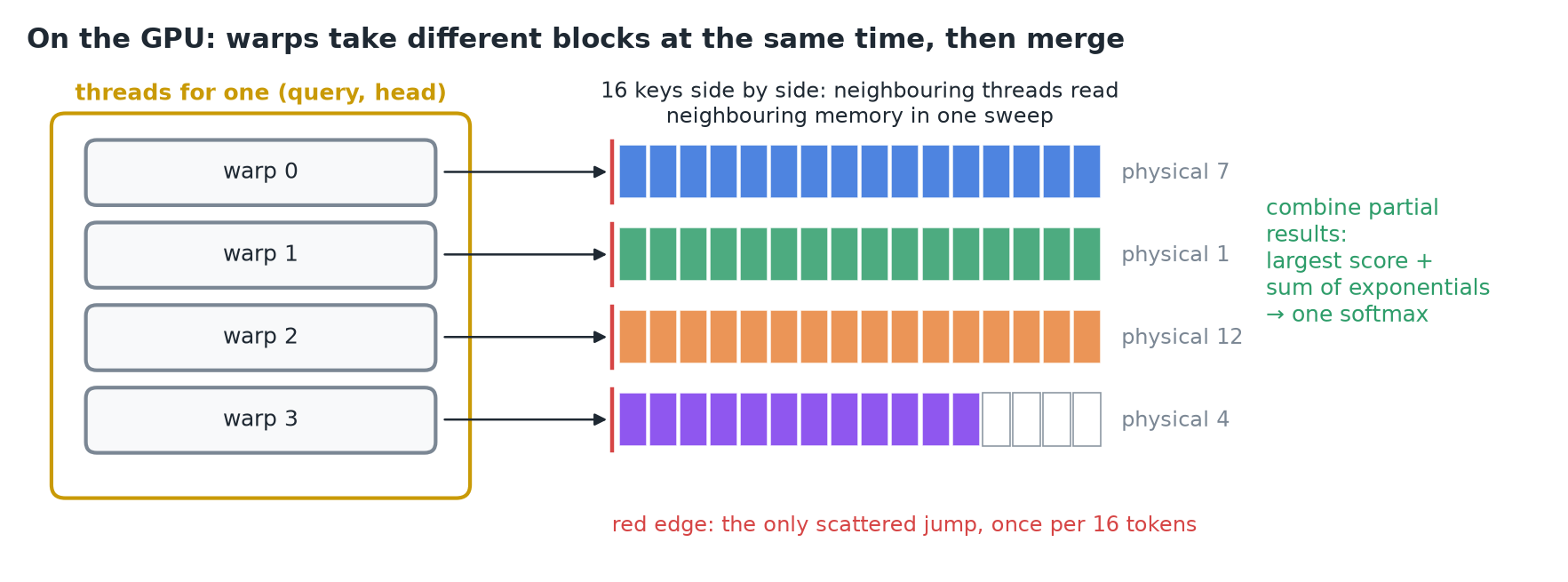 Coalesced reads inside each block; one indirection per block.
◆ Merging two partials (max score m and sum of exponentials l from each warp):
4. Is it free? No, but it pays
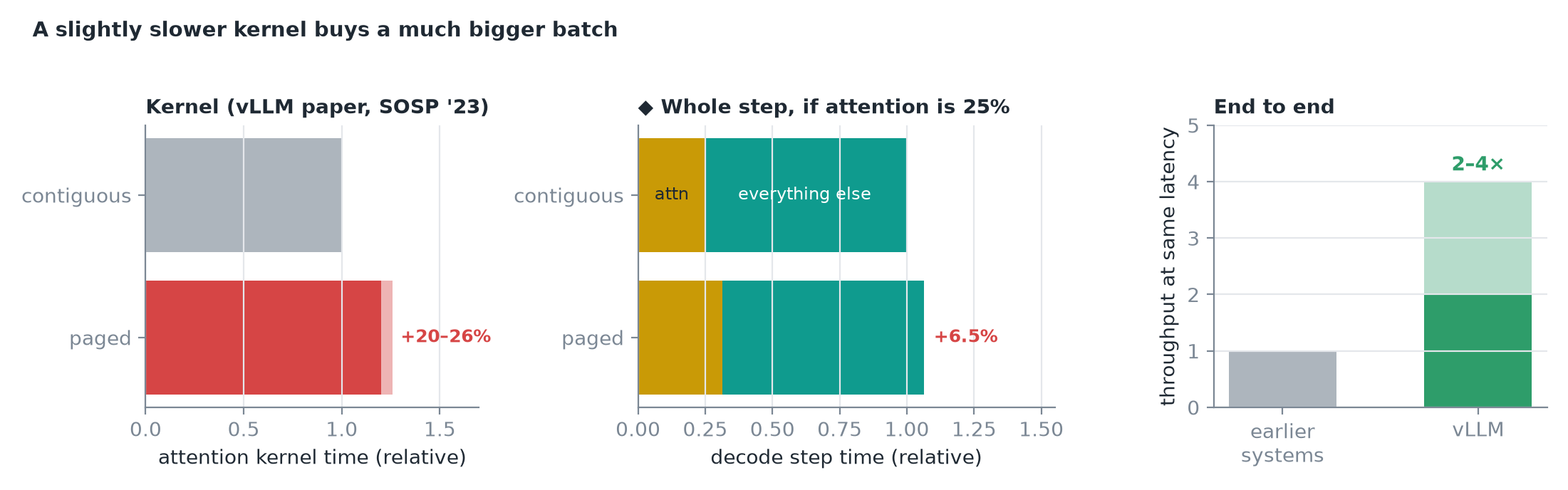 Left: every block needs a table lookup and some bookkeeping, so the kernel ran ~20–26% slower in the original paper. Middle: ◆ if attention were a quarter of a decode step, that's ~6.5% on the step. Right: end-to-end, vLLM served 2–4× the throughput of earlier systems at the same latency.
- Attention is only part of a step, and decode is limited by memory traffic, which hides much of the extra work at large batches.
- Near-zero waste lets far more requests fit in memory at once: a slightly slower kernel in exchange for a much bigger batch.
- Paged KV is now the norm: FlashAttention and FlashInfer both accept block tables directly.
5. Recap