44 · Reproduce the Long-Prompt Interference Problem
Source: fanout.sh / inference-eng / 10-01 · ~4.5 min
NOTE
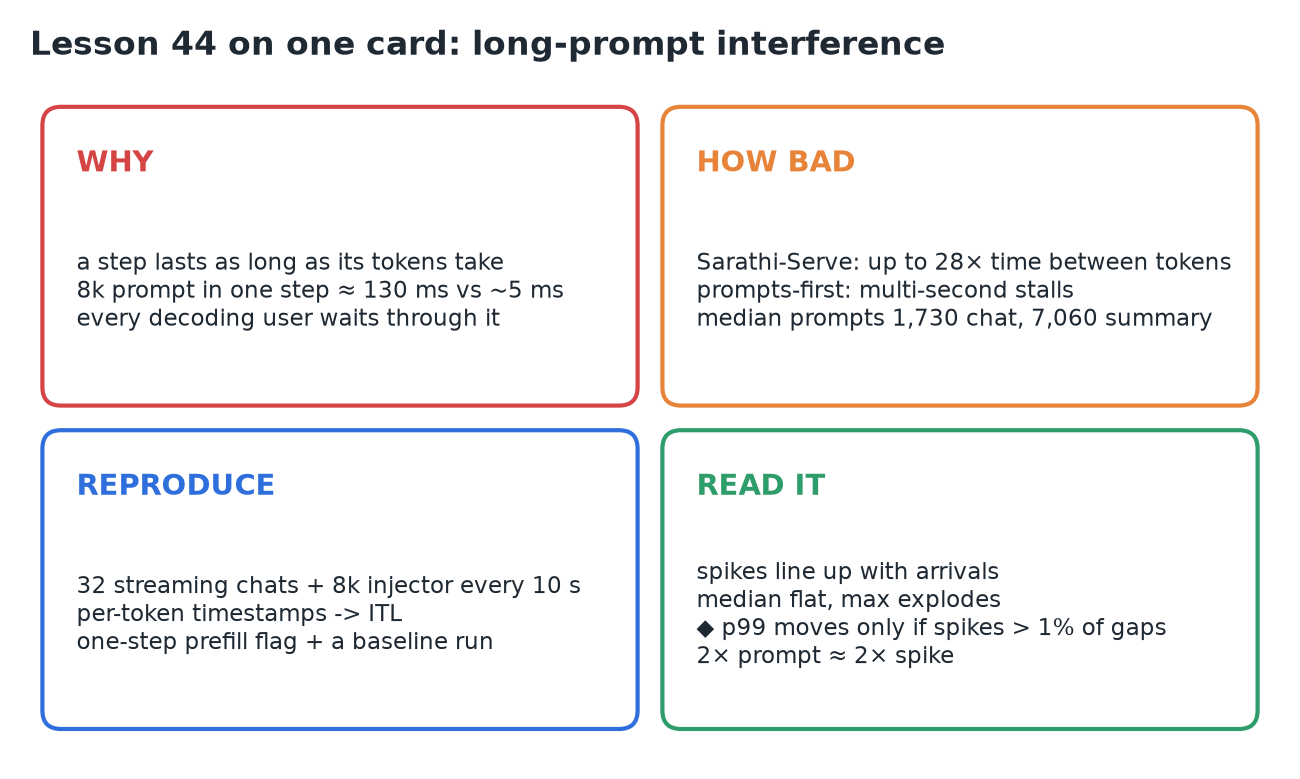
Every running request gets one token per step, and a step lasts as long as its work takes. A decode-only step is a few milliseconds, but an 8,000-token prompt processed in one step is ≈ 8,000 × 16 GFLOP ≈ 130 ms, and every user mid-answer waits through it. Sarathi-Serve measured time between tokens up to 28× a decode-only step. Reproduce it with 32 streaming chats, an injector sending one 8k prompt every 10 s, per-token timestamps, a one-step-prefill setting and a baseline run. The spikes line up with arrivals; the median stays flat while the tail explodes.
1. Why one prompt pauses everyone
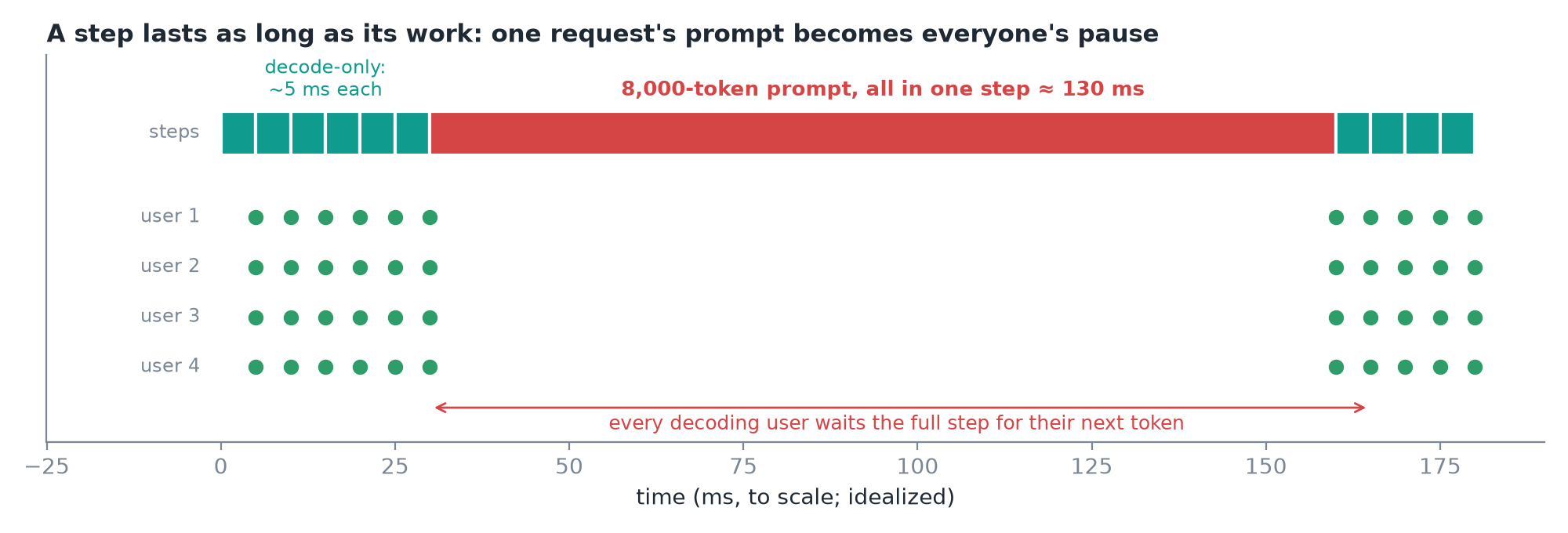 Drawn to scale: six 5 ms decode steps, then one 130 ms step that carries the whole prompt.
- Thirty users are streaming smoothly. One pastes a long document and asks for a summary. Every other stream freezes, though nobody else did anything different. That's long-prompt interference.
- A step gives every running request one token, and it lasts as long as its work takes.
- Decode-only steps are short: a few milliseconds for Llama 3.1 8B.
- An 8,000-token prompt gets processed all in one step, and every user mid-answer is stuck in that same step: one request's prompt became everyone's pause.
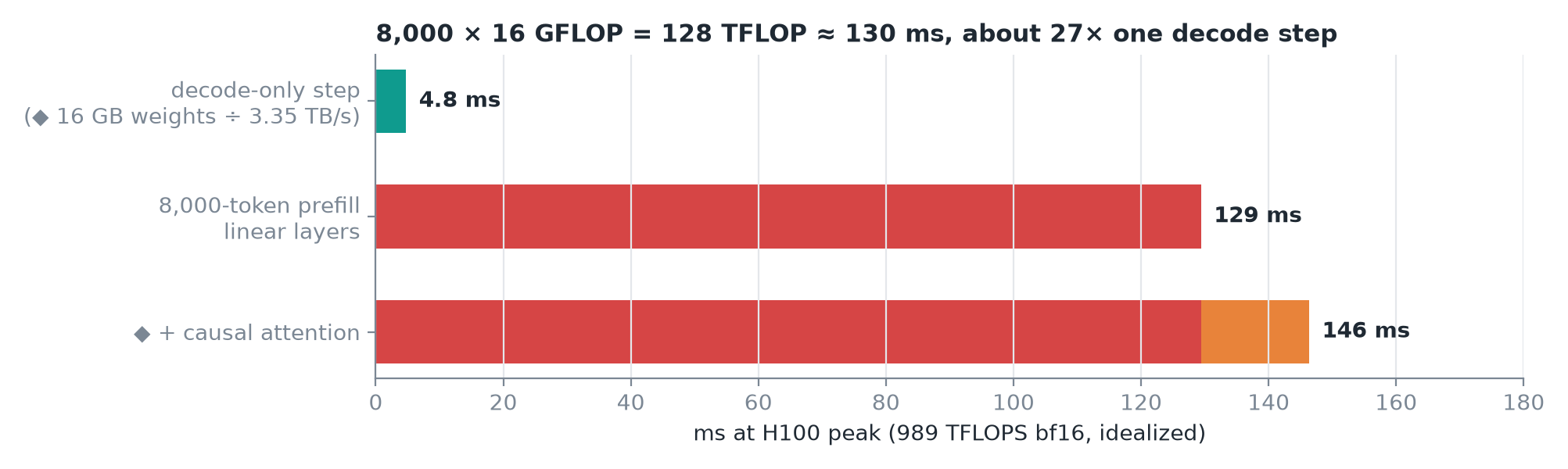 ◆ The decode bar (weights ÷ bandwidth) and the attention segment are my arithmetic, not the lesson's.
- That's at peak math, before attention (idealized). ◆ Causal attention over 8k tokens adds ≈ 17 ms, so ≈ 146 ms: about the ≈ 150 ms spikes the lesson's trace shows.
TIP
◆ 130 ms ÷ 4.8 ms ≈ 27× a decode step, which is right in line with Sarathi-Serve's measured 28×.
2. How bad it gets in real systems
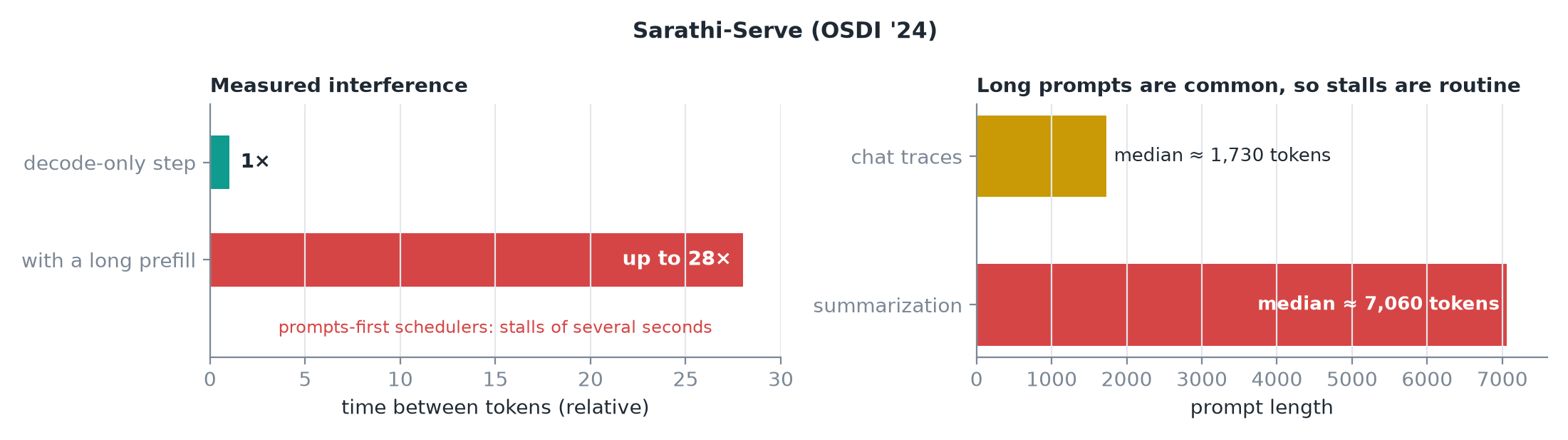 Numbers from the Sarathi-Serve paper (OSDI '24).
- Mixing a long prefill into a decode batch made the time between tokens up to 28× a decode-only step.
- Schedulers that ran every waiting prompt first stalled ongoing answers for several seconds.
- Long prompts aren't rare: median prompt ≈ 1,730 tokens in chat traces, ≈ 7,060 for summarization. With real traffic these stalls are a regular event.
3. Reproduce it on your own server
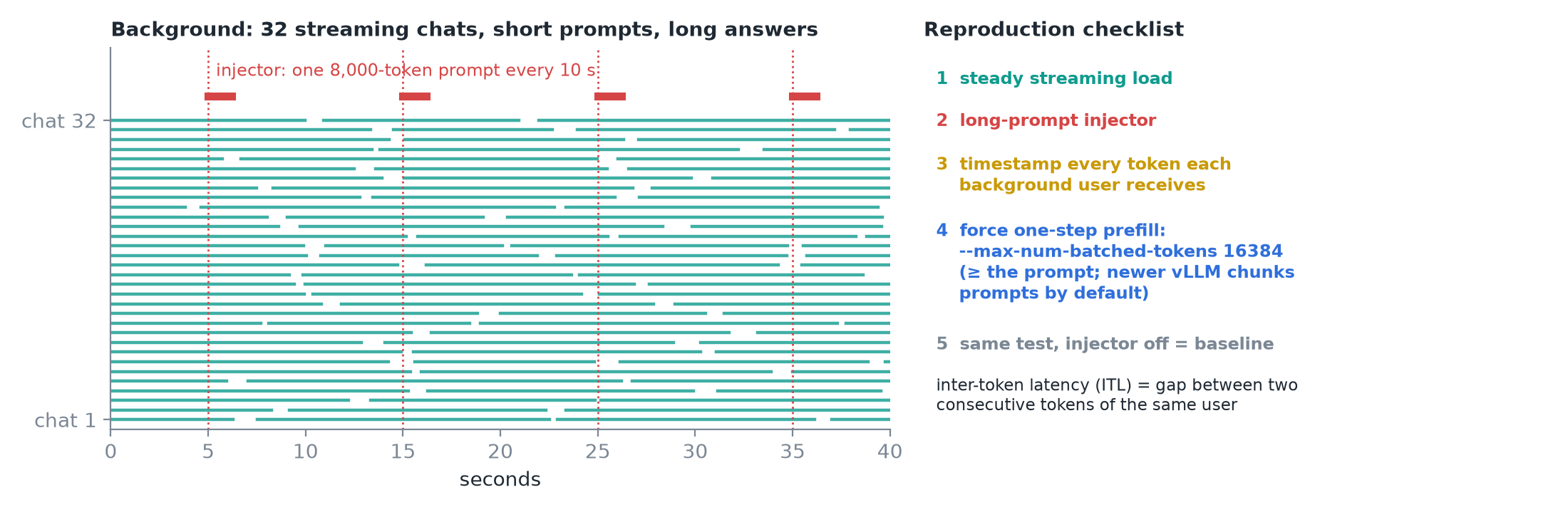 The background lanes are illustrative; the injector fires at 5, 15, 25 and 35 s.
- Background load: 32 streaming chats, short prompts, long answers.
- Injector: one 8,000-token prompt every 10 s.
- Token logger: timestamp every token each background user receives. The gap between two consecutive tokens is the inter-token latency (ITL).
- Force one-step prefill: newer vLLM chunks prompts by default, so set
--max-num-batched-tokensat least as large as the long prompt (the lesson uses 16384). - Baseline: the same test with the injector off.
4. Read the results
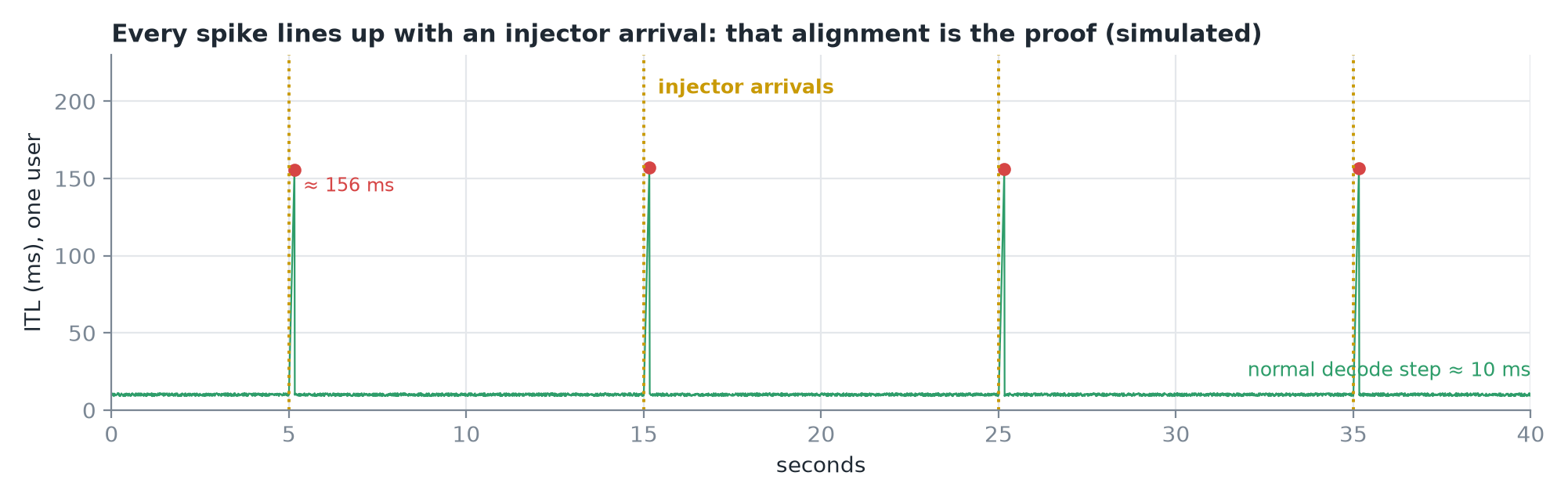 Simulated with ~10 ms decode steps and the ≈ 146 ms prefill from section 1.
- Most gaps sit at the normal decode step. Every 10 s there's a tall spike, lined up exactly with an injector arrival. That alignment is the proof the long prompts cause the stalls.
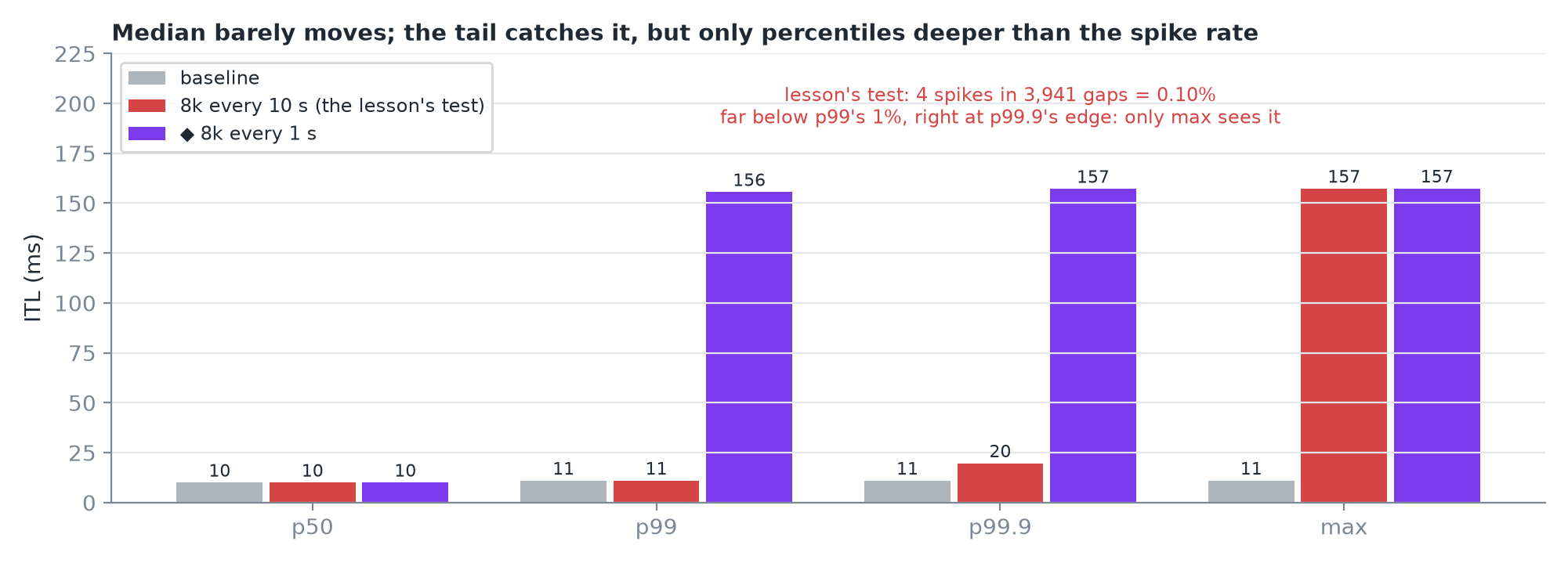 Percentiles from the same simulation. ◆ The "every 1 s" run is mine.
- The median barely moves versus baseline: most steps are still normal.
- The tail and the maximum shoot up. That's the signature: averages look fine, the tail is terrible.
WARNING
The lesson says p99 shoots up, but its own test doesn't produce that. With ~10 ms steps over 40 s, each user sees about 3,940 gaps and only 4 are spikes: 0.1%, far below the 1% that p99 looks at. So p99 stays at baseline and only the max (and p99.9, just barely) shows it. To make p99 move, the spikes must be more than 1% of gaps, for example an injector every 1 s. When you reproduce this, report max and p99.9, or the stall count.
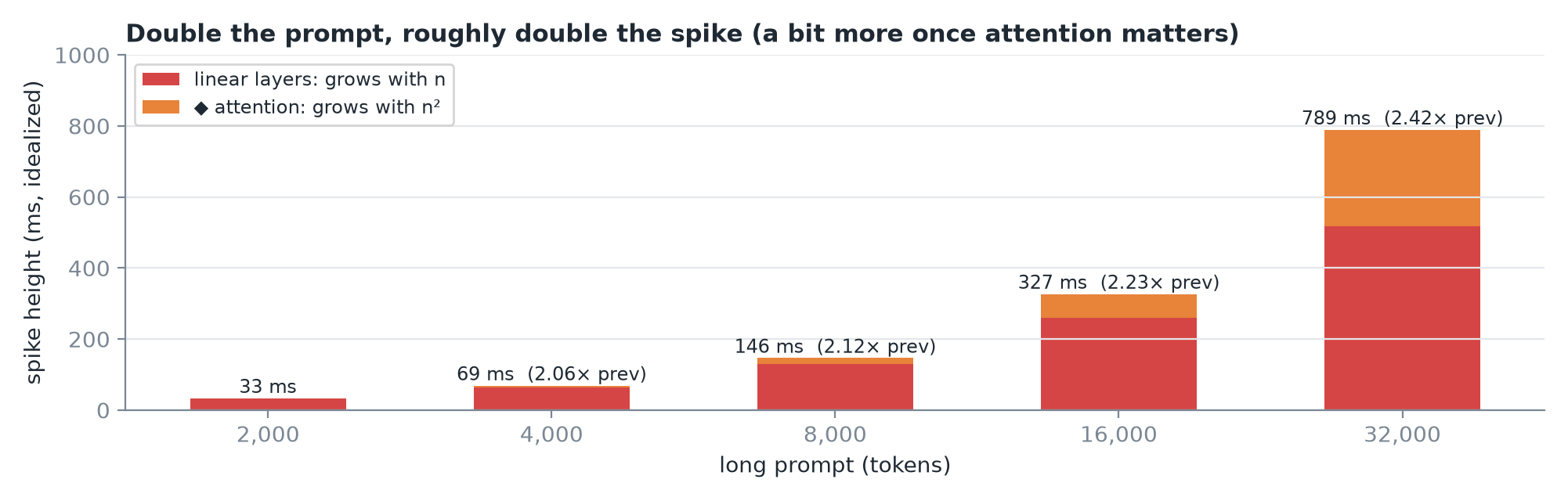 ◆ Idealized FLOP model: linear layers plus causal attention at H100 peak.
- Double the prompt, and the spikes roughly double too. ◆ Slightly more than 2× once attention's n² term grows: 2.12× from 4k to 8k, 2.23× from 8k to 16k.
5. Recap