12 · MLP, RMSNorm & Residual Connections
Source: fanout.sh / inference-eng / 02-03 · ~7 min
NOTE
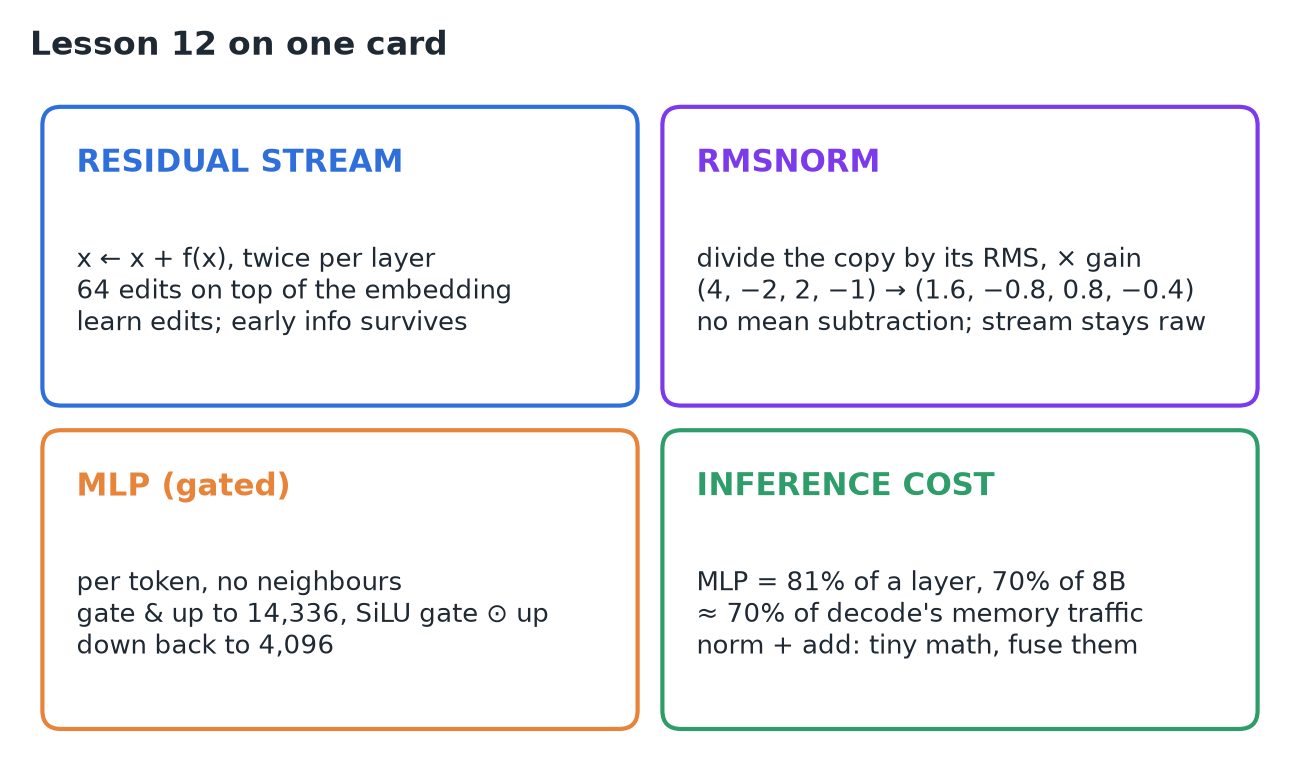
Besides attention, every layer has a normalization step, an MLP and two additions. The additions form the residual stream: each sublayer reads a copy, computes an edit and adds it back (x ← x + f(x)). RMSNorm rescales that copy to a predictable size before each sublayer. The MLP works on each token alone: expand 4,096 → 14,336 twice (gate and up), gate with SiLU, shrink back. For inference, the MLP is where the weights are: 81% of a layer, ~70% of the 8B model, so ~70% of every decode step's memory traffic. Norms and adds are tiny math, so engines fuse them.
1. The residual stream: edits, not rebuilds
Think of each token's hidden state as a vector traveling down a highway through all 32 layers. A layer doesn't replace the vector: it reads a copy, computes a change, and adds the change back.
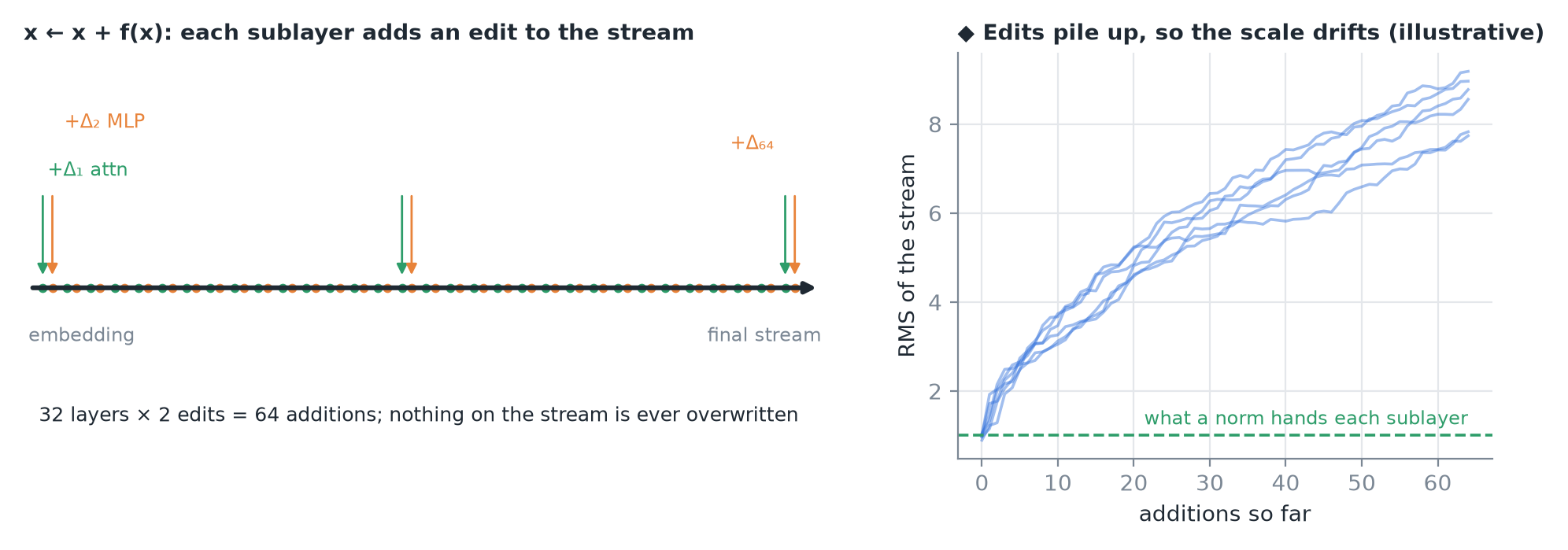 Right (◆): adding edit after edit lets the stream's scale wander, which is why each sublayer gets a normalized copy.
- Each layer adds twice (attention, then MLP), so the final stream = embedding + 64 edits.
- A layer only has to learn a useful edit, not rebuild the whole representation.
- Information from early layers survives to the end, because nothing overwrites it.
2. RMSNorm: rescale the copy
Sublayers work best on inputs of a predictable scale, but the stream's numbers drift. So before attention and again before the MLP, the copy going in is normalized. Llama uses RMSNorm (root mean square normalization).
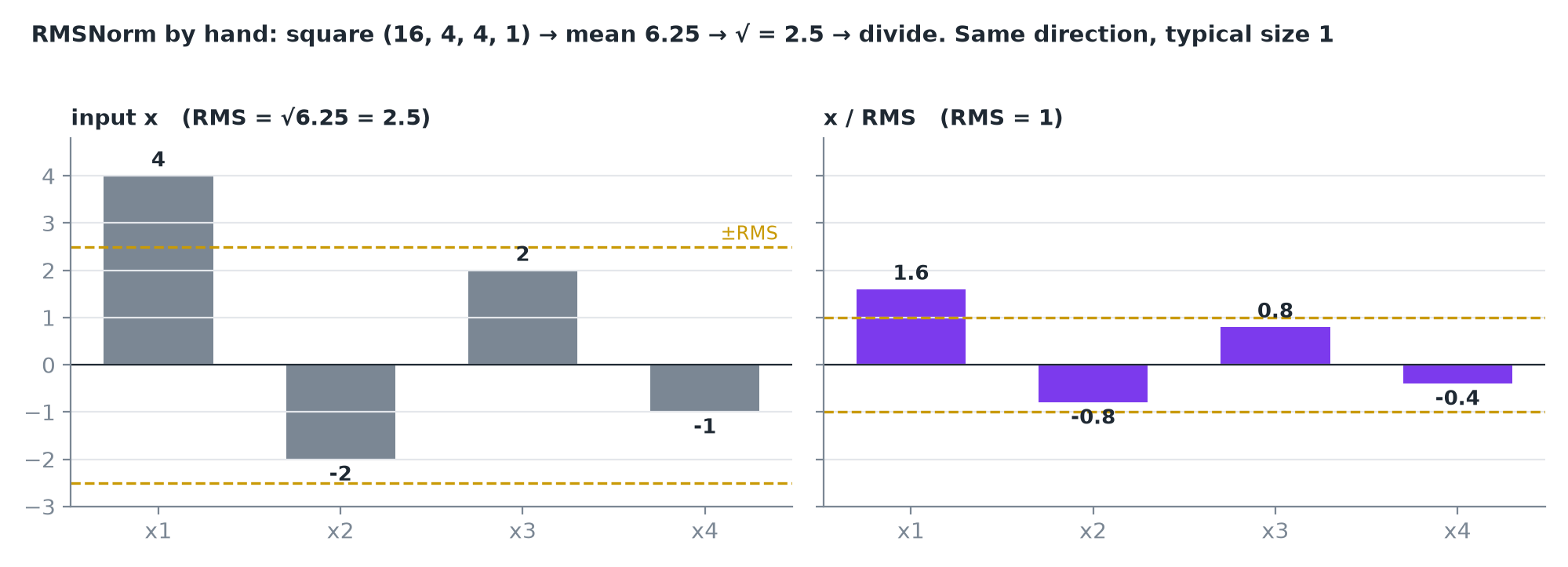 Then a learned gain, one number per dimension, scales each entry back up or down.
| LayerNorm (older transformers) | RMSNorm (Llama) | |
|---|---|---|
| Formula | γ · (x − μ) / σ + β | γ · x / RMS(x) |
| Subtracts the mean? | Yes | No: skipped, works just as well |
| Learned shift β? | Yes | No |
IMPORTANT
Only the copy is normalized. The stream itself keeps its raw values.
3. The MLP: per-token feature gating
Attention moves information between tokens. The MLP (feed-forward network) works on each token completely on its own and never looks at its neighbors.
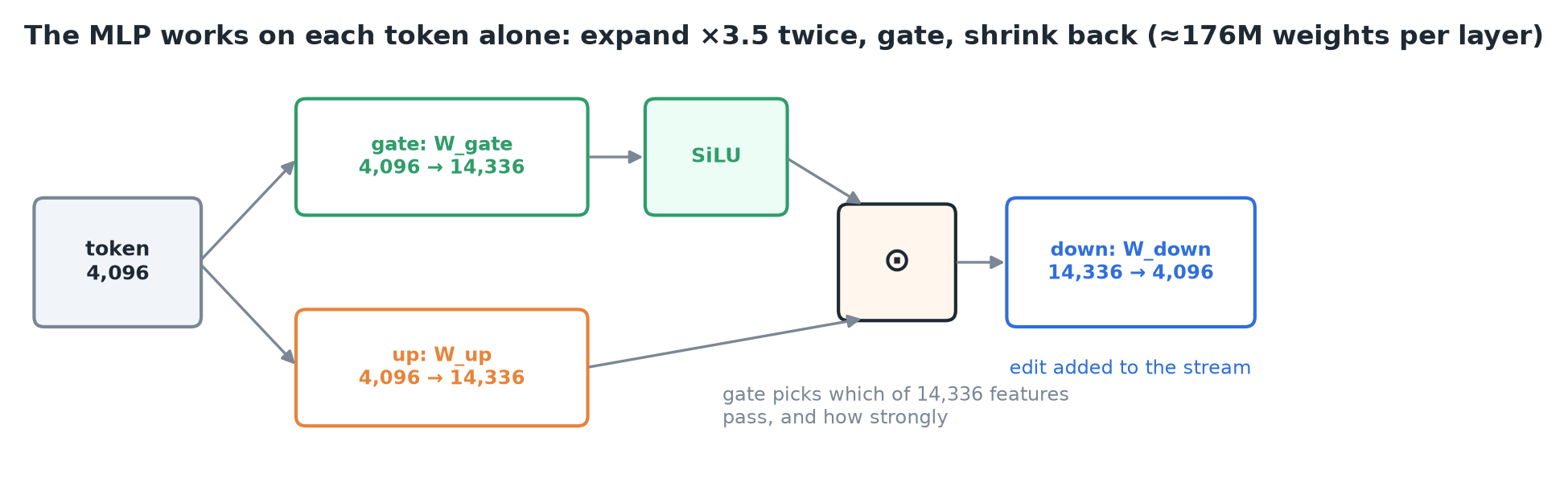 Llama 3 8B: two 4,096 → 14,336 projections (gate, up), then down 14,336 → 4,096. The result is the edit added to the stream.
The gate goes through SiLU, a smooth curve: big positive inputs pass almost unchanged, negative ones are squashed toward zero. The gated vector then multiplies the up vector entry by entry.
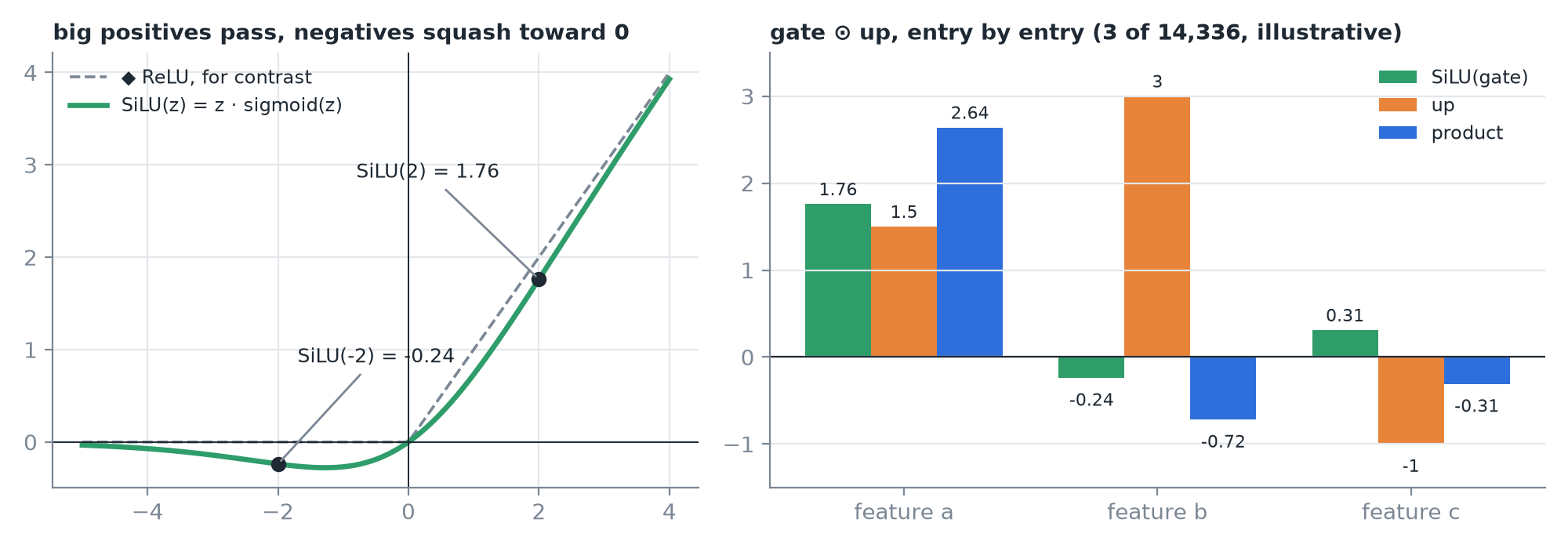 SiLU(gate) ⊙ up = (1.76, −0.24, 0.31) ⊙ (1.5, 3, −1) = (2.64, −0.72, −0.31).
TIP
The gate decides, per token, which of the 14,336 features get through and how strongly. Researchers have found that much of what a model knows (facts, patterns) is stored in these MLP weights.
4. Where the weights are (and the memory traffic)
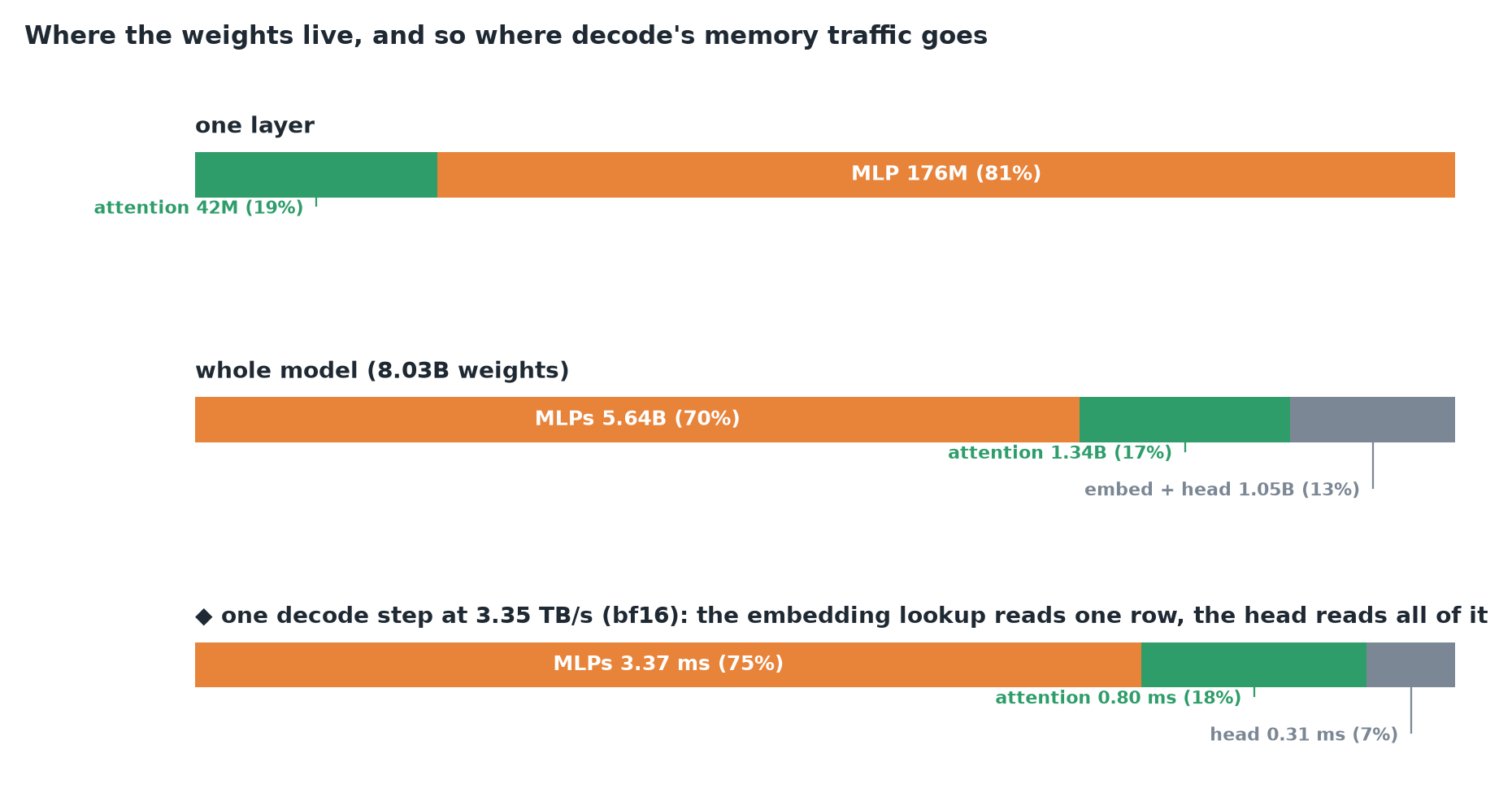 Per layer: attention ≈ 42M, MLP ≈ 176M (81%). Whole model: MLPs hold 5.64B of 8.03B (70%).
Generating one token means reading every weight from memory, so roughly 70% of every decode step's memory traffic is the MLP. ◆ Per token, the embedding lookup reads only one row, so the MLP's share of bytes actually read is closer to 75%. Either way, the MLP is the first place to look when shrinking weights.
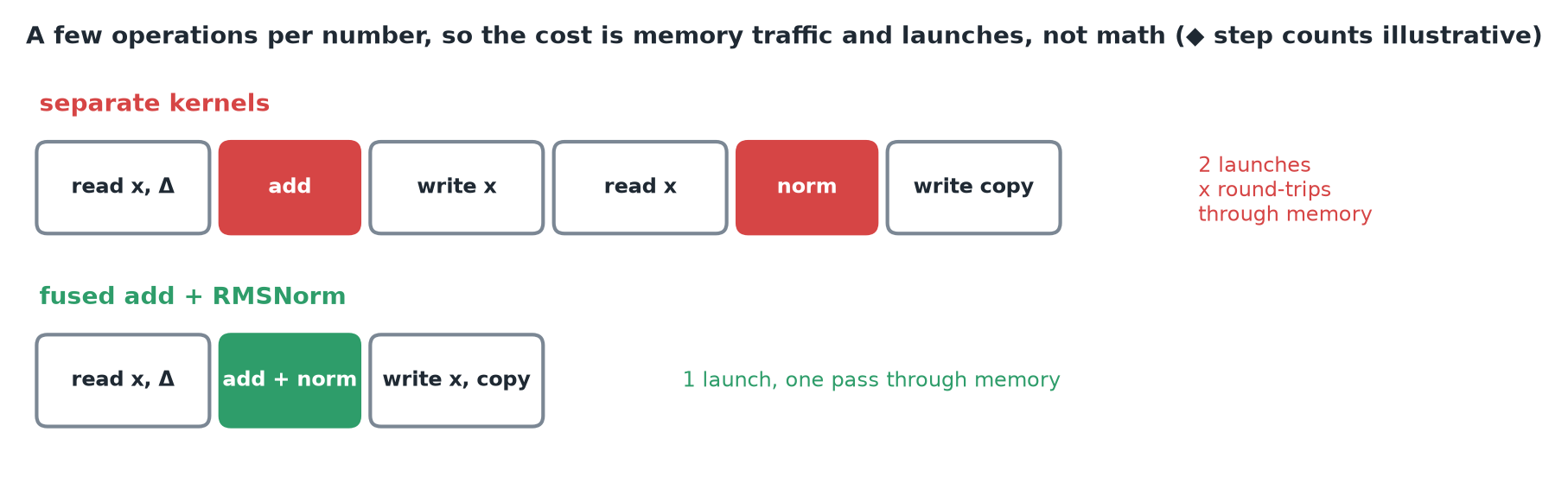
Norms and adds do only a few operations per number, but each still has to read the whole hidden state from memory and write it back. So engines fuse them: one kernel does the add and the norm in a single pass.
5. The full layer
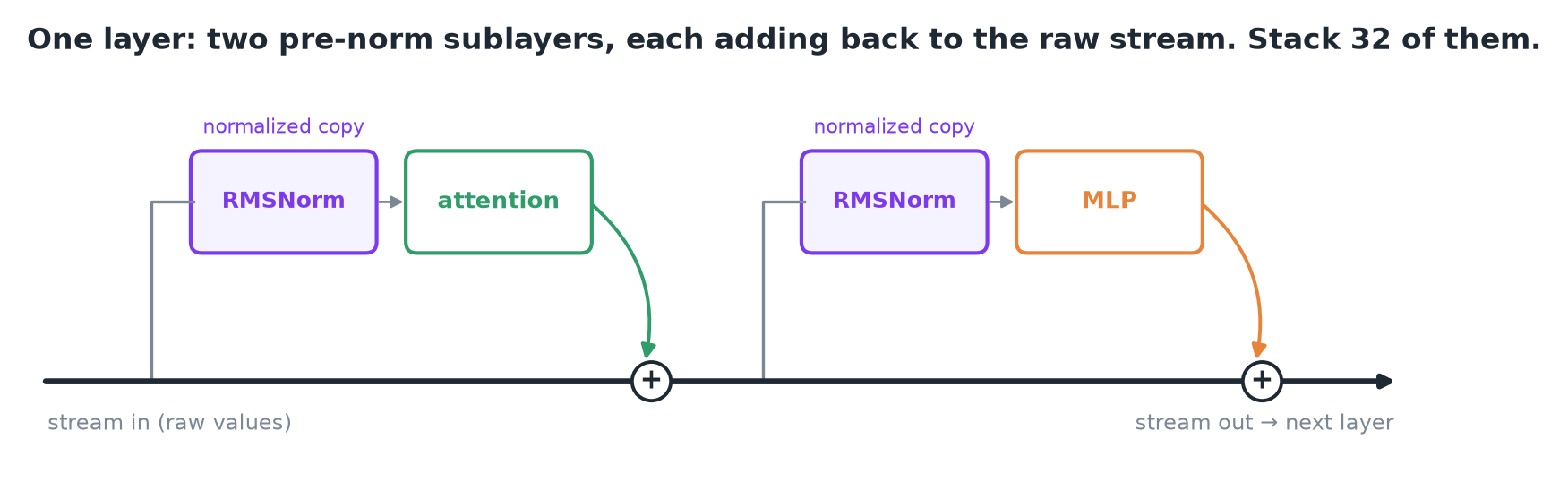 Normalized copy → attention → add back. Normalized copy → MLP → add back. Thirty-two of these make the model body, and the stream ends holding a rich vector for the last token.
6. Recap