17 · Build a KV Cache
Source: fanout.sh / inference-eng / 03-04 · ~7 min
NOTE
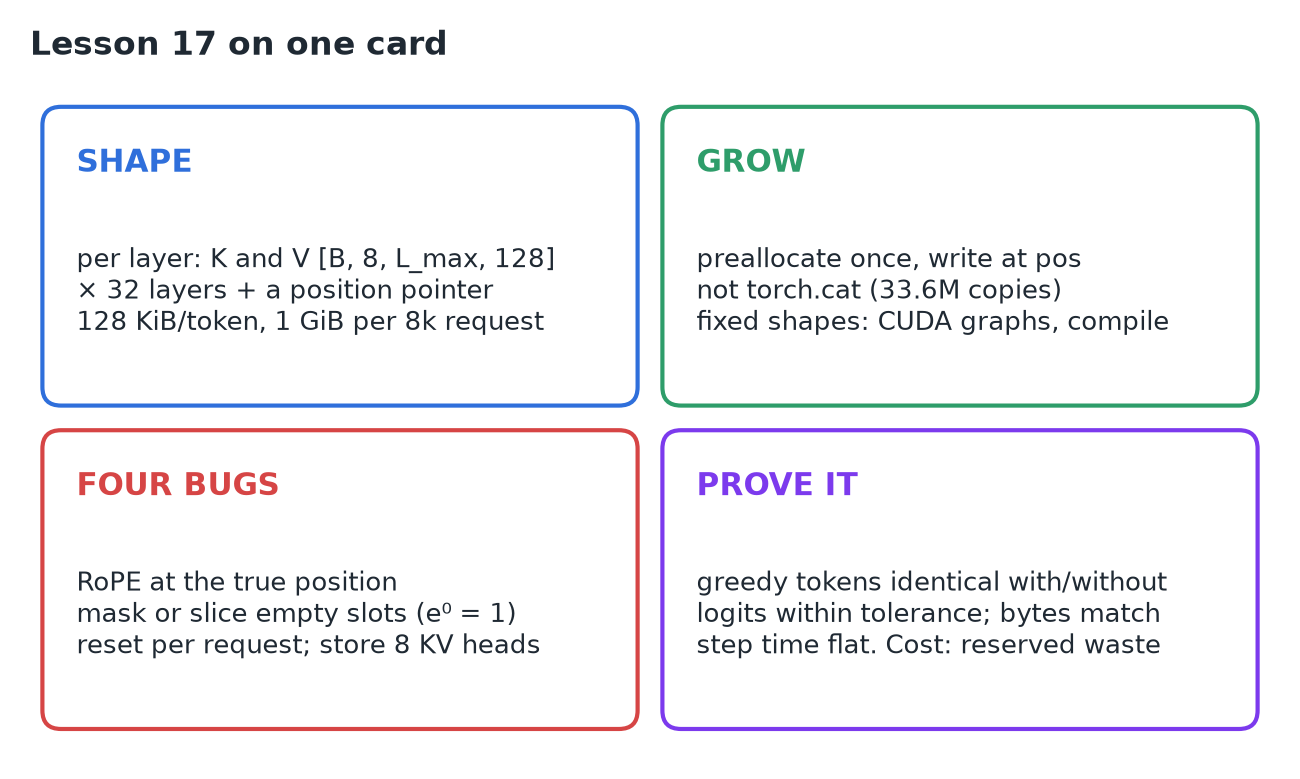
A KV cache is one key tensor and one value tensor per layer, shaped [batch, 8 KV heads, max length, 128] for Llama 3 8B, plus a pointer saying how many slots are filled: 128 KiB per token, so 8,192 reserved tokens is exactly 1 GiB per request. Preallocate the buffer and write each new K/V in place (concatenating copies everything every step: 33.6M token copies over 8k tokens). Prefill writes slots 0 … P−1 in one shot; each decode step writes at the pointer, reads only slots 0 … pointer, and advances it. Four classic bugs: wrong RoPE position, reading empty slots, not resetting, copying KV heads. Prove it with identical greedy tokens, matching byte counts and flat step time. The hidden cost: reserved but unused memory.
1. What we store
In every layer, attention produces a key and a value per token, per KV head. So each layer gets two tensors:
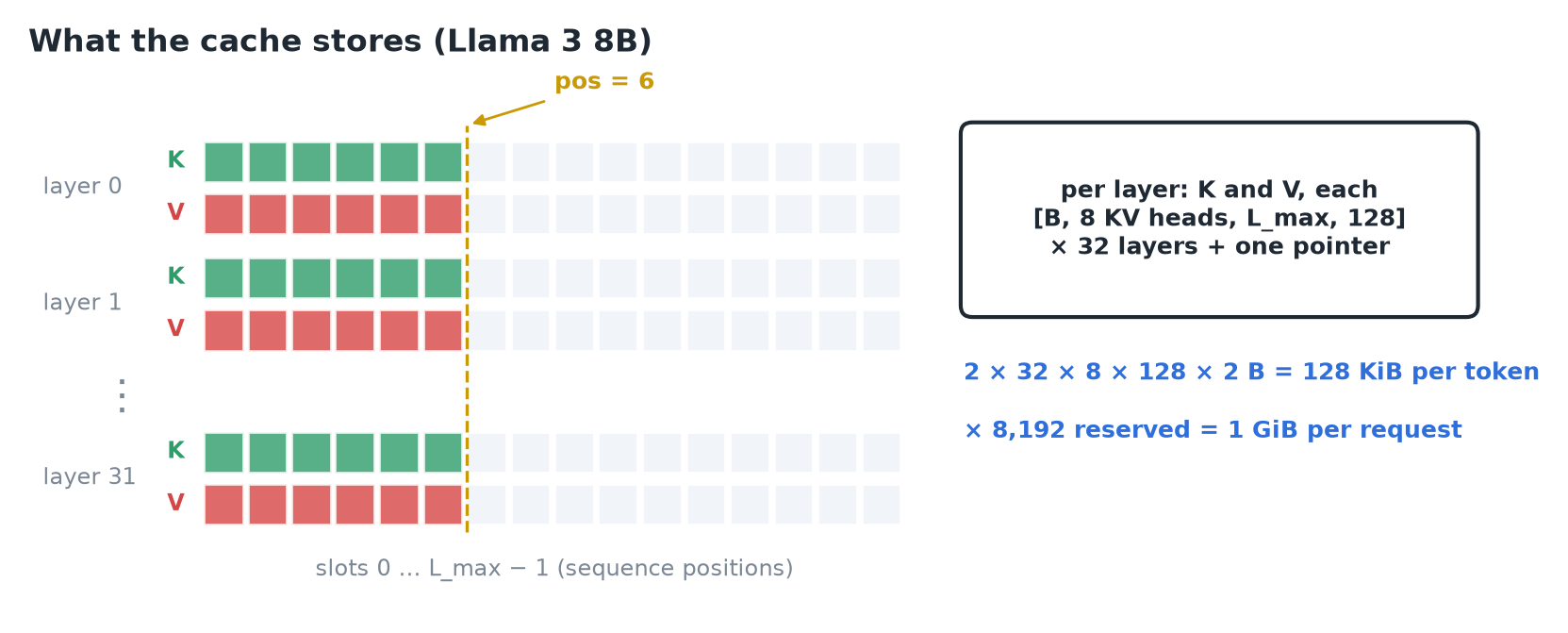 32 layers × (K, V), each [B, 8, L_max, 128], plus one small but essential piece: the position pointer.
The per-token size is lesson 05's 128 KiB (2 × 32 × 8 × 128 × 2 bytes). Reserve 8,192 tokens and a single request's cache is exactly 1 GiB.
2. How the cache grows
# naive: a brand-new tensor every step, copying everything
k = torch.cat([k, k_new], dim=2)
# better: allocate once, write into the next empty slot
k_cache = torch.empty(B, 8, L_max, 128)
k_cache[:, :, pos] = k_new
pos += 1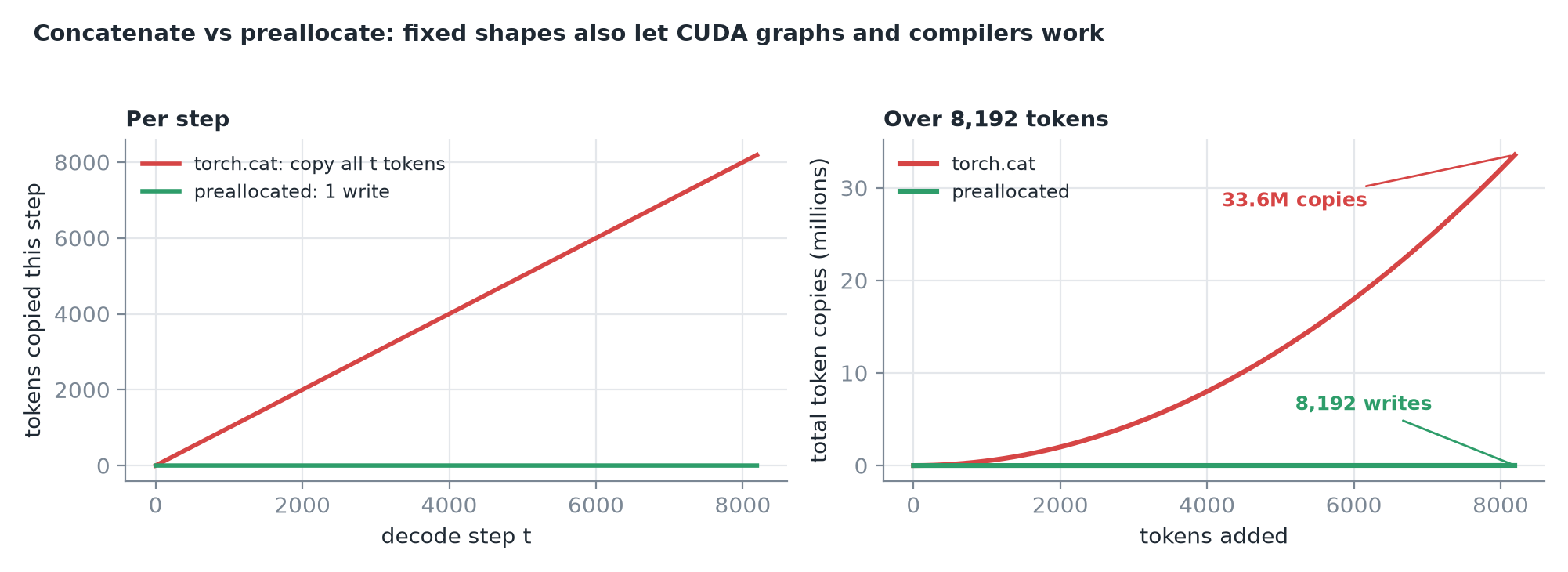 Concatenation: more than 33 million token copies just to add 8,192 tokens. Preallocation: one small write per step, whatever the length.
TIP
With preallocation the tensor shapes never change, exactly what CUDA graphs and compilers need. Production code (e.g. torchtune) uses a fixed buffer plus a position counter.
3. Prefill writes, decode appends
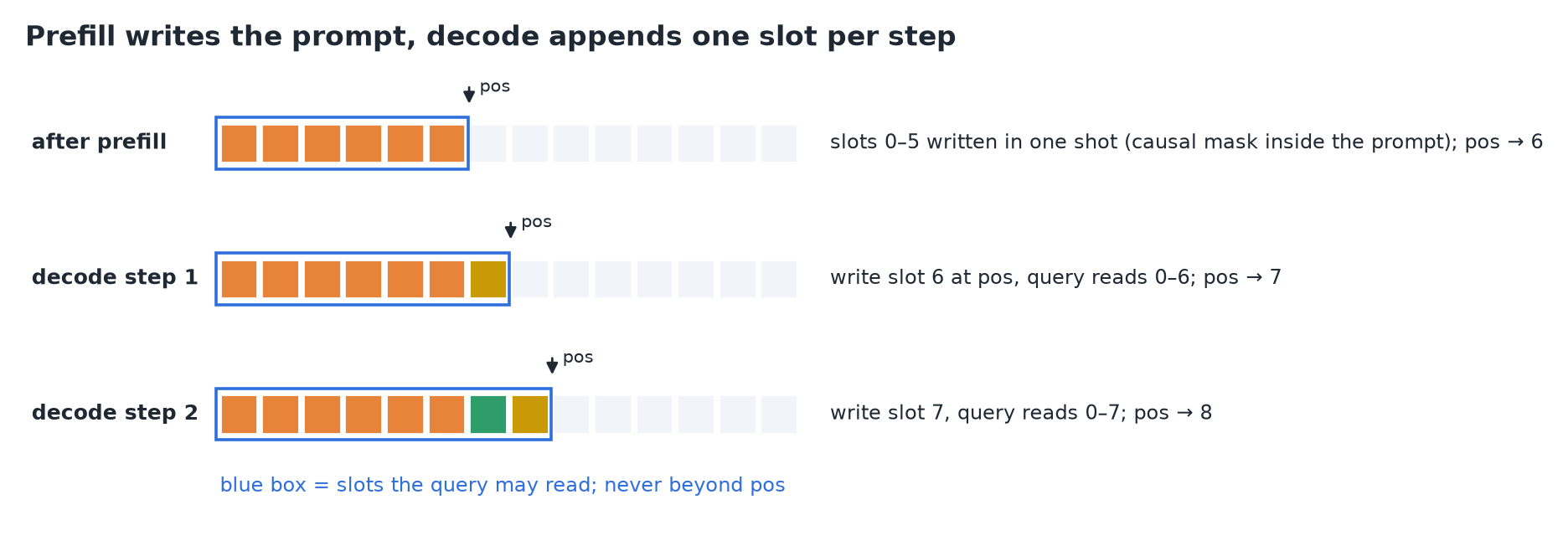
- Prefill: the whole prompt arrives at once; its K/V go into slots 0 … P−1 in one shot, in every layer. Inside the prompt, attention still uses the causal mask. The pointer jumps to the end of the prompt.
- Decode: each step writes the new token's K/V at the pointer, its query reads slots 0 … pointer and nothing beyond, then the pointer moves forward by one.
4. Four bugs that catch almost everyone
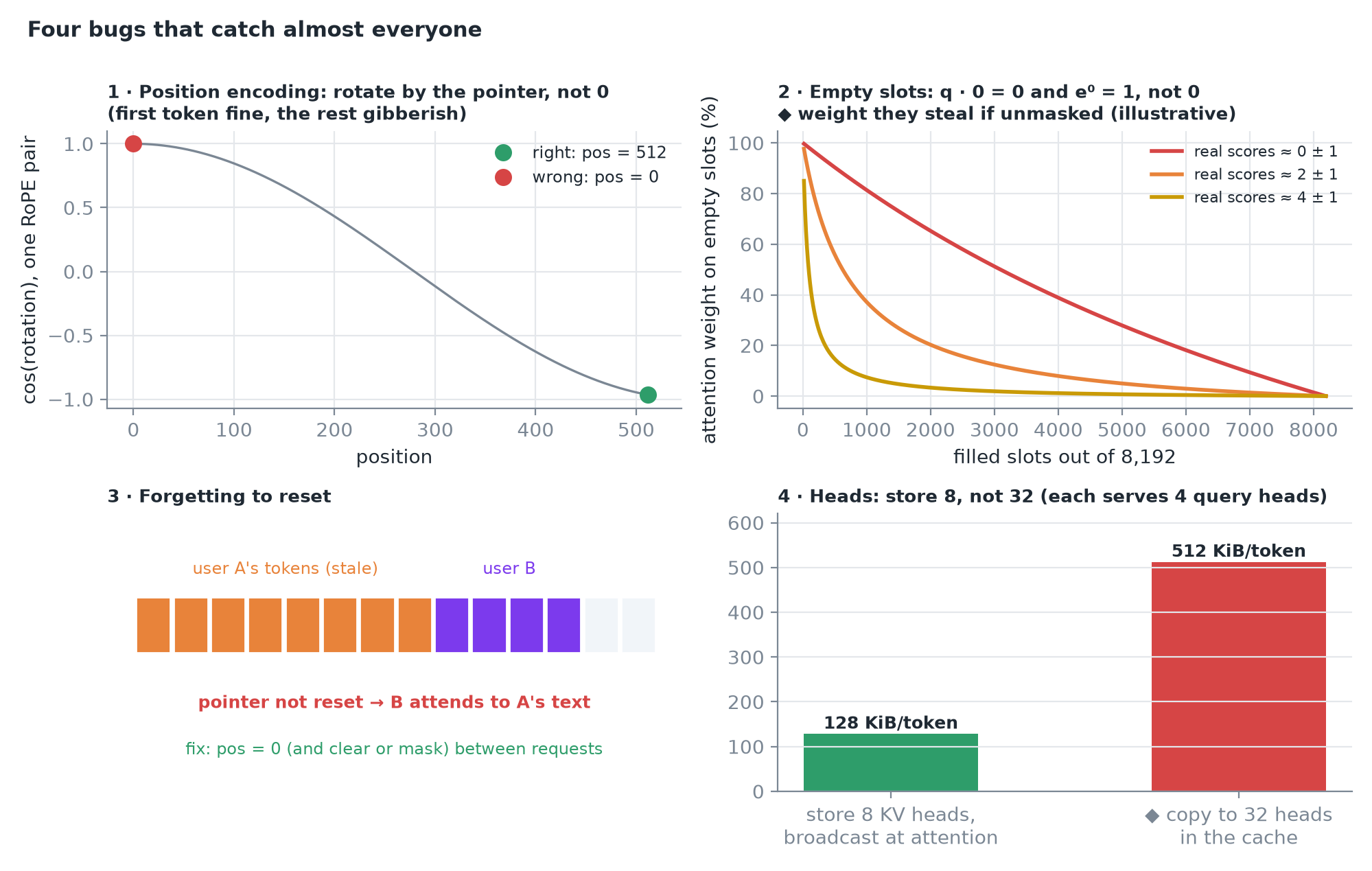
- Position encoding. Llama rotates each query and key by an angle set by the token's position (RoPE). In decode you feed one token, so it's tempting to call it position 0, but it's really position 512 (or wherever the pointer is). Get it wrong and the first token is fine, then gibberish.
- Reading empty slots. A preallocated buffer is full of zeros. A zero key gives score 0, and e⁰ = 1, not 0, so unfilled slots quietly steal attention weight. Always slice or mask to the filled length.
- Forgetting to reset. If the pointer isn't cleared between requests, the next user's prompt attends to the previous user's text.
- Heads. Llama stores only 8 KV heads, each shared by 4 query heads. Broadcast them at attention time; don't copy them into the cache.
5. Prove it works
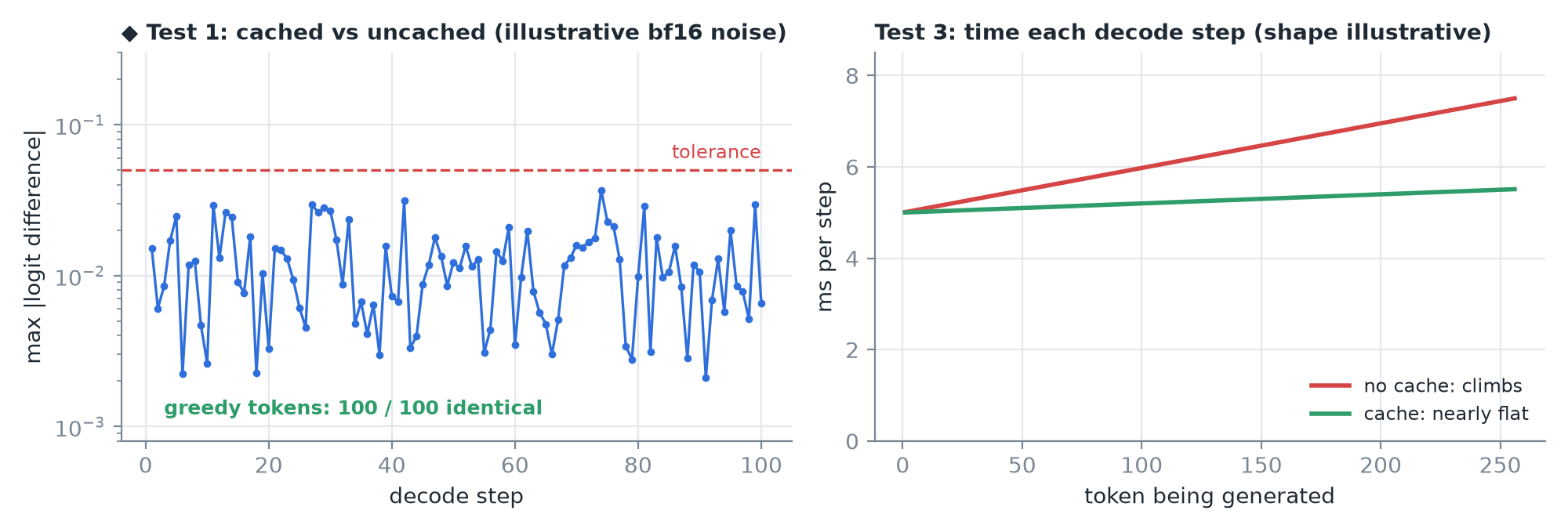
- Correctness: generate 100 tokens greedily with and without the cache; the token sequences must match exactly. Caching changes how we compute, not what. Logits won't be bit-identical in 16-bit, but should agree within a small tolerance.
- Memory: allocated bytes must equal 2 × layers × KV heads × head dim × length × bytes per number.
- Speed: time each decode step: flat with the cache, climbing without.
6. The hidden cost of preallocating
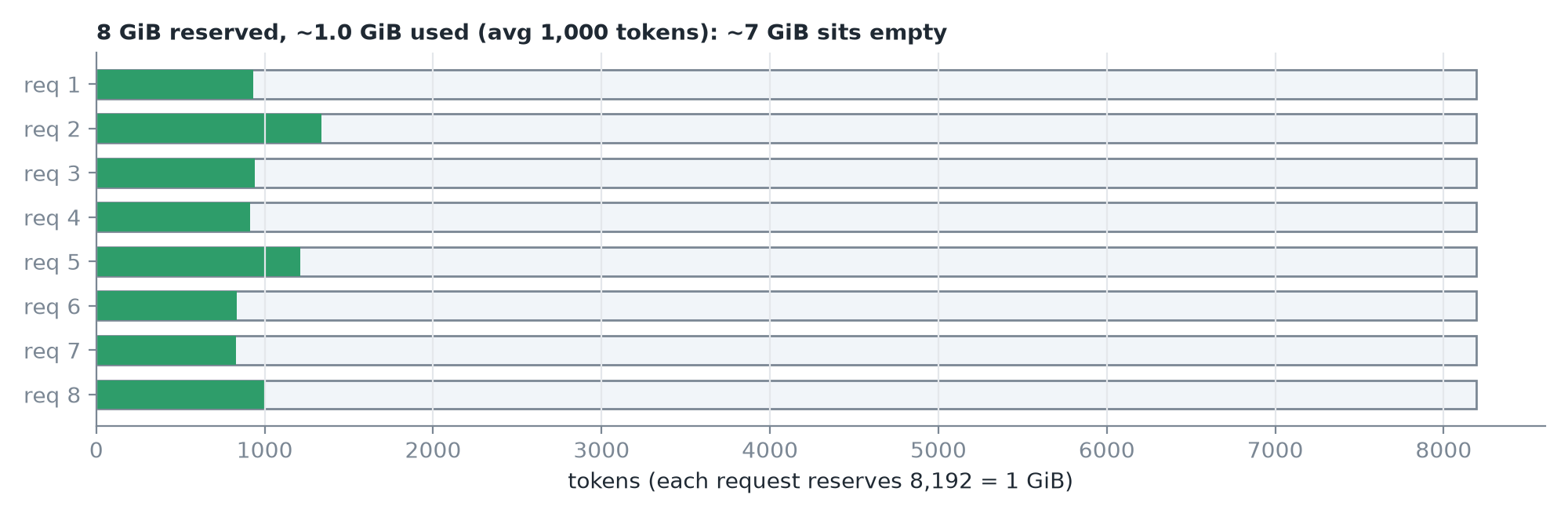 Eight requests reserved for 8,192 tokens each set aside 8 GiB. If they average 1,000 tokens, about 7 GiB sits empty, which limits how many requests fit on the GPU. Paged memory fixes this.
7. Recap