33 · Iteration-Level Scheduling
Source: fanout.sh / inference-eng / 07-02 · ~5.5 min
NOTE
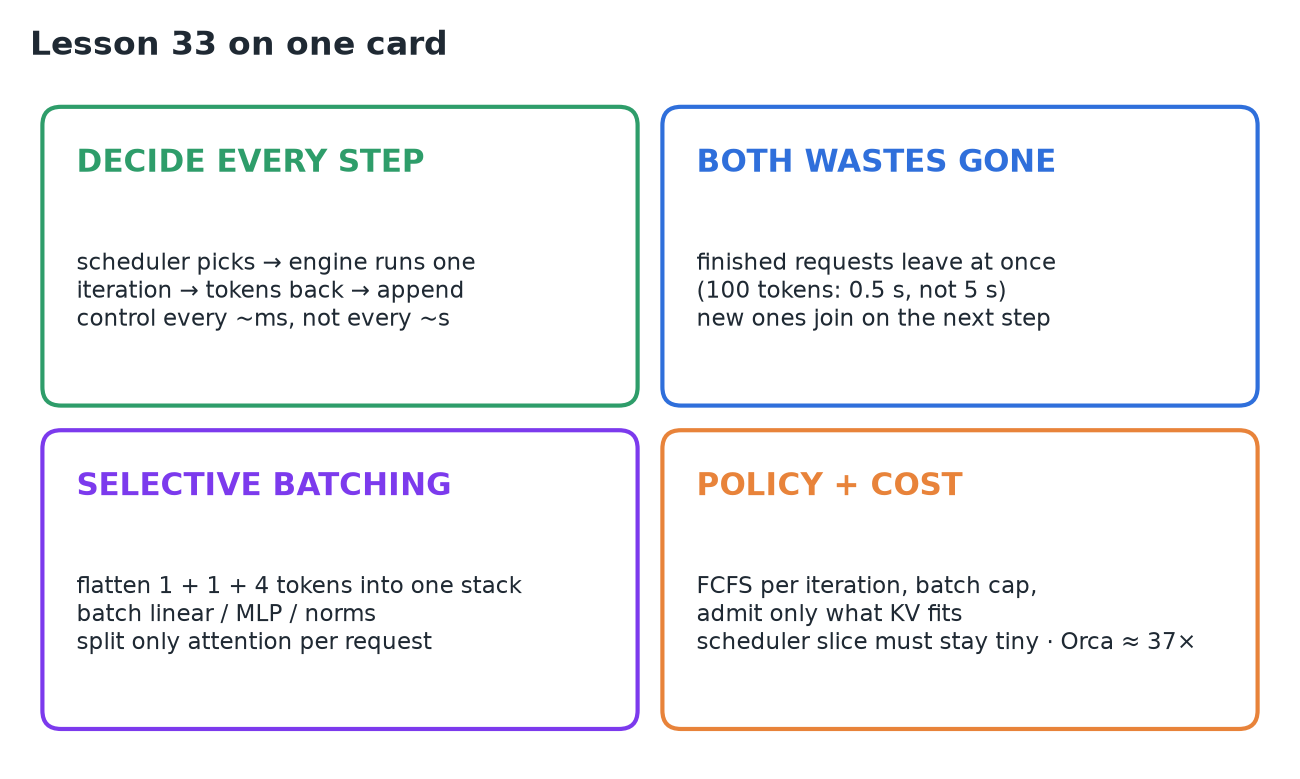
The waste in static batching comes from who decides what's in the batch, and how often: once per batch. Iteration-level scheduling (Orca, 2022) makes it once per step: the scheduler picks requests, the engine runs one iteration (one new token each), hands the tokens back, and the loop turns again. Finished requests leave at once and new ones join on the next step. Selective batching mixes decodes and prefills without padding by batching every layer except attention, which runs per request. A policy (FCFS per iteration, a batch cap, only what fits in KV) decides who runs. Orca reported ~37× the throughput of FasterTransformer on GPT-3 175B at the same latency.
1. Who decides, and how often
Split the server into a scheduler (picks the work) and an engine (runs the model on the GPU).
| Request-level (old) | Iteration-level (Orca) | |
|---|---|---|
| Scheduler hands over | A batch: "run until everyone is done" | "Run one iteration for A, B, C" |
| Engine hands back | All answers, when the last request finishes | One new token per chosen request |
| Scheduler gets control | Every few seconds | Every few milliseconds |
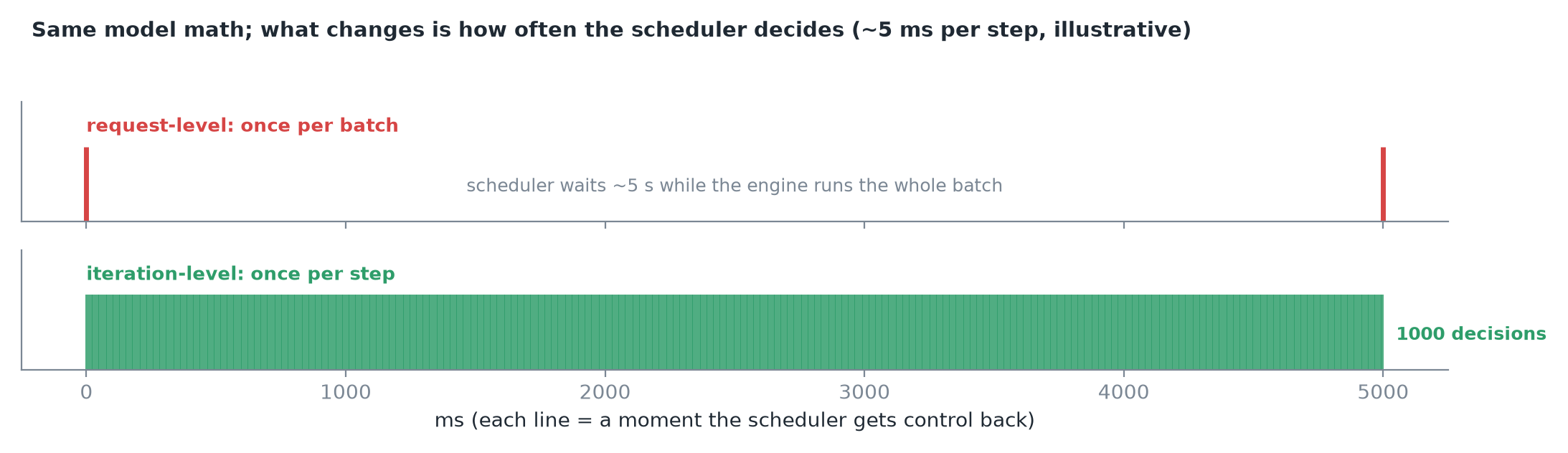 The model's math is exactly the same; what changed is that the scheduler gets control back after every step.
2. That one change fixes both problems
Same four requests needing 100, 200, 300 and 1,000 tokens:
- On step 100 the first request emits its last token; the scheduler sees it right away and sends the answer back: at ~5 ms per step that's 0.5 s, not 5 s.
- Its slot is free, so a request that arrived a moment ago starts on the very next step instead of waiting for the whole batch to drain.
- The batch stops being a fixed group: it's whoever happens to be running on this step.
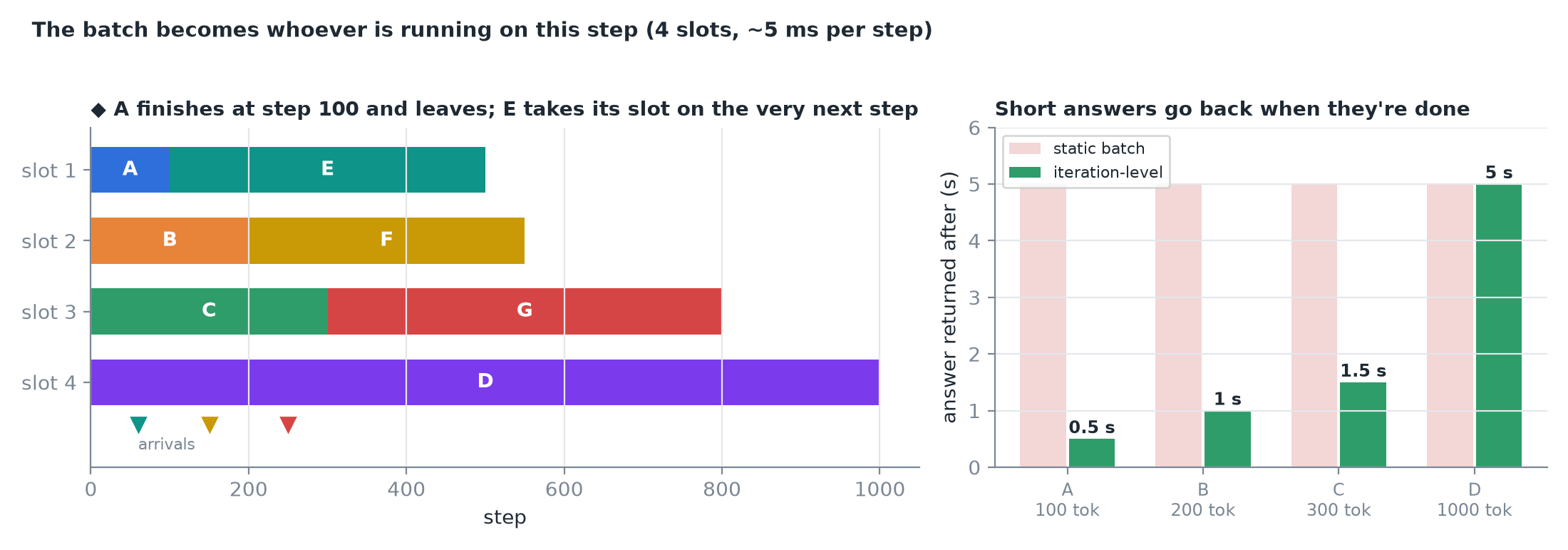 ◆ Left: an illustrative run with three later arrivals (E, F, G) filling slots as A, B and C finish. Right: each answer goes back when it's done.
3. The catch: steps aren't rectangles anymore
On one step two requests might be decoding (one token each) while a new one processes its whole prompt (say four tokens). Normal batching wants every request to have the same number of tokens; 1, 1 and 4 don't make a rectangle.
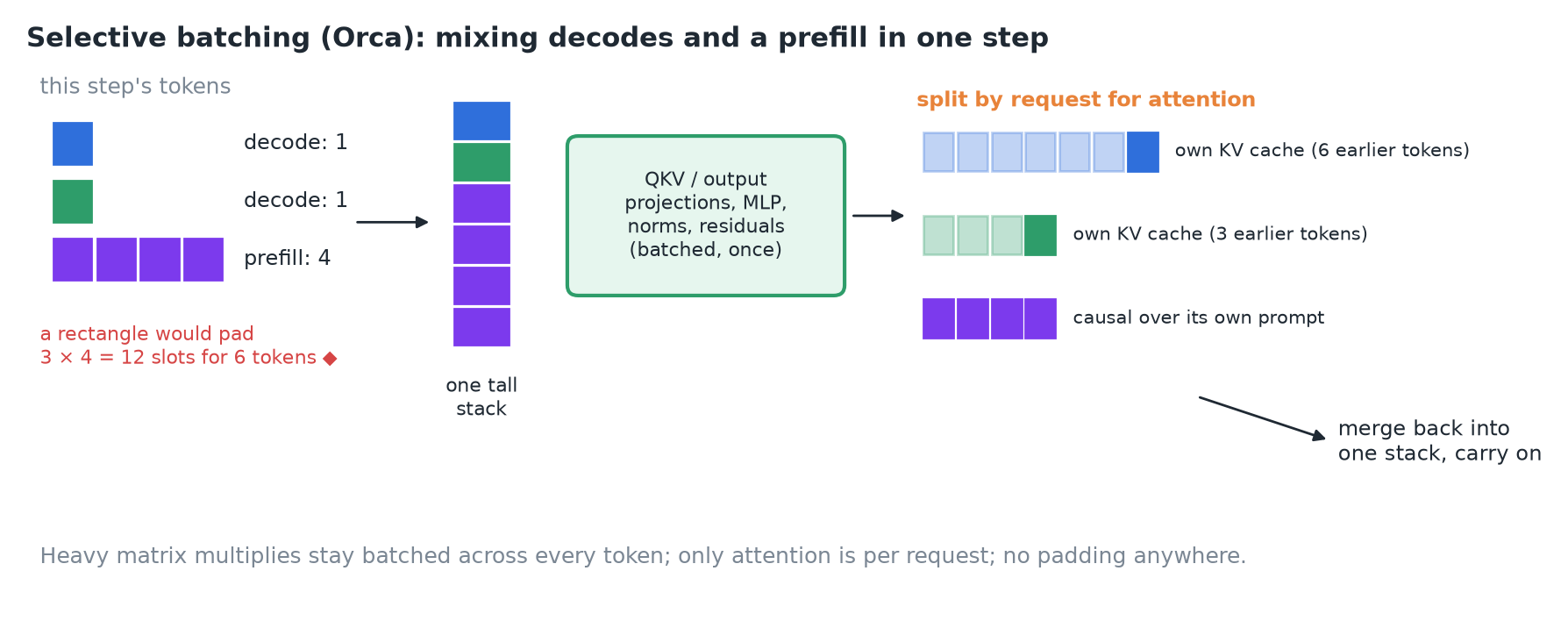 Orca's selective batching: flatten all six tokens into one stack for the token-wise layers; split by request only for attention; merge back.
- Most layers don't care which request a token belongs to: the linear layers, MLP, norms and residual adds treat every token the same. Flatten the six tokens into one tall stack and run those layers once, on all of them.
- Attention is the exception: each token may only look at earlier tokens from its own request, in that request's KV cache. So split the stack just before attention, run attention per request against its own history, then merge back.
- The heavy matrix multiplies stay batched, and nobody needs padding.
4. Who gets picked, and what it costs
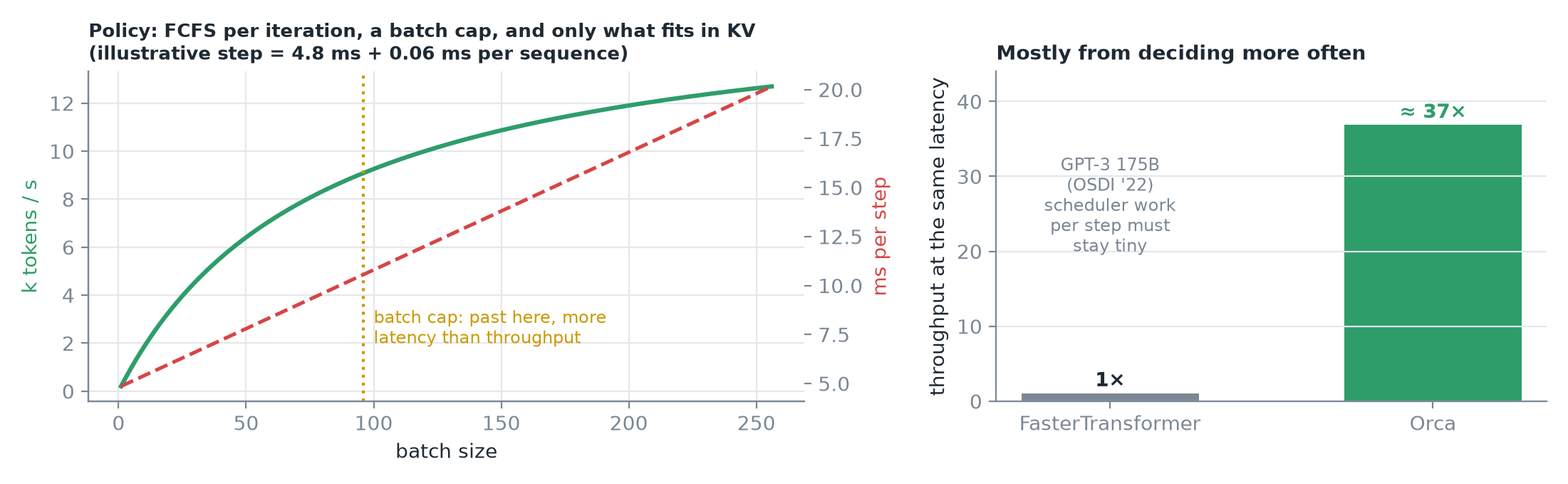 Left: illustrative step-time model; past some batch size, extra requests add more latency than throughput, so operators cap it. Right: Orca vs FasterTransformer on GPT-3 175B (OSDI '22).
- First come, first served, per iteration: a request that arrived earlier has always run at least as many steps as one that arrived later.
- A cap on batch size: past a point, a bigger batch adds more latency than throughput, so operators tune that knob.
- KV memory: every running request needs room for its cache, so the scheduler can only admit what fits.
- The scheduler now runs every step, so its own work must take a tiny slice of those few milliseconds.
IMPORTANT
Orca's ~37× came largely from simply deciding more often.
5. Recap