50 · Precision, Memory & Hardware Support
Source: fanout.sh / inference-eng / 11-01 · ~5 min
NOTE
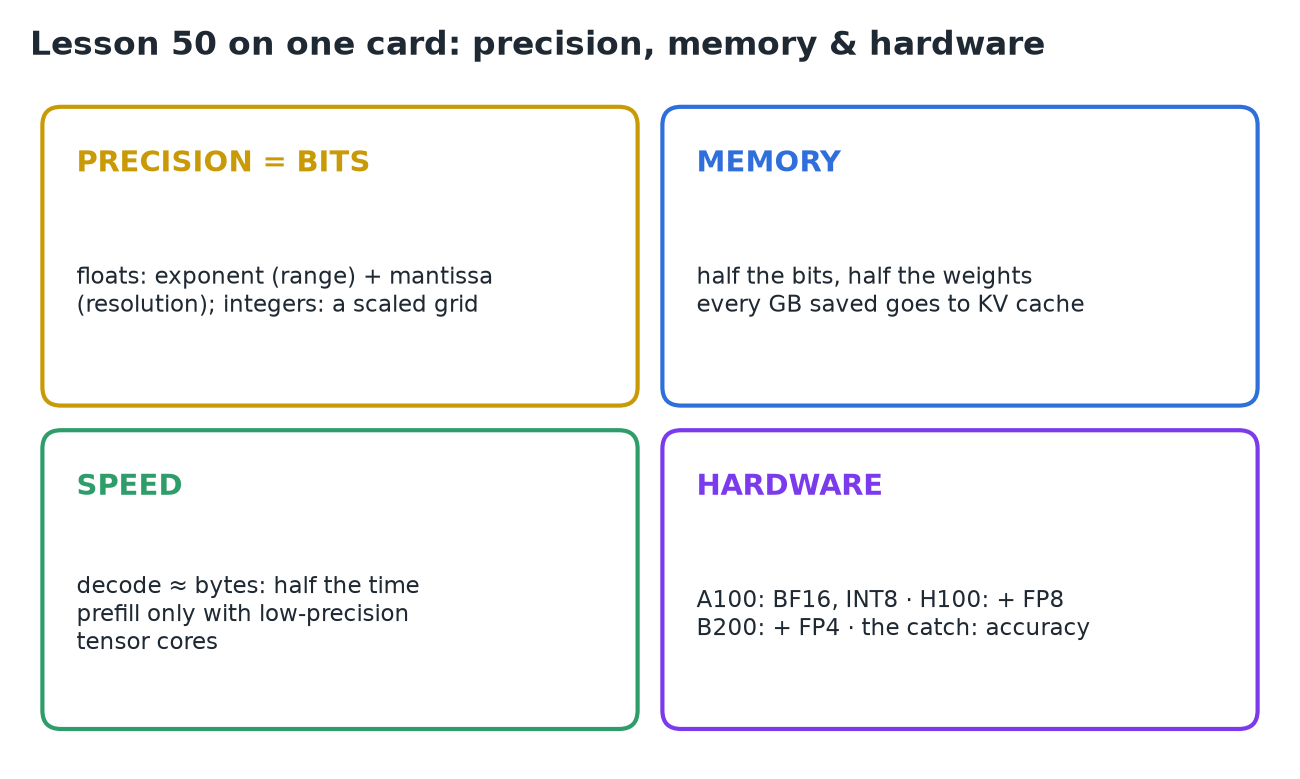
Precision is bits per number: floats split them into exponent (range) and mantissa (resolution); integers are an even grid times a scale. Weight memory is parameters × bytes, so Llama 3.1 8B goes 16 → 8 → ~4 GB and a 70B model drops from two GPUs to one. Decode streams the weights, so its floor halves with the bits (4.8 → 2.4 → 1.2 ms); prefill is math, and only speeds up when the tensor cores compute in that format, which depends on the GPU generation. The catch is accuracy.
1. What precision is
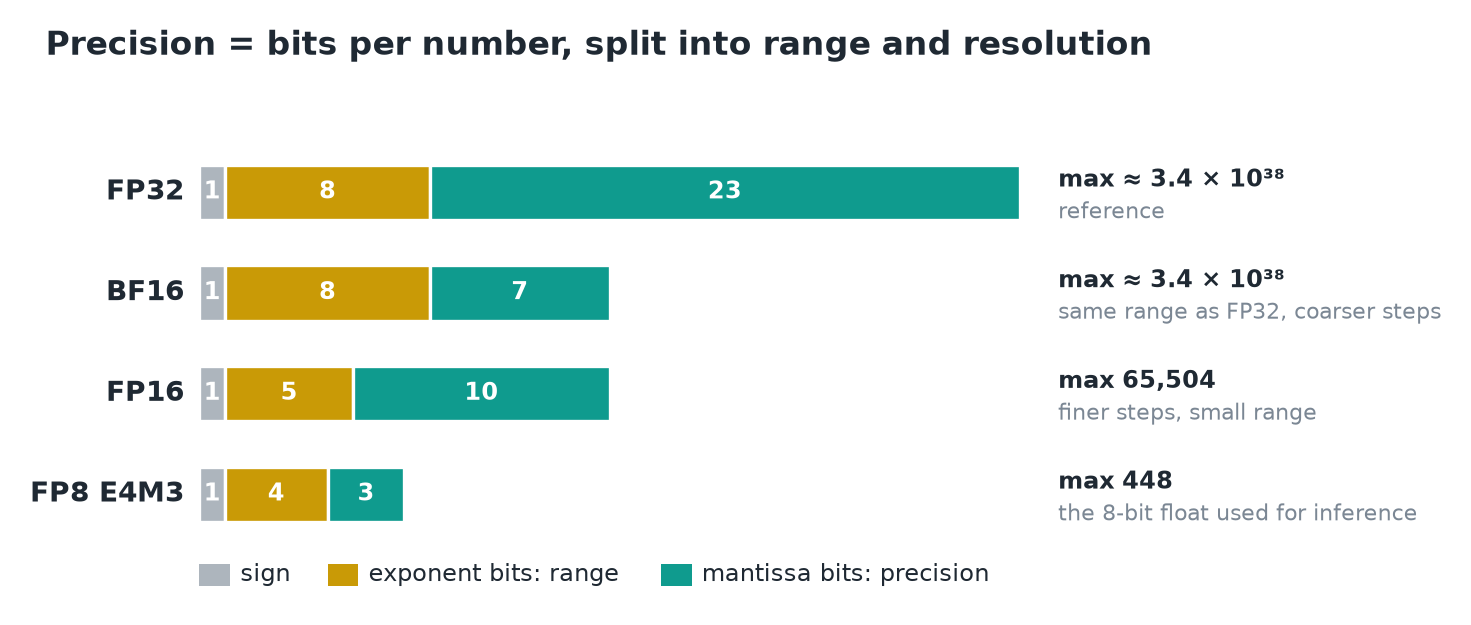 Same 1-bit sign; the formats differ in how they split the rest.
- Exponent bits set how big or small a number can get: its range. Mantissa bits set how finely it's resolved: its precision.
- BF16 (8 + 7): the same range as FP32, just coarser steps.
- FP16 (5 + 10): finer, but tops out at 65,504.
- FP8 E4M3 (4 + 3): the 8-bit float used for inference; largest value 448.
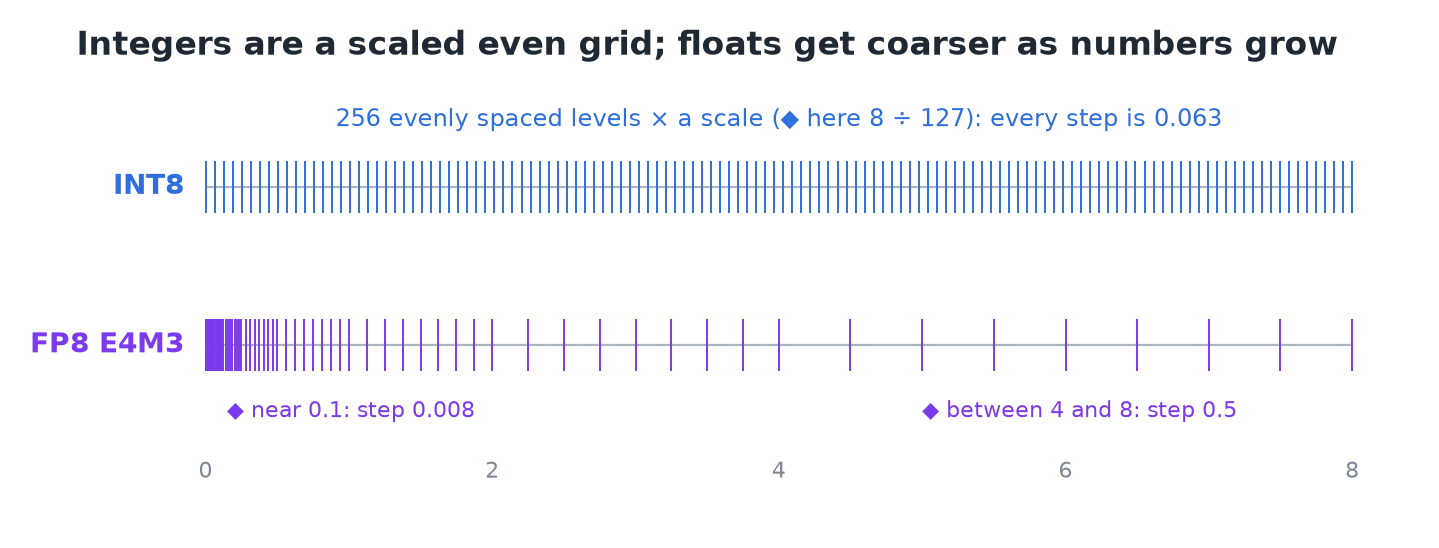 ◆ Real E4M3 values between 0 and 8, against INT8 scaled so its largest level is 8.
- INT8 is just 256 evenly spaced levels, plus a scale factor that stretches them over the numbers you actually have.
- ◆ Floats are the opposite shape: fine near zero and coarse for big values (E4M3's step is 0.008 near 0.1, but 0.5 between 4 and 8).
2. Memory
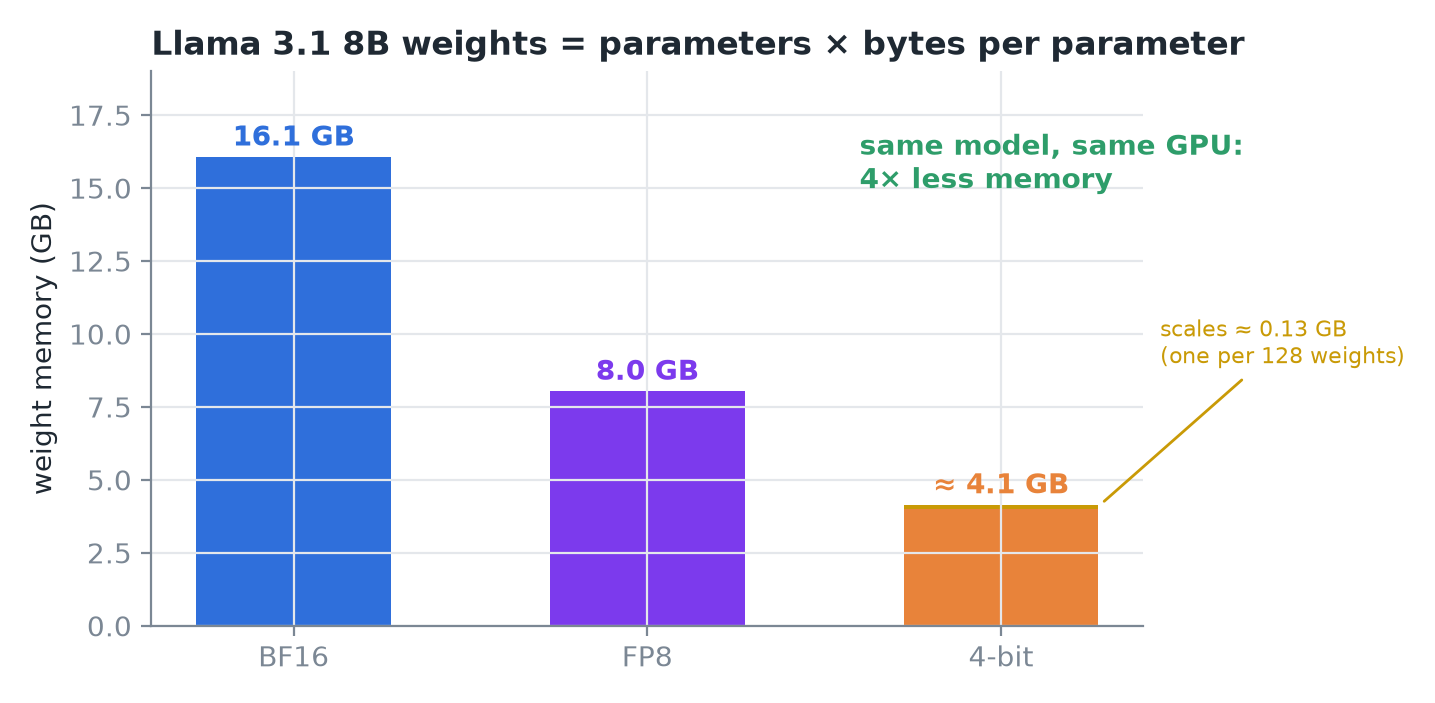 ◆ The scale overhead assumes one 16-bit scale per 128 weights.
- Llama 3.1 8B: 16.1 GB in BF16, 8.0 GB in FP8, ≈ 4.1 GB at 4 bits once you include the scale factors.
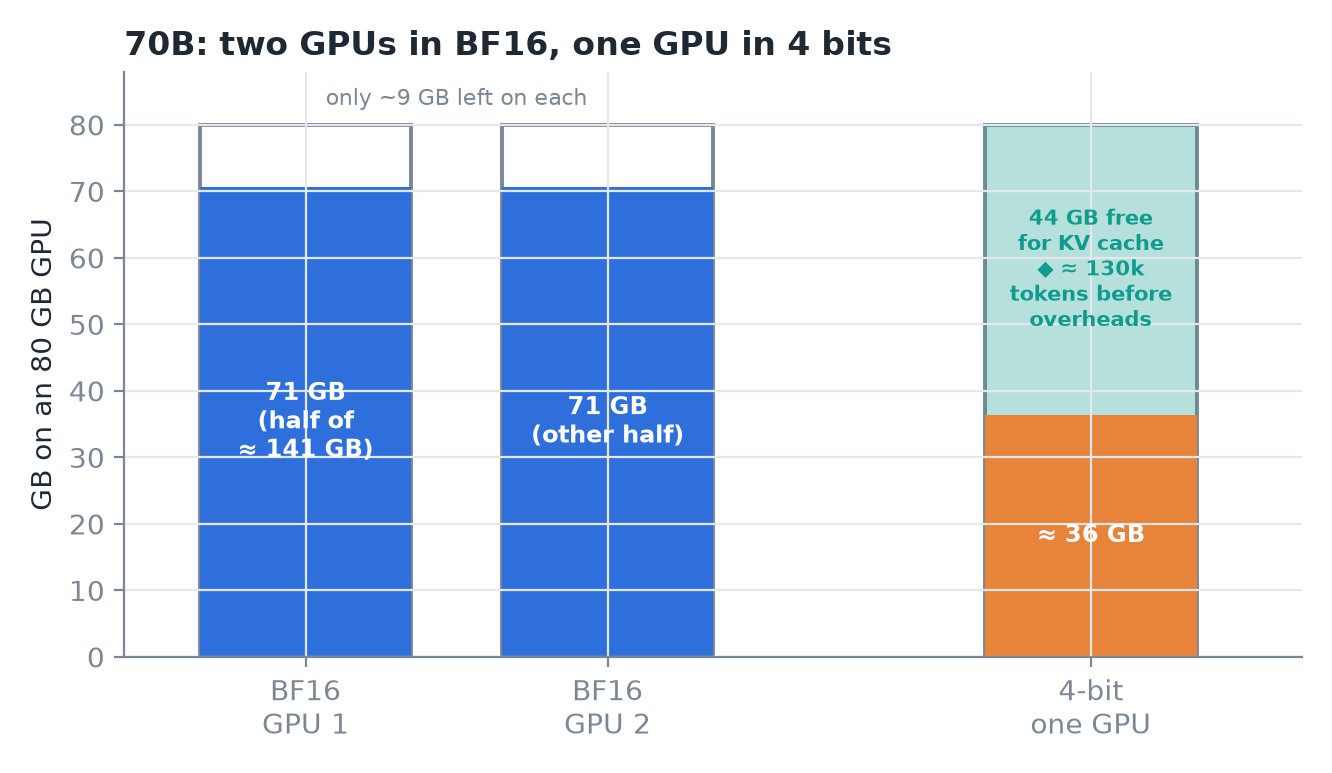 ◆ The even split and the token count are my arithmetic, at 320 KiB of KV per token for Llama 3 70B.
- The effect is bigger on large models: 70B needs ≈ 141 GB in BF16, so two 80 GB GPUs. At 4 bits it's ≈ 36 GB and fits on one, with room left for KV cache.
- Every gigabyte saved on weights goes to KV cache, which means more requests running at once.
3. Speed
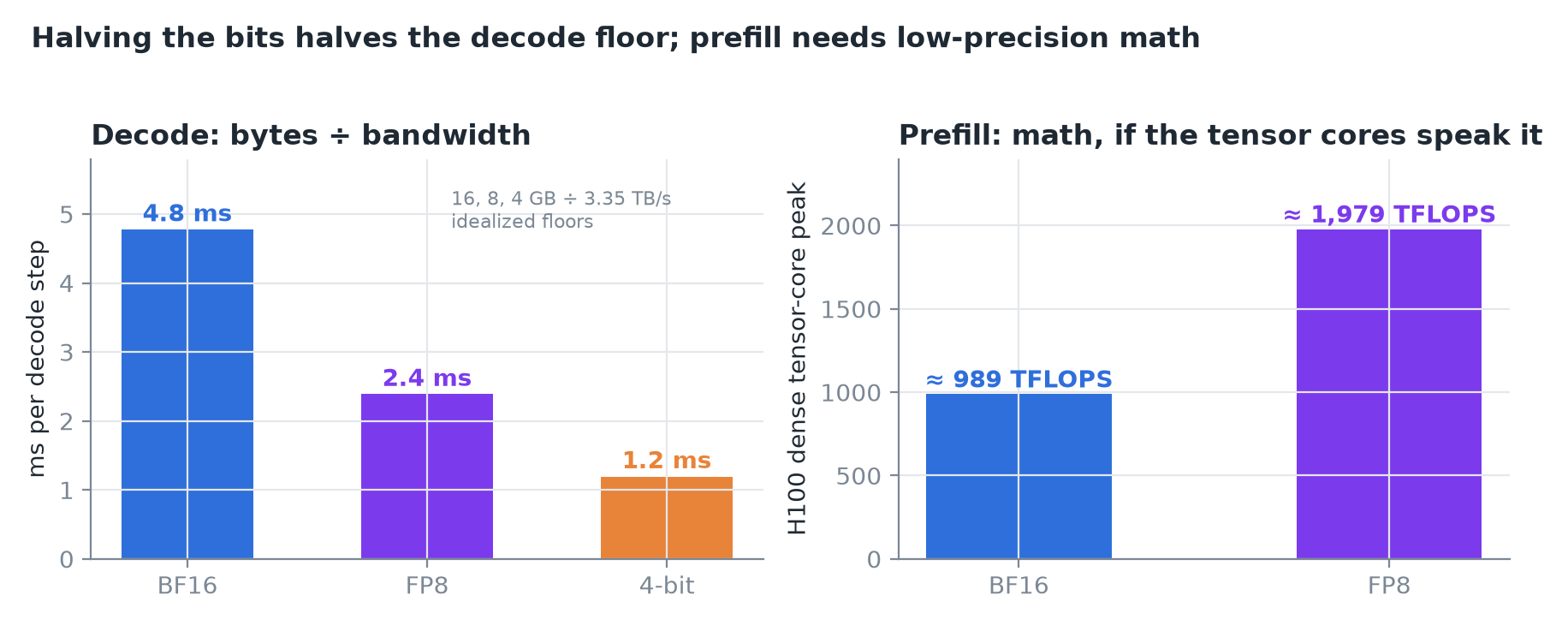 Decode floors from bytes ÷ bandwidth; prefill from the H100's dense tensor-core peaks.
- Decode is limited by memory bandwidth: each step streams all the weights, so step time roughly follows the bytes. Idealized floors, but the direction is real.
- Prefill is limited by math. Smaller weights alone don't make the math faster: prefill only speeds up if the tensor cores multiply in the lower precision.
- On an H100, FP8 math runs at about 2× BF16: ≈ 1,979 vs 989 TFLOPS dense.
4. Which GPUs compute which formats
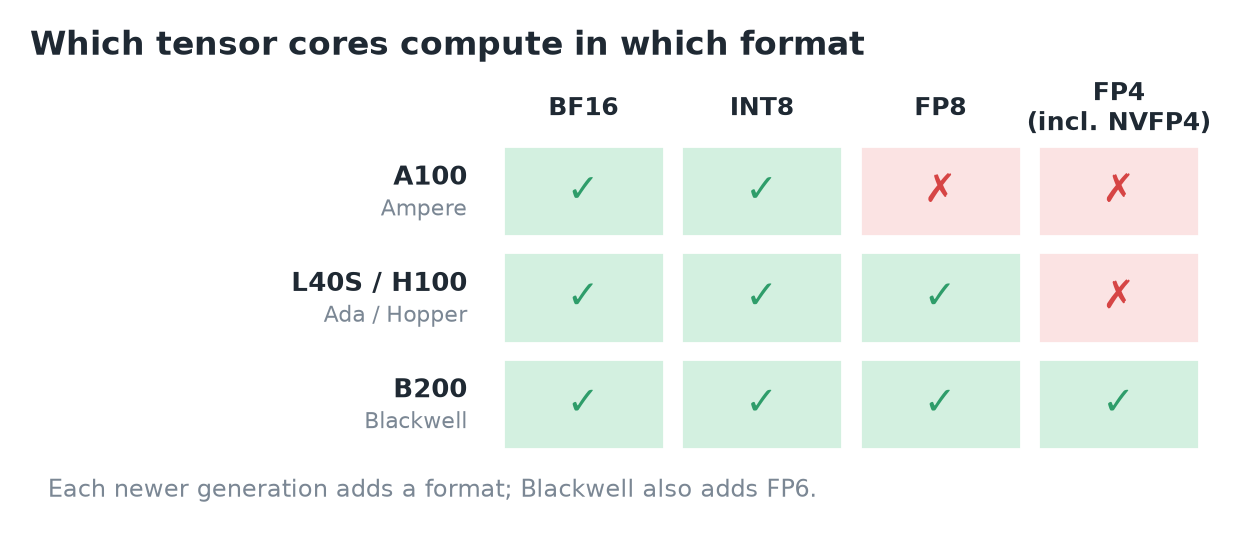 Tensor-core support by generation, as listed in the lesson.
- A100 (Ampere): BF16 and INT8, no FP8.
- L40S (Ada) and H100 (Hopper): add FP8.
- B200 (Blackwell): adds 6-bit and 4-bit floats, including NVIDIA's NVFP4.
5. Two ways to use low precision
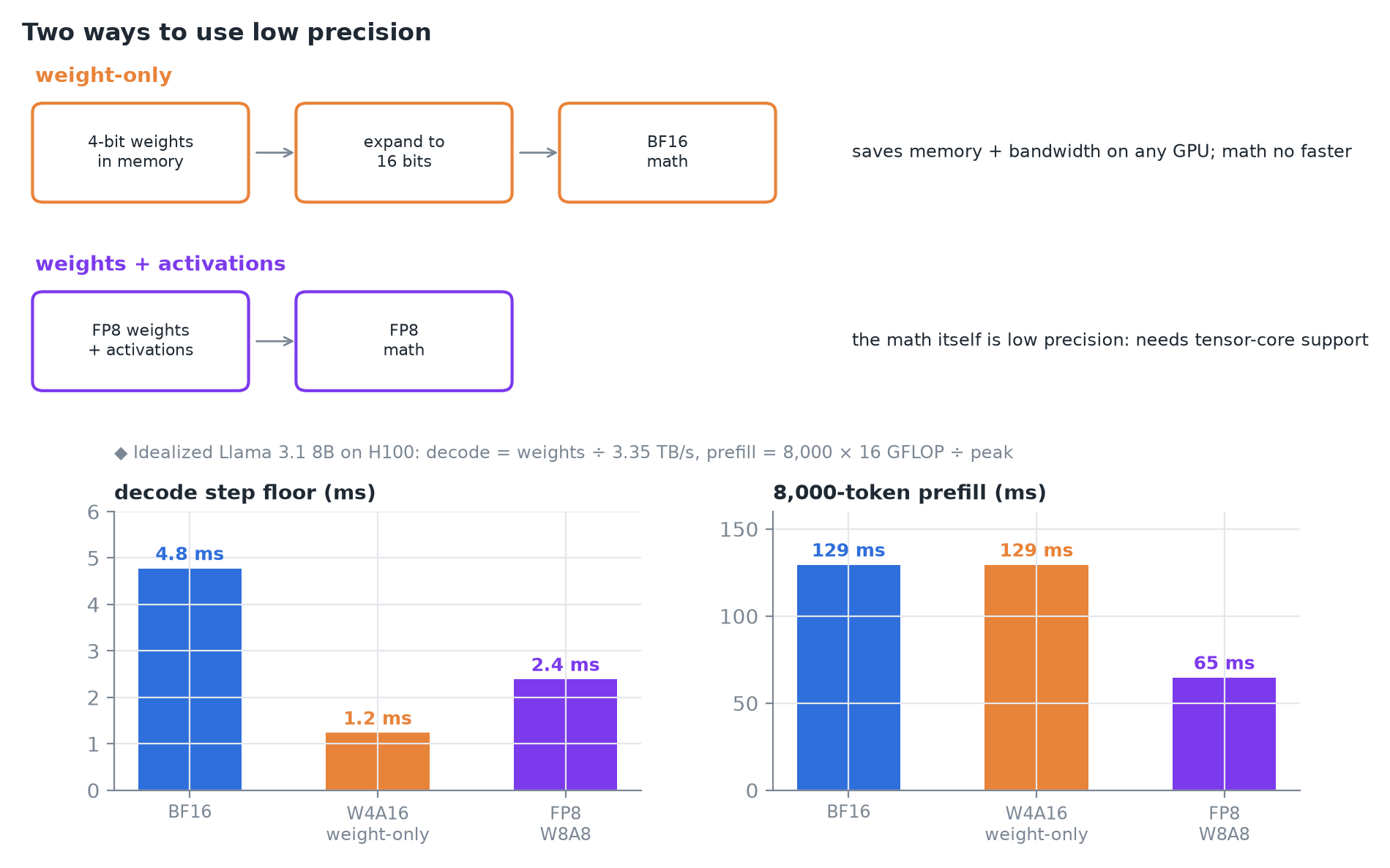 ◆ The bars are an idealized model; real weight-only kernels also pay to expand the weights.
| Weight-only | Weights + activations | |
|---|---|---|
| What happens | stored small, expanded to 16 bits right before the math | the math itself runs in low precision |
| Saves | memory and bandwidth | memory, bandwidth and math |
| Runs on | any GPU | only where the tensor cores support the format |
| Speeds up | decode | decode and prefill |
TIP
◆ Weight-only helps most while decode is limited by reading the weights. At large batches, decode gets closer to being limited by math, and expanding the weights adds work, so weight-only gains shrink.
6. Recap