16 · Understand & Measure the Decode Phase
Source: fanout.sh / inference-eng / 03-03 · ~6 min
NOTE
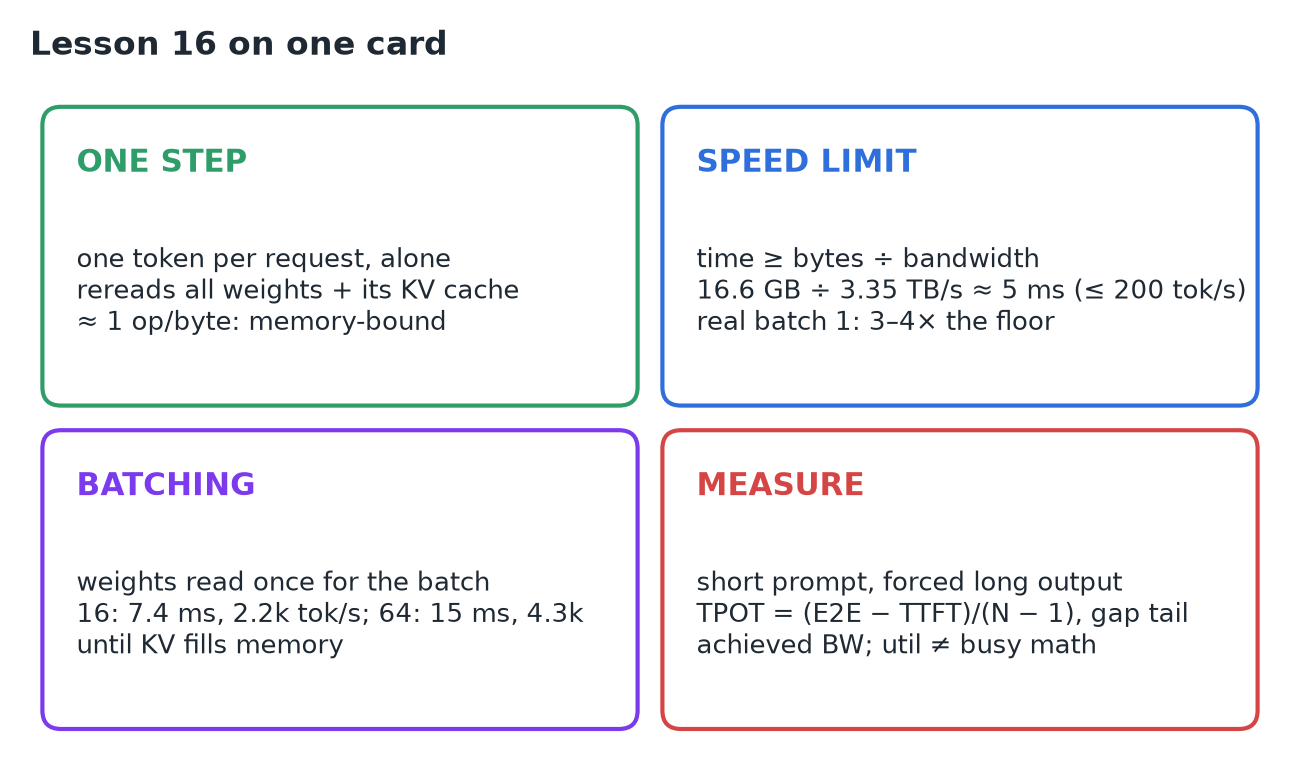
Prefill handles 2,000 tokens in ~60 ms; decode then spends several ms on every single token, so per token it can be ~100× more expensive. Each decode step pushes the newest token through all 32 layers alone (vector × matrix) and must read all the weights plus this request's whole KV cache, doing ~1 op per byte: memory-bound. So time per token ≥ bytes ÷ bandwidth: ~16.6 GB ÷ 3.35 TB/s ≈ 5 ms (≤ ~200 tokens/s per request), and real batch-1 systems land 3–4× above that floor. Batching shares the weight read: batch 64 is 15 ms per step but >4,000 tokens/s, until the KV cache fills memory. Measure with a short prompt, a forced long output, TPOT, the inter-token gap tail, and a concurrency sweep.
1. One decode step
The newest token goes through all 32 layers by itself. In each layer it meets every weight matrix, but as one vector times a matrix, not a block of tokens. In attention, its query reads the keys and values of every earlier token from the cache. One token comes out, its K and V join the cache, and the next step begins.
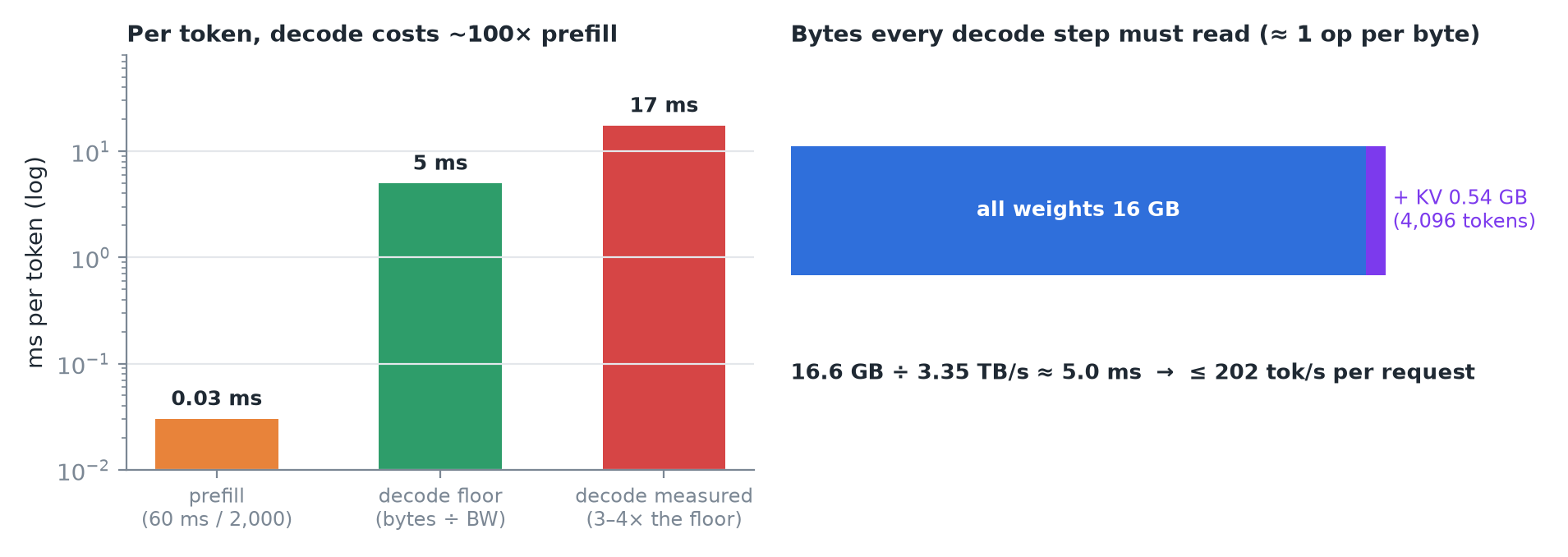 Every step reads two things: all the weights and this request's whole KV cache, with ~1 op per byte against the H100's ~300 ridge.
IMPORTANT
Decode is memory-bound: the GPU spends its time waiting for bytes, so its speed limit is bytes read ÷ memory bandwidth.
2. The speed limit
- Llama 3 8B weights ≈ 16 GB; a 4,096-token conversation adds ≈ 0.5 GB of KV cache.
- 16.6 GB ÷ 3.35 TB/s ≈ 5 ms per token: one request can't beat ~200 tokens/s on this GPU.
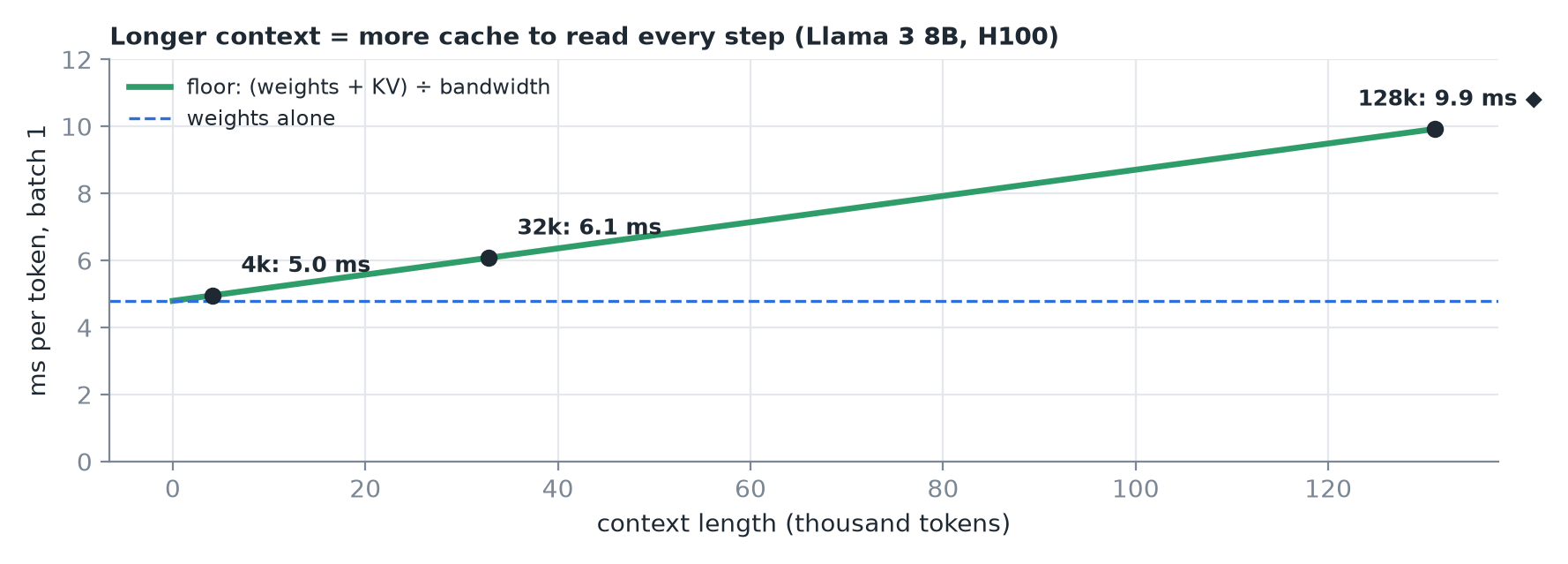
- Longer context means more cache to read: at 32k tokens the floor rises to ~6 ms.
WARNING
Real systems land above the floor. One recent study measured batch-1 decode of 7–8B models on H100s at a quarter to a third of this ideal: small kernels and launch overheads eat the time. The floor tells you where the ceiling is, not where you are.
3. Batching: how servers reach thousands of tokens/s
If 16 requests decode together, the weights are read once for all 16. Each request still reads its own KV cache, but the big 16 GB read is shared.
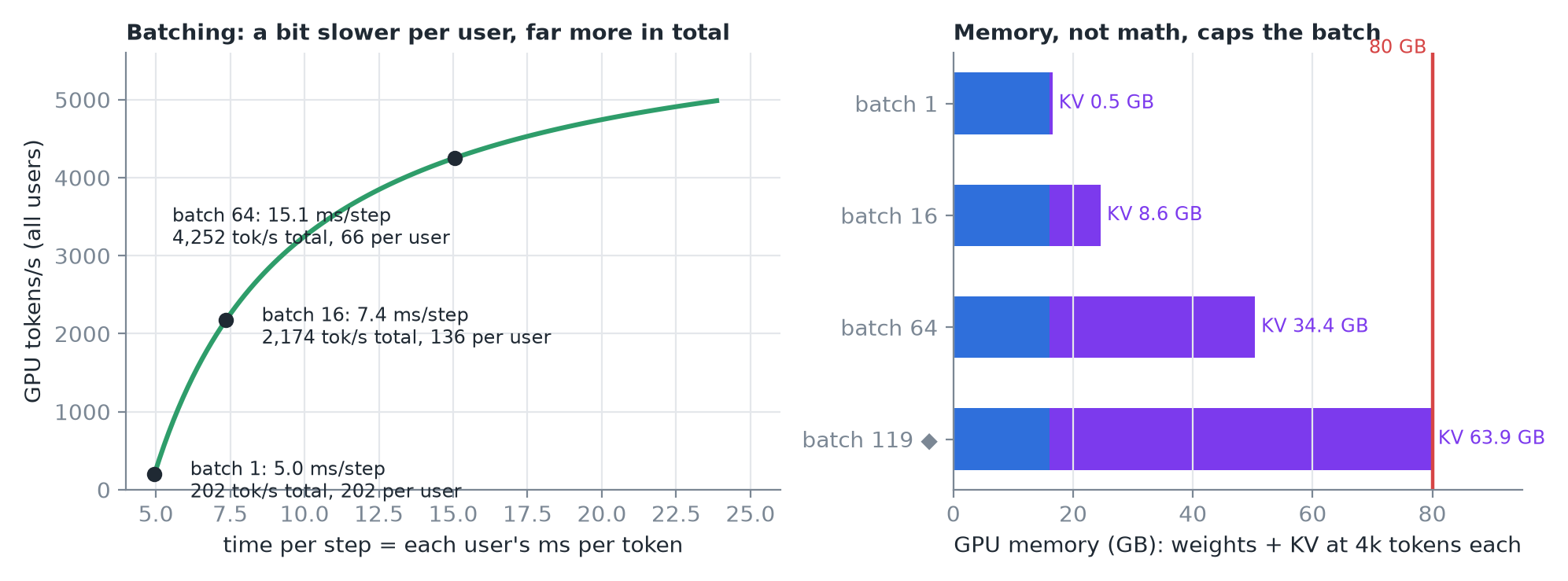 Left: each user's stream slows a little; the GPU does far more. Right: every request keeps its KV cache in memory; 64 requests × 4k tokens ≈ 34 GB on top of 16 GB of weights. ◆ At 4k each, ~119 fit in 80 GB (see 02).
TIP
Decode's central trade-off is latency per user vs total throughput, and memory, not math, caps the batch.
4. Measure it honestly
- Short prompt, long output (a few hundred tokens), so prefill barely matters.
- Force the length (e.g. ignore the end-of-text token) so every run generates the same count.
- Record TTFT and end-to-end time, then TPOT = (E2E − TTFT) ÷ (N_out − 1).
- Keep the individual inter-token gaps: their tail shows stalls an average hides.
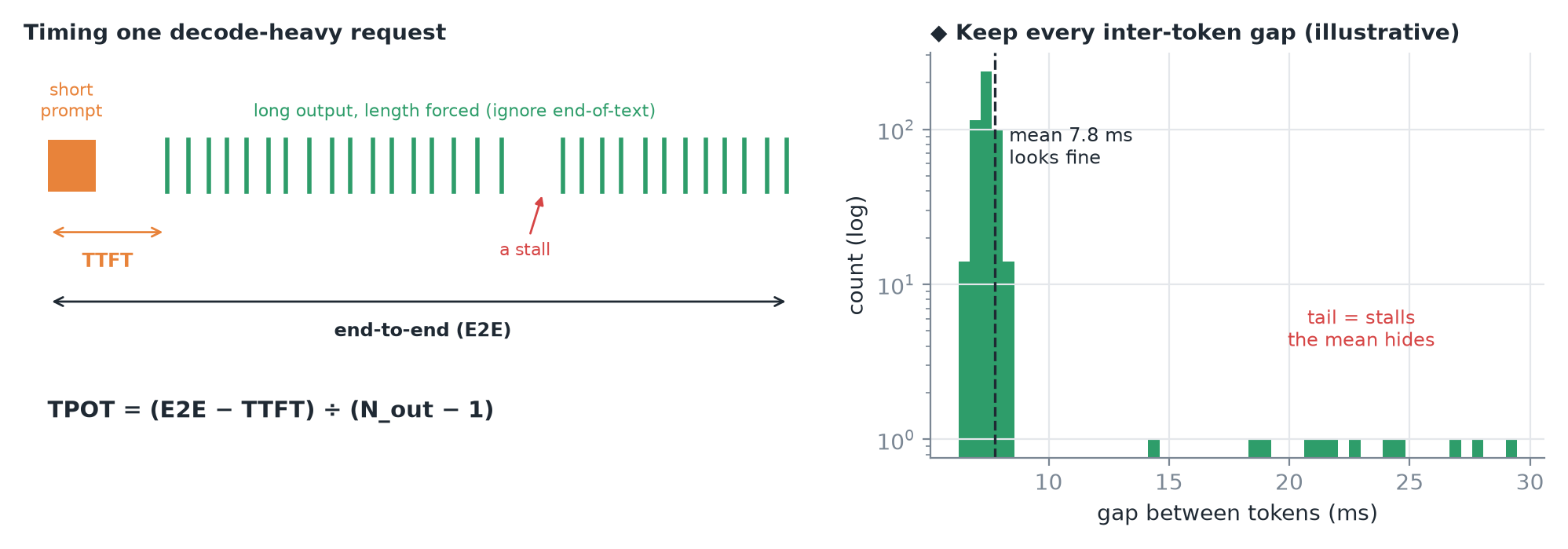
Then sweep concurrency (1, 2, 4, 8 … 64), plot throughput against time per token, and convert to achieved bandwidth = bytes per step ÷ measured step time, e.g. 16.6 GB ÷ 12 ms ≈ 1.4 TB/s ≈ 41% of peak.
CAUTION
GPU utilization can read ~100% during decode while the math units are mostly idle. It only means some kernel was running (see 09).
5. Every later lever
Quantization, cache compression and smarter batching all move fewer bytes or share them better.
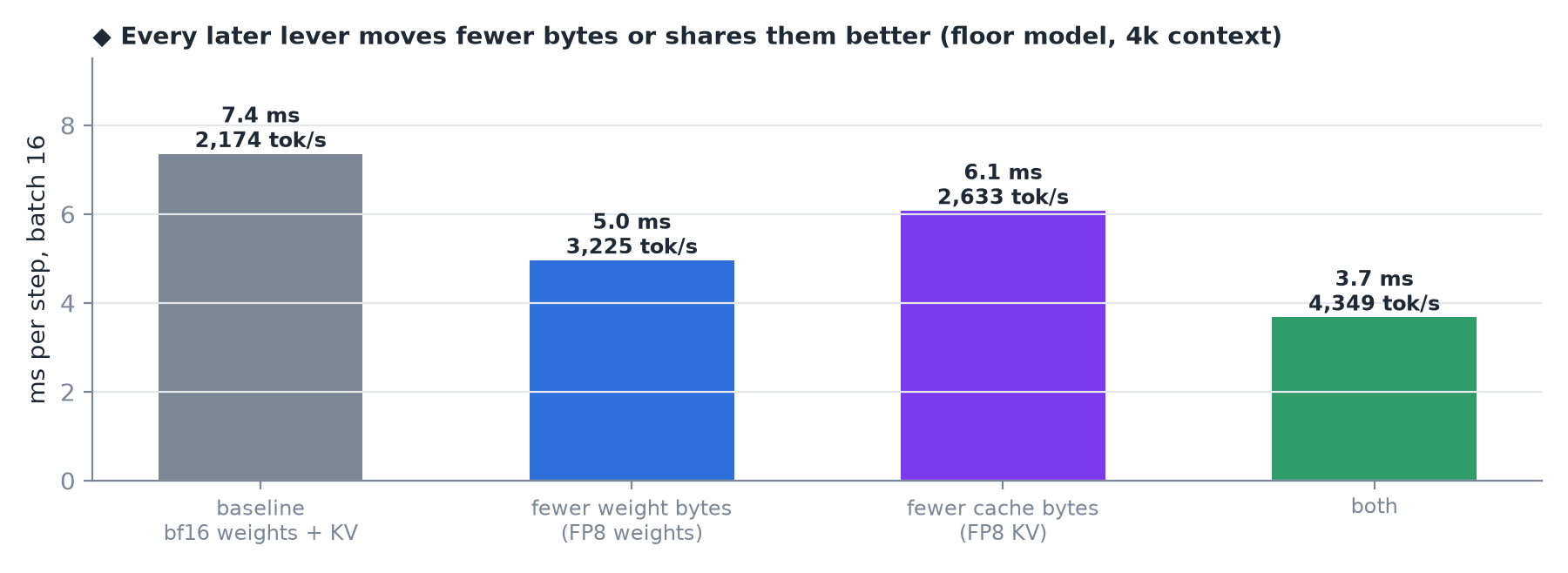 ◆ Floor-model arithmetic at batch 16, 4k context: halving weight bytes helps most here; halving cache bytes matters more as batch or context grows.
6. Recap