18 · Calculate Model & Runtime Memory
Source: fanout.sh / inference-eng / 03-05 · ~7 min
NOTE
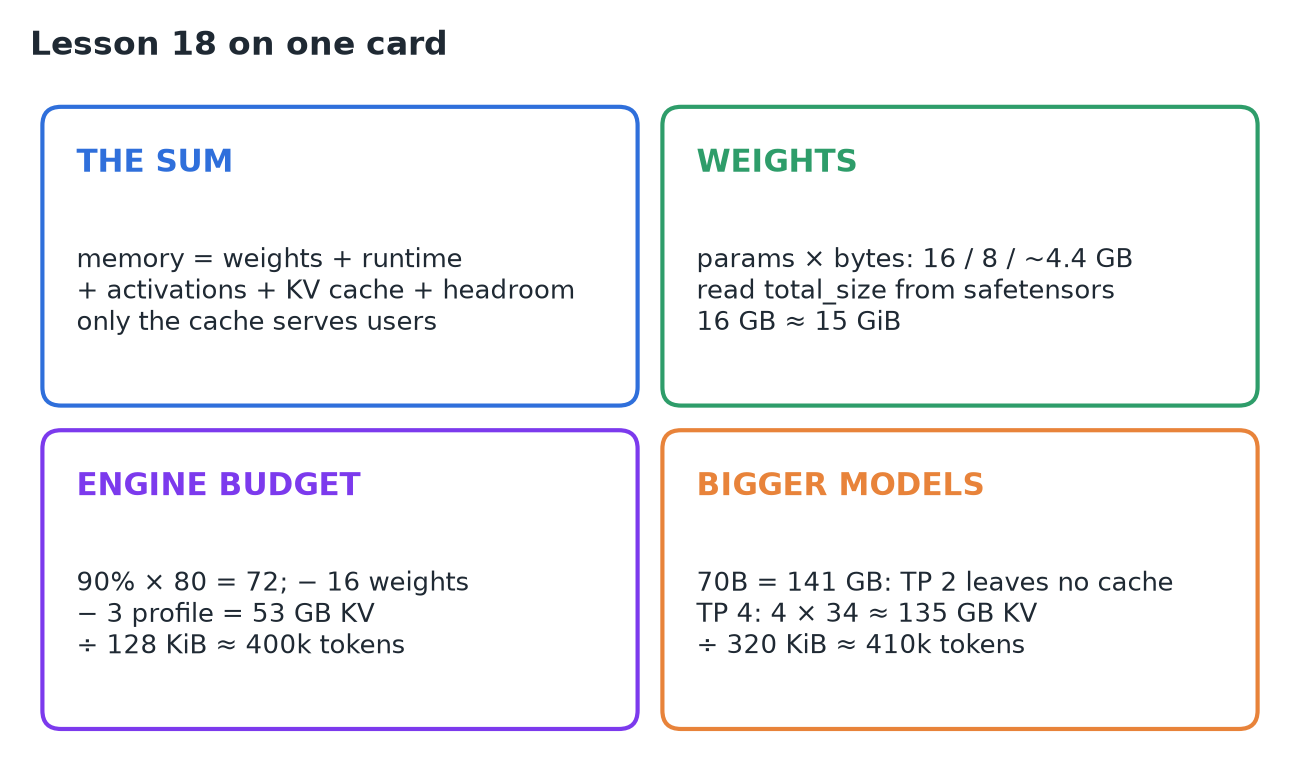
16 GB of Llama 3 8B weights on an 80 GB H100 does not leave 64 GB spare. GPU memory = weights + runtime overhead + activations + KV cache + headroom, and only the KV cache actually serves users, so the game is: know the overhead precisely and give the rest to the cache. vLLM does this at startup: take a 90% budget (72 GB), subtract the measured weights (16) and a profile run's peak (≈ 3), and the rest, ≈ 53 GB ≈ 400k tokens, becomes KV cache. Llama 3 70B (141 GB) doesn't fit on one GPU, leaves no cache on two, and on four gets ≈ 135 GB of cache ≈ 410k tokens.
1. Where GPU memory goes
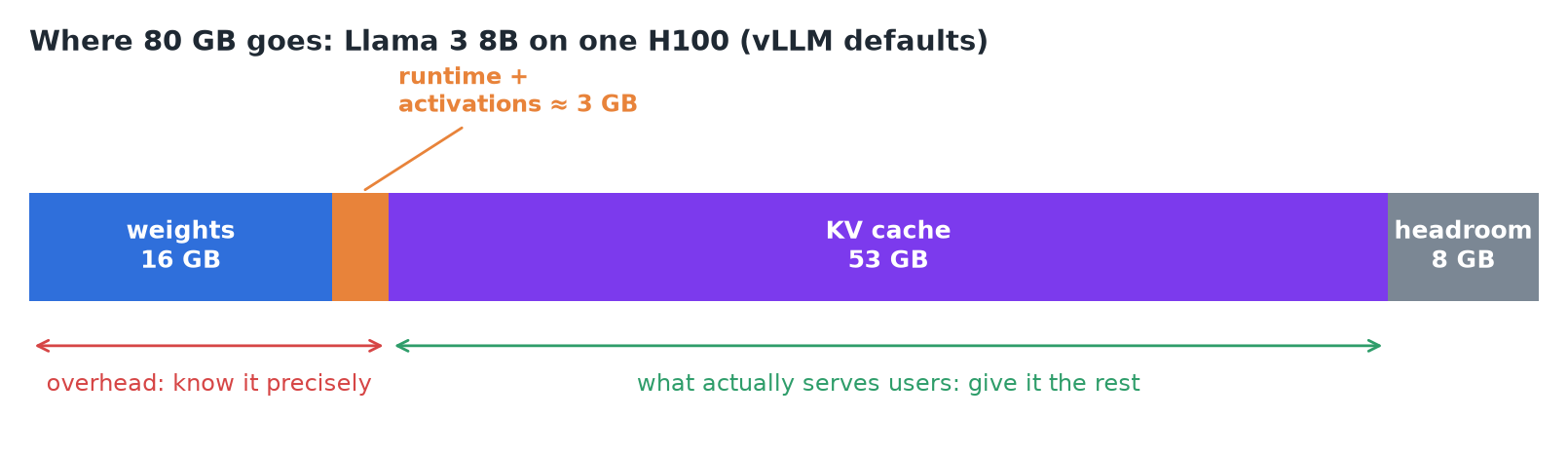 Weights (the biggest fixed piece), a runtime slice (CUDA context, communication buffers, kernel workspaces), activations (temporary tensors of a forward pass), the KV cache (every active request's keys and values), and headroom you never plan to use (CUDA graphs, fragmentation, safety margin).
IMPORTANT
Everything except the KV cache is overhead. The KV cache is what lets you serve users.
2. Weights: the easy part
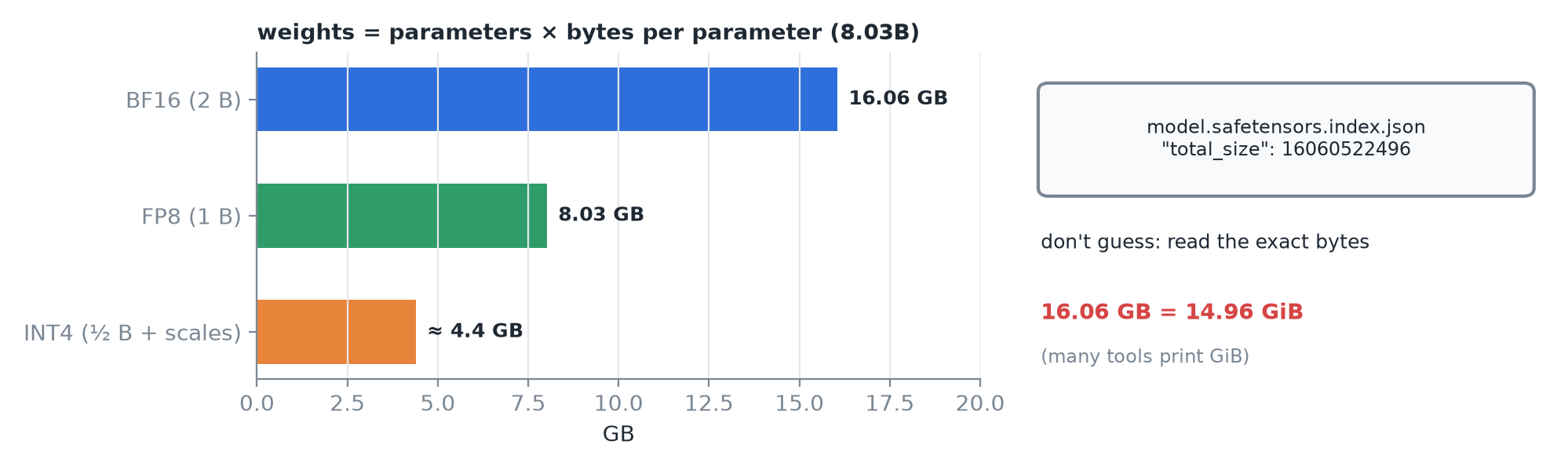 Four-bit formats come to a little over 4 GB because the scaling factors add extra.
- Don't guess the parameter count: the model's
model.safetensors.index.jsonlists the exacttotal_sizein bytes. - Watch the units: 16 GB ≈ 15 GiB, the unit many tools actually print (unit table in 04).
3. The runtime's share (easy to forget)
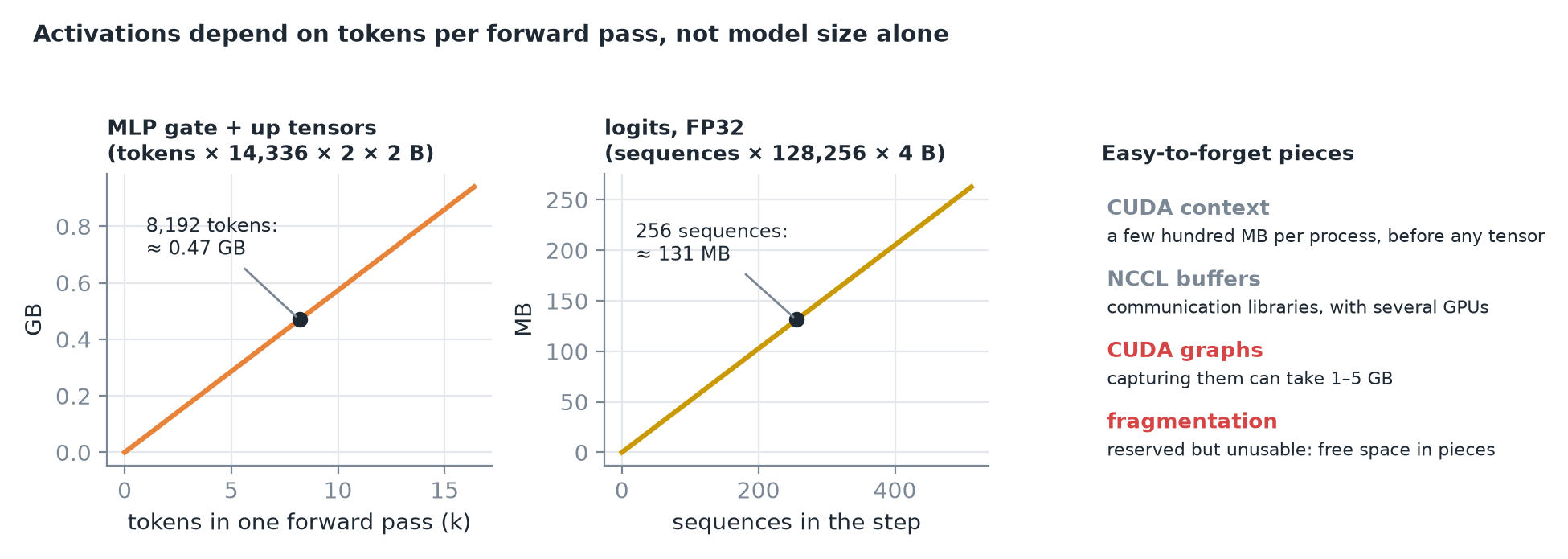
- CUDA context: just initializing the GPU in a process takes a few hundred MB, before any tensor exists. With several GPUs, NCCL adds its own buffers.
- Activations: depend on how many tokens one forward pass handles, not on model size alone. 8,192 tokens in one step: the MLP's gate and up tensors alone take ~0.5 GB, for an instant. Logits for 256 sequences in FP32: ~131 MB.
- CUDA graphs: capturing them to cut launch overhead can take 1–5 GB.
- Fragmentation: the allocator may reserve memory it can't hand out, because free space is split into pieces too small to use.
4. How a real engine sizes the cache
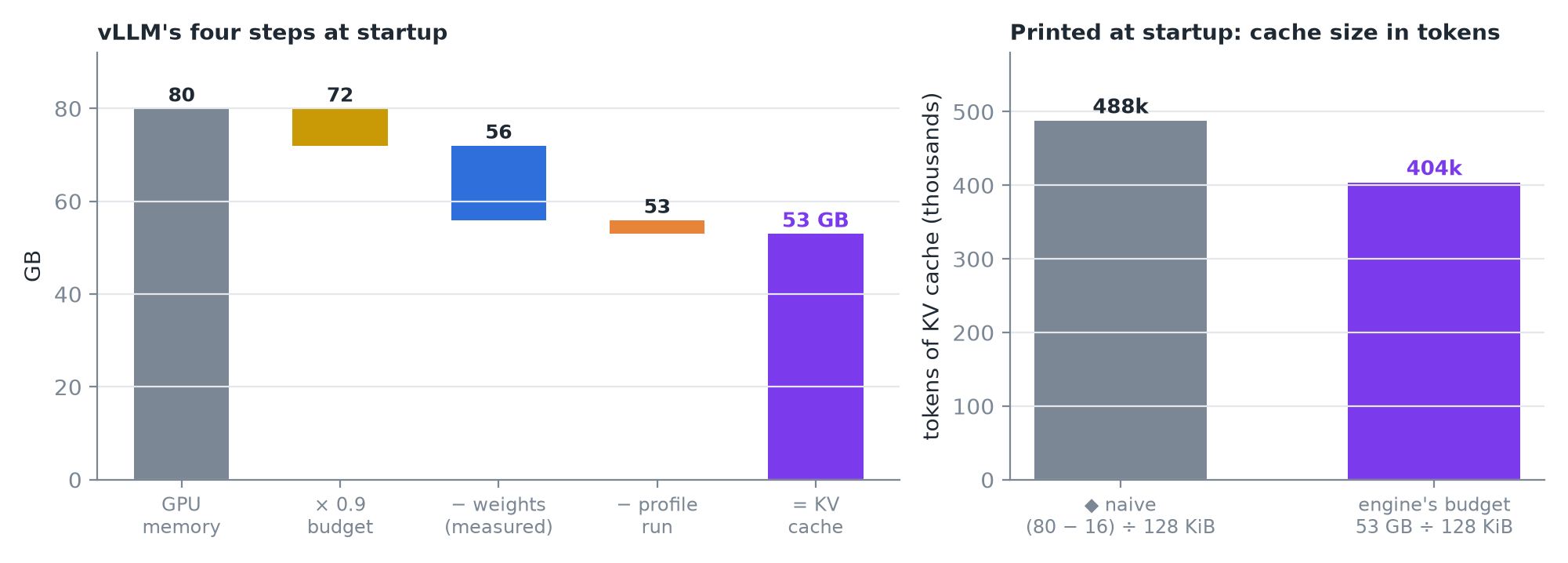 Step 1: budget = 90% of the GPU (72 GB). Step 2: load and measure the weights (16 GB). Step 3: one fake forward pass at the largest allowed batch records peak activation and non-torch memory (say 3 GB). Step 4: the rest is KV cache, ~53 GB ≈ 400k tokens at 128 KiB each. ◆ The naive "(80 − 16) ÷ 128 KiB" from 02 overstates it by ~20%.
The engine prints this at startup: KV cache size in tokens, and how many full-length requests fit. The last 10%, outside the budget, is left for CUDA graphs and surprises.
5. A bigger model: Llama 3 70B
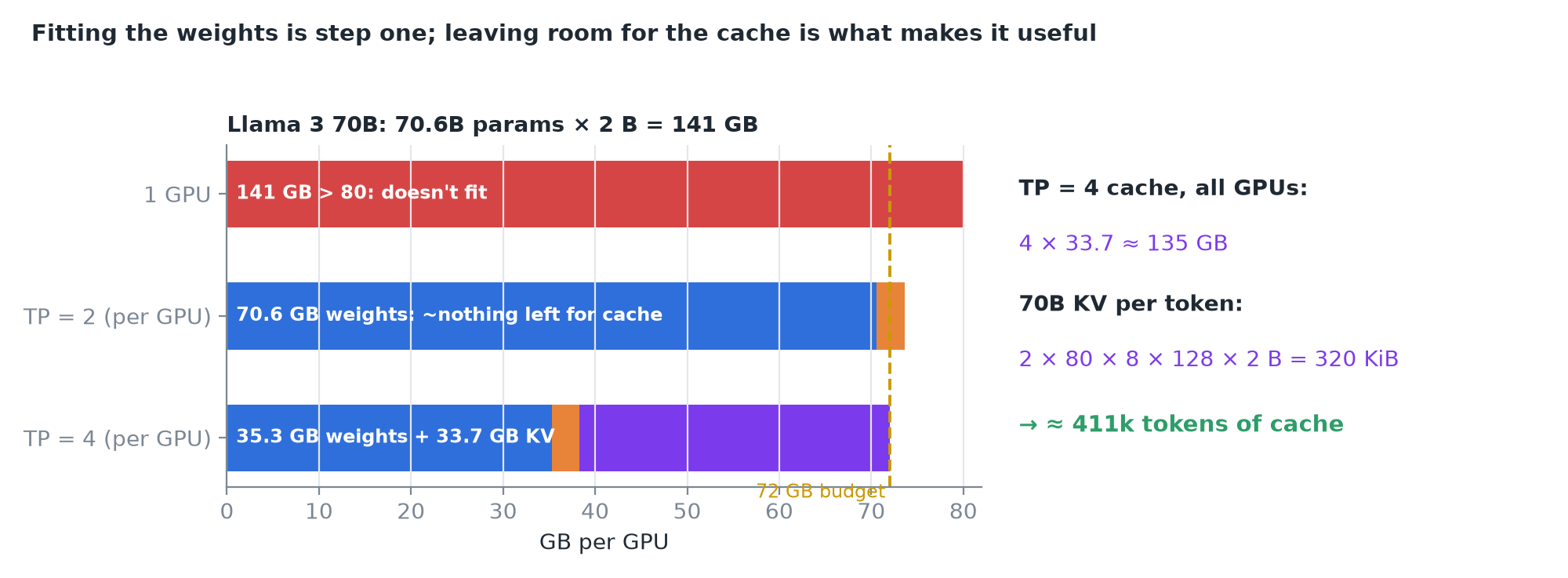 70.6B × 2 B ≈ 141 GB. Tensor parallelism splits it: 2 GPUs hold 70.6 GB each, leaving almost nothing of the 72 GB budget; 4 GPUs hold ~35 GB each and leave ~34 GB each for cache.
TIP
Fitting the weights is only step one. Leaving room for the cache is what makes the deployment useful.
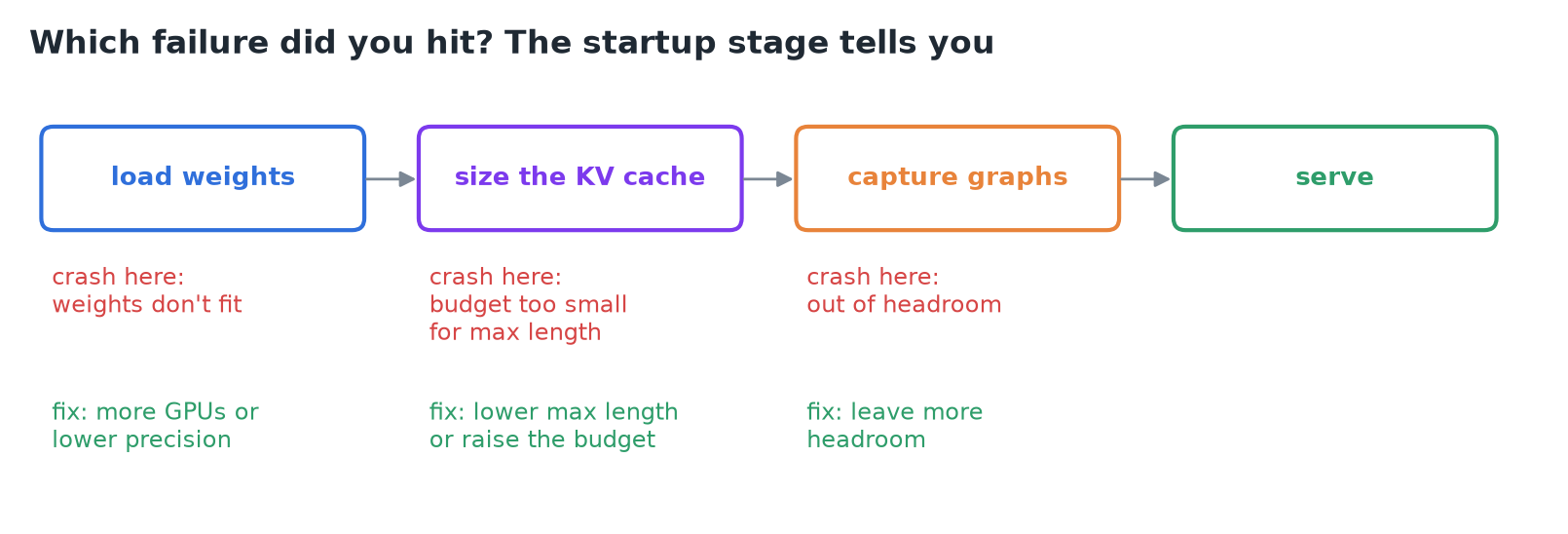
6. Which failure did you hit?
7. Recap