47 · Automatic Prefix Caching
Source: fanout.sh / inference-eng / 10-05 · ~5 min
NOTE
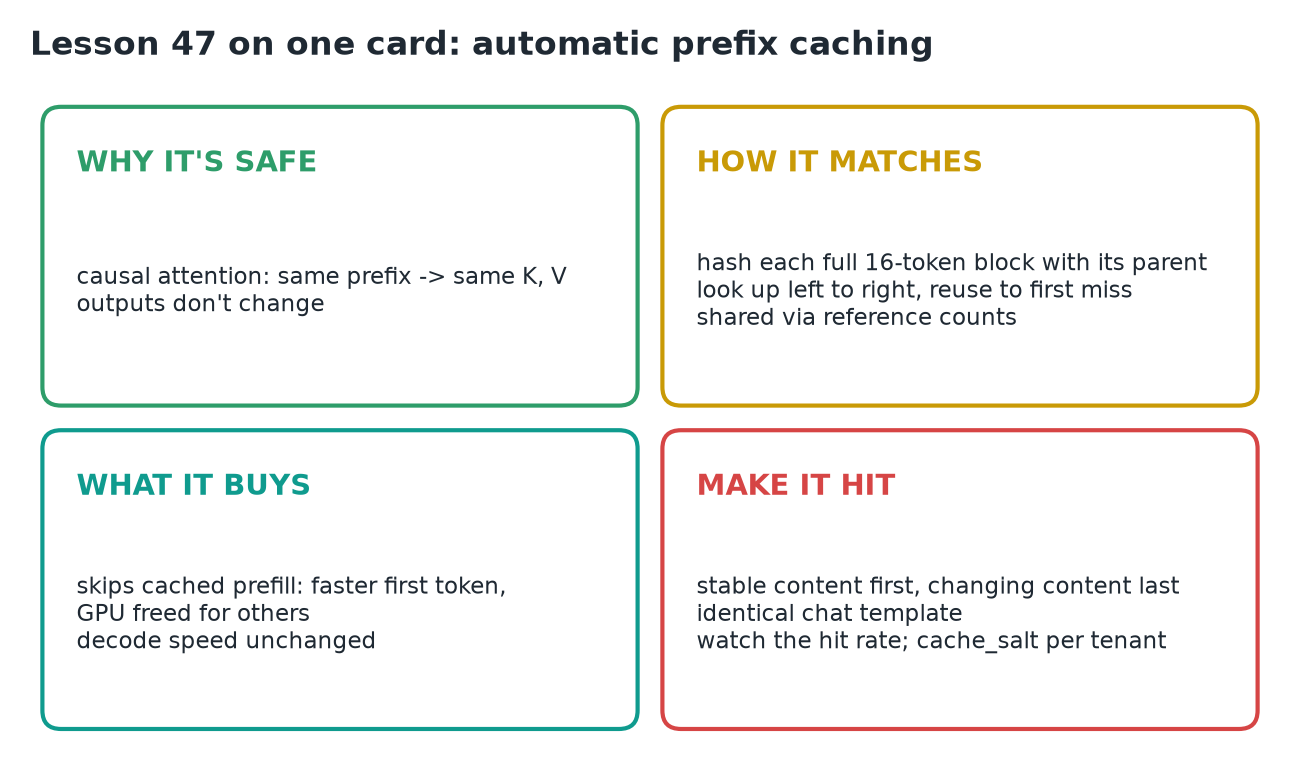
Causal attention means an identical prefix produces an identical KV cache, so a request can borrow another's K and V for the shared start and compute only what's new, with unchanged output. vLLM finds matches by hashing each full 16-token block together with its parent's hash and reusing blocks up to the first miss. Hits skip prefill: in vLLM's benchmark, mean TTFT fell 108 → 68 ms at 80% hits, but decode speed is unchanged. Matching is exact from token one, so put stable content first, changing content last, and watch the hit rate.
1. Identical work, every request
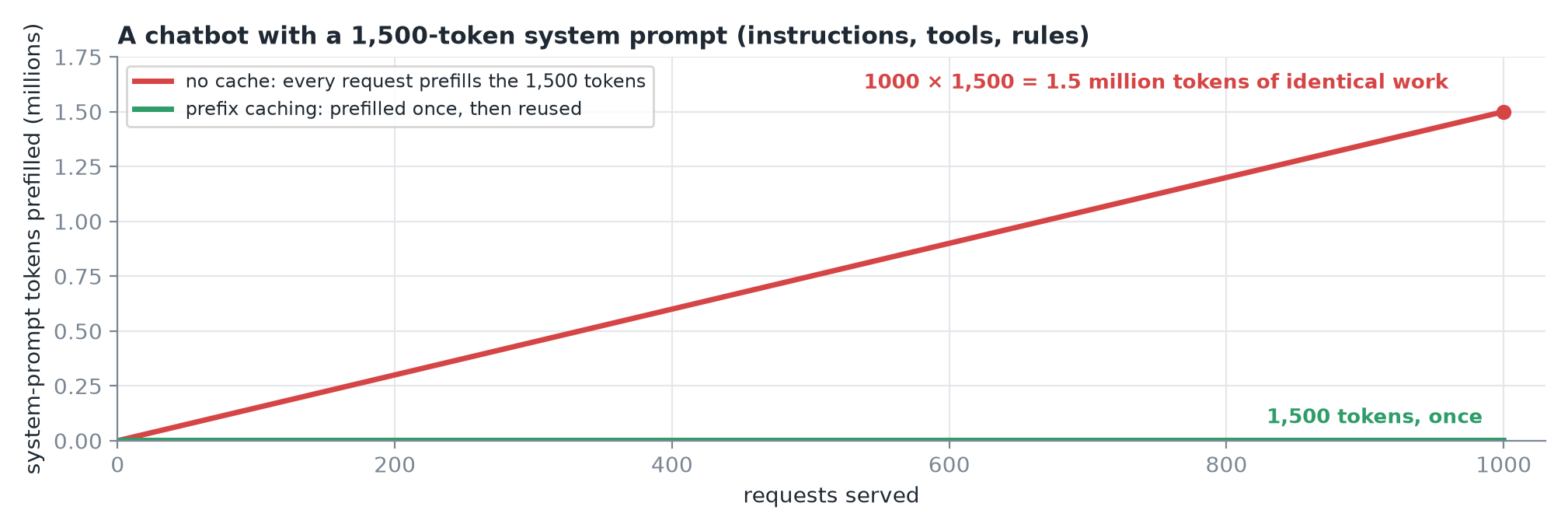 Without caching, the shared system prompt is prefilled from scratch on every request.
- A chatbot's 1,500-token system prompt (instructions, tools, rules) starts every request.
- Automatic prefix caching does that work once and reuses it.
2. Why reuse is safe: causal attention
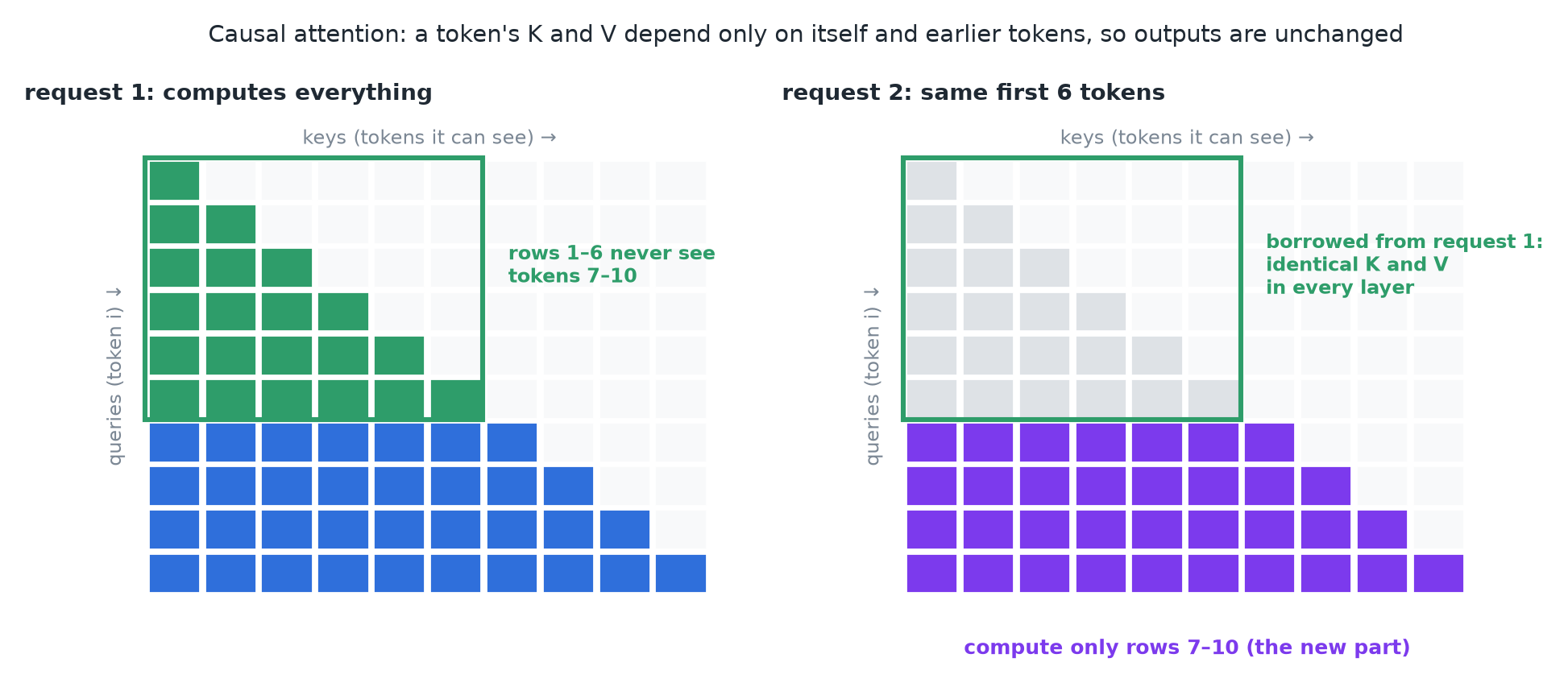 Rows are query tokens, columns the tokens each can attend to; the shared prefix rows never see the suffix.
- A token's keys and values depend only on that token and the tokens before it, never on what comes after.
- Two prompts with the same exact start therefore have identical K and V for that start, in every layer.
- Request 2 borrows request 1's cache for the shared part and computes only the new part. The model's output doesn't change at all.
3. Finding a shared prefix fast
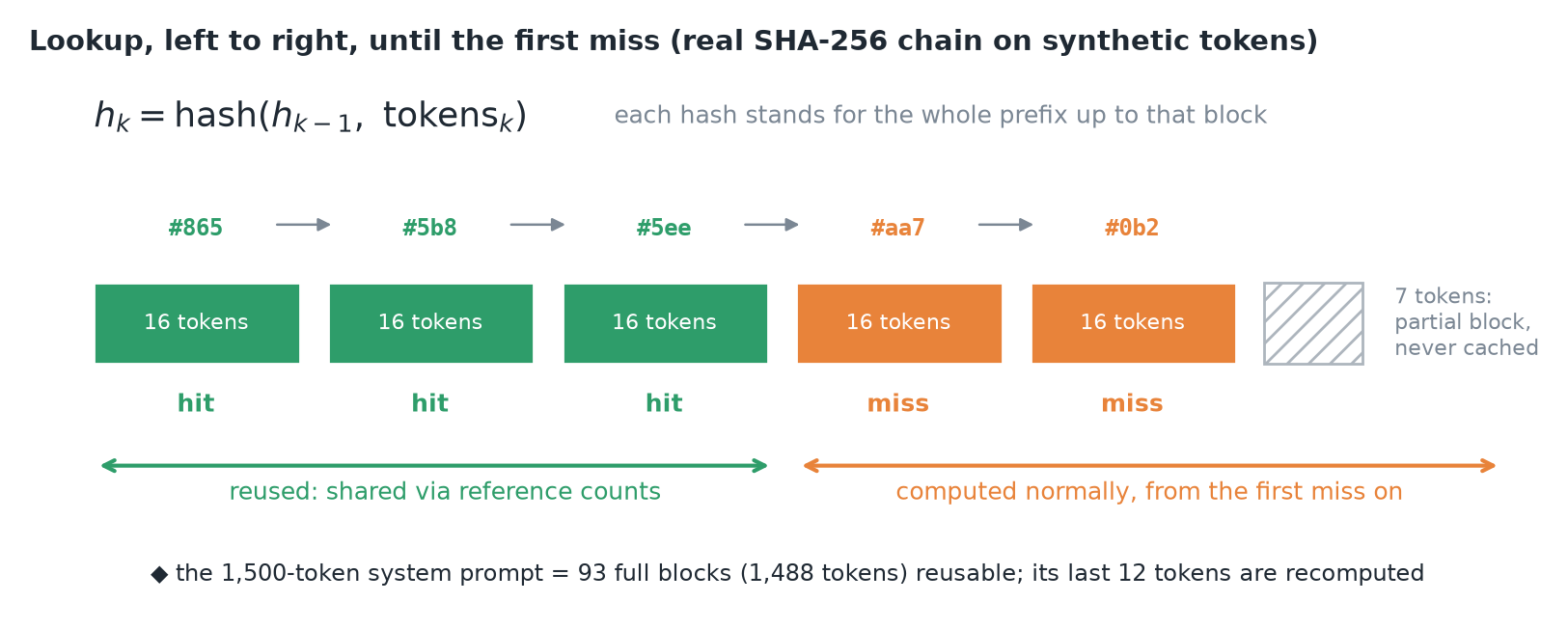 Hash chain over 16-token blocks; reuse stops at the first miss.
- vLLM works one KV block at a time, 16 tokens each, and fingerprints every full block:
- Because each hash includes its parent's, one hash stands for the entire prefix up to that block, not just its 16 tokens.
- On arrival, the engine hashes the prompt block by block and looks each hash up left to right: hit, hit, hit, first miss. Everything before the miss is reused; everything from the miss on is computed normally.
- Only full blocks are cached, so reuse comes in steps of 16 tokens; a trailing partial block is never cached.
- Matched blocks are shared through reference counts, the same sharing mechanism as copy-on-write blocks.
4. What it buys, and what it doesn't
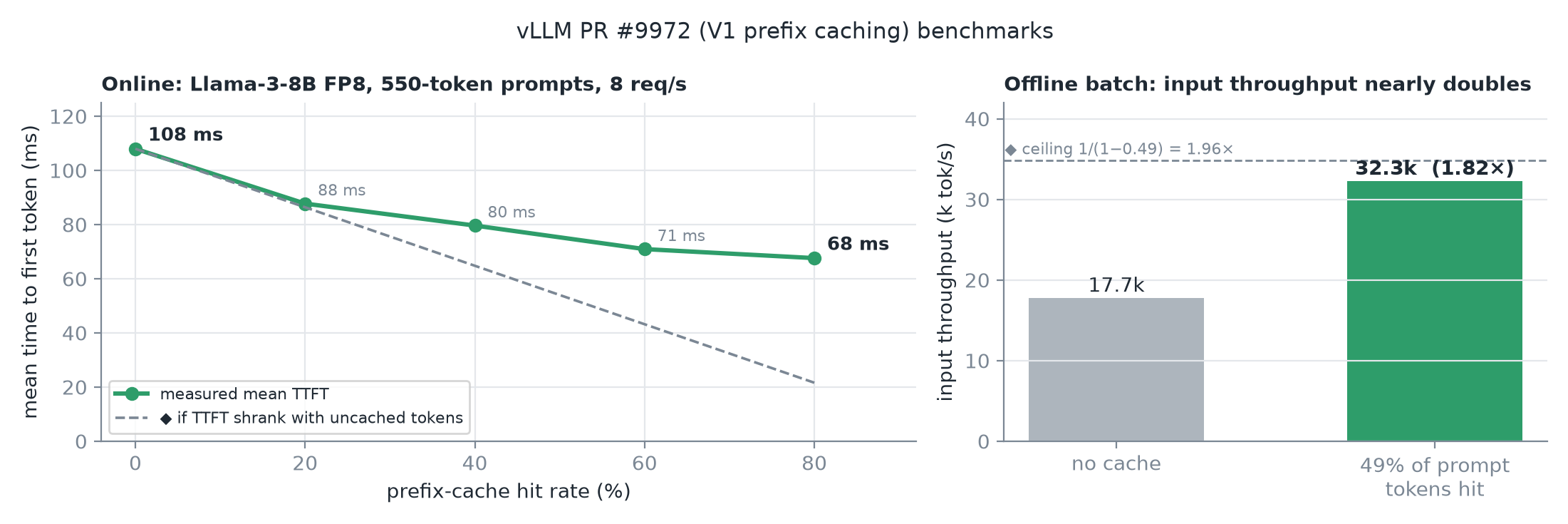 vLLM PR #9972: the lesson cites the 0% and 80% points; ◆ the middle points and the dashed lines are from the same PR table or my own arithmetic.
- Prefill for the cached part is skipped: the first token arrives sooner and the GPU has more time for everyone else.
- Online (Llama-3-8B FP8, 550-token prompts, 8 req/s): mean TTFT ≈ 108 ms at 0% hits → ≈ 68 ms at 80% hits.
- Offline, with about half the prompt tokens hitting: input throughput nearly doubled (17.7k → 32.3k tok/s, 1.82×).
TIP
◆ TTFT fell 37%, not 80%. Some of the time to first token doesn't shrink with fewer prompt tokens: scheduling, the uncached tail, and sampling the first token. The offline gain sits close to its ceiling of 1/(1 − 0.49) ≈ 1.96×, because a batch job is almost all prefill. The same PR also shows mean time per output token dropping from 29 to 25 ms at 80% hits. Decode itself isn't faster; there's simply less prefill competing with it.
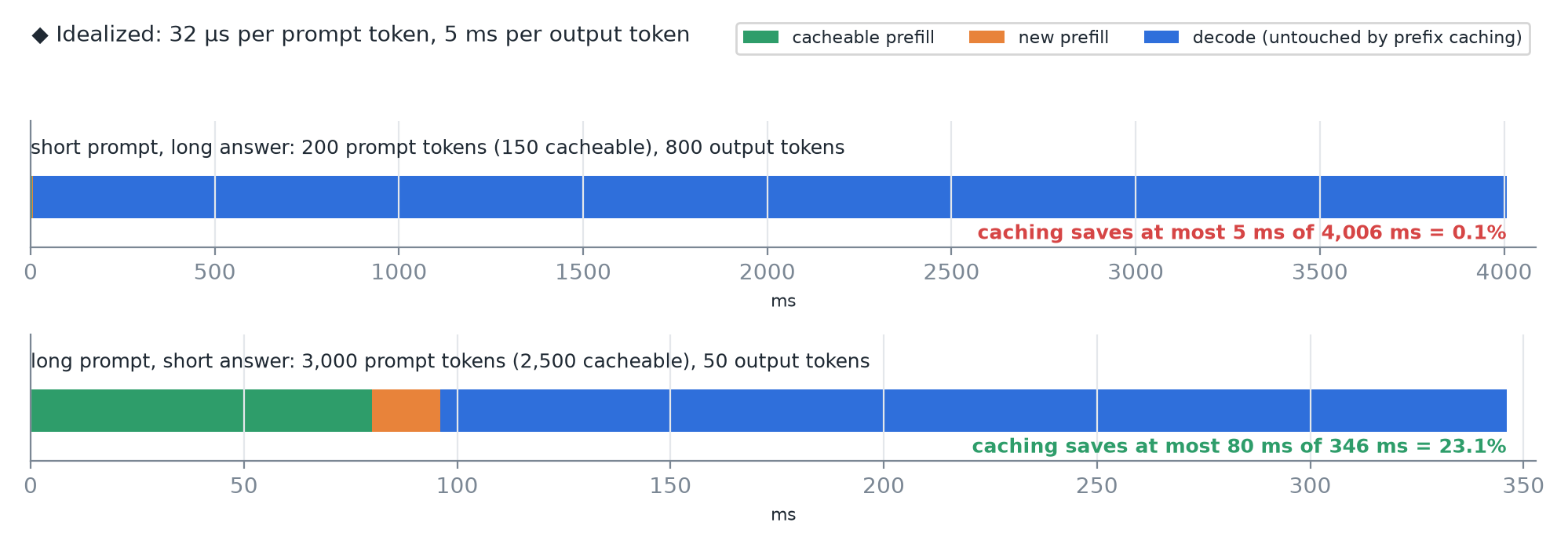 ◆ Idealized per-request time for two workload shapes.
- Prefix caching doesn't make decoding faster. For short prompts with long answers, it barely helps.
5. The catch: matching is exact, from token one
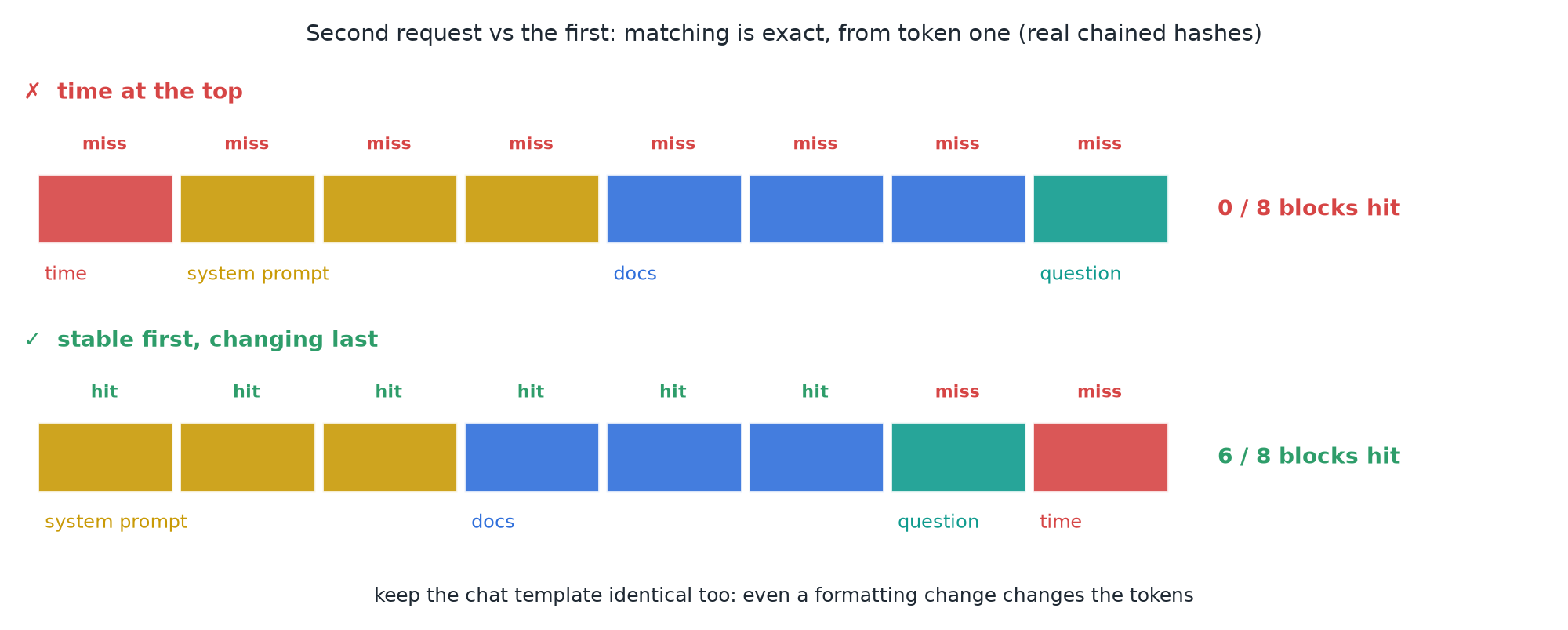 Same second request, two orderings: a dynamic block at the front makes every later hash differ.
WARNING
Change one token near the start and every hash after it changes, because each hash includes the one before. A timestamp or a user name at the top silently breaks caching for everything below it.
The rule:
- Stable first: system prompt, tool definitions, long documents.
- Changing last: the user's question, the current time.
- Keep the chat template identical across requests; even formatting changes the tokens.
6. Measure, and isolate tenants
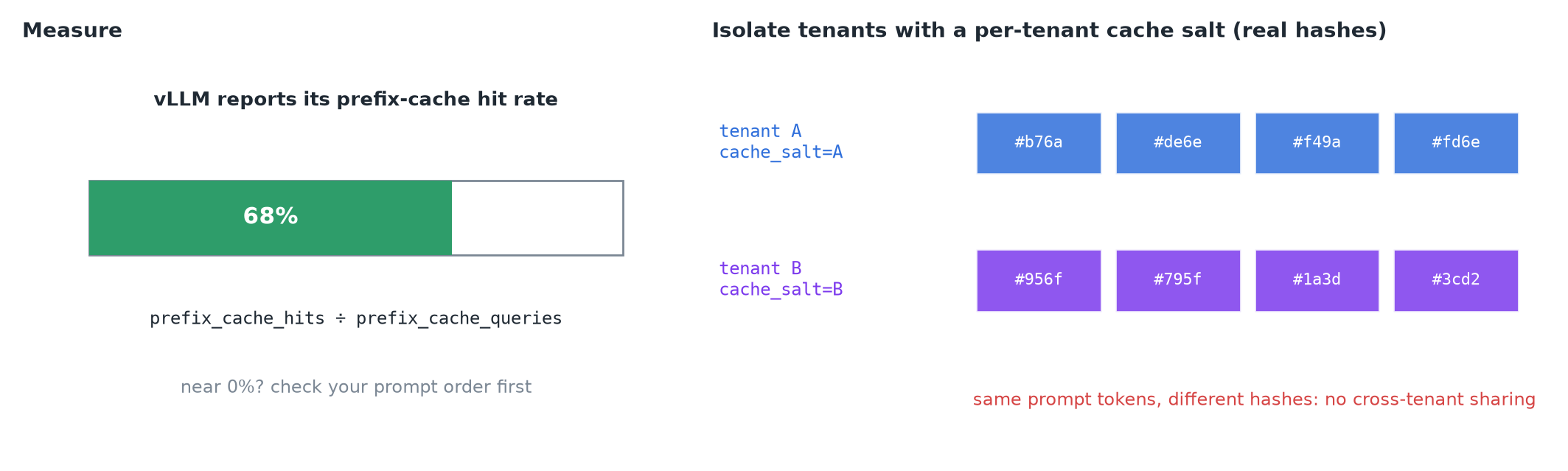 The 68% is illustrative. Salted hashes: the same tokens give different fingerprints per tenant.
- vLLM reports its prefix cache hit rate, so you can check caching is really happening.
- If customers must never share cache, give each tenant a
cache_salt: it's mixed into the hashes, so identical prompts from different tenants never match.
7. Recap