13 · Logits, Sampling & the Next Token
Source: fanout.sh / inference-eng / 02-04 · ~7 min
NOTE
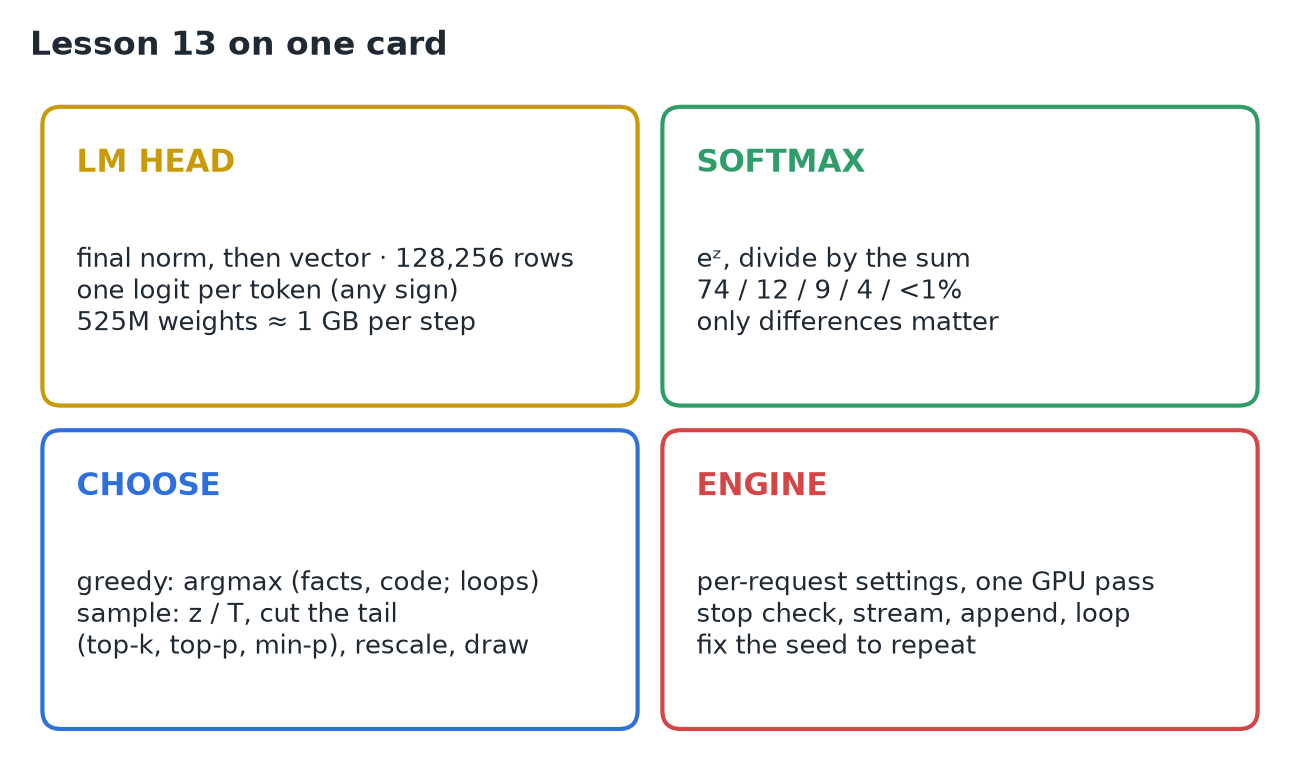
After 32 layers, the last token's vector becomes text in three steps: scores for every vocabulary entry, probabilities from the scores, and one choice. The LM head (after one last RMSNorm) dots the vector with 128,256 rows to get logits. Softmax turns them into probabilities, and only their differences matter. Then either take the top one (greedy) or sample, after temperature reshapes the distribution and top-k / top-p / min-p cut its tail. An engine does this for every request in the batch, every step, on the GPU, then checks for a stop, streams, appends and loops.
1. The LM head: one score per token
The vector gets one last RMSNorm, then is multiplied by the language model head: a matrix with one row per vocabulary token (128,256 for Llama 3). Each row is a direction in the same 4,096-d space; the dot product with the vector is that token's score, its logit. Rows pointing the same way as the vector get high logits.
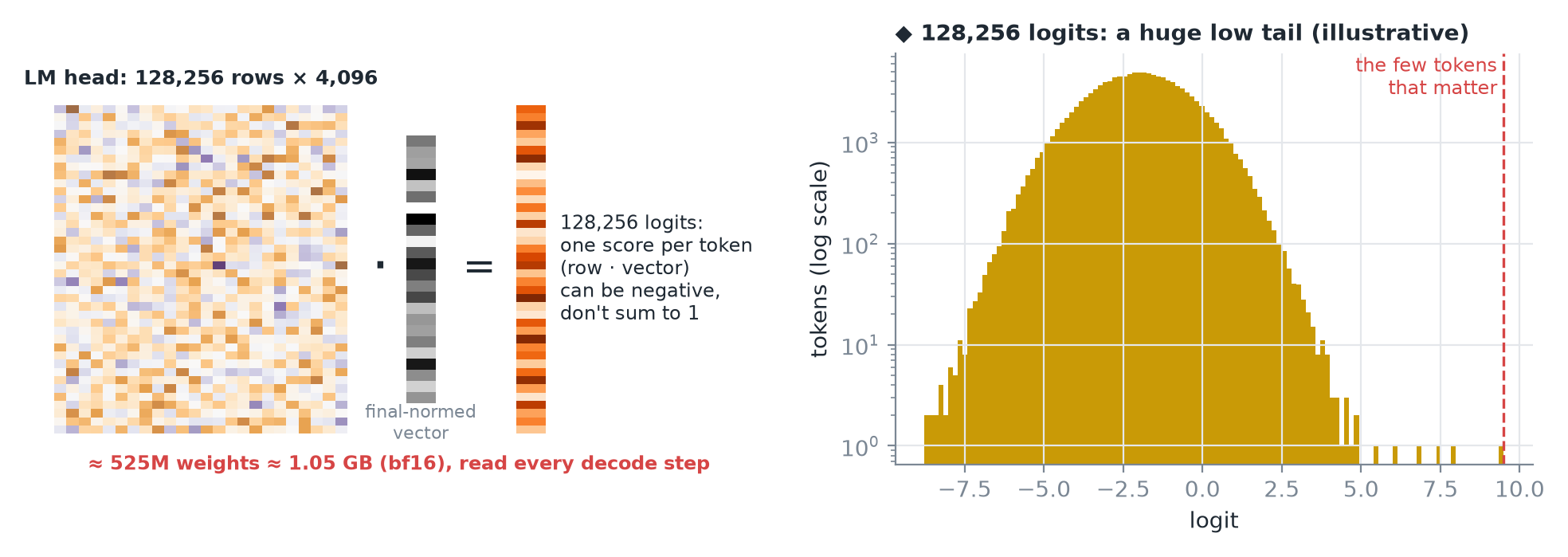 128,256 × 4,096 ≈ 525M weights ≈ 1 GB in bf16, read on every decode step.
TIP
Only the last position's logits pick the next token, so during prefill engines run the head for one position, not the whole prompt (sizes in 10).
2. Softmax: scores to probabilities
Logits are just scores: they can be negative and don't add up to anything. Toy vocabulary, prompt "The capital of France is":
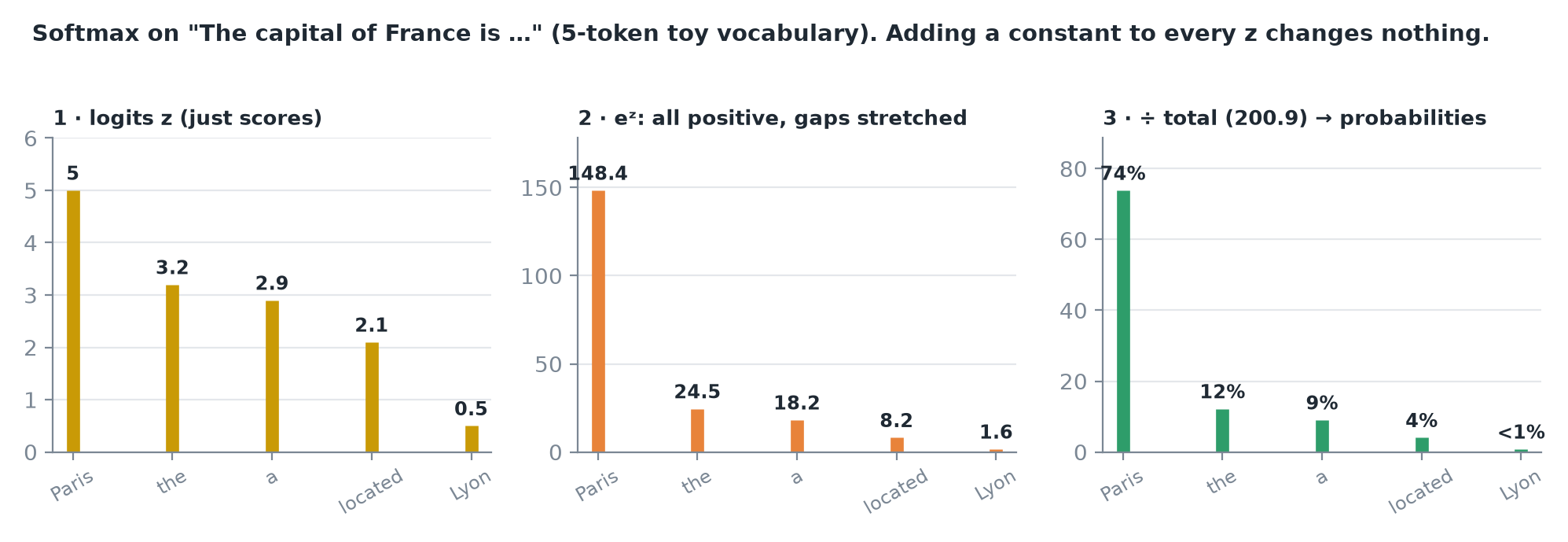 Raise e to each logit (all positive, gaps stretched), then divide by the total (200.9) so they sum to 1.
IMPORTANT
Adding the same number to every logit changes nothing. Only the differences between logits matter.
3. Choosing: greedy or sample
- Greedy: always take the most likely token (here, Paris). Fast and repeatable, great for facts and code. In open-ended writing it can lock into loops ("…and the cat sat on the mat and the cat sat on the mat…").
- Sample: draw at random, weighted by the probabilities.
Temperature reshapes the probabilities before the draw: divide every logit by T, then softmax again.
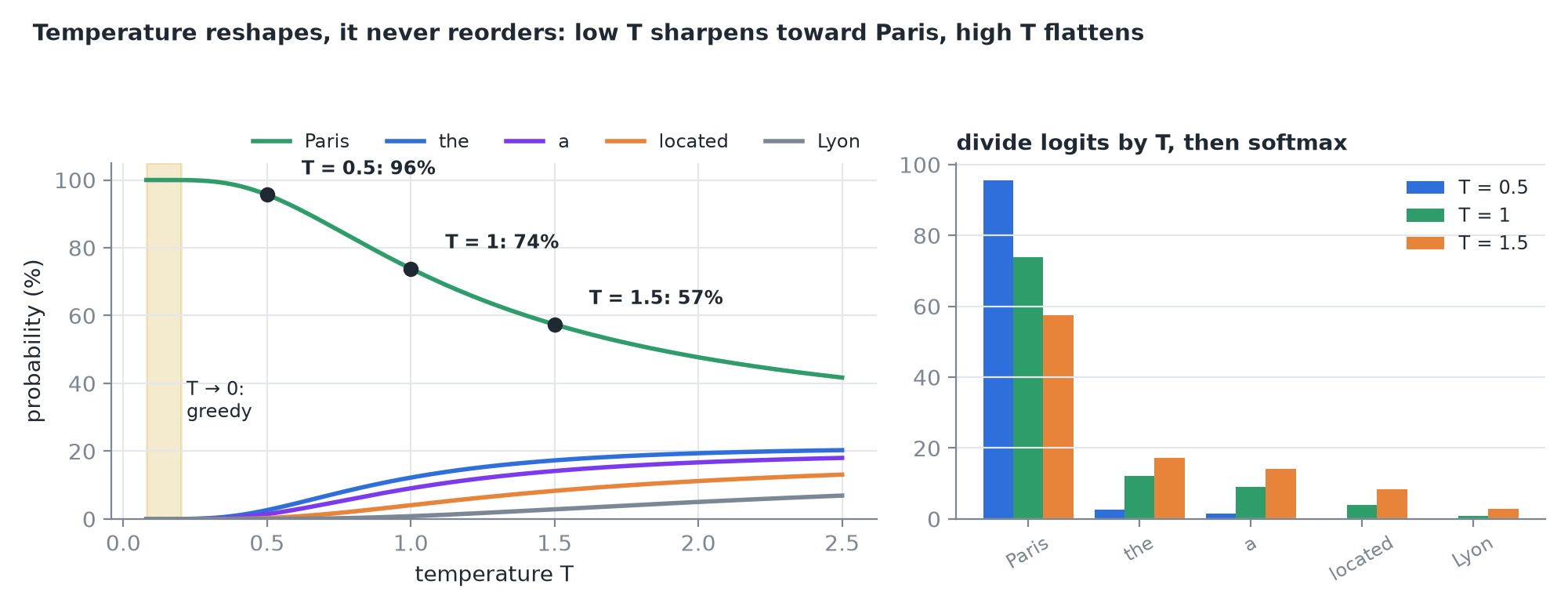 T = 1 changes nothing; T = 0.5 stretches the gaps (Paris 96%); T = 1.5 squeezes them (Paris 57%). As T → 0, sampling becomes greedy, which is why APIs treat temperature 0 as greedy.
4. Cutting the tail
Even at a sensible temperature, the ~128,000 unlikely tokens share a little probability. Draw enough tokens and one of the weird ones eventually gets picked. So we cut off the tail and rescale what's left to sum to 1.
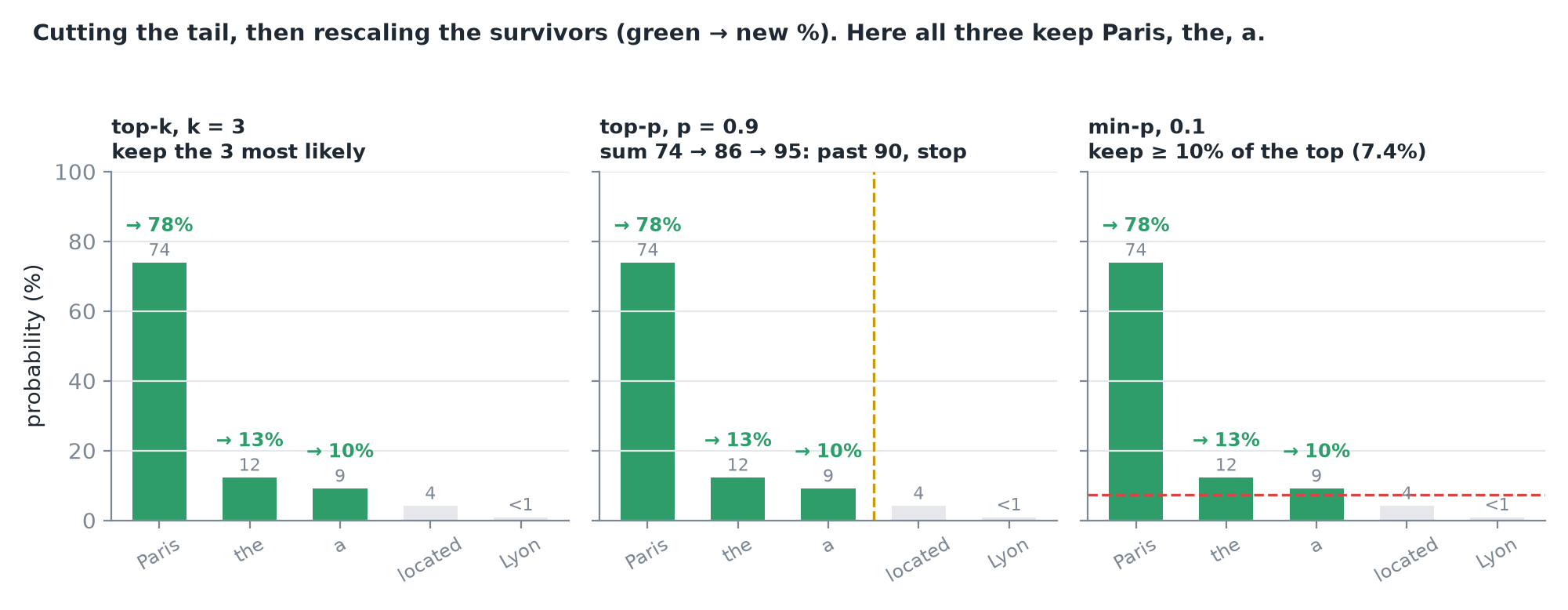 Top-k keeps a fixed count; top-p keeps the smallest set whose running sum passes p; min-p keeps any token at least a fraction of the top one's probability.
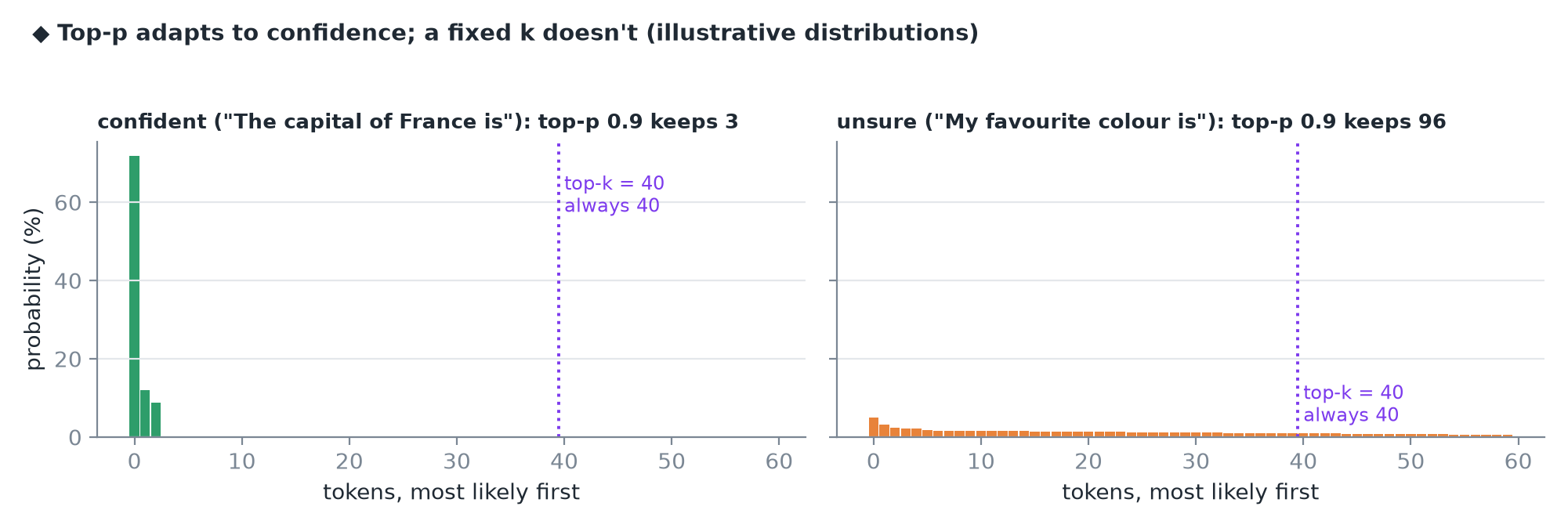
A fixed k ignores how confident the model is. Top-p adapts: when the model is confident, the nucleus is tiny; when it's unsure, it grows. Min-p is a newer rule with the same spirit.
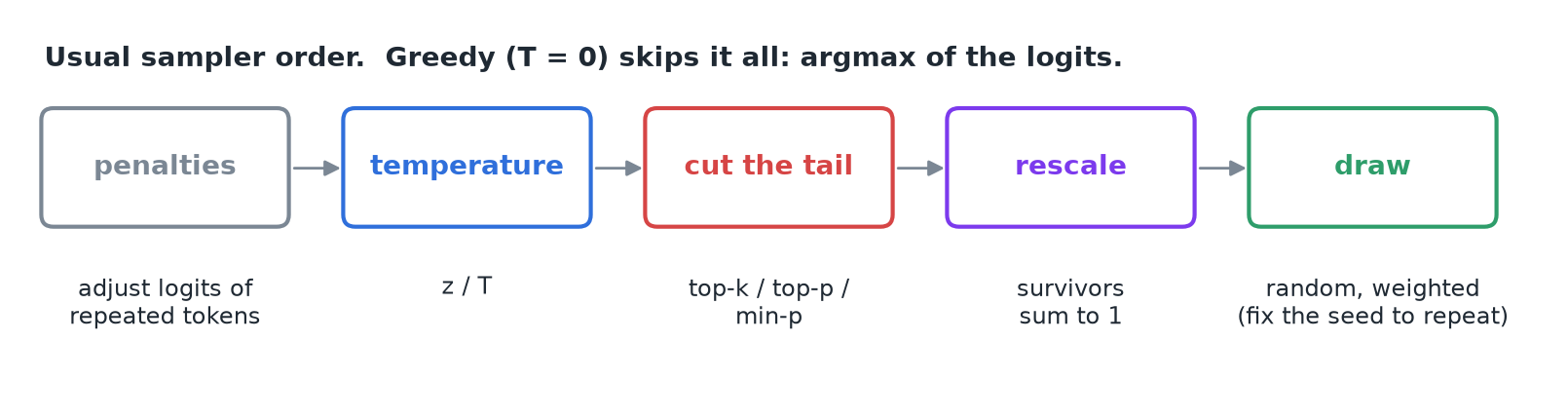
The usual order:
5. Inside an engine
Serving many requests at once, each step produces one row of logits per request, and every request can bring its own settings (one greedy, another T 0.8 with top-p 0.95). The engine's sampler applies each request's settings to its own row, all on the GPU, in one pass.
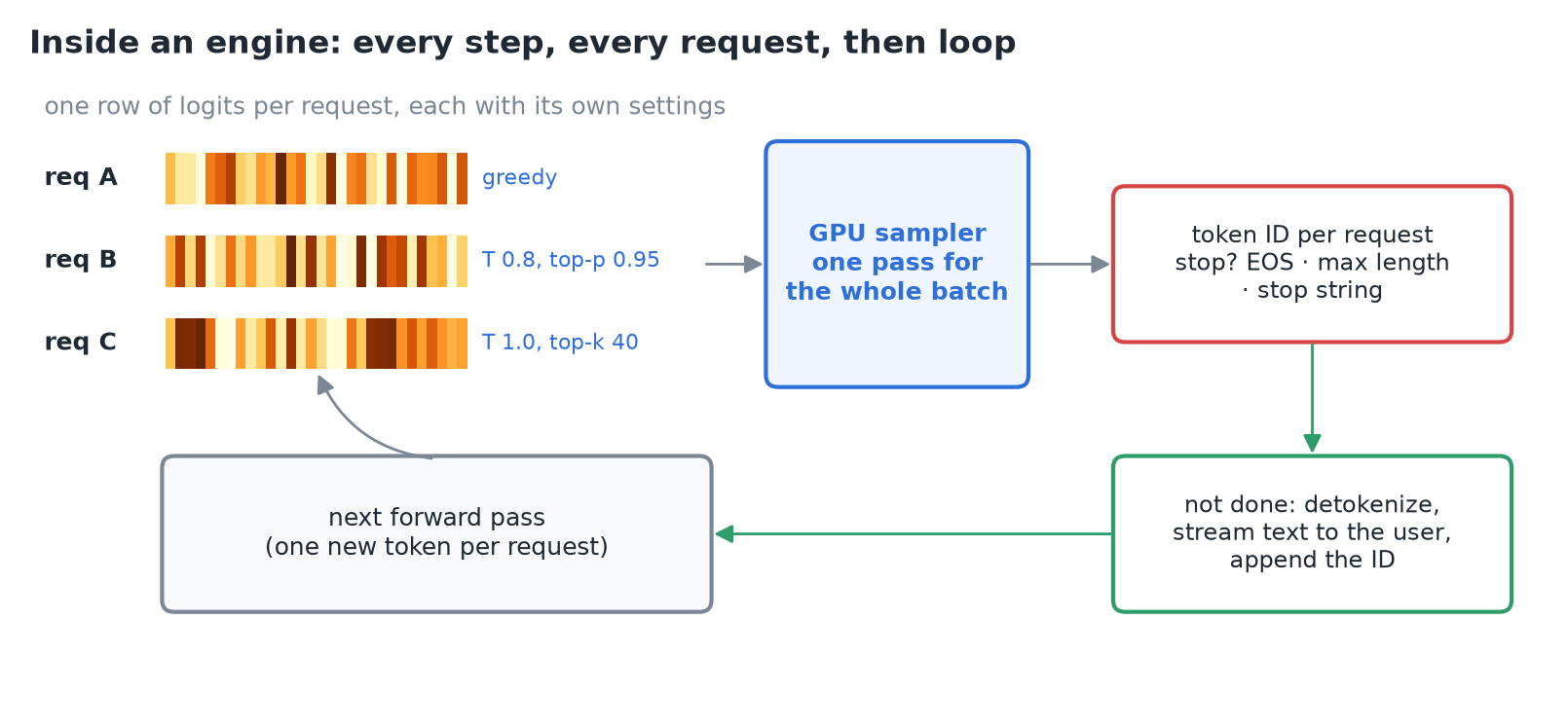 Out comes one token ID per request. Stop if it's an end-of-text token, the maximum length, or a stop string. Otherwise turn the ID back into text, stream it, and append it so the next forward pass produces the token after it.
Need the same sampled output twice? Fix the random seed.
6. Recap