41 · Preemption, Recomputation & KV Pressure
Source: fanout.sh / inference-eng / 08-05 · ~5 min
NOTE
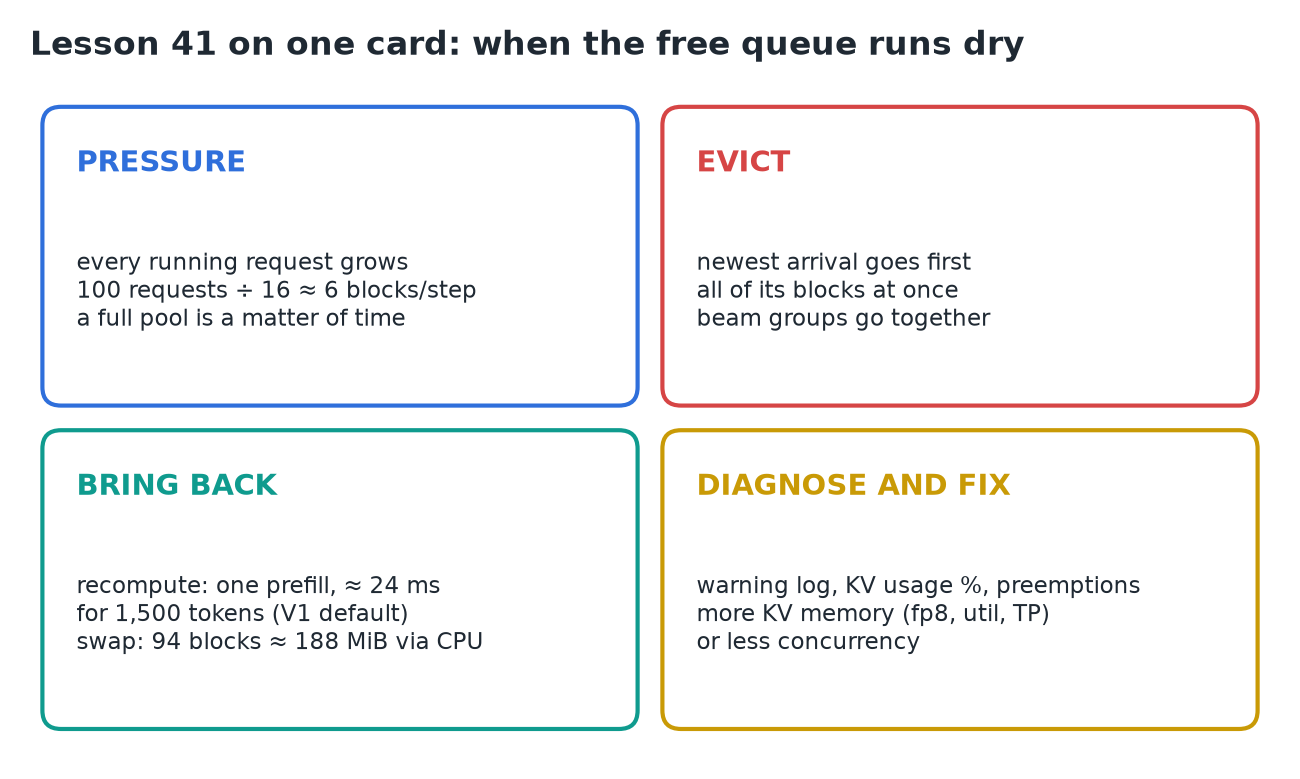
Paged blocks make KV memory efficient, but it's still finite. Every running request grows, so under load the free queue eventually runs dry while nobody has finished. vLLM then evicts the most recent arrival, all of its blocks at once, and later brings it back by recomputing its tokens in one prefill (the V1 default, ≈ 24 ms for 1,500 tokens on Llama 3.1 8B) or by swapping its blocks through CPU memory. Frequent preemption means KV pressure: watch the warning log and the KV usage and preemption metrics, then give the cache more memory or ask for less at once.
1. Pressure builds quietly
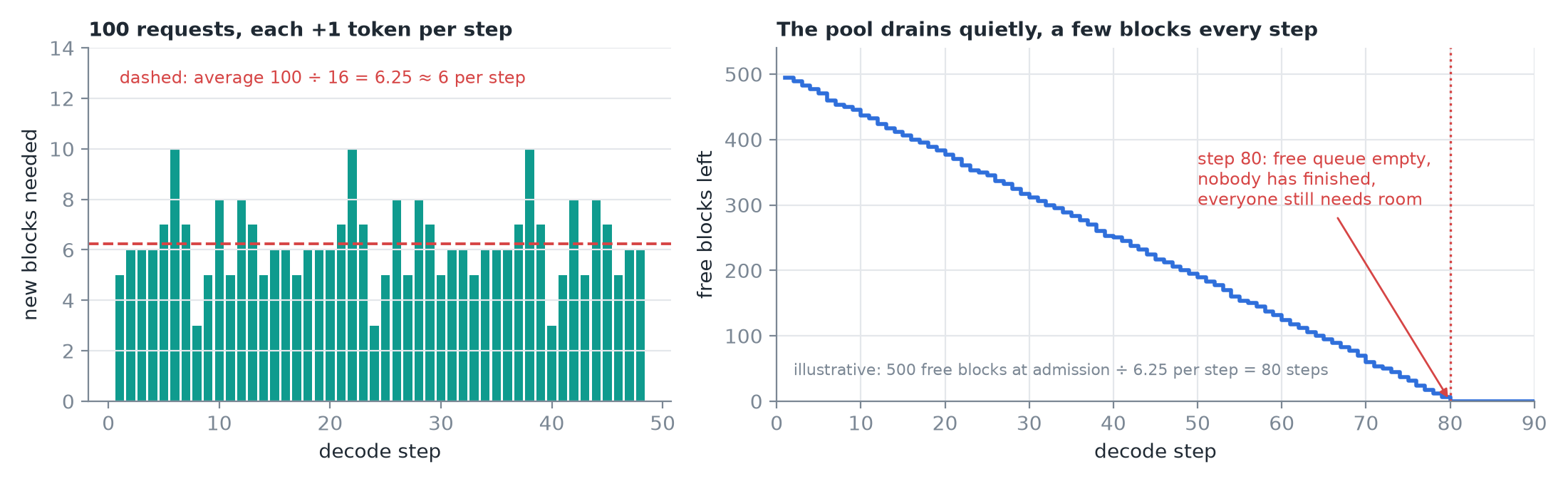 Left: with requests at different points in their blocks, new-block demand jitters around 6.25 per step. Right: the pool drains at that rate until a step asks for a block and none is left.
- Every running request adds one token per step; with 16-token blocks each needs a new block about once every 16 steps.
- With 100 requests decoding: 100 ÷ 16 ≈ 6 new blocks every step.
- The scheduler admitted each request on the room it needed at that moment; it couldn't know how long each answer would grow.
- The scariest moment: the free queue is empty, nobody has finished, so nothing will be freed, and everyone needs room for their next token.
2. Push someone out
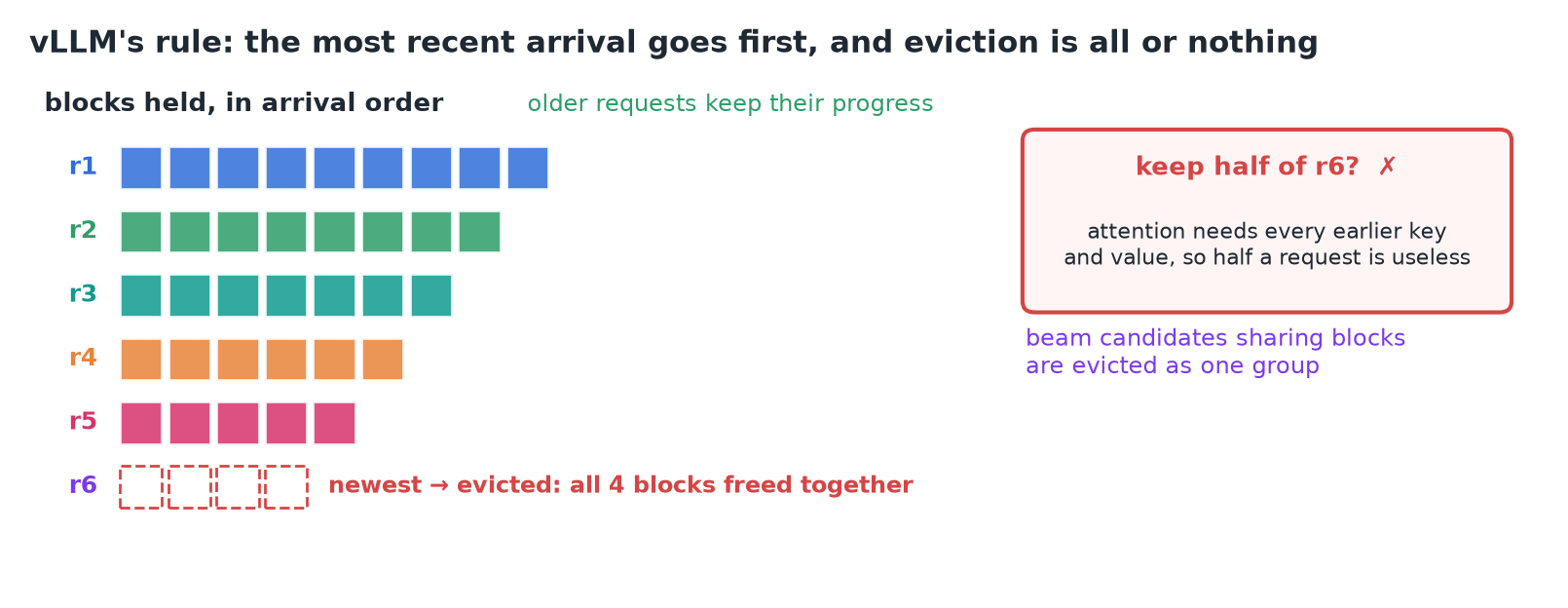 The newest request is evicted whole; the older ones keep their progress.
- vLLM's rule follows arrival order: the request that arrived most recently goes first, so older requests keep their progress.
- Eviction is all or nothing. Attention needs every earlier key and value, so keeping half a request's blocks would be useless.
- Beam candidates that share blocks are evicted as a group.
3. Bring the victim back: recompute or swap
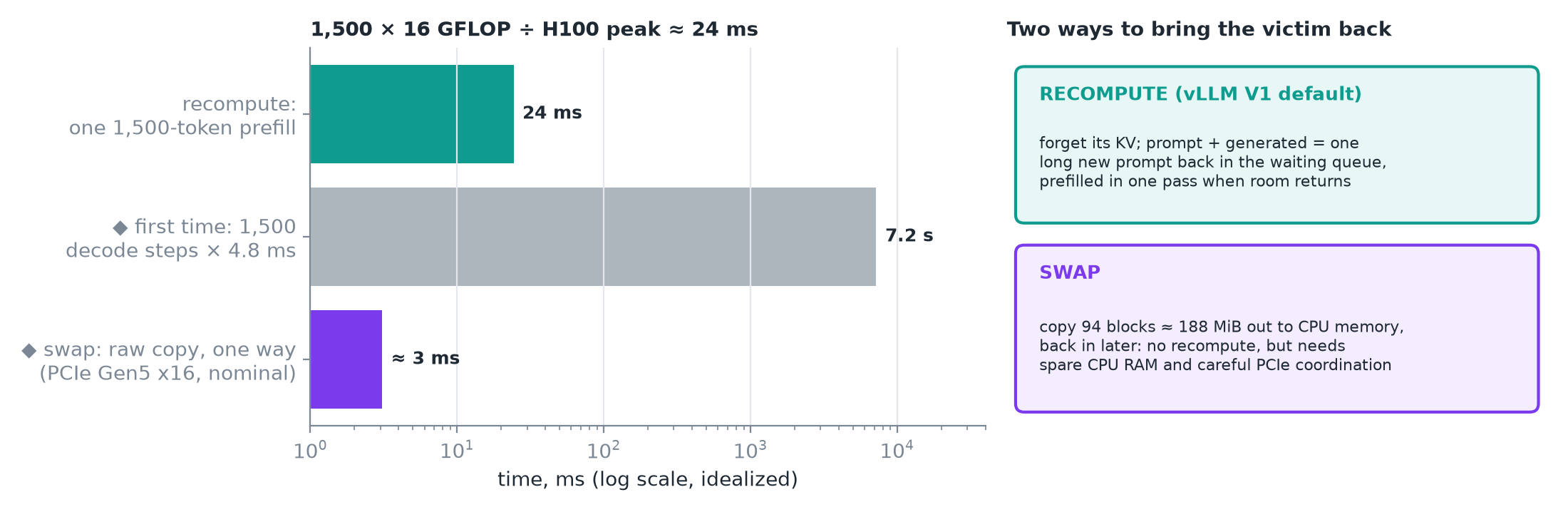 Recompute redoes the KV in one parallel pass; swap parks it in CPU memory. ◆ The grey and purple bars are my estimates.
Recompute forgets the victim's KV. It goes back to the waiting queue with prompt + everything generated so far treated as one long new prompt, which is prefilled in one parallel pass when there's room; decoding then picks up where it left off.
- That's Llama 3.1 8B at H100 peak (idealized), far faster than generating those tokens one by one the first time. ◆ At an idealized 4.8 ms per decode step, 1,500 steps take about 7.2 s.
Swap copies the victim's blocks out to CPU memory and back later:
- It avoids recomputing, but needs spare CPU memory and careful coordination while data moves over PCIe.
- vLLM's current engine (V1) uses recompute by default.
TIP
◆ The raw copy is not the bottleneck: 188 MiB over PCIe Gen5 x16 (~64 GB/s nominal) is about 3 ms each way. What swap really costs is the spare CPU memory and the coordination.
4. Thrashing
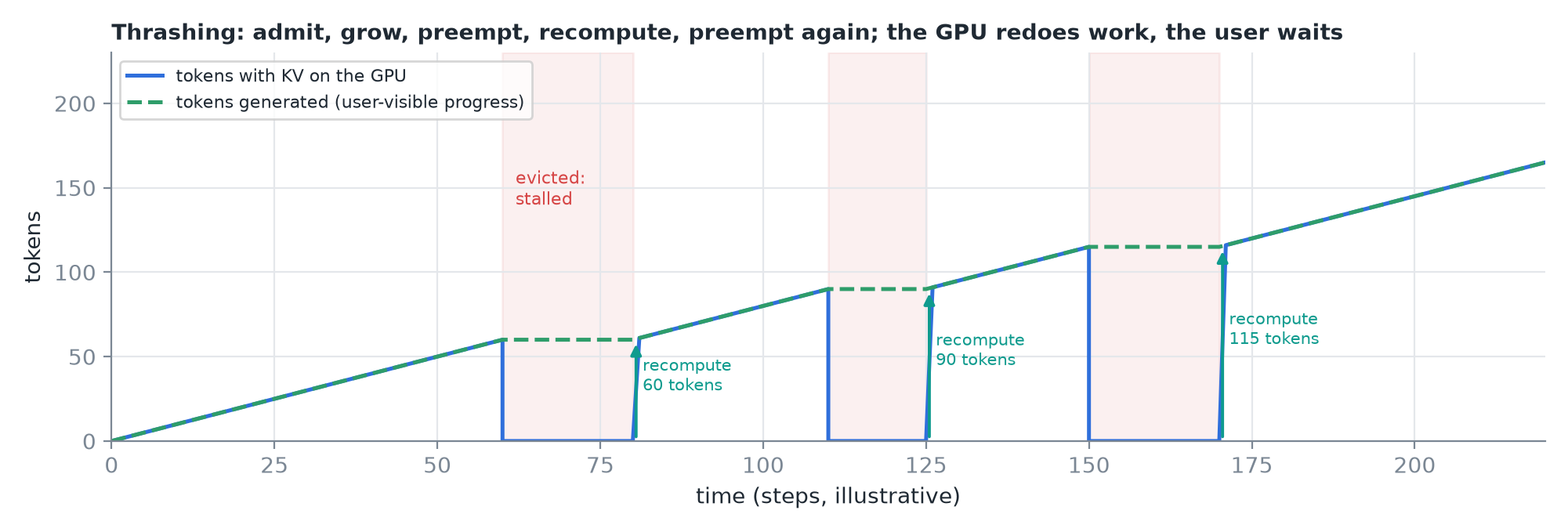 One request caught in the loop (illustrative timings): each eviction stalls it, and each return re-prefills everything it had.
- One preemption is fine; a steady stream is a problem. The engine admits a request, everyone grows, someone is preempted, recomputed, then preempted again.
- That's thrashing: GPU time goes into redoing work, and users see their answers stall.
5. Spot it and fix it
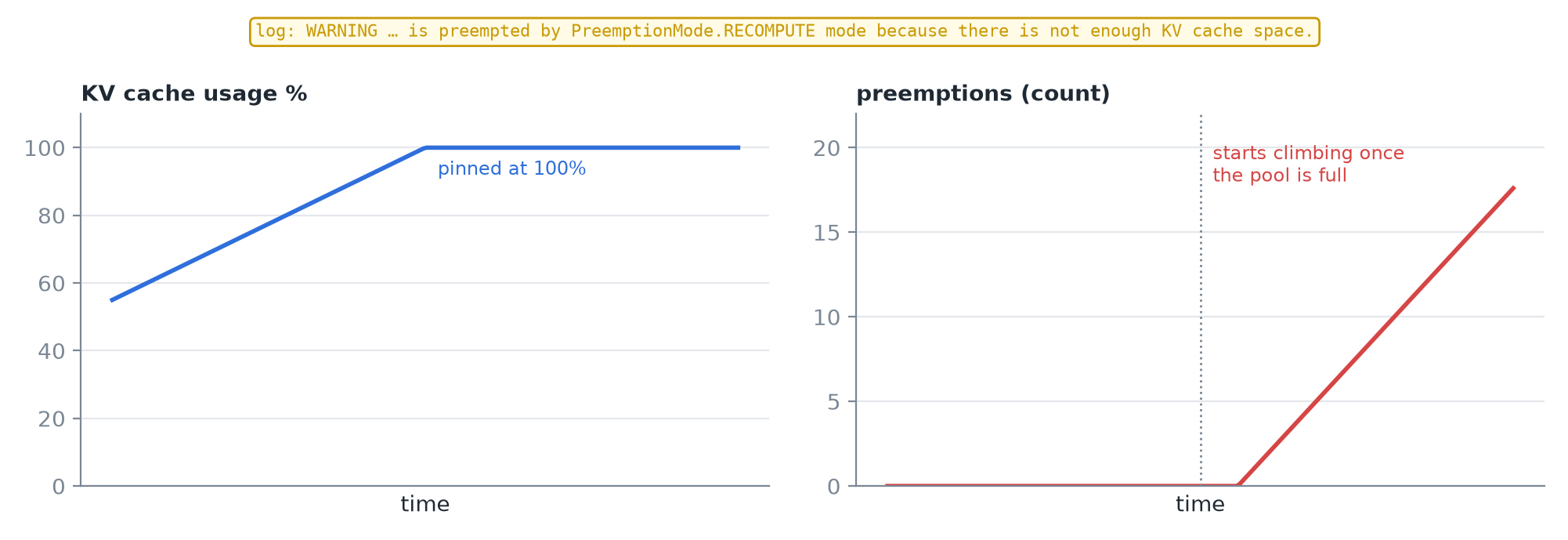 vLLM logs a warning per preemption and exports metrics for KV cache usage and preemption count; preemptions climb once usage pins at 100%.
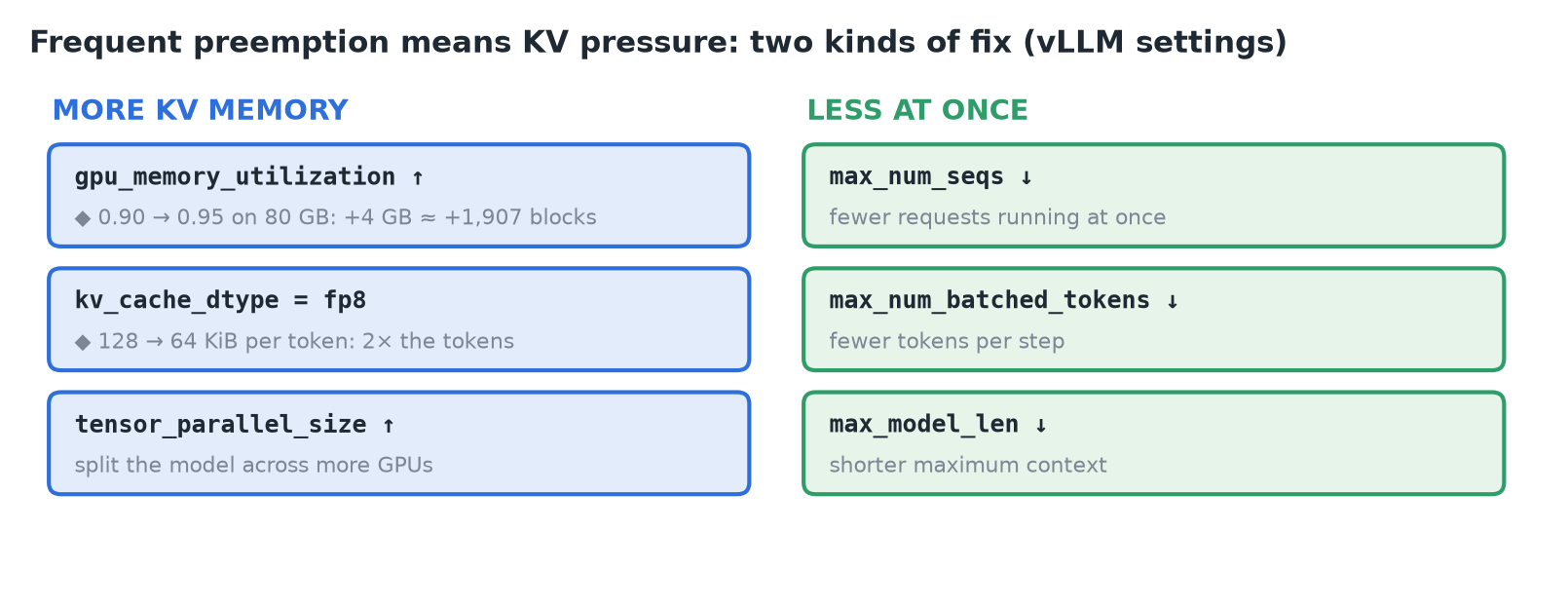 Two kinds of fix. ◆ The two estimates assume an 80 GB GPU and Llama 3.1 8B's 128 KiB per token.
IMPORTANT
Frequent preemption is a sizing problem: either give the KV cache more memory, or ask for less concurrency.
6. Recap