08 · Generate & Stream Your First Tokens
Source: fanout.sh / inference-eng / 01-03 · ~8 min
NOTE
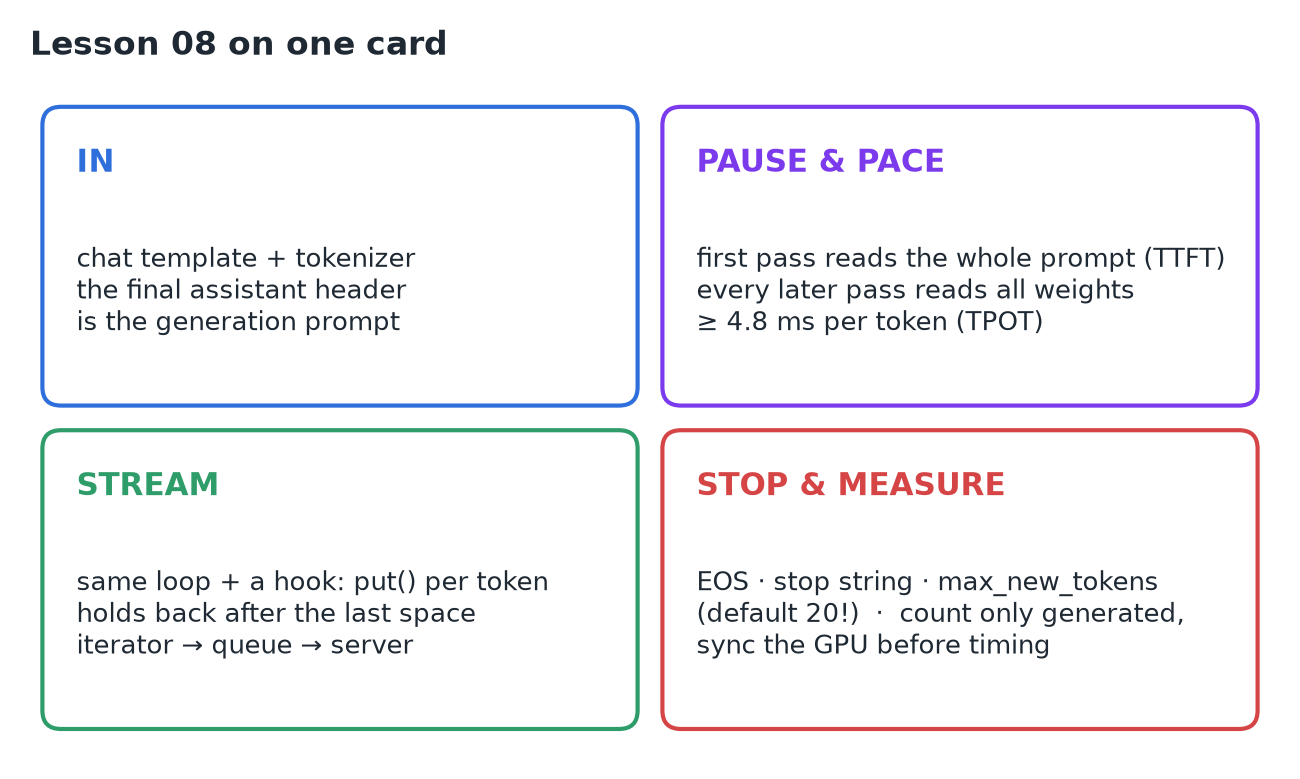
What a user sees, a pause then a steady stream, is the whole of inference from the outside. The prompt is wrapped in a chat template and tokenized; generate() runs one forward pass per token. The first pass reads the whole prompt (the pause, TTFT); every later pass reads all the weights once (the pace, TPOT, ≥ 4.8 ms on an H100). Streaming is the same loop with a hook. Generation stops for exactly three reasons, and the tokens/s you see is easy to mis-measure.
Running example: Llama 3.1 8B Instruct on one H100.
1. What the model actually receives
A language model only continues a sequence of tokens. "User" and "assistant" are conventions learned from how training data was laid out; the chat template (shipped in tokenizer_config.json) reproduces that layout.
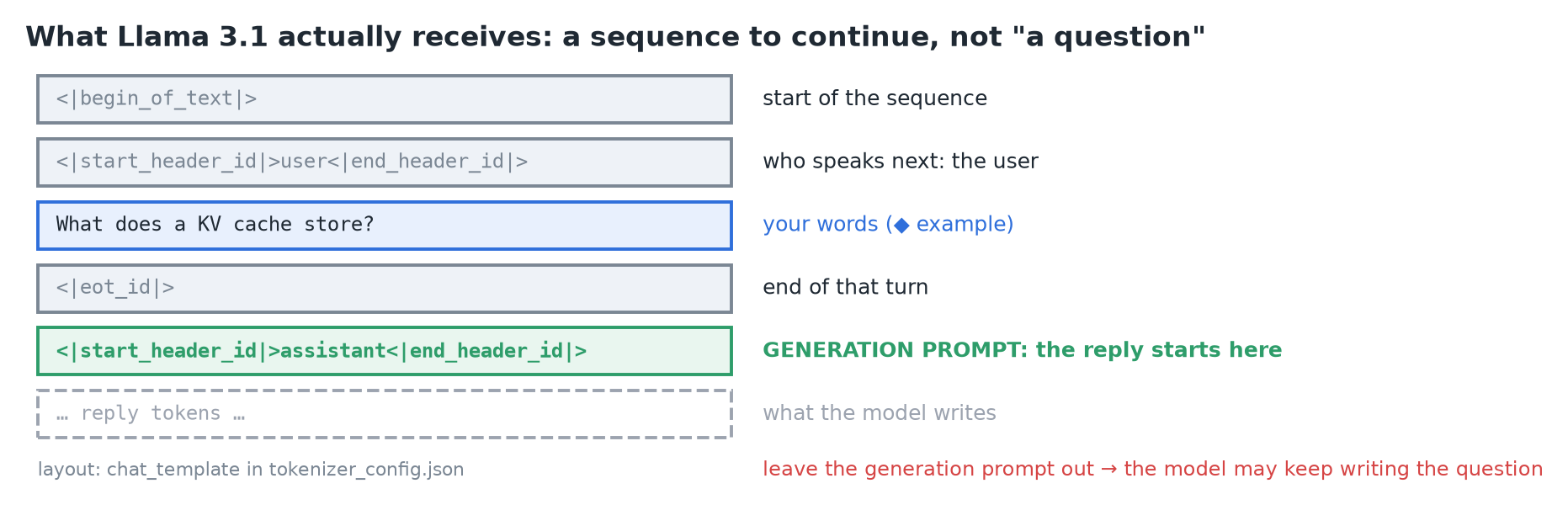 Your message is wrapped in special markers, then the template appends an assistant header and stops.
- That final assistant header is the generation prompt: the cue that the next tokens are the reply. Leave it out and the model may keep writing your question, the most natural continuation.
- The tokenizer then turns the text into integers: a ~30-word question ≈ ~30 tokens (illustrative).
2. The loop
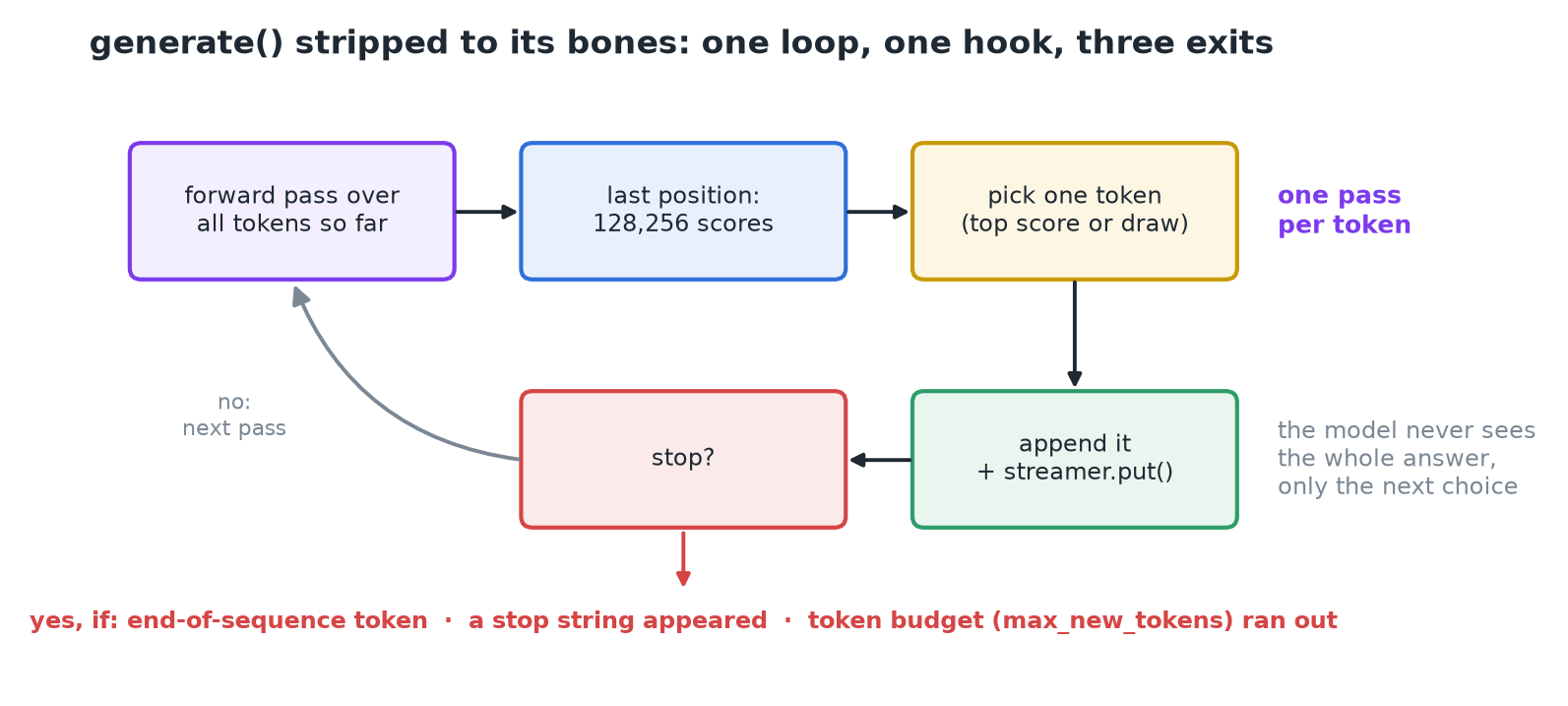 Run the model, take the last position's 128,256 scores, pick one token, append it, check whether to stop, repeat.
IMPORTANT
One forward pass per token. The model never sees the whole answer, only the next choice. And the first trip round the loop is different from all the others.
3. The pause and the pace
- First pass (prefill): reads all ~30 prompt tokens at once, in parallel across every layer, and stores their keys and values for later. Real arithmetic: the GPU is busy.
- Every later pass (decode): adds one token and reuses the stored K/V. Tiny arithmetic, but it still reads all 16 GB of weights:
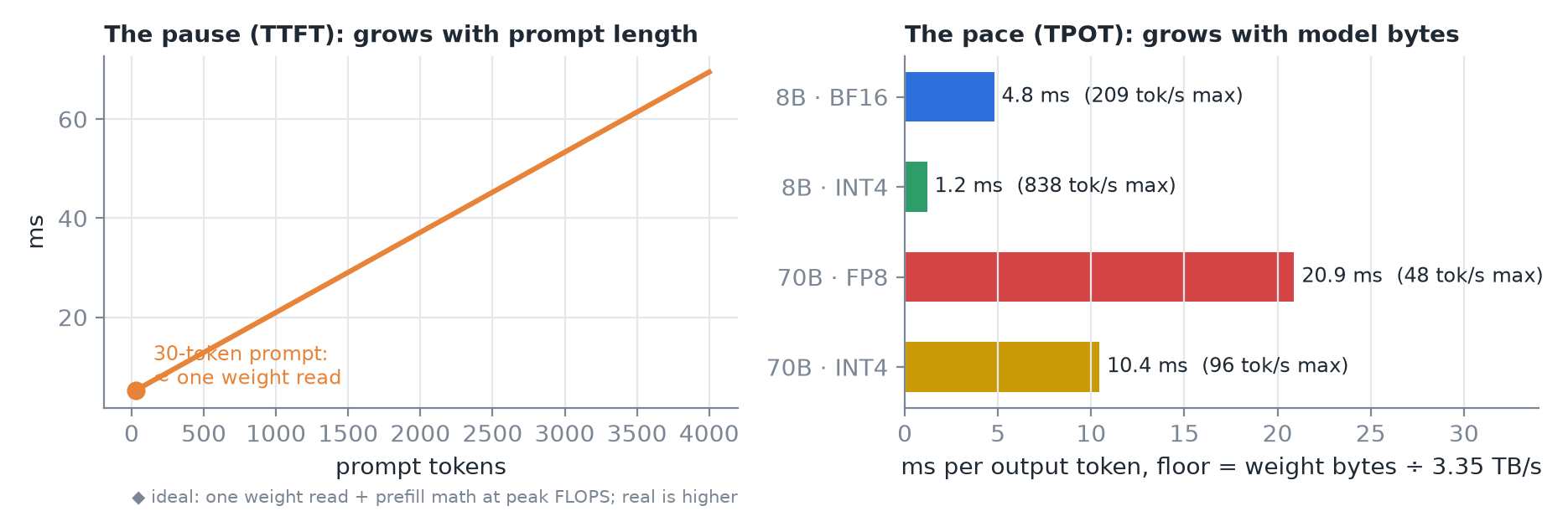 Left: a longer prompt means a longer pause. Right: a bigger (or less quantized) model means a slower pace. The loop is the same.
The pause = time to first token (TTFT); the pace = time per output token (TPOT).
4. Streaming: the same loop with a hook
In Transformers you pass generate() a streamer; every time a token is picked, the loop calls streamer.put().
TextStreamerkeeps the tokens so far, decodes the whole buffer, and prints only what's new.- It holds back everything after the last space: a token is often half a word, and the next token can change how the previous one should be spelled. So the display trails the model by about a word, on purpose; a newline flushes it.
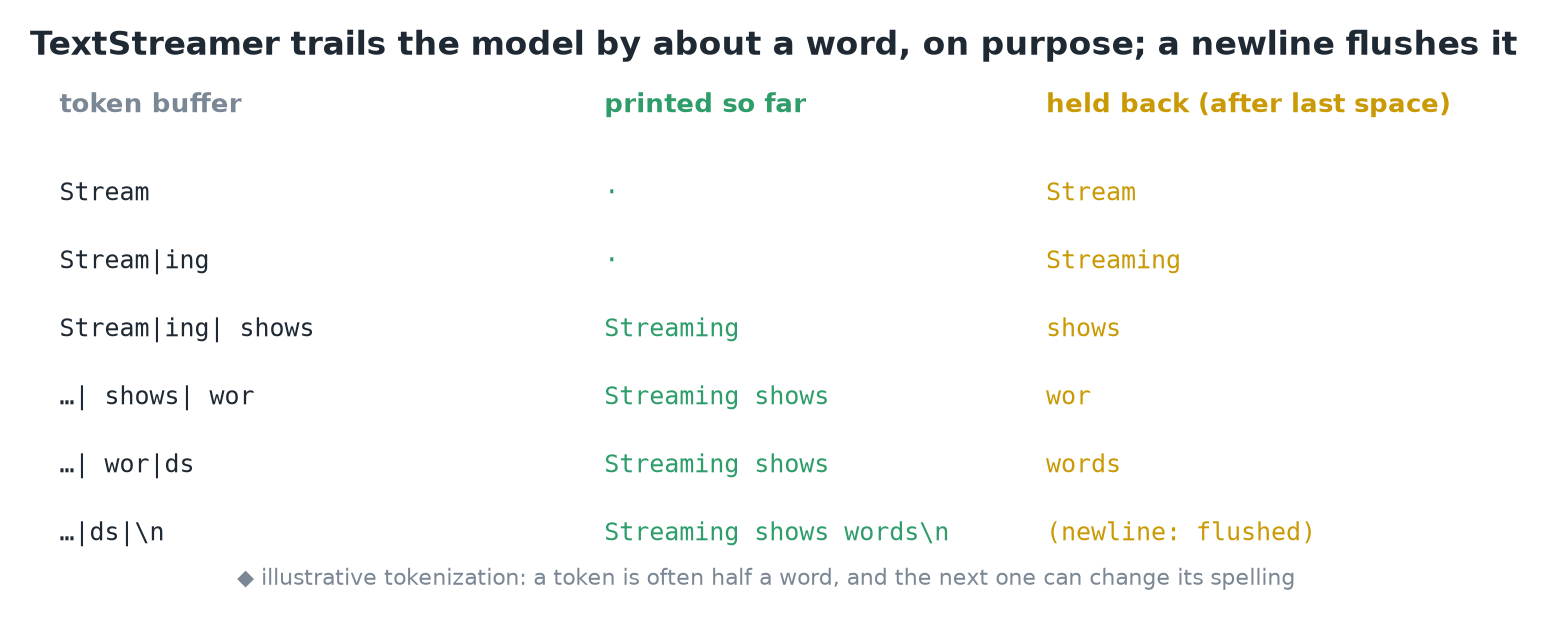 Text is printed only up to the last space; the partial word waits for the next token.
TextIteratorStreamerpushes finished text into a queue; your server reads from the other end without blocking the loop. That's the seam where a chat server plugs in.
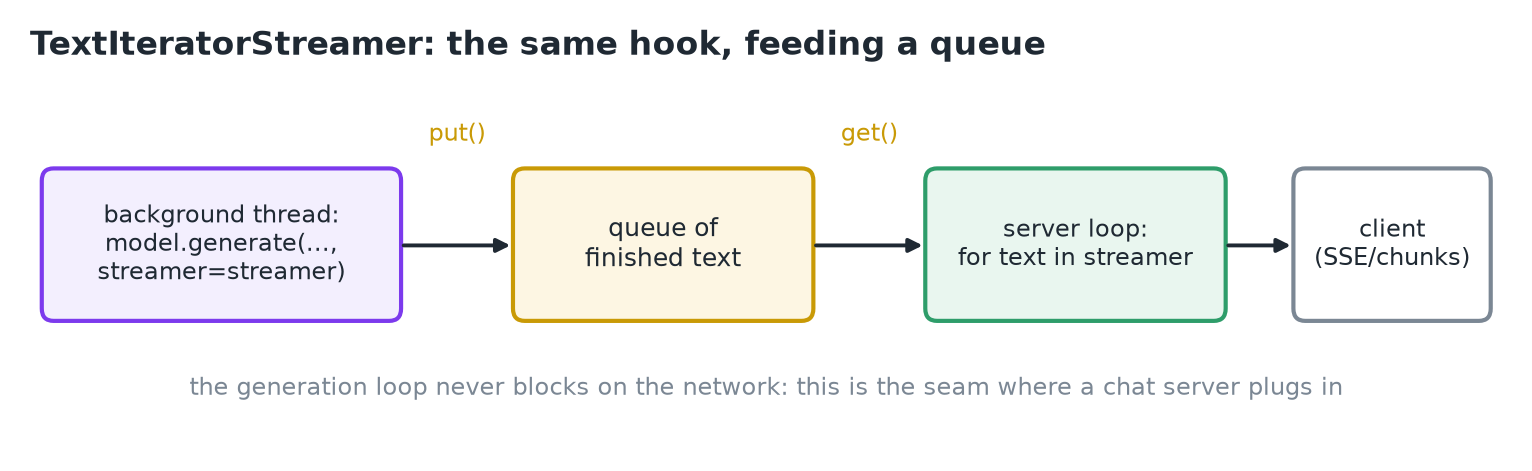 generate() runs in a background thread; the server iterates over the queue and forwards text to the client.
5. Why it stopped
Only three reasons, and none of them is punctuation:
| Reason | Where it's set |
|---|---|
| The model picked an end-of-sequence token | generation_config.json: Llama 3.1 lists three EOS ids |
| A stop string you asked for appeared | Per request |
| The token budget ran out | max_new_tokens: defaults to 20 in Transformers unless the model config says otherwise |
WARNING
An unset max_new_tokens is the classic cause of an answer that ends mid-sentence.
The same config carries this model's sampling defaults: sampling on, temperature 0.6, top-p 0.9. Those are someone's choices, not laws: read them, and override per request.
6. Reading the numbers
Most tools print: prompt tokens (what went in, after the template), generated tokens (what came out), and tokens/s, usually generated tokens ÷ time since the first token.
Our request (illustrative): ~30 prompt tokens, 60 generated, a pause of a few hundred ms, then roughly 200 tok/s at the floor (the floor is arithmetic).
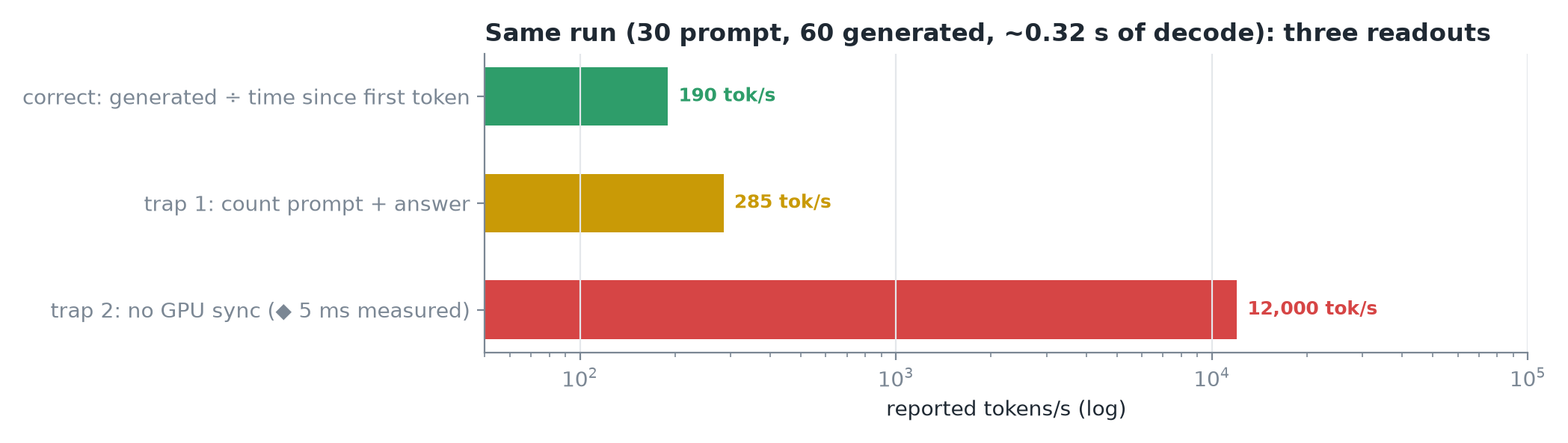 The same run reported three ways: correctly, counting the prompt as output, and timing an unsynchronized GPU call.
- Trap 1:
generate()returns prompt + answer; count the whole output and you overcount. - Trap 2: GPU work is asynchronous: the Python call returns before the GPU finishes, so a stopwatch around it measures almost nothing. Synchronize first, or use CUDA events.
WARNING
- "The model is slow to start": the first step is doing ~30 tokens of work in one go.
- "Streaming makes generation faster": it changes when you see tokens, not when they're made.
- "It stops at the end of a sentence": it stops on an end token, a stop string or a budget.
7. Recap