35 · Token Budgets, Max Sequences & Max Batched Tokens
Source: fanout.sh / inference-eng / 07-04 · ~5.5 min
NOTE
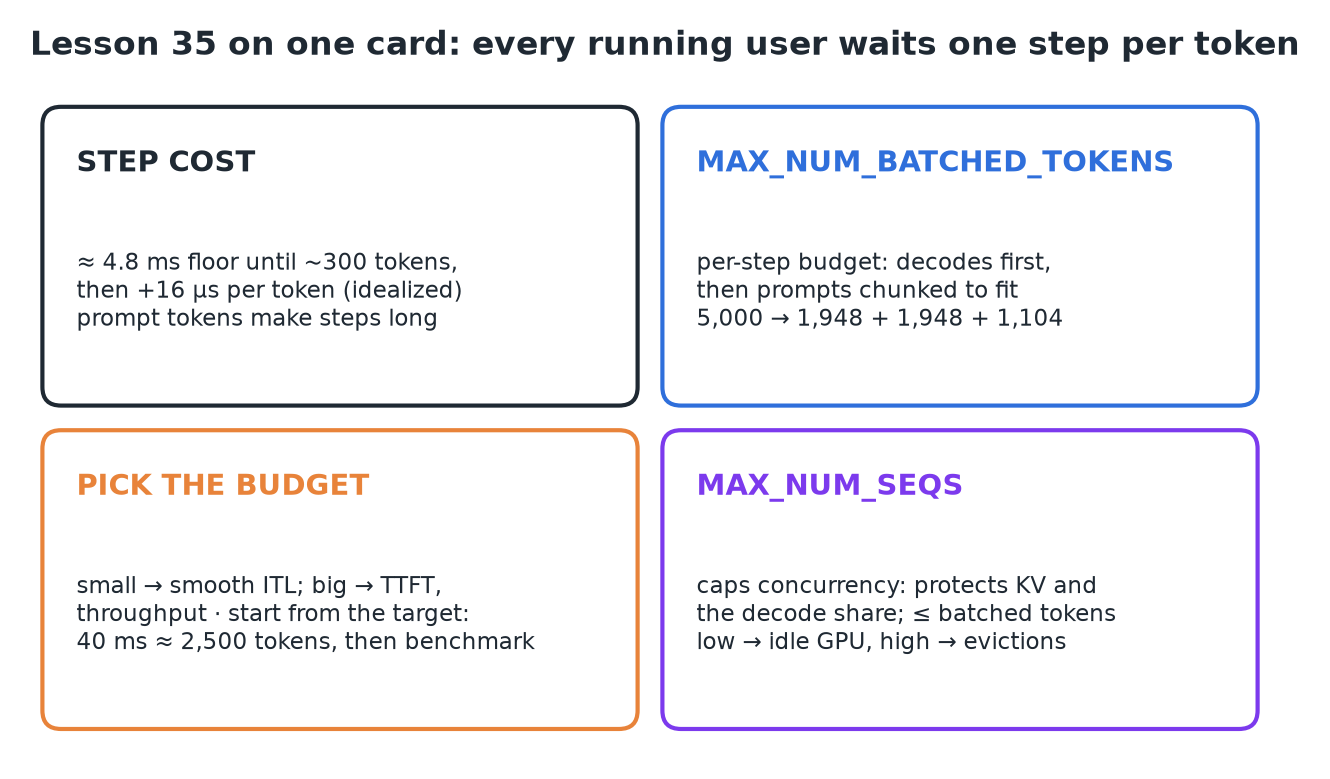
Every user mid-answer gets one token per step, so if one step runs long, all of them wait. A step's length is set by the tokens it processes: flat at the ~4.8 ms weight read until ~300 tokens, then rising (idealized: 512 → 8 ms, 2,048 → 33 ms, 8,192 → ~130 ms). Decode tokens are nearly free; prompt tokens make steps long. max_num_batched_tokens caps each step: decodes first, then prompts chunked to fit. Small budgets favor smooth decoding (ITL); big budgets favor TTFT and throughput. max_num_seqs caps concurrency, protecting KV memory and the decode share of the budget. A request runs only after passing three gates: a free sequence slot, room in the budget, and free KV memory.
1. What one step costs
Llama 3.1 8B on an H100: every step reads all 16 GB of weights once (~4.8 ms), and every token adds ~16 GFLOP of math.
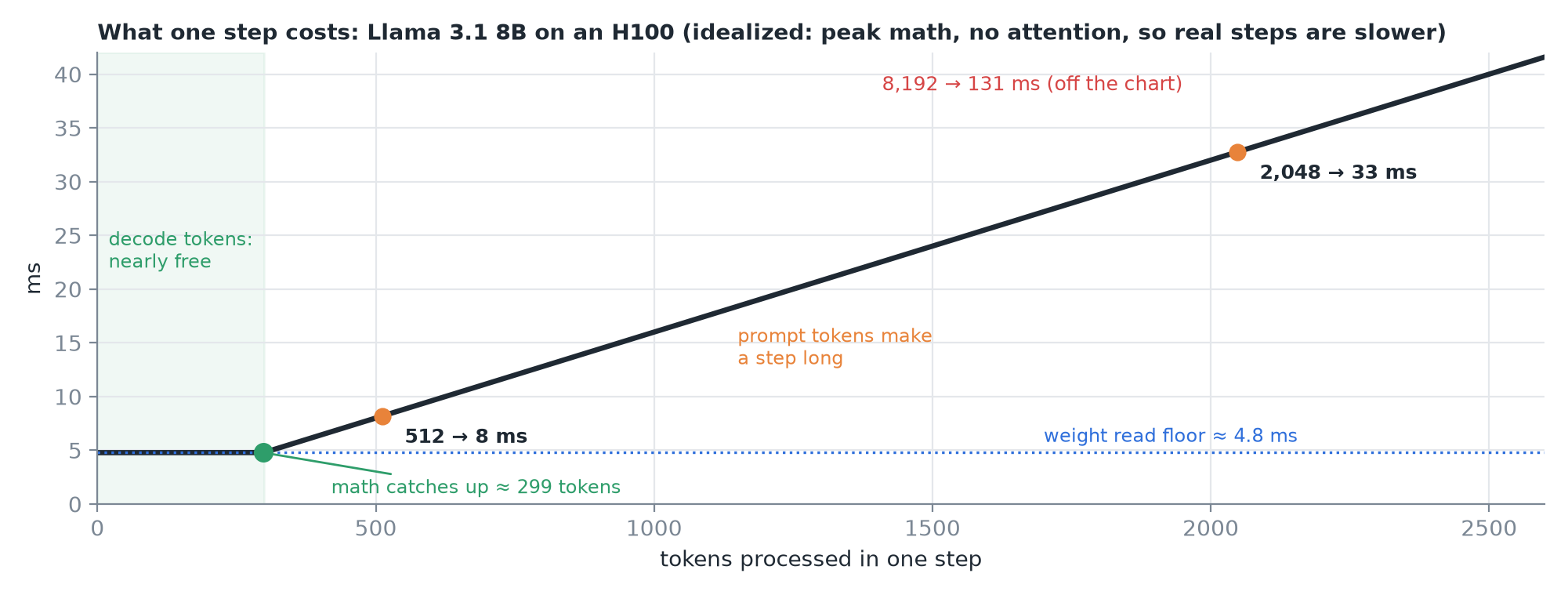 With a few tokens the math hides inside the weight read, so the step is flat; it catches up at ~300 tokens and every token after that adds time. Idealized (peak math, no attention), so real steps are slower; the shape is the point.
2. max_num_batched_tokens: a budget filled in a fixed order
Budget 2,048, 100 requests decoding: they go first (one token each, 100 used), leaving 1,948 for prompts. A 5,000-token prompt doesn't fit, so it's chunked:
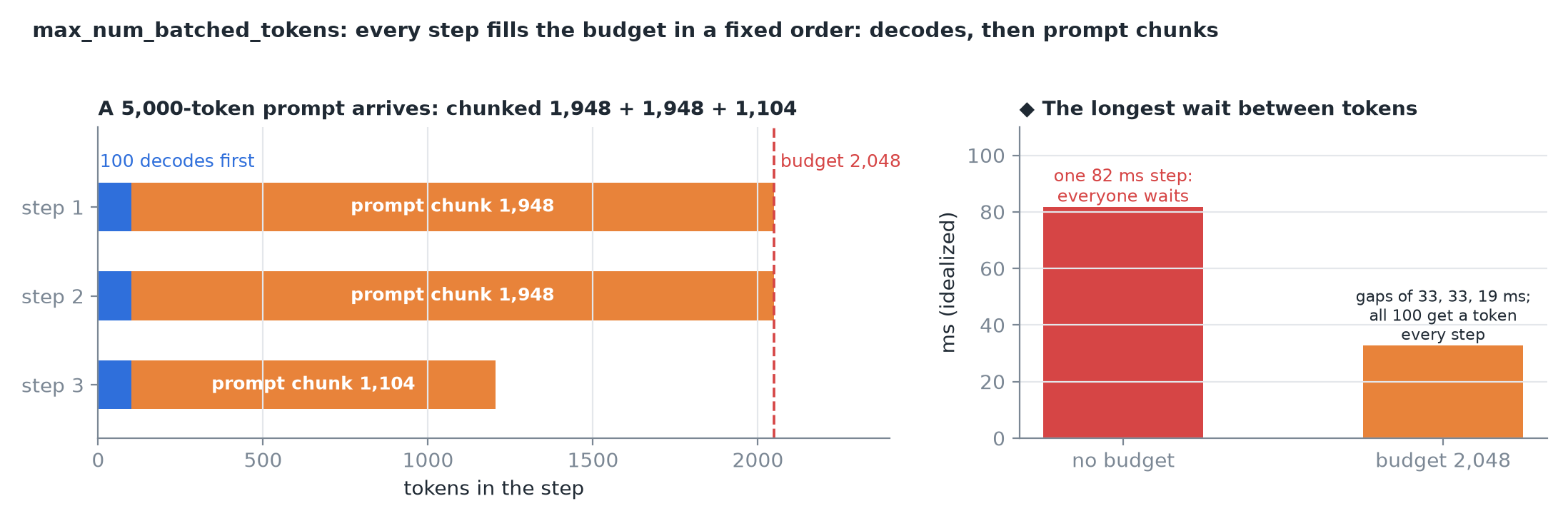 Meanwhile all 100 decoders got a token on every one of those steps. ◆ Right: idealized longest gap between tokens with and without the budget.
3. How big should the budget be?
| Small budget | Big budget | |
|---|---|---|
| Each step | Short | Long when it carries a big prompt chunk |
| Decoding users | Steady stream: low inter-token latency | Wait longer on prompt-heavy steps |
| Long prompts | Spread over many steps: later first token | Finish in fewer steps: better TTFT and throughput |
vLLM's tuning guide says the same: smaller values like 2,048 give better inter-token latency, larger values better time to first token.
Start from your latency target. If you want a token at least every 40 ms, find the step size that lands under 40 ms on your hardware: 40 ms ÷ 16 µs ≈ 2,500 tokens in the idealized model. That's roughly your budget; confirm it with a benchmark.
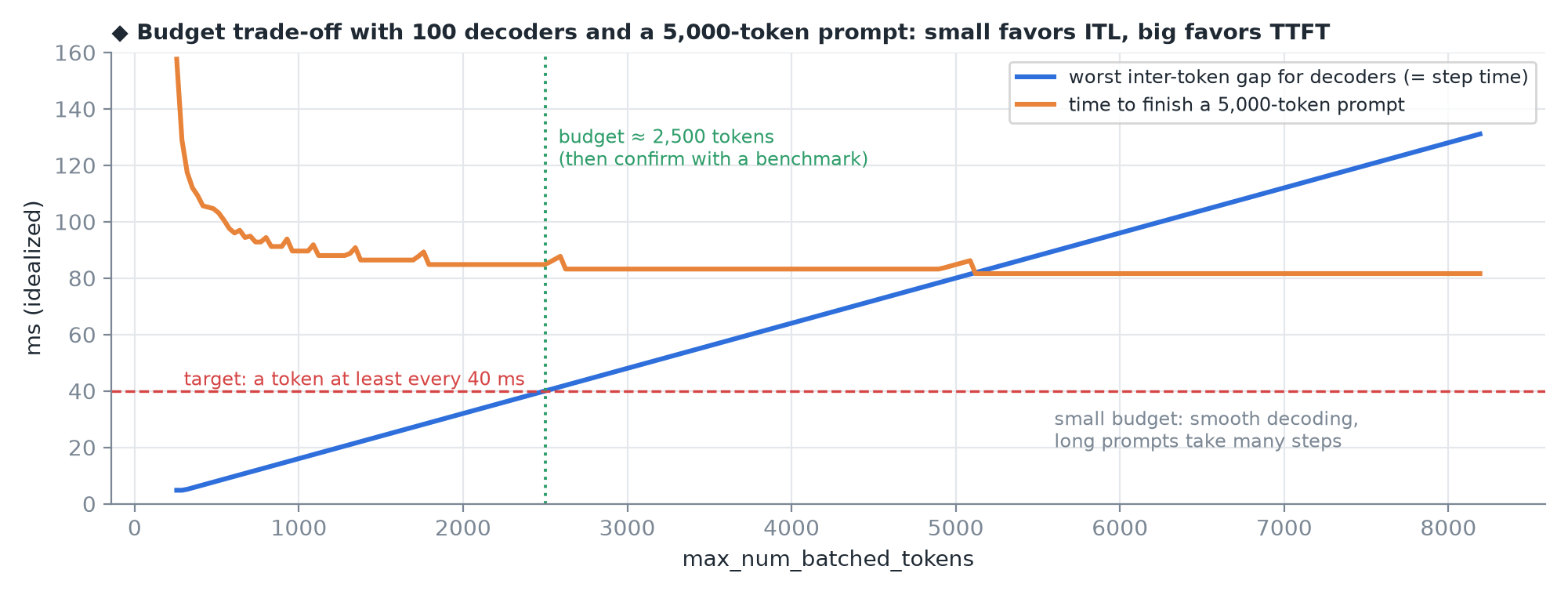 ◆ Idealized sweep. In this model the prompt's total math is the same however it's split, so TTFT drops steeply up to ~1,000 tokens and then flattens; real steps add per-step overhead and attention re-reads earlier chunks, which is why bigger budgets keep helping TTFT in practice.
4. max_num_seqs: cap on running requests
- Every running request holds a KV cache that grows with each token; too many at once and memory runs out mid-answer, so the engine has to evict someone.
- Every running request also spends one token of the budget each step, so
max_num_seqs≤max_num_batched_tokens, or decodes alone could overflow it.
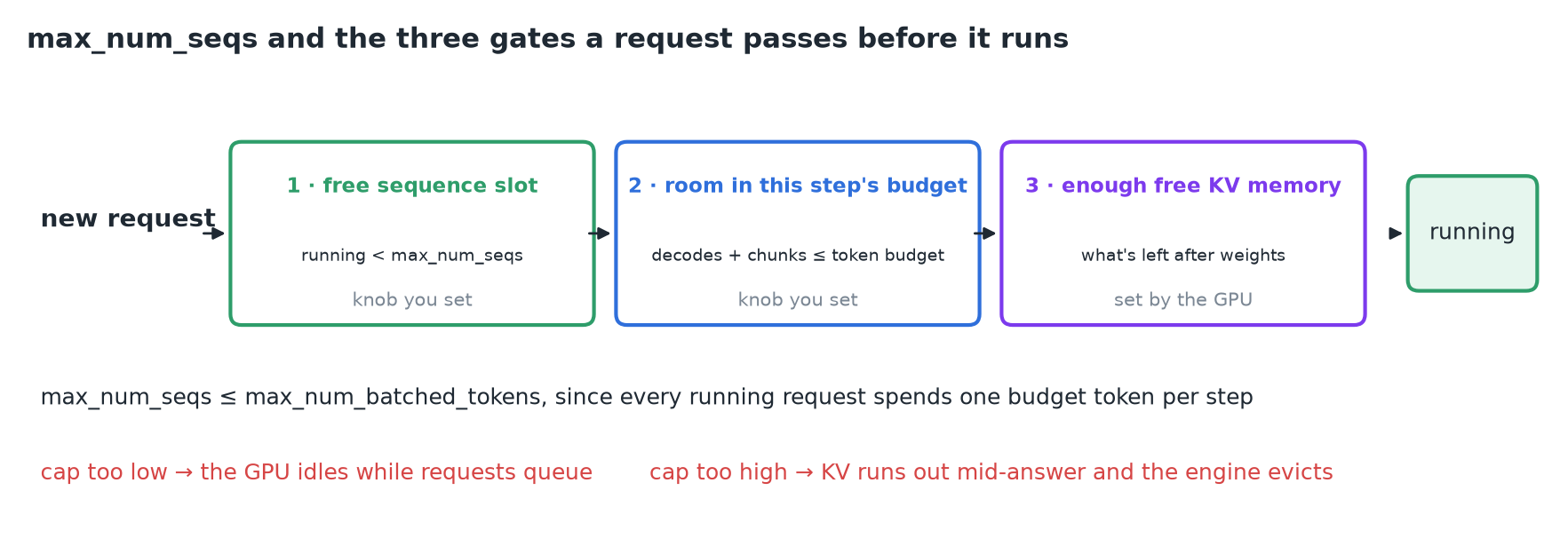 A new request needs a free sequence slot, room in this step's token budget, and enough free KV memory. The first two are knobs you set; the third comes from what GPU memory is left after the weights.
WARNING
Cap too low → the GPU idles while requests queue. Cap too high → you run out of KV memory and start evicting.
5. Recap